Life-Saving Food Needed in Blue Nile, Sudan by May

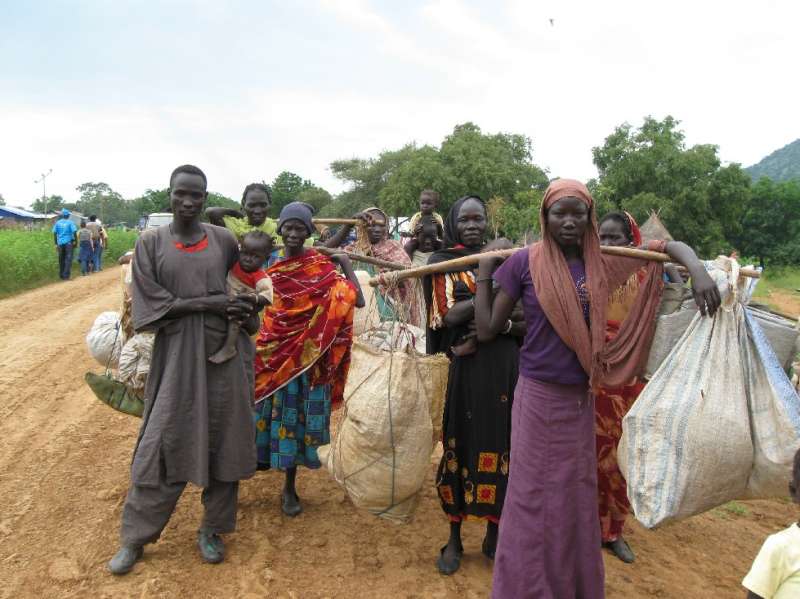
The fighting in Blue Nile Sudan has caused a hunger and refugee crisis with thousands fleeing to South Sudan and Ethiopia. Many others who remain behind in Blue Nile are suffering from food shortages Credit: UNHCR

The fighting in Blue Nile Sudan has caused a hunger and refugee crisis with thousands fleeing to South Sudan and Ethiopia. Many others who remain behind in Blue Nile are suffering from food shortages Credit: UNHCR

The UN World Food Programme (WFP) announced yesterday that life-saving food aid is starting to be delivered to the conflict-affected areas of Blue Nile state in Sudan. The government of Sudan had previously blocked WFP from delivering food in Blue Nile.

Blue Nile and South Kordofan have been the scene of conflict since 2011 as Sudan’s government has waged war against rebels who fought with South Sudan during years of Civil War. Thousands have been displaced and fled to South Sudan or Ethiopia. Those who remained have suffered from hunger. There had been reports of people trying to live off roots and leaves from the forest.

To start, WFP is feeding more than 51,000 conflict affected people in Blue Nile. WFP Programme Officer Arduino Mangoni says, “We are giving a two-month ration for this first round of distribution, following an assessment which we carried out early last month in two of the areas most severely affected by the conflict — Geissan and Kurmuk.” The plan is to expand this aid to four other areas of Blue Nile.

Even before the conflict began WFP was providing aid in these areas to 183,000 people. It is now a race against time to provide food in six areas of Blue Nile before the rainy season of May. When the rains come, roads can become impassable making food deliveries difficult or even impossible by truck.

WFP, which relies on voluntary funding, needs US $20.5 million dollars to provide the desperately needed food.

Leave a comment

Filed under global hunger

School Feeding Starts for Syrian Refugee Children

The UN World Food Programme (WFP) said today that school feeding has started for over 10,500 Syrian children in refugee camps in Jordan and Iraq. The goal is to boost nutrition and school attendance at the same time.

WFP is already reporting a 20 percent school attendance increase in the Jordan camps since the feeding began.

Muhannad Hadi, WFP’s Emergency Coordinator for the Syria crisis, says “Many Syrian children have already gone through an incredible ordeal — losing family members, crossing borders and living as refugees in neighbouring countries — and they need to be back in school. We use school feeding across the world to provide vital nutrition to children and encourage them to stay in school. We don’t want to see a lost generation of Syrian children who fail to reach their potential.”

At the Zaatari refugee camp in Jordan 6,000 children are receiving a mid-day snack in two UNICEF operated schools. Save the Children is assisting with distribution of the food. WFP plans to boost the Jordan program to reach 30,000 children. At the Domiz camp in Northern Iraq 4,500 children are receiving the nutritious snacks, which are fortified with 11 vitamins, 3 minerals and 450 calories. Plans are underway to increase the program in Iraq to 6,000 children.

WFP relies on voluntary funding and needs US $ 780,000 to continue the school feeding for the rest of the year. For the entire Syria relief mission WFP is short on US $ 113 million in funding to provide aid through June.

WFP has a relief fund where you can donate to help Syrian war victims.

Leave a comment

Filed under global hunger

Millions of Syrians Desperate for Food Aid

Though many families have fled Homs, a few choose to return to their homes in the neighbourhood of Baba Amr despite the challenges. Of those who have fled from Homs to Aleppo,many were later forced to move along when the fighting intensified there as well (photo courtesy WFP/Abeer Etefa)

Though many families have fled Homs, a few choose to return to their homes in the neighbourhood of Baba Amr despite the challenges. Of those who have fled from Homs to Aleppo,many were later forced to move along when the fighting intensified there as well (photo courtesy WFP/Abeer Etefa)

Life-saving food aid is not reaching hungry Syrians because of the escalating conflict between Assad’s government and rebels. The UN World Food Programme (WFP) said today that “the situation is critical in conflict zones and some opposition-held areas where WFP has limited access and where millions of people are believed to be in acute need of food.”

WFP is urging the warring parties to allow food aid to pass safely into conflict zones. The hardest-to-reach areas include parts of rural Damascus, Quneitra, Dara’a, Deir Ezzor, Al-Raqqa, and the north of the country, particularly Aleppo and Idlib.

Muhannad Hadi, WFP’s Regional Emergency Coordinator for the Syria crisis, says, “It has become a struggle now to move food from one area to the other with our warehouses and trucks getting increasingly caught in the crossfire. We are sometimes left with the difficult decision of calling off the dispatch of food to a place where we know there is dire need for it.”

WFP lost some food when a mortar struck one of its warehouses. The UN food agency is trying to feed 2.5 million Syrians this month inside the battered country.

Funding problems as well as violence plague the relief mission. WFP relies on voluntary funding from governments and the public. Funds are needed to feed not only the at least 2.5 million Syrians inside the country, but also the close to a million refugees who have fled to Jordan and other neighbors.

WFP has already started to bring Plumpy’Doz, a food that fights child malnutrition, into Syria. As the conflict continues, more and more Syrian children will be at risk of lasting physical and mental damage, or even death, from the malnutrition in the country.

WFP has set up a relief fund for Syria.

Article first published as Millions of Syrians Desperate for Food Aid on Blogcritics.

Leave a comment

Filed under global hunger

How Athletes Can Feed Syrian Refugees

There is a humanitarian emergency ongoing in the Middle East with refugees fleeing war-torn Syria. While it might seem a world away and hard to help, there is actually something you can do.

Earlier I reported how the free app Charity Miles is raising funds for the UN World Food Programme (WFP), the largest hunger fighting agency. WFP works in around 70 countries and is providing food aid for Syrian war victims.

The Charity Miles app tracks your walking, running and biking distances. For every mile a donation is made to WFP, or any charity of your choice. The Charity Miles for WFP are going toward their school meals programs. WFP has just started school feeding for Syrian refugee children in Jordan.

By walking, running and raising Charity Miles for WFP you can help increase the funding amounts for school meals. It’s an easy way to get involved in the relief effort no matter where you are in the world.

You can get started at Charitymiles.org

Leave a comment

Filed under global hunger

Help Fight Hunger in America from Your Kitchen

The Child Hunger Ends Here program is part of ConAgra Foods’ ongoing commitment to help end child hunger in America. For every code entered by 8/31/13, ConAgra Foods will donate the monetary equivalent of one meal to Feeding America Credits: ConAgra Foods

This week I have an Easter oped in the Des Moines Register with some free ways you can fight world hunger using Charity Miles and FreeRice. There is another way too using groceries you might already have in your own kitchen.

ConAgra Foods has placed special codes on many of its products. These include Chef Boyardee, Healthy Choice, Hunts Tomato Sauce, Peter Pan peanut butter, Marie Callender and many others. When you see a red push pin on the product label that says Child Hunger Ends Here, the eight digit code is right next to it in a blue box.

You then go to the web site Child Hunger Ends Here, enter the 8 digit code, click submit and ConAgra will donate 1 meal to Feeding America. This will support food banks across the country which are part of the Feeding America network. So far 741,545 codes have been entered since January 11th and the goal is to reach 3 million meals.

When you visit the site you can view information about hunger in your state. There is also a complete list of ConAgra products where you can find the codes.

It’s an easy way to help support food banks with products you might very well have in your kitchen right now.

Leave a comment

Filed under Hunger in America

Remember the Hungry This Easter

Remember the Hungry this Easter (author's photo)

Remember the Hungry this Easter (author’s photo)

A survey by the National Retail Federation says Americans will spend about 17.2 billion dollars on Easter this year.

Imagine if that spending could be changed, just even a little bit. If one billion of that amount went to global hunger relief it could fund humanitarian emergencies in war devastated Syria, South Sudan, Afghanistan, and Mali and other countries.

At the time of Easter 1946 Americans cut back on festivities in order to help those suffering in countries leveled by World War II. While the hard fought war had been won, the peace had not. Hunger was the enemy that remained. The U.S. Army in Austria, for instance, was helping provide school meals to hungry children.

Americans listened to the plea of President Harry Truman around Easter when he warned, “we cannot ignore the cry of hungry children. Surely we will not turn our backs on the millions of human beings begging for just a crust of bread. The warm heart of America will respond to the greatest threat of mass starvation in the history of mankind.”

Truman canceled the White House egg roll as part of the nationwide effort to conserve food. The Gramercy Boys Club in the Bronx, New York created arm bands with the reminder “Don’t waste food.” They canceled their own Easter Egg hunt and decided to send their candy to the children in Europe. Americans rallied to send as much food as they could overseas whether it was through buying CARE packages or community collections.

The first 20,000 CARE packages of food arrived in France a couple weeks after Easter. In Cincinnati, Ohio firehouses, schools, and food stores served as collection points for a city-wide canned good drive. In May the Cincinnati Enquirer reported the city had sent 10 tons of food off to Europe with more collections to come. One Cincinnati man even donated an entire paycheck to the relief effort.

Herbert Hoover, who led hunger relief after both World Wars, penned the series of books on America’s life-saving efforts called An American Epic. Americans can today can start writing the next volume by their actions in this turbulent time in the world.

War and drought disasters are placing millions at risk of starvation. The conflict in Syria has destroyed food production factories and even if the fighting mercifully ended today it will takes years to rebuild the supply system. Both war and drought have struck at Mali and the Sahel region of Africa. In South Sudan people are living off foods from the wild because of internal conflict and poor harvests. In Afghanistan, very little is told about the hunger that makes about 60 percent of its youngest children stunted in growth. In Haiti, there is still much to be done to fight hunger and help the country rebuild.

Infant children are the most vulnerable to these disasters but a small sachet of the peanut paste Plumpy’Nut, which costs about 33 cents, can save them. It’s a nutrient rich food that some say tastes similar to a Peanut Butter Cup.

Even today there are ways to feed the hungry without spending a nickel. If you go online and play FreeRice you raise money every time you answer a question correctly. If you go to CharityMiles.org you can download a free app and go run, walk or bile to raise money for the World Food Programme or Feeding America. There is hunger within America’s border too with 50 million plus in need.

This Easter nothing could be more important than saving the lives of the hungry. There is more than enough food on the planet for everyone. No more important steps could be taken toward peace than relieving this crushing agony of hunger that afflicts 870 million people around the globe. The message of Easter is to stop that suffering and renew the world.

originally published at the Des Moines Register, Cincinnati.com and History News Network.

Leave a comment

Filed under global hunger

Plumpy’Doz Needed in Syria to Stop Deadly Child Malnutrition

The UN World Food Programme (WFP) said today that Plumpy’Doz, a food to prevent deadly malnutrition, is being used in war-torn Syria. Plumpy’Doz, a nutrient-rich peanut paste, is being deployed at health centers in Damascus. It will be distributed more widely in the coming days with the help of UNICEF.

Laure Chadraoui of WFP says the agency will soon have enough Plumpy’Doz to treat close to 100,000 children.

There are an estimated four million people displaced within Syria. They have lost everything. Their livelihoods are gone. Food production in the country has been stopped in many areas because of damage to factories. It is not safe for farmers to go to their fields. What food can be produced is very high-priced.

This hunger crisis is taking its toll on children. When food becomes scarce small children are most at risk for malnutrition, which can have deadly consequences at that age.

Without the right food, infants can suffer physical or mental damage which cannot be reversed. Plumpy’Doz, a food which requires no preparation or refrigration, is used to prevent this from happening.

Save the Children released a report that shows the horror of hunger unfolding from this conflict. The report states, “few displaced families have any food stocks at all. They are having to cut down on the number of meals they and their children eat each day.”

If this war continues more children will be at risk of starvation. Aid agencies, such as WFP and Save the Children, need steady funding to keep the humanitarian pipeline of food well stocked. They are feeding not only war victims inside Syria but around a million people who have fled to neighboring countries.

The World Food Programme has set up a Syria relief fund.

Leave a comment

Filed under global hunger

School Meals Vital to Recovery in Burkina Faso

During the Sahel drought of 2012 children at the Tin-Ediar school in Burkina Faso line up for meals provided by the World Food Programme. The children are provided breakfast and lunch at school. (WFP/Anne Poulsen)

During the Sahel drought of 2012 children at the Tin-Ediar school in Burkina Faso line up for meals provided by the World Food Programme. The children are provided breakfast and lunch at school. (WFP/Anne Poulsen)

Many of us have seen drought at one time or another. Last summer a severe one scorched across much of the United States. The impact is hard, but imagine if you are a poor family in a developing country, dependent on crops for income and food. When drought strikes it destroys your food supply and you have almost nothing to fall back on.

This is what happened in the Sahel region of Africa last year when massive drought struck. The UN World Food Programme (WFP) in Burkina Faso says this caused many families to move to mining zones to find work. Their children would have to work too, meaning they would have to drop out of school.

WFP, though, had a school feeding plan to help families deal with the shock of drought and to keep the children in class. Last year in Burkina Faso, one of the Sahel countries, WFP fed 91,783 children breakfast and lunch at school and some girls received take-home rations. When food becomes scarce and high-priced as it did in the Sahel last year, food at school becomes a life-changer.

Burkina Faso had another emergency besides drought. The war in Mali created a number of refugees, some of whom fled to Burkina Faso. Ariane Waldvogel, the WFP deputy country director for Burkina Faso, says, “Malian refugee children were absorbed into local schools and received school meals…This assistance was key in not only improving the food security of the refugee children but also played a role in keeping relations between refugee and Burkinabé host communities peaceful.”

As 2013 unfolds school meals are still vital in Burkina Faso and throughout the region. School attendance in Burkina Faso’s Sahel region as a whole is low. WFP wants to expand its program to reach 100,000 children this year as it continues to help Burkina Faso recover. In time this program can help build a national school meals program, such as we have here in the United States.

WFP depends on voluntary donations, though. They need about U.S. $4.1 million to provide the meals this year. Some funding has been received from Switzerland and the United States.

Waldvogel says, “The additional US $1.7 million are urgently required to enable WFP to purchase and deliver food in time to ensure that school children resume school in October and continue to receive their two meals a day. Multi-year funding would be ideal for this programme, providing a steady funding stream, which would allow WFP to provide constant school feeding assistance throughout the academic year.”

The U.S. McGovern-Dole program, which funds school meals in developing countries, would be a great resource for Burkina Faso. It’s important that the U.S. Congress not reduce funding for this program as stipulated by the Sequester. School meals play a critical role bring stability throughout the world in areas impacted by drought and conflict. There is no better example of this than in the Sahel region of Africa.

Article first published as School Meals Vital to Recovery in Burkina Faso on Blogcritics.

Leave a comment

Filed under global hunger

Obama visits Jordan, where Syrian refugees need food aid

President Obama continued his MIddle East tour today by visiting Jordan, home to refugees from the war in Syria (Official White House Photo by Pete Souza)

President Obama, as part of his Middle East tour, visited Jordan today to meet with King Abdullah II. Jordan is home to 460,000 refugees from the war in Syria.

The UN World Food Programme (WFP) says it’s “strained by limited resources” trying to feed a refugee population that grows by the day.

During March WFP plans to feed 142,000 refugees at the Al Za’atri camp. As the numbers of refugees increase, food distributions are becoming more crowded and difficult. New camp sites are being explored.

For 117,515 refugees across all governorates of Jordan WFP uses a voucher program to provide food assistance. WFP says, “the vouchers entitle Syrians to purchase items valued at US$33 in selected shops, where fresh fruit, vegetables, meat and other key staples are available.”

WFP faces a funding shortage of US $156 million dollars for its refugee relief operation and its mission inside Syria. Resources are also stretched thin because of other ongoing hunger emergencies in war-torn Mali, South Sudan, Afghanistan, Yemen and other nations.

The UN food agency is voluntarily funded. President Obama said today the US will provide $ 200 million in additional humanitarian aid. As the conflict continues the humanitarian needs will grow. The US budget for international food aid though is at risk of cuts through the Sequester.

WFP has set up a relief fund for the Syria crisis.

Leave a comment

Filed under global hunger

USAID Official tells Congress of Syrian Hunger Emergency

This week Nancy Lindborg of USAID testified before the Senate about the humanitarian crisis in Syria.Credits: file photo courtesy of Mercy Corps

This week Nancy Lindborg of USAID testified before the Senate about the humanitarian crisis in Syria. Credits: file photo courtesy of Mercy Corps

Nancy Lindborg of the US Agency for International Development (USAID) spoke to the House Committee on Foreign Affairs yesterday about the growing humanitarian crisis facing war-torn Syria.

Her testimony followed an alarming report by Save the Children which states that potentially as many as “3.2 million people need food assistance in 58 sub-districts alone, suggesting that the situation may be much worse than previously thought.”

Lindborg, the Assistant Administrator for Humanitarian Assistance said, “World Food Program (WFP) activities supported by the United States currently provide monthly rations to nearly 1.5 million within Syria and approximately 300,000 refugees in Jordan, Lebanon, Turkey, Iraq and Egypt.”

She also described how US assistance is helping people in Aleppo governorate receive bread. Shortages of this basic staple have become widespread across Syria.

As Lindborg noted in her testimony, WFP is scaling up its activities to reach 2.5 million Syrians by the end of April. WFP, which relies on voluntary contributions from the US and other countries, is very short on funding.

Budget decisions made by the Congress in coming weeks will have an effect on Syria and other nations facing humanitarian disasters. Bread for the World reported this week that the sequester cuts will impact international food aid. Even before these proposed cuts international food aid makes up less than one tenth of one percent of the entire federal budget.

The Save the Children report warns, “as the fighting continues and families are finding that accessing nutritious food becomes ever more difficult, expensive, and even dangerous, there are the first signs of an increase in the number of children suffering malnutrition.”

The World Food Program has set up a relief fund for Syria.

Leave a comment

Filed under global hunger