End National Tragedy of Hunger

Donations are needed more than ever by food banks and pantries across the country (author’s photo)

This week I have a letter in the New York Times on fighting hunger in America. As President Ronald Reagan said, “If even one American child is forced to go to bed hungry at night, or if one senior citizen is denied the dignity of proper nutrition, that is a national tragedy.”

The need for public donations and a strong federal emergency food assistance program (TEFAP) has never been greater. Matt Knott, the president of Feeding America, says, “We have seen a tremendous rise in the number of people coming to the food pantries, soup kitchens and other emergency feeding centers served by Feeding America food banks since 2007, including many middle class families seeking assistance for the first time.”

Yet funding for TEFAP is not keeping up with the demand created by these difficult economic times.

Ohio, an election battleground state, has been hit hard, with 15.5 percent of its population facing “food insecurity” and 6.4 percent facing “very low food security,” “meaning that the food intake of one or more household members was reduced…because the household lacked money and other resources for food.”

Lisa Hamler-Fugitt of the Ohio Association of Foodbanks says, “Our hunger relief network is strained, and state and federal programs face the risk of funding losses that cannot be overcome.”

Kurt Reiber, president of Cincinnati’s Freestore Foodbank, says, “we have seen a drop off in the amount of food that we receive through the USDA’s TEFAP program this year as compared to prior years.”

Hunger forces families into difficult decisions. A Feeding America study showed that “34 percent of client households report having to choose between paying for medical bills and food.” It can create a spiraling effect of destruction for individuals, families, and entire communities. Health, educational performance, and work production all can suffer as a result of hunger, making it much harder for recovery.

With food prices expected to rise next year, this will put even more strain on those already in poverty. It will become more difficult for food banks to acquire a supply to help those in need.

Despite this alarming hunger crisis, Congress is also planning reductions in food stamps which will eliminate free school meals for nearly 300,000 children in the U.S. School meals have been a safety net for children for decades and help boost learning. To lose them now would be catastrophic to America.

What can be done? Citizens can help by supporting their local food banks and many of their programs, including weekend backpack food programs for schoolchildren. Citizens can also write to their representatives asking they support hunger-fighting programs like TEFAP and food stamps.

Making your voice heard through words and actions is essential to ending the national tragedy of hunger.

Article first published as End National Tragedy of Hunger on Blogcritics.

Leave a comment

Filed under Hunger in America

Charity Miles for Halloween!

Here is a video about Charity Miles for Halloween and below are some instructions on how you can use this tool to help feed the hungry. If you get through Halloween!

Here is a video and some instructions on how to use the free app Charity Miles to help raise funds for the World Food Programme, Feeding America and other charities while you walk, run or bike.  (courtesy Ekaterina Oshepkova of the World Food Programme)

How do I use the app Charity Miles?

1. Download the application at charitymiles.org

2. It will ask you to connect via Facebook. Note, without a Facebook account, you will not be able to use the application. Also, your GPS must be on. (most cell phones apparently already have this on)

3. When you are ready to exercise, select the charity in which you will be exercising for. You can do so by sliding the screen until you see WFP, which is the 10th charity.

4. Select, walk, run, or bike. The application will then start & track your distance.

5. When you are finished, or want to take a break, select stop.

6. If you wish to resume, select resume. If you are finished, select finish.

7. When you are finished with your exercise, the application will prompt you to accept sponsorship. Accept Sponsorship. If you do not accept sponsorship and allow a post to your Facebook wall, no money will be donated to the charity.

Leave a comment

Filed under global hunger, Uncategorized

Ithaca’s Food for Thought Takes on Global Hunger

Amanda Riggio, former Food For Thought member and Ithaca College student, conceived an event, “Rise Up for Rice,” where students could gather together and answer trivia questions at freerice.com to help eradicate world hunger. (Food for Thought photo)

New York is full of great history and heroes. During the fall of 1947, for example, the Friendship Train rolled through the state collecting food for the hungry in war-torn Europe.

Today, not far from where the Friendship Train made its New York stops, students at Ithaca College are also collecting donations to feed the hungry. One way they accomplish this is through an online trivia game called FreeRice.

Every time you answer a question correctly playing FreeRice, ten grains of rice are donated to the UN World Food Programme. And the Friendship Train is one of the questions in this game!

Ithaca College has a dedicated organization to fighting world hunger called Food for Thought. Back in 2010 I wrote a story on Elizabeth Stoltz who founded this hunger-fighting group.

Stoltz had set up an event for the Ithaca community called the Walk for Plumpy’nut, a fundraiser to provide life-saving food to malnourished children. This event has continued ever since collecting thousands of dollars each year to purchase Plumpy’nut. She was also running a magazine called Plumpy’nut Press.

Since that time Food for Thought has expanded its reach in feeding the hungry. In addition to the annual Walk for Plumpy’nut it has started the Rise up for Rice challenge using the FreeRice game. Two of Food for Thought’s current officers, Lethia McFarland and Lindsey Smith, recently shared some of the groups accomplishments in the following interview.

Who developed the idea of the Rise Up For Rice Challenge?

Amanda Riggio, former Food For Thought member and Ithaca College student, conceived an event, “Rise Up for Rice,” where students could gather together and answer trivia questions at freerice.com to help eradicate world hunger.

How many players participated in the Rise Up For Rice Challenge this year?

Unfortunately, we cannot measure the number people participated this year, given that many people did so remotely, but we did raise 43,590 grains of rice collectively.

Did you have a tournament involving different teams too?

We did not. Everyone who participated logged in under the same account “riseupforrice,” so that we could best track the impact.

How many grains of rice did you raise this year?

43,590 grains (over four times the amount that we raised last year!)

How did you promote the event on campus?

We actively promoted the event via social media, including Facebook and Twitter. To supplement this, we also designed small pamphlets and distributed them throughout campus.

Do you have members participating from outside the campus?

It could have been a possibility, but unfortunately, we could not measure that affirmatively.

Can people still take part in Rise up For Rice all year long?

Yes! We encourage students to play on the day of Rise up for Rice, but the account is open all year long.

Rise up for Rice was preceded by another event on campus called Walk for Plumpy’nut? How did that event go this year?

At our 6th Annual Walk for Plumpy’nut on Sunday, October 7th, we welcomed 109 people and walked together in solidarity to fight childhood hunger. We were able to raise over $4,100 dollars, as well as obtain 40 sponsors for this year’s walk. All of the proceeds will go directly to Concern Worldwide to buy Plumpy’nut for distribution in therapeutic feeding centers across Ethiopia. Plumpy’nut, a ready-to-use therapeutic food, will be used to help treat severely malnourished children. Overall, we hosted a successful event, thanks to the gracious support of the Ithaca community.

Article first published as Ithaca’s Food for Thought Takes on Global Hunger on Blogcritics.

Leave a comment

Filed under global hunger

George McGovern Championed Food for Peace

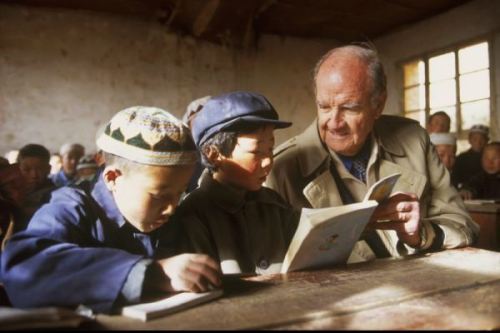
George McGovern, author of War Against Want and the Third Freedom, was named the United Nations World Food Programme’s first global ambassador against hunger. Credits: WFP

George McGovern passed away Sunday at 90 years old. He ran for President against Richard Nixon in 1972 and was a senator from South Dakota. But I remember him first for a book he wrote in 1964 called War Against Want: America’s Food for Peace Program.

McGovern was the director of Food for Peace under President Kennedy. This was the top U.S. program in fighting world hunger, started during the Eisenhower administration. McGovern’s book explored the history of Food for Peace and America’s leadership in fighting world hunger.

I ordered a copy from Amazon.com one day in 2006 after taking a leadership course at the College of Mount St. Joseph. Up until that point I really had no idea what Food for Peace was or very much knowledge about global hunger in general. What better introduction than War Against Want. Ever since getting that book, I have been writing about hunger issues.

In 2008, the Friends of the World Food Program held a teleconference with McGovern. I got the chance to talk with him and he told his story of how influenced he was by his experiences as a bomber pilot in World War II. He saw hunger in the war-torn countries and that planted the seed for him becoming an advocate for the needy.

McGovern was a leader who emerged from a World War II generation that understood how powerful a force hunger is in international relations. This wisdom helped the Greatest Generation navigate the treacherous waters of the post-war world.

When McGovern became the Food for Peace director in 1961 he hit the ground running and led a big expansion, especially with school feeding. Children in South Korea, Brazil, India, Poland and other countries received school meals during McGovern’s tenure. These countries are now donors to food aid.

The U.S. Food for Peace program led to the creation of an international version which is today known as the UN World Food Programme (WFP). McGovern was the one who got the ball rolling on this initiative, now the largest food aid organization in the world. The U.S. Food for Peace program is the single biggest donor to WFP. So the two programs work hand-in-hand in the global effort to end hunger.

McGovern remained active in fighting hunger even long after his days in government. He served as a goodwill ambassador for WFP. Josette Sheeran, the WFP director from 2007-2012, said: “I have treasured knowing him and feeling his incredible support.”

In 2000, an international school meals program was started by McGovern along with Senator Bob Dole. The McGovern-Dole program has fed millions of children in Haiti, Afghanistan, Yemen, Bangladesh and other locations. Each year McGovern-Dole grants are awarded to WFP and other hunger fighting organizations so they can provide school meals in developing countries. If you want to pay tribute to McGovern a great way would be to advocate for this program to be expanded. What better way to reach out to the world than through school meals?

As WFP’s current director Ertharin Cousin says, “George McGovern saw – way before anyone else – how the simple, sustained act of putting a meal in the hands of a poor child at school could change that child’s life and give them a chance at a better future.”

McGovern also was a leader in building the U.S. national school lunch program including summer feeding. At a Friends of WFP teleconference someone asked whether hunger should be fought first at home before going abroad. McGovern replied: Why not do both? There are after all enough resources in the world to reach all hungry people. Why give any quarter in the fight against hunger? He certainly did not.

While McGovern has moved on, his legacy remains, and also his spirit. You can see this when new advocates for ending world hunger emerge, ready to build on the foundation he left. McGovern’s story, in that sense, is far from over.

Article first published as George McGovern Championed Food for Peace on Blogcritics.

Leave a comment

Filed under global hunger

Hunger is Huge Foreign Policy Issue

What should President Obama and Gov. Mitt Romney talk about during tonight’s foreign policy debate? The force that can make or break a foreign policy: food.

There are 870 million people worldwide who suffer from hunger and malnutrition. Such a large-scale crisis is a threat to international stability.

Read my oped in the Tennessean newspaper


Leave a comment

Filed under global hunger

How to Use Charity Miles to Raise Funds for the World Food Programme and Feeding America

Here is a video and some instructions on how to use the free app Charity Miles to help raise funds for the World Food Programme, Feeding America and other charities while you walk, run or bike.  (courtesy Ekaterina Oshepkova of the World Food Programme)

How do I use the app Charity Miles?

1. Download the application at charitymiles.org

2. It will ask you to connect via Facebook. Note, without a Facebook account, you will not be able to use the application. Also, your GPS must be on. (most cell phones apparently already have this on)

3. When you are ready to exercise, select the charity in which you will be exercising for. You can do so by sliding the screen until you see WFP, which is the 10th charity.

4. Select, walk, run, or bike. The application will then start & track your distance.

5. When you are finished, or want to take a break, select stop.

6. If you wish to resume, select resume. If you are finished, select finish.

7. When you are finished with your exercise, the application will prompt you to accept sponsorship. Accept Sponsorship. If you do not accept sponsorship and allow a post to your Facebook wall, no money will be donated to the charity.


Leave a comment

Filed under global hunger

World Food Day: Hunger Here and Far

FreeRice has two goals: Provide education to everyone for free. Help end world hunger by providing rice to hungry people for free.

Tuesday, October 16th, is World Food Day. But for 870 million hungry people across the globe this day is just another one of suffering. What can you do on World Food Day to help them?

When you sit down to eat breakfast, lunch or dinner on World Food Day imagine an “invisible guest” at your table, one of the world’s hungry. This is exactly what Americans did after World War I in a fundraiser led by Herbert Hoover and General John Pershing.

You could feed that “invisible guest” with a donation of even a few dollars to a humanitarian group like the World Food Programme, Save the Children, Church World Service or Catholic Relief Services. Or you can donate to a food bank in your area. You can fight hunger at home and abroad.

On World Food Day you can also take action with a computer, a cell phone and Facebook. You can visit the site Freerice.com and play an award-winning education game where for every correct answer 10 grains of rice are donated to the World Food Programme. You can test yourself in vocabulary, math, or even the SAT.

Need inspiration? Free Rice has a famous quotes section. The more people play, the greater action against world hunger.

If we saw someone suffering from hunger before our eyes we would take action. For many of us though, hunger may be hidden from view or taking place in a land far away so we do not always feel connected to the crisis. In many cases we may not be aware. Hunger often does not make the news headlines.

Right now, there are hungry people displaced by flooding and conflict in South Sudan, some who are hard to reach because of poor roads.

We have heard about the conflict in Syria. That war has also led to a major hunger crisis for millions of people, some displaced inside Syria and others who have fled to neighboring countries. Even if the fighting in Syria were to end today, there still would be an emergency for months to come, especially with the damage to the country’s farms.

In the Sahel region of Africa, East Africa, Afghanistan, Yemen and other countries millions of children are suffering severe malnutrition. They just need some food to stay alive and avoid the physical and mental damage caused by malnutrition. Without food societies cannot develop.

Global hunger needs to be part of the public conversation and also that amongst our leaders. How often has it even come up though during this election season? If the public is not talking about it and the leaders are not either, we won’t see powerful enough action against this global menace. You can make a difference there too by just communicating with government leaders about hunger. Get a conversation going with those who are there to represent your interests.

Hunger is the greatest threat to peace and development. It can be defeated though. But it takes a strong enough collective will and that can start with you on World Food Day.

Article first published as World Food Day: Hunger Here and Far on Blogcritics and at the Des Moines Register.

Leave a comment

Filed under global hunger

My Oped in the Des Moines Register on Nuclear Weapons

When President Obama and Mitt Romney take to the stage for a foreign policy debate on Oct. 22, nuclear weapons are sure to come up, especially Iran’s ambitions for the bomb. But the debate should also focus on the countries that actually have nukes, including Russia, China, North Korea and rivals India and Pakistan.

Read the article at the Des Moines Register


Leave a comment

Filed under History

Tears Tell Story of Syria, an Interview with Laure Chadraoui

Where there is war there is hunger. This holds true with the conflict now taking place in Syria. The UN World Food Programme, the largest food aid organization, is currently feeding 1.5 million Syrians displaced within their own country.

Hundreds of thousands of other Syrians who fled to neighboring Iraq, Lebanon, Turkey and Jordan are also receiving aid. Secretary of State Hillary Clinton says, “conditions in Syria continue to deteriorate as the Assad regime relentlessly wages war on its own people.”

The longer the fighting continues, hunger will only intensify as the country’s regular food supply systems continue to break down. The World Food Programme, and its partner the Syrian Arab Red Crescent (SARC) are the lifeline for saving innocent Syrians from starvation.

Laure Chadraoui, a World Food Programme (WFP) officer, was just on a mission into Syria. She shares her experience in the war-torn country following interview.

You were just in the conflict areas of Syria and met with families. Can you tell us about the impact of this conflict on them to give readers an idea of life in a war zone?

During my recent mission to Syria, I visited Damascus, one area in Rural Damascus and Homs. Talking to displaced people, I saw how shocked they were from what had befallen their country. They still could not believe that this is happening to them. After more than a year and a half, many are in shock. During a door to door distribution of WFP food assistance by Syrian Arab Red Crescent volunteers in Homs, I saw a woman, in her early 20s, standing at the door of her house, or new shelter is a more accurate description, holding a one year old girl.

She did not ask for anything as I approached to talk to her. When I asked her where she came from, she was in tears before she could say: Khaldiyeh. Khaldieyeh, in the old city of Homs, has endured recently heavy fighting. She had only recently given birth and had to flee with her husband and her newborn baby. Her husband was not at home, she told me, he goes looking for someone to hire him as a daily worker, most of the time to no avail. What she receives from WFP is all she has got to feed her baby. She was not very comfortable telling her story, but her tears told most of it. I imagined, then, that many of these displaced people, lost members of their families, or their homes, or their livelihoods, or maybe all at once. Their lives are shattered. This woman, found a home, in a safe area in Homs, but the sound of explosions and fighting is clear, and she, like many others know it is probably not far from what they used to call “home.”

I met other WFP beneficiaries at public shelters, each family living in a room, that is now the kitchen and the bedroom and the playground. The mattresses lined up on top of each other to give space for the family to sit together is the common image that strikes you everywhere in those shelters. Sometimes more than one family share one room. I met a family with children and a baby no more than 4 months who has taken an empty and unfinished villa as her new shelter. The villa is still under construction, has no doors or windows. That was the best they could find. It looked like it was in the middle of nowhere. Their needs are huge from food to medical care and non-food items. The mother told me, she fled with only the clothes they were wearing. They were poor where she came from but had a roof over their head; we had a decent life and we were happy, she told me. However, it was a relief to see that our food is reaching them and in many ways saving their lives.

Are children at risk of physically and mentally damaging malnutrition in Syria and are there going to be enough food supplies and access to prevent this?

It was particularly painful to see displaced children. They are not only uprooted from their familiar environment but also from their schools. WFP is working closely with UNICEF to ensure children’s nutritional needs are met. We are importing plumpy doz which is expected in the coming weeks targeting around 100,000 children under 5 years old. WFP is also providing logistic support to other agencies and we have shipped humanitarian supplies on behalf of UNICEF, among others, to different parts of the countries.

How much agricultural land has been harmed by the fighting and what impact will this have going forward?

A Joint Rapid Food Security Needs Assessment mission, conducted in June 2012, by WFP, FAO, and the Syrian Ministry of Agriculture and Agrarian Reform in Syria revealed that the agricultural sector has lost a total of US$1.8 billion this year as a result of the crisis due to losses and damages to crops, livestock and irrigation systems. The assessment has shown that strategic crops, such as wheat and barley, have been badly affected. The findings indicated that 3 million people are in need of food, crop, and livestock assistance such as seeds, food for animals, fuel and repair of irrigation pumps over the next 12 months.

How is the funding level for the Syrian relief mission? And how can people help?

WFP’s operation in Syria is short if US$ 56 million to be able to continue its most needed food assistance to 1.5 million displaced and vulnerable people until the end of the year. Individuals wishing to contribute can also do so by visiting WFP’s official site.

Article first published as Tears Tell Story of Syria: An Interview with Laure Chadraoui on Blogcritics.

Update: The World Food Programme has started a Syria relief fund. Visit the WFP Syria relief fund page.

Leave a comment

Filed under global hunger

South Sudan’s Jonglei State Suffering from Conflict, Flooding

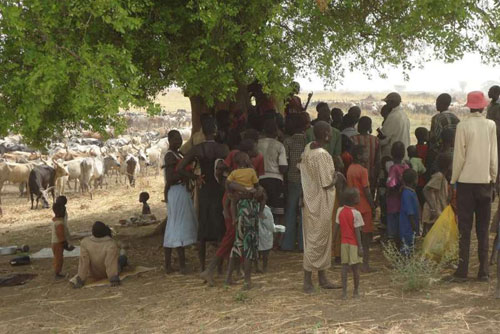
file photo of members of the Lou Nuer gather under the shade of a tree in Ethiopia after fleeing from South Sudan’s Jonglei state. (Credits: UNHCR/S.Tessema)

Jonglei, the largest state in South Sudan, has been hard hit by recent flooding with over 201,000 people impacted. The flooding has resulted in destruction of homes and farmland in Jonglei and other areas of South Sudan. Loss of farmland is devastating in a region that has long suffered from severe hunger and malnutrition.

Access to the flooded areas remains a significant challenge according to a United Nations report. Roads are poor in the area making it more difficult to move supplies.

Jonglei is not only suffering from floods but also continuing fighting between South Sudan’s army and a rebel group in Pibor County’s Likuangole town. The UN reports that fighting is also taking place in nearby Gumuruk town. In Pibor town people are fleeing as they anticipate the violence spreading.

The UN also reports that humanitarian aid groups are not able to access those in need in Likuangole and Gumuruk because of insecurity. Around 90,000 people cannot receive medical care.

South Sudan has been plagued by internal violence, particularly in Jonglei as rival tribes have continually launched attacks against each other. The government launched a disarmament program earlier this year to try and quell the violence.

The United Nations Mission in South Sudan says its “particularly concerned by the apparent emergence in Jonglei of an armed insurgency group linked to the militia leader David Yau Yau, which is believed to be acting in concert with groups of armed youths who have evaded the civilian disarmament operation in the state.”

Leave a comment

Filed under global hunger