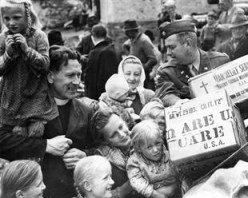
In 1947 Americans fed a “silent guest” during the holidays and this led to a CARE package going overseas to feed the hungry. Credits:CARE
New England is known for its seafood, the Boston Red Sox and Celtics. Less known is how one Christmas holiday New England took on the challenge of feeding the world.
The year was 1947, just two years after World War II, and nations in Europe and Asia were suffering food shortages. Americans were ready to help. When the holidays rolled around that year an announcement was made from Plymouth, Massachusetts asking families to feed a “silent guest” at their holiday meals.
By making a donation to the Silent Guest Committee, a CARE package would be sent to a hungry family in Europe. A newspaper headline saying “Feasts Provide for All” was the idea.
And the donations poured in. From Thanksgiving through Christmas people reached out to help those suffering overseas. CARE packages flooded Europe and other areas to feed the hungry. Food was life and hope for people trying to rebuild from the war ruins. Another headline read “New England Gives Cheer to the Needy.”
Hunger was fought at home too. In Boston, the Volunteers of America fed the homeless and the Salvation Army was very active.
As this Christmas arrives Americans can take in a “silent guest” at their holiday meal. Just taking some spare change they can purchase multiple meals. That’s right. If you were to find one dollar of change in a coat pocket, on a chair, or in a piggy bank you could feed a child for a week.
So this holiday think like Beantown and New England did in 1947 and feed a “silent guest.” Help change the world.
A few charities to send “Silent Guest” donations include:
Last spring I wrote an op-ed about the looming famine in the Sahel region of Africa. Drought and conflict were causing massive food shortages for millions of people across at least eight countries.
Humanitarian agencies and donors did take action. Lives were saved. A disaster on the scale of the East Africa famine of 2011 was avoided.
But by no means is the Sahel out of the woods, as hunger still is very much present there. As Rene McGuffin of the World Food Programme says, “The response was effective…but malnutrition rates remain unacceptably high throughout much of the region.”
As this Season of Giving has arrived it’s important to remember what the individual can do to lead the fight against hunger worldwide. Even just going online and playing the game FreeRice can raise funds to feed children in Niger, one of the Sahel countries. The rice will go towards the school feeding program that helps children fight off hunger and be able to get an education.
Imagine if on Christmas Eve or Day people everywhere actually feed children in Niger simply by going online and playing this award-winning trivia game.
There are many different ways you can help. Just this month I sponsored a student from the College of Mount St. Joseph, Elizabeth Paff, who ran and raised money to feed children a life-saving food called Plumpy’nut. This food treats children with severe malnutrition. The donations, some still coming in, go to a non-profit organization called Edesia that produces the Plumpy’Nut and is currently making it for the war-torn Democratic Republic of the Congo and Chad, one of the Sahel countries.
Writing to your representative in Congress asking them to fully fund the Food for Peace program is another significant step. Food for Peace is the U.S. program that responds to hunger emergencies all around the world in a effort to promote stability. Food for Peace funding is part of the Farm Bill which is currently stalled in Congress. If that delay continues Food for Peace funding will run out. To fight hunger at home Feeding America is asking Congress to fund food stamps and the TEFAP program that supports foodbanks.
There is enough food in the world for everyone. Hunger can be defeated here at home and abroad. What can make that happen is within each individual – the holiday spirit of giving.
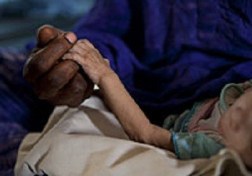
A mother attends to her severely malnourished child at an inpatient feeding centre in Mao, Chad. Plumpy’Nut is used to treat this potentially deadly condition (UNICEF Chad/2011/ Esteve)
Elizabeth Paff, a College of Mount St. Joseph (Ohio) student, yesterday finished two weeks of running to raise donations of close to 600 meals of Plumpy’Nut for starving children. Plumpy’Nut is a peanut paste used to feed small children who suffer severe malnutrition and need life-saving intervention.
The donations were sent to Edesia, a non-profit organization that produces Plumpy’Nut and is making the food currently for malnourished children in the Democratic Republic of the Congo and Chad.
Heidi Reed, the Communications Manager for Edesia, says, “We are so grateful for Elizabeth Paff for keeping up the fight, the awareness, and the funding to help save the lives of severely malnourished children. Every dollar raised brings us closer to a world where more children are given a chance at life.”
For every minute Paff ran over the last 2 weeks a donation was made equivalent to the cost of 1 package of Plumpy’nut (33 cents). For the last couple of runs the donation size was increased to 1 dollar for each minute run. Paff completed a 47 minute run on Friday adding to the total reported on the Cincinnati Enquirer web site earlier in the day.
Paff is a member of the Leadership Pathways program at the Mount and graduated from Oak Hills High School in Cincinnati. She also has forthcoming publications related to global hunger and has been quoted in the Buffalo News.
Readers are encouraged to send matching donations as a holiday gift to Edesia at www.edesiaglobal.org. Even a donation of one dollar can buy 3 meals of Plumpy’Nut.
Congress will decide budget amounts for food aid programs at home and abroad in the upcoming Farm Bill Credits: World Food Program USA
This week foodbanks across the country will be distributing food rations to the needy. Also this week a shipment from the U.S. Food for Peace program arrived in conflict-torn and impoverished Yemen. What do these two programs have in common besides fighting hunger?
Both initiatives depend on funding from federal programs in the upcoming Farm Bill legislation. Many food banks benefit from The Emergency Food Assistance Program (TEFAP) which sends donations to states for foodbanks to distribute. The Food for Peace program fights hunger overseas as a way to promote stability worldwide.
Congress will be deciding in the coming days how much to fund both of these hunger-fighting plans. Now is the time for people to let their representatives in government know that fighting hunger needs to be a priority of both our domestic and foreign policies.
Food is the basis of all things. Children in America suffering from hunger cannot learn and become the best they can be. Food can be a difference-maker for a child and his or her family, a safety net when tough economic times come.
Overseas, food is life-saving in areas of conflict and natural disaster, of which there are many ongoing – in South Sudan, the Democratic Republic of the Congo, Syria and elsewhere. When the conflicts end, food can give people and communities the stability they need to rebuild and make peace. Food can also make the difference there whether a child attends and finishes school.
While the face of hunger may be different from one country to the next, it is vitally important to combat the menace wherever it may be.
Ensuring funding for TEFAP and Food for Peace as well as the McGovern-Dole international school meals program are steps we can take without breaking the bank. Food aid programs are relatively inexpensive when compared to other programs. Annual spending on nuclear weapons for instance would beat Food for Peace and TEFAP by close to $50 billion.
There is enough food in the world to feed everyone, so why not fight hunger at home and abroad? This year’s Farm Bill is a great place to start by supporting TEFAP and Food for Peace.
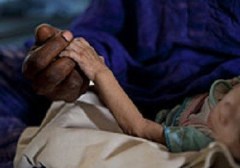
A mother attends to her severely malnourished child at an inpatient feeding centre in Mao, Chad. Plumpy’Nut is used to treat this potentially deadly condition (UNICEF Chad/2011/ Esteve)
Recently, I wrote about how you can raise money to fight global hunger by running and using the Charity Miles app. My fellow writer and runner, Elizabeth Paff, is joining in on this mission with a slightly different spin.
Elizabeth (Biz) is going to run and raise money for a food called Plumpy’Nut that saves the lives of starving children around the world. For every minute Biz runs through December 14, I will make a donation to Edesia, a non-profit organization that produces the Plumpy’Nut.
Each donation will buy a Plumpy’Nut meal (about 33 cents) which consists of a peanut paste fortified with crucial nutrients for children under the age of five. Without these nutrients small children can suffer lasting physical and mental damage.
Plumpy’Nut (as well as its variations like Plumpy’Sup) are currently being used in emergencies such as the conflicts in Syria, South Sudan, and the Democratic Republic of the Congo. Plumpy’Nut, which comes in a packet, is a food that can be easily distributed in these dangerous areas as it requires no refrigeration or preparation. In crisis areas there is a race against time to reach the hungry and especially the smallest children as they are the most vulnerable.
When the massive famine and drought struck East Africa last year it was Plumpy’Nut that saved many lives. When famine threatened the Sahel region of Africa this year Plumpy’Nut was again called into action. Edesia, which was recently featured on New England’s Chronicle TV show, produces Plumpy’Nut for aid groups like the World Food Programme, UNICEF, and others to use in the field.
Biz is a member of the Leadership Pathways program at the College of Mount St. Joseph, and is an activist fighting hunger. She will log her miles at Mount St. Joseph’s indoor track. I hope others will sponsor her running too and make the donations to Edesia as I am. This will make an inspired holiday gift. I am already counting her runs both Tuesday and Wednesday of 40 minutes each to the tally. So please join in.
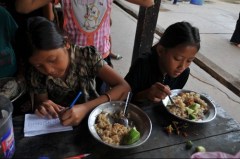
Using Charity Miles you can help support school feeding programs run by the World Food Programme Credits: WFP/Kongkea Chhoeun
In my last article, I wrote about Charity Miles and how you can use this free app to help raise donations to fight hunger and cancer.
Yesterday, I interviewed Alanna Imbach of the UN World Food Programme (WFP). She tells us more about how by walking, running or biking you can help support WFP, the world’s largest organization fighting hunger.
WFP is always on the lookout for innovative new ways to tackle global hunger issues, and engage people in efforts to reduce malnutrition and hunger. Charity Miles founder and brainchild, Gene Gurkoff, invited WFP to join up with this exciting new initiative early in 2012. When the game-changing phone application went live in June of this year, WFP was one of an initial nine top charities that walkers, runners and bikers can choose to support.
Give us an example of how funds raised through Charity Miles will help WFP feed the hungry?
It’s incredibly easy—and it’s free! When you use the Charity Miles app, your phone’s GPS is used to measure the distance that you cover during your walk or workout. WFP then receives 25 cents for each mile that you walk or run, or 10 cents for each mile biked. It may not sound like much, but with as little as 25 cents, WFP is able to provide a healthy meal to a child in school.
How easy is it for someone to join?
Using Charity Miles to support WFP in the fight against hunger is as simple as downloading the free application onto your iPhone or Android smartphone, then activating it while you enjoy your jaunt through the fresh outdoors. The app can be downloaded at charitymiles.org, and must be connected to an active Facebook account.
Do you see an increasing trend of support for WFP resulting from Charity Miles?
WFP’s partnership with Charity Miles is not just about raising money. It is also very much about raising awareness about global hunger, and empowering people to change the world by earning meals for hungry and malnourished kids in need, all while having fun. It has been great to see more and more people using Charity Miles as a launching pad to start conversations (and friendly competitions!) with their friends and colleagues about hunger in school and homes around the world.
I bought an Android phone a couple of months ago and downloaded the free Charity Miles app. You select a charity and choose whether you are going to run, walk, or bike. The app keeps track of your miles. Every mile you cover leads to a donation to the charity of your choice. The results of your runs get posted to your Facebook page.
I started out on Thanksgiving day with a three-mile run and took a little break to submit the results so Stand up 2 Cancer could earn the donation. The three miles I ran donated about seven minutes of cancer research.
The next three-mile run was for Feeding America and this donated about eight meals. As a member of the Feeding America Blogger Council I was also busy getting an online petition set up to support America’s foodbanks. So please sign this petition.
After another much-needed break especially considering the very hilly terrain I was running (the place is called Western Hills), my plan was to next run for the World Food Programme (WFP). My phone had a glitch so I lost about a mile’s worth. However, I did run a little over two miles after that, leading to a donation of five meals to WFP.
I also was able to mention Charity Miles to a few people I passed along the way.
Just as I am writing this I have received a message from Charity Miles stating:
“Yesterday was Charity Miles’ biggest day ever! Over 8,900 miles in one day – nearly half of which were for Feeding America, helping to feed over 15,000 people! What a great way to celebrate Thanksgiving!”
I am happy to be nine of those miles yesterday and to raise money for causes I am very involved with. My column here, primarly about world hunger, is nearing its 500th article.
I was glad to see Stand up 2 Cancer recently added to the Charity Mile list. I know how deeply devastating this disease is. My mother passed away from lung and brain cancer this summer.
There are many other charities as well that you can help when you join. I never used a cell phone or Android before starting this, so for experienced people it should be relatively easy to set up.
FreeRice has two goals: Provide education to everyone for free. Help end world hunger by providing rice to hungry people for free.
What if on Thanksgiving Day you could share food with a hungry person a world away? What if you could feed hundreds or thousands of “silent guests” on Thanksgiving? Actually you can, with FreeRice, the award-winning online game which helps feed the hungry.
When you play FreeRice you answer questions in many subjects including vocabulary, math, etc. For every correct answer, 10 grains of rice are donated to the UN World Food Programme, the largest food aid organization.
This year I had the opportunity to write some of the questions that appear in the new FreeRice section on world hunger. I have also been encouraged by the response to the game.
Recently, I wrote a story on the great work Ithaca College’s Food for Thought organization has done with FreeRice. This is part of their ongoing campaign against hunger which is highlighted by the Walk for Plumpy’nut.
A College of Mount St. Joseph student, Elizabeth Paff, has been promoting FreeRice as part of an upcoming campus walk event against hunger. The St. John’s Church in Delhi, Ohio told me they are playing FreeRice with some of their school programs.
FreeRice has raised money to feed schoolchildren in Haiti after the earthquake. Currently FreeRice donations are headed to Niger, a country in Western Africa that has suffered a severe drought this year. In addition, Niger is host to thousands of refugees from a conflict in the neighboring country of Mali.
We saw this year how tough drought is and how it can lead to higher food prices. In Niger, where farmers have less technology and means to cope, the consequences of drought multiply. We can throw this country a safety net by playing FreeRice.
So after turkey this year, make some time for FreeRice. By simply playing this game, you can invite a “silent guest” into your home on Thanksgiving, and help feed people a world away in Niger.
I was recently introduced, by one of its most loyal customers, to a very popular yogurt shop called Orange Leaf.
So I got an idea to propose a holiday event there to fight hunger by awarding gift certificates to Orange Leaf customers who get the highest scores playing the game FreeRice.
FreeRice is the online trivia game where for every correct answer, 10 grains of rice are donated to the UN World Food Programme. So hopefully this event will get up and running at the Orange Leaf which I visited in Cincinnati. While I was at the store I sampled the yogurt and gave it a yum!
Now for me and others yogurt is a pleasure to add to the day. But a world away there are others for whom getting a chance to buy yogurt and other fresh foods is a simple step toward coping with the trauma of war.
Refugees from the war in Syria who have fled to neighboring countries are without resources to buy food. One initiative the World Food Programme (WFP) has started is providing electronic vouchers so the refugees can actually shop at a store near where they are staying.
The food vouchers have been provided to over 120,000 refugees in Lebanon, Iraq, Jordan, and Turkey. WFP says, “The food vouchers can be redeemed against a list of items including cheese, milk, yogurt and eggs, which are not normally included in food rations. WFP often uses vouchers when food is available in the market but people do not have enough money to buy it.”
This is less expensive aid compared to shipping in food long distances and gives the refugees some choices as to what they may buy. The use of vouchers also helps the stores in the area where the refugees live. This means less of a burden on the host communities and more peaceful coping.
As WFP videographer Jonathan Dumont says, the voucher system gives refugees a chance to have a family meal again and in a troubled region, “a little comfort and stability goes a long way.”
With any luck yogurt will soon be helping to raise funds for the World Food Programme through the FreeRice contest, while at the same time be a part of its hunger relief operation through electronic vouchers. A tale of two yogurts.
With the election behind us, it’s time to focus on a major hunger crisis here at home and abroad. There are 50 million people hungry in the U.S. and worldwide there are 870 million starving people, a major cause of instability.
We don’t need to wait for the President and the Congress to act. I was reminded by Elizabeth Paff, a leadership student at the College of Mount St. Joseph on the Ohio River, that in America action starts from the grassroots. She wrote, “it has to start with someone out there so why not me?”
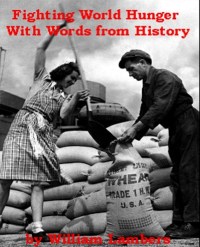
In 1947, along the Ohio River, that same leadership spirit was in action when a train rolled by as part of nationwide tour collecting food for war-torn Europe. The Friendship Train, as it was called, was powered by the initiative and generosity of everyday Americans. Wheat flour, milk, beans, macaroni, spaghetti, eggs, dried peas, and other foods were collected. These donations came when Europe’s recovery was still very much at risk. Winter was fast setting in with food supplies running low.
George Marshall, then Secretary of State, said, “from this time on…every man, woman and child in this country will exert a direct personal influence on the course of international affairs.” And they most certainly did in helping feed Europe’s hungry. The Friendship Train preceded one of our most successful foreign policy initiatives, the Marshall Plan that rebuilt Europe from the ashes of World War II.
Every American today can have a similar influence, whether feeding war refugees and flood victims in South Sudan or a hungry person in Syria or Afghanistan displaced by conflict. If everyone became a leader, had their own type of “Friendship Train,” this would be the biggest contribution to peace that can be made.
It does not take much to make a difference. Even one dollar buys a week’s worth of meals for a child. A church I visited had a collection jar for such a purpose called Change for a Change. Anyone with a computer can play the online game FreeRice and raise funds for the World Food Programme. Organizing a fundraising road race or walk in your community can also send a powerful message that world hunger is a top priority.
We cannot expect there to be peace with millions of people malnourished and children stunted in growth. The instability we see in the world will never cease unless there is food, hope, and opportunity for all.
At home leadership is needed too, with many Americans struggling to get enough food for their families. Unemployment, health issues, or natural disasters like Hurricane Sandy place people in need of emergency food banks. We have to make sure that these foodbanks have enough supplies.
That is where citizens can take the lead in organizing canned good collections or online fundraisers. Athletes can use a cell phone app called Charity Miles to raise money for Feeding America as well as the World Food Programme.
Combining your charitable acts with messages to the President and the Congress can make leadership contagious. You can encourage Congress, for instance, to pass legislation helping the hungry such as the upcoming Farm Bill.
Today, there is enough food worldwide to feed all the hungry at home and abroad. It’s not a question of resources as much as leadership. That is where you can come in to take charge in confronting the food crisis facing our planet.





 Author William Lambers