Category Archives: History

Crusade Of Prayer for Peace

In September of 1961 the Archdiocese of Washington held a Crusade of Prayer for Peace. At this time the Cold War was well underway and the Soviet Union had recently tested a massive nuclear weapon. The United States would soon resume its nuclear test explosions as well. The Cuban Missile Crisis would follow in a year.

I found the prayer card in my late mother’s Saint Andrew Daily Missal.  She lived in the Washington, DC area at the time of the Prayer for Peace event. To read the prayer click on the card below.

Leave a comment

Filed under History, Uncategorized

UN Food Agency Aided World War I Reconstruction in Syria

The Hejaz Railway, which ran through Syria and Jordan, was damaged during World War One (photo courtesy Jordan Tourism Board)

The UN World Food Programme (WFP) did not start its operations until 1963. However, one of its earliest projects was helping rebuild from the destruction left over from World War I. The Hejaz Railway, which originally ran from Syria to Saudi Arabia, was damaged during the First World War of 1914-1918.

The WFP enacted a Food for Work project to help rebuild some still-damaged sections of the railway in Syria and Jordan. Workers were given food in exchange for their labor. The New York Times reported in 1964 that the food rations for this project would feed 750 workers for two years. Parts of the Hejaz railway are still operational to this day.

WFP continues Food for Work projects like this today to improve transportation which is essential for feeding a nation and building an economy. Without good roads or rails, food, medicine and critical supplies cannot move quickly or efficiently. Goods cannot be as easily exchanged. In South Sudan, for example, the lack of good roads has made food distributions that much more difficult in one of the world’s hungriest countries.

Conflict is raging within Syria again today with rebels battling the government. WFP says it “continues to provide food assistance to 850,000 beneficiaries in 14 Syrian governorates” through its partner the Syrian Arab Red Crescent. WFP, which relies on voluntary funding, needs donations to supply the food but also safe access so it can reach all those in need.

They are estimated to be at least 1.5 million people in Syria who will need food aid in the coming months as the fighting continues. There are also many Syrians fleeing into neighboring countries who will need assistance.

Article first published as UN Food Agency Aided World War I Reconstruction in Syria on Blogcritics.

Suggested by the author:

Leave a comment

Filed under global hunger, History

The Power of Film and Ending Child Hunger

This Sunday was the Global Hunger Summit in London hosted by British Prime Minister David Cameron. With the eyes of the world focused on the London Olympics, the idea was to shift some of that attention toward the global hunger crisis afflicting nearly one billion people.

Adrian Lovett, Europe Executive Director of ONE, says: “The Prime Minister and the Vice-President of Brazil deserve real credit for seizing this moment to insist on the same ambition in the race to end extreme hunger and malnutrition. For too long, this scourge has failed to receive the global attention it deserves. Efforts to provide children the nutrients they need to grow and thrive have been under-funded and under-resourced.”

But now that the summit is over, the action must begin with child feeding for infants and meals for school-age children.

First priority is to secure life-saving food for children under five years of age. At that age the children are most vulnerable to physical and mental damage from malnutrition. Then for children over five you start providing feeding programs at school to help them grow physically and mentally.

If every nation has a comprehensive school lunch program we could drastically reduce child hunger and poverty while giving every child a chance to learn or even become an Olympian. Interestingly, the last time the Olympics were held in London was in 1948 when Europe was struggling to recover from World War II. School meals played a big role in helping rebuild from the destruction

Back in 2008, I wrote a short film called “Ending Child Hunger: School Lunches for Kids Around the World.” The film premiered at the College of Mount St. Joseph in February of that year. Now today, the film has been updated with more material about why school lunches are so important. World leaders need to align their foreign policy in support of child feeding.

So sit back and enjoy the film. You will hear from lots of people including Dwight Eisenhower, Herbert Hoover as well as correspondents from the World Food Programme discussing school meals in developing countries. You will hear from those who benefit from the feeding programs the most: children and their families.

Ending Child Hunger: School Lunches for Kids Around the World from William Lambers on Vimeo.

Ending Child Hunger: School Lunches for Kids Around the World from William Lambers on Vimeo.

Article first published as The Power of Film and Ending Child Hunger on Blogcritics.

Leave a comment

Filed under global hunger, History

The Final Olympic Event: The Global Hunger Summit

Two-time Olympic silver medalist Paul Tergat says “As sports men and women, it is important for all of us to use our privileged positions to raise awareness about the challenges that some of the less fortunate among us have to face.” (photo courtesy of the World Food Programme)

This Sunday British Prime Minister David Cameron is hosting a summit on the global hunger crisis. This meeting, coming at the close of the London Olympics, hopes to draw the media spotlight toward the nearly one billion people worldwide who suffer from hunger and malnutrition.

For humanity, the most important Olympic event is this hunger summit. Ertharin Cousin, the director of the UN World Food Programme (WFP), says, “The Global Hunger Event comes at a time when the eyes of the world are focused on the pinnacle of human physical achievement at the London Olympics. For far too many children, a lack of food and nutrition means that, sadly, they will never have a chance to compete in life.”

Right now hunger is striking conflict-ravaged South Sudan and Sudan, Afghanistan, Yemen, and Haiti. In the Sahel region of Africa humanitarian aid is needed to prevent famine after a severe drought. Over in East Africa there is still tremendous hunger one year after drought struck the region leading to famine in Somalia.

Drought in the U.S. this summer may cause higher food prices for an extended period of time, making the global hunger fight that much harder to carry out. Aid agencies like WFP depend on voluntary donations from the government and the public to fight hunger.

But will governments be able to provide funds during tough economic times and needs at home? It’s important to remember that food aid is a relatively inexpensive foreign policy expense when you compare it to programs like nuclear weapons spending. Targeting food aid for budget cuts is barking up the wrong tree.

The last time London hosted the Olympics was in 1948, the same year the Marshall Plan started to rebuild Europe after World War II. Following the conflict, the world was on the brink of the most massive famine in history. Former U.S. president Herbert Hoover was appointed as food ambassador in 1946 to coordinate a global response to save millions of lives. UNICEF was created during this time period to meet the needs of children who suffered more than anyone from the war. In 1947 Austria, Italy, and France received pre-Marshall Plan aid so they could have enough food for the winter before the recovery program started.

The food aid provided to Europe offered the foundation for reconstruction. As former Army Chief and Secretary of State George Marshall said, ” Food is the very basis of all reconstruction. Hunger and insecurity are the worst enemies of peace.”

This Sunday in London the starving peoples of the world are hoping the Olympic spirit can come to their aid via the hunger summit.

Article first published as The Final Olympic Event: The Global Hunger Summit on Blogcritics.

Leave a comment

Filed under global hunger, History

Eisenhower Believed Allied Victory was Inspiration for Fighting Global Hunger

Dwight Eisenhower (Eisenhower Library photo)

Times may be tough for the US, but we have seen tougher. The struggle to fight global hunger need not be relegated to the backburner.

In 1948 when Dwight Eisenhower made a speech about fighting child hunger, he invoked the great resilience of America in overcoming challenges. He used the example of June 1944 just after the Allied Landings of D-Day to start the invasion of Nazi-occupied Europe. A massive storm struck the coast, and the destruction it caused could have severely harmed the Allied forces. But even greater than the storm was the resolve of America and its allies in overcoming obstacles.

Today, both Congress and President Obama should show stronger support for fighting global hunger, which means increased funding for the US Food for Peace and McGovern-Dole programs.

Right now these global hunger fighting programs are in serious jeopardy of more budget cuts.

The World Food Program USA reports, “Despite this increasing need, national budget cuts have decreased the funding for Title II, the main legislation for food assistance in the Food for Peace program. The reduction from $1.84 billion to $1.46 billion since 2010 can negatively impact vulnerable populations in a variety of ways, making each recurring crisis deeper and more costly to address.”

Afghanistan, South Sudan, Yemen, East Africa, the Sahel region of Africa and many other areas are suffering from severe hunger and malnutrition. Food for Peace and McGovern-Dole donations make a huge difference for these crisis points. But if not enough resources are provided to these hunger fighting initiatives, then the enemy of hunger can live to fight another day.

The US has to increase its Food for Peace arsenal. If America has enough resolve to battle world hunger, we can take the greatest step toward world peace there is.

Article first published as Eisenhower Believed Allied Victory Was Inspiration for Fighting Global Hunger on Blogcritics.

Leave a comment

Filed under global hunger, History

This Memorial Day You Can Save a Life in Famine-Threatened West Africa

This Memorial Day is a time to remember lost loved ones. It’s also a time when people can rally to save the lives of millions of people threatened by starvation in the Sahel region of Africa.

A severe drought has ruined food supplies in this part of West Africa, which includes Niger, Mauritania, Mali, and five other countries. Conflict in Mali has created a refugee crisis; small children have already starved to death as a result of the food shortages. Aid agencies do not have enough resources to defeat the famine.

West Africa Faces Food Crisis (Australian Broadcasting Corporation video)

How can someone help? Do exactly what General John J. Pershing did after World War I. That war, in which he commanded American forces, produced a massive food shortage that threatened millions with starvation in Europe and other areas. Pershing co-hosted a fundraising dinner along with Herbert Hoover who ran American relief efforts during and after the war.

Description: New York City, Children's Relief Fund, 12/29/1920, Invisible Guest Dinner (Hoover Presidential Library and Museum photo)

A chair was placed at the table signifying an “invisible guest,” one of the hungry and suffering. Funds were collected at the dinners through the cost of the plate and also additional contributions. The money funded the work of the American Relief Administration overseas, the agency that led the fight against the other enemy of the World War I- Hunger.

Description: CRB, American Relief Administration Food Distribution, Poland, CA 1919 (Hoover Presidential Library and Museum photo)

Today, Memorial Day offers an opportunity for people to have their own “invisible guest” event. If it leads to a donation of even the cost of one Memorial Day cookout meal, it can save a life.

The director of the UN World Food Programme, Ertharin Cousin, says, “Time is not on our side. If no new food or cash contributions are received immediately, the resulting inability to pre-position and distribute enough food at the peak of the lean season, from June to September, would be catastrophic for the most vulnerable, food insecure people – especially women and children.”

Children being screened for their nutrition status at a supplementary feeding centre in Mauritania. (WFP/Jacqueline Seeley)

The UN World Food Programme has started a relief fund where people can donate to the Sahel relief effort. Save the Children also has its own Sahel relief fund. Both offer great opportunities to feed an “invisible guest” this Memorial Day.

If the donations come in, children will be saved from starvation in the Sahel region of Africa.(WFP/Rein Skullerud)

Article first published as This Memorial Day You Can Save a Life In Famine-Threatened West Africa on Blogcritics.

1 Comment

Filed under global hunger, History

This Day in History in the Fight Against Global Hunger

Winston Churchill once said, “The further backward you look, the further forward you can see.” As President Obama is set to make a speech about today’s global hunger crisis, it helps to look back on this day in history.

On May 17, 1946 Herbert Hoover addressed the nation as famine threatened to strike the countries devastated by World War II. Hoover had been appointed as a “food ambassador” by Harry Truman. Hoover set out to coordinate the global response and millions of lives were saved by this effort. As Hoover put it, the  world had to come together to master the famine.

Herbert Hoover (far right) served as food ambassador under President Truman (center).  Hoover, Truman and General Dwight Eisenhower (far left) made multiple speeches about fighting hunger after World War II in order to win the peace. (Truman Library photo)

The citizens of America responded, sending CARE packages and even having trains cross the country collecting food for the hungry. The recovery program for Europe after the war, known as the Marshall Plan, was built on a foundation of food and nutrition.

We face a new hunger crisis today, as conflict in Sudan, East Africa, the Sahel region of Africa, Yemen, and Afghanistan has escalated the ranks of the hungry. Also, drought has descended in many of these areas which has ruined food production. Children are dying from malnutrition.  Right now aid agencies lack the funding to keep up with the crisis.

The UN World Food Programme said earlier this month that 364 million dollars is needed right away to fight hunger in the Sahel. UNICEF Yemen is only 32 percent funded for this year for its relief work. The World Food Programme in South Sudan is short $132 million dollars for relief work.

Peace in these countries depends on whether there is enough food supply and nutrition, especially for the smallest children. If enough funding is provided, millions of children in these countries could be spared death or damaging malnutrition.

Peace is advanced if we save the children. This we know. Still, history gives hope that the world can respond to the threat of famine today. On this day in history the Greatest Generation was focused on defeating the last enemy of World War II: Hunger.

Listen to Herbert Hoover address the nation on May 17,1946 about the famine after World War II.

Read more about President Obama’s speech on global hunger at the Global Agriculture and Food Security Symposium on May 18th.

Article first published as This Day in History in the Fight Against Global Hunger on Blogcritics.

Leave a comment

Filed under global hunger, History

This Easter, Let’s Remember the World’s Hungry

Imagine Easter with no chocolate or candy or egg hunts. In 1947 in Europe, this was just the case in countries struggling in the ruins of World War II. Newspapers reported a scarcity of everything but faith.

This Easter there will be nearly 1 billion people worldwide suffering from hunger. They are in earthquake-recovering Haiti, war-torn countries Afghanistan, Sudan,  and in the drought hit areas of the Sahel and East Africa.

Developing countries need school feeding programs to fight malnutrition and give their children an education. Not enough emphasis is placed on these vital programs. (WFP/Ramin Rafirasme)

All too often in the discussion of world affairs, the basic needs of food and agriculture are forgotten. Then strategy makers and analysts ponder over how to solve the crisis, often ignoring the obvious. Food supply and accessibility are the foundation all nations need to thrive and have peace.

What needs to change? World leaders need to get more involved in the fight against hunger. Many times their efforts are piecemeal. It’s very important that citizens write their representatives in government about fighting hunger both at home and abroad.

Internet technology offers several ways for people to get involved too. If you visit the sites of the World Food Programme, Save the Children, Feeding America, Catholic Relief Services and others, you will find all kinds of tools and information that you can use to take action against hunger. These agencies want you to get involved and bring your talents and expertise to the table.

What may look dark today can turn around. For Europe’s 1947 Easter, the situation looked quite desperate. But fast forward to the Easter of 1949 and you will find a different tale. Newspapers reported joyful celebrations in Western Europe “from their own labor and the efforts of the European Recovery Program,” known as the Marshall Plan.

This Easter remember the hungry and suffering, and see what you can do to help them.

Article first published as This Easter, Let’s Remember the World’s Hungry on Blogcritics.

Read a newspaper article about the Argosy Easter Ship that help feed children in Belgium during the First World War.

Leave a comment

Filed under global hunger, History

South Sudan and the War of 1812

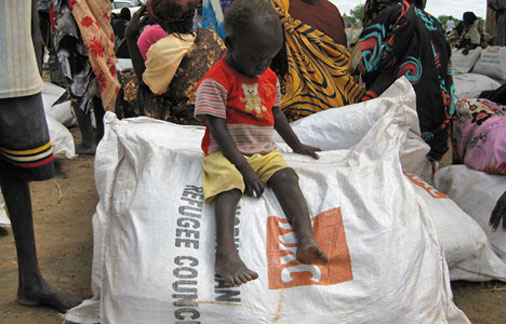
This child in Sudan is receiving food aid from the Norwegian Refugee Council (NRC). Many more children in the world are in need of food safety nets. (NRC Sudan)

At a Senate hearing in March, actor and Sudan activist George Clooney was asked about how to keep Americans, especially youth, engaged with the conflict and hunger in South Sudan. Can people here in the U.S. feel a sustained connection to a country many thousands of miles away?

Imagine for a moment a country that has recently gained its independence. War, territorial and boundary disputes, and the inability of the young government to cope with emergencies are the tragic realities.

Cities and towns have come under assault from their northern neighbor, forcing civilians to flee their homes in terror. Farmers have been forced away from their land by armies, thus ruining food production.

What you just read would describe South Sudan today. The description could also fit the United States during the War of 1812.

For when the United States was a young nation, like South Sudan now, it experienced war on its soil. This year is the 200th anniversary of the War of 1812, which President Obama and British Prime Minister David Cameron talked about at their White House meeting in March. During that war the British burned the White House to the ground. After the War of 1812 had ended, little by little the two sides moved away from conflict and toward partnership.

The Rush-Bagot Agreement of 1817 disarmed the Great Lakes and Lake Champlain, which during the war were the scene of naval battles and fierce bombardments on coastal towns. A naval arms race was averted. This allowed the U.S. border with the British colony of Canada to develop in peace rather than diverting resources into costly warships which might have provoked a new war.

One of the most tense standoffs between Britain and the U.S. in the decades after the War of 1812 was over who owned the Oregon Territory of the Northwest. In 1846 veteran diplomat Albert Gallatin, one of the peace commissioners during the War of 1812, published an essay urging calm between the two rivals. His words for peace were what any standoff needs to get resolved.

Today, South Sudan is faced with building peace with their neighbor Sudan. The two sides fought a civil war that ended in 2005 with the Comprehensive Peace Agreement. But this agreement has a long way to go before becoming a genuine peace.

Last summer, fighting erupted between South Sudan and Sudan over the disputed territory of Abyei. A United Nations Security Force has been dispatched for the demilitarizing of Abyei and to ensure protection and humanitarian aid for civilians.

In South Kordofan and Blue Nile, fighting is raging. U.S. Ambassador Princeton Lyman says “conflict has been raging there since last May, arising from issues never fully resolved in the civil war because people in those states, particularly in the Nuba mountains, fought with the South.”

There is also internal conflict in South Sudan between rival tribes, the Lou Nuer and the Murle, that has displaced many thousands of people in the Jonglei state. These two tribes have repeatedly attacked each other over the years through cattle raids and kidnappings. The scale of their battles, though, has increased substantially in recent months.

In May a peace conference is set to begin to deal with this deadly rivalry. Archbishop Daniel Deng Bul, head of the Peace, Reconciliation and Tolerance in Jonglei Committee, says, “I am expecting everybody who loves peace to participate in this process because we have lost so many people. I hope everybody will come, sit together and try to find a lasting solution for the problems.”

There is an initiative underway to collect the guns that have proliferated in Jonglei and there are plans for a buffer zone between the Lou Nuer and the Murle to help transition to peace.

Deng Bul says, “It is important for all citizens not to carry arms because the arms are tempting [people] to unnecessary actions. If we want to have development in Jonglei, we must make sure that everybody is not carrying a gun.”

South Sudan desperately needs its own peacemakers before it’s too late. The internal and external conflict has harmed the region’s food supply. Drought has also struck. These two elements, combined with preexisting poverty, are creating a hunger crisis approaching famine. The UN World Food Programme, which relies on voluntary funding, says nearly five million people in South Sudan are suffering from hunger. Food is desperately needed to reinforce the peace process.

South Sudan needs the United States and others to stay with them during these rough waters as it tries to build a road to peace.

As we mark the 200th anniversary of the War of 1812, students and other citizens can take time to reflect on the peace with Britain that emerged from the ashes. This learning adventure in American history can also offer a way for students and others to connect with South Sudan. How can this newly independent nation build their own road to peace?

For what the governor of Ohio, Thomas Worthington, proclaimed after the War of 1812 rings true. Worthington said we must seek the day “when bloody wars engendered in pride and wickedness, and prosecuted in fury and unrighteousness, shall forever cease, and when every human being, in the true spirit of humanity, meekness and charity,shall do justly, love mercy, and walk humbly with his God.”

Article first published as South Sudan and the War of 1812 on Blogcritics.

Leave a comment

Filed under global hunger, History

Will the Hunger Games Match the Rose Bowl Films?

Fans of the novel The Hunger Games are setting up canned good collections to fight global hunger when the film version premieres this month. The Hunger Games is an adventure tale set in the future when North America has gone through drought, famine and war.

The film’s producers at Lionsgate are partnering with the UN World Food Programme (WFP) and Feeding America.

Hopefully this activism will spread across the country. We know from history that film gatherings can make a difference in fighting hunger.

At the University of Michigan in 1947 an event was set up where students could view films of the Rose Bowl football games. Their admission price was a canned good which would be placed upon the Friendship Train.

The Friendship Train traveled across the United States collecting food for the hungry in Europe after World War II. It was one of the magical happenings that took place in the spirit of the Marshall Plan which saw the rebuilding of a continent from the ruins of war.

 The Michigan Daily reported that 10,000 students descended upon area stores buying up canned food. The grocers were practically cleaned out of stock.

So area businesses also benefited from this food drive to help the hungry overseas. One grocer noted that the students made nutritious choices, such as corn.

The Hunger Games has a real opportunity to match this kind of activism, and more so considering that social media provides more ways to organize such an event.

So we will see. Perhaps some of the theaters might even have a showing or two where the admission is a canned good or a one or two dollar donation.

A website has been set up where you can view a video with the stars of the film talking about how you can take action. You can take a quiz and learn more about global hunger. Donations are accepted on the site that will benefit WFP, the largest food aid organization in the world, and Feeding America, which is the leading agency fighting hunger in the United States.

Article first published as Will The Hunger Games Match the Rose Bowl Films? on Blogcritics.

Leave a comment

Filed under global hunger, History