Tag Archives: Syria

Millions of Syrians and Yemenis Suffer From Hunger, Cold

Zaatari refugee camp in Jordan, currently home to 30,000 Syrians who have fled recent fighting in the country. Some 75% of the camp's inhabitants are women and children.Credits: WFP/Jonathan Dumont

Zaatari refugee camp in Jordan, currently home to 30,000 Syrians who have fled recent fighting in the country. Some 75% of the camp’s inhabitants are women and children. Credits:
WFP/Jonathan Dumont

It was just several years ago that Syria was helping refugees from the fighting in Iraq. Now it is Syrians taking refuge in Iraq and other countries as the war between rebels and President Assad’s forces continues.

Victoria Nuland, spokesperson for the U.S. State Department, said this week, “For nearly two years, the Assad regime has brutalized its own people…Assad has lost all legitimacy and must step aside to enable a political solution and a democratic transition that meets the aspirations of the Syrian people.”

Syrians are fleeing daily to Iraq, Lebanon, Turkey, Egypt, and Jordan. Not only do they have to fight hunger but also cold weather.

Um Raed, a mother who recently arrived at Zaatari camp in Jordan, said, “It’s cold, unbelievably cold. My son has only a short sleeved shirt – the clothes he had on when we escaped our country.”

The United Nations High Commission for Refugees is trying to provide shelter, blankets, and clothing for the refugees. This has not been an easy task with hundreds of thousands of Syrians in need and funding low.

This month storms hit the Zaatari camp, flooding and blowing over tents. Syrians who had just gone through the trauma of being displaced from their homeland were dealt another blow. Conditions will continue to be tough for the coming winter months.

Laure Chadraoui, a spokesperson for the UN World Food Programme in Jordan (WFP), said, “The temperature drops here as low as minus two or minus three [Celsius] sometimes, especially at night.” WFP gives food aid to the refugees.

WFP says it might need to feed 750,000 Syrians refugees this year. Meanwhile, inside Syria WFP is feeding about 1.5 million victims trapped by the fighting. This mission is made more difficult by the ongoing violence but also by funding difficulties.

Meanwhile, in Yemen, as the nation undergoes political transition half of the country does not have access to clean water and 10 million people suffer from hunger. A United Nations report said, “Out of the 1 million children suffering from acute malnutrition more than 150,000 may die if they do not receive immediate assistance.”

The same report also says, “Extreme poverty, volatile food and commodity prices and an increase of the cost of living will further reduce access to food, basic services and livelihoods for millions of Yemenis.”

Aid agencies like the UN World Food Programme (WFP) and UNICEF will need funding to help Yemen fight off the hunger crisis. These agencies rely on donor governments and the public.

The U.S. Food for Peace program is the largest single supporter of WFP. If the U.S. Congress supports Food for Peace in upcoming budget negotiations, it can lead to more donations to fight hunger in Yemen and elsewhere.

The UN warns, “There can be no sustainable transition in Yemen without the full support for the humanitarian response.”

Humanitarian aid is a crucial part of achieving peace and stability whether in Syria or Yemen.

Article first published as Millions of Syrians and Yemenis Suffer from Hunger, Cold on Blogcritics.

Leave a comment

Filed under global hunger

Harsh Weather, Low Funding New Threats to Syrian Refugees

Al Za’atri camp following heavy rains. Credits: Abdalrheem Alarjan©WFP

Humanitarian aid agencies are struggling to feed, clothe, and shelter Syrians who are fleeing to neighboring countries daily, escaping the conflict in their homeland.

Sybella Wilkes of the UN High Commission for Refugees said yesterday, “The lack of funds are very worrying.” The UN has issued an appeal for US $1 billion to provide relief for hundreds of thousands of Syrians. Only a fraction of the funding has come in from donor governments.

The UN World Food Programme’s (WFP) director, Ertharin Cousin, said today, “These families have gone through very difficult moments, losing their loved ones and worrying about the people and homes they left behind. We have a commitment to continue to support Syrian refugees – whether in Turkey or in the other neighbouring countries – with some of them in very precarious conditions this winter.”

WFP said today that at the Al Za’atri camp in Jordan heavy rains, sleet and snow damaged tents and displaced families. Save the Children staff were also injured when upset refugees entered a WFP food distribution site. The incident occurred when someone tried to use two ration cards.

WFP also reports that despite the difficult conditions, general food distributions in January were able to start. The food voucher program, however, was delayed temporarily due to the harsh weather because people could not travel to the markets.

From January 2-8 over 6,200 welcome meals were provided to new arrivals at the Al Za’atri camp.

Meanwhile, in Lebanon there are now over 192,000 Syrians who have sought refuge. Poor weather also has caused delays there in the relief program. Relief programs for Syrian refugees are also ongoing in Turkey, Iraq, and Egypt.

As long as the conflict continues in Syria, humanitarian needs will continue to grow. WFP is making plans to potentially feed as many as 750,000 Syrian refugees. Inside Syria WFP is feeding around 1.5 million people impacted by the fighting.

Wilkes adds, “We urgently need to replenish our warehouses, provide financial assistance to the most needy, and expand our outreach efforts to reach the most vulnerable.”

Time is running out for many Syrians as the harsh winter weather takes hold.

Article first published as Harsh Weather, Low Funding New Threats to Syrian Refugees on Blogcritics.

Leave a comment

Filed under global hunger

Tears Tell Story of Syria, an Interview with Laure Chadraoui

Where there is war there is hunger. This holds true with the conflict now taking place in Syria. The UN World Food Programme, the largest food aid organization, is currently feeding 1.5 million Syrians displaced within their own country.

Hundreds of thousands of other Syrians who fled to neighboring Iraq, Lebanon, Turkey and Jordan are also receiving aid. Secretary of State Hillary Clinton says, “conditions in Syria continue to deteriorate as the Assad regime relentlessly wages war on its own people.”

The longer the fighting continues, hunger will only intensify as the country’s regular food supply systems continue to break down. The World Food Programme, and its partner the Syrian Arab Red Crescent (SARC) are the lifeline for saving innocent Syrians from starvation.

Laure Chadraoui, a World Food Programme (WFP) officer, was just on a mission into Syria. She shares her experience in the war-torn country following interview.

You were just in the conflict areas of Syria and met with families. Can you tell us about the impact of this conflict on them to give readers an idea of life in a war zone?

During my recent mission to Syria, I visited Damascus, one area in Rural Damascus and Homs. Talking to displaced people, I saw how shocked they were from what had befallen their country. They still could not believe that this is happening to them. After more than a year and a half, many are in shock. During a door to door distribution of WFP food assistance by Syrian Arab Red Crescent volunteers in Homs, I saw a woman, in her early 20s, standing at the door of her house, or new shelter is a more accurate description, holding a one year old girl.

She did not ask for anything as I approached to talk to her. When I asked her where she came from, she was in tears before she could say: Khaldiyeh. Khaldieyeh, in the old city of Homs, has endured recently heavy fighting. She had only recently given birth and had to flee with her husband and her newborn baby. Her husband was not at home, she told me, he goes looking for someone to hire him as a daily worker, most of the time to no avail. What she receives from WFP is all she has got to feed her baby. She was not very comfortable telling her story, but her tears told most of it. I imagined, then, that many of these displaced people, lost members of their families, or their homes, or their livelihoods, or maybe all at once. Their lives are shattered. This woman, found a home, in a safe area in Homs, but the sound of explosions and fighting is clear, and she, like many others know it is probably not far from what they used to call “home.”

I met other WFP beneficiaries at public shelters, each family living in a room, that is now the kitchen and the bedroom and the playground. The mattresses lined up on top of each other to give space for the family to sit together is the common image that strikes you everywhere in those shelters. Sometimes more than one family share one room. I met a family with children and a baby no more than 4 months who has taken an empty and unfinished villa as her new shelter. The villa is still under construction, has no doors or windows. That was the best they could find. It looked like it was in the middle of nowhere. Their needs are huge from food to medical care and non-food items. The mother told me, she fled with only the clothes they were wearing. They were poor where she came from but had a roof over their head; we had a decent life and we were happy, she told me. However, it was a relief to see that our food is reaching them and in many ways saving their lives.

Are children at risk of physically and mentally damaging malnutrition in Syria and are there going to be enough food supplies and access to prevent this?

It was particularly painful to see displaced children. They are not only uprooted from their familiar environment but also from their schools. WFP is working closely with UNICEF to ensure children’s nutritional needs are met. We are importing plumpy doz which is expected in the coming weeks targeting around 100,000 children under 5 years old. WFP is also providing logistic support to other agencies and we have shipped humanitarian supplies on behalf of UNICEF, among others, to different parts of the countries.

How much agricultural land has been harmed by the fighting and what impact will this have going forward?

A Joint Rapid Food Security Needs Assessment mission, conducted in June 2012, by WFP, FAO, and the Syrian Ministry of Agriculture and Agrarian Reform in Syria revealed that the agricultural sector has lost a total of US$1.8 billion this year as a result of the crisis due to losses and damages to crops, livestock and irrigation systems. The assessment has shown that strategic crops, such as wheat and barley, have been badly affected. The findings indicated that 3 million people are in need of food, crop, and livestock assistance such as seeds, food for animals, fuel and repair of irrigation pumps over the next 12 months.

How is the funding level for the Syrian relief mission? And how can people help?

WFP’s operation in Syria is short if US$ 56 million to be able to continue its most needed food assistance to 1.5 million displaced and vulnerable people until the end of the year. Individuals wishing to contribute can also do so by visiting WFP’s official site.

Article first published as Tears Tell Story of Syria: An Interview with Laure Chadraoui on Blogcritics.

Update: The World Food Programme has started a Syria relief fund. Visit the WFP Syria relief fund page.

Leave a comment

Filed under global hunger

Food, Clothing, Tech, and Logistics All Crucial for Syrian Aid

Though many families have fled Homs, a few choose to return to their homes in the neighbourhood of Baba Amr despite the challenges. Of those who have fled from Homs to Aleppo,many were later forced to move along when the fighting intensified there as well (photo courtesy WFP/Abeer Etefa)

This week I have an article on the History News Network about why humanitarian aid is so critical for Syria. We have to look ahead too, with winter not too far around the corner.

If the conflict continues, humanitarian needs are only going to increase. When you add colder temperatures on top of this prospect, it is cause for great alarm. Winter clothing will be needed for refugees from the Syrian conflict, in addition to food and other basic items.

Here is some of the latest information from the UN World Food Programme (WFP) on its hunger relief efforts for Syrian war victims. In September WFP is feeding around 1.5 million people in 14 Syrian governorates affected by the conflict. WFP works through its partner the Syrian Arab Red Crescent.

WFP says, “The situation remains tense across the country with armed activities on-going in various governorates and on international roads causing WFP dispatches to be delayed and monitoring activities hindered especially in Idleb, Homs and Aleppo.”

WFP relies on voluntary donations from the international community. There have been generous donations already from the United States and other countries. But so much more is needed given the size of the emergency. That is why funding for the U.S. Food for Peace program, which is a major supporter of WFP, is so crucial.

WFP currently faces a $61 million shortage of funding in Syria. Another vital aspect of WFP’s work is in the area of communications and logistics. These measures help connect aid groups so they can better coordinate operations and transportation.

WFP reported last week, “Urgent funding is also needed to continue implementing activities under the Special Operation (SO) 200477, aimed at augmenting WFP’s capacity in logistics, communication and security amidst the increasingly challenging environment.”

In addition to relief activities inside Syria there is help needed for hundreds of thousands who have fled the country into neighboring Iraq, Lebanon, Jordan, and Turkey. WFP also needs additional funding for this operation.

Catholic Relief Services is also carrying on relief work to help the refugees, with their focus on Jordan and Lebanon. They are also urging people to contact Secretary of State Hillary Clinton to build support for helping the refugees and ending the conflict.

Article first published as Food, Clothing, Tech, and Logistics All Crucial for Syrian Aid on Blogcritics.

Leave a comment

Filed under global hunger

WFP to host Syrian hunger relief event on Google

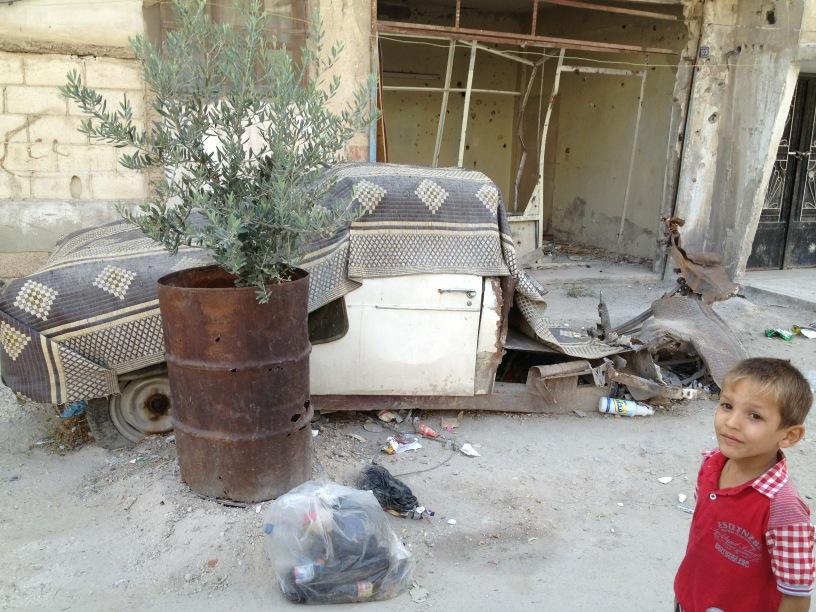
A family’s destroyed car surrounded by ruins in Baba Amr in Syria
Credits: WFP/Laure Chadraoui

The UN World Food Programme (WFP) and Google+ will be hosting an event at 12pm Eastern time on Thursday, September 20th where people can learn more about the growing humanitarian crisis in Syria. Using a Google + Hangout representatives from WFP will discuss how critical food aid is for refugees from the conflict in Syria.

WFP is trying to feed 1.5 million people in Syria this month as well as thousands who have fled to neighboring countries. Abeer Etefa, a WFP Middle East officer, will be in Damascus, Syria to discuss how the UN food agency is carrying out this complex and dangerous relief mission.

She will be joined by members of the media and will take questions. You can submit your questions on Google+ or Twitter using the hashtag #wfpsyria.

WFP says that event will be broadcast on their Google+ Page and on YouTube. Facing a funding shortage of 61 million dollars for its relief work, WFP hopes to rally global support for helping war victims in Syria and throughout the Middle East.

Leave a comment

Filed under global hunger

Syria: Humanitarian Crisis Worsens, WFP To Seek More Funding

Faiza Alabed holds her newborn, with her son by her side. The family fled the violence in Syria for the safety of Jordan. (Bill Lyons/CRS)

As fighting continues in Syria, humanitarian needs are increasing. The UN World Food Programme (WFP) reports, “there has been a recent dramatic increase in the number of people leaving their homes in search of safety with a number of them seeking shelter in schools across the country.”

WFP, through its partner the Syrian Arab Red Crescent, is feeding 850,000 people in 14 Syrian governorates. Funding for the relief mission is short $43 million dollars. As WFP plans to increase food distributions to 1.5 million civilians, even more funding will be required. WFP depends entirely on voluntary donations.

Many others Syrians are fleeing into neighboring countries including Jordan, Lebanon, Iraq and Turkey. The United Nations High Commissioner for Refugees (UNHCR) says there is a “major increase” in Syrians fleeing into Jordan. Last Thursday, a record 2, 200 Syrians crossed the border into Jordan. The average number of refugees arriving in Jordan had already increased to about 1000 a day and prior to that was around 400.

In just one week the number of refugees fleeing Syria into neighboring countries increased from 170,116 to 202,512. UNHCR spokesman Adrian Edwards says, “Further arrivals are expected.”

Catholic Relief Services (CRS) is providing aid to refugees in Jordan and Lebanon. Caroline Brennan of CRS recently interviewed some of the refugees. One of them told her, “We escaped in the middle of the night. God protected us. We came to Jordan with nothing-literally with the clothes on our backs. The most important thing is that our kids are safe. I didn’t even take my last paycheck when we left. I couldn’t look back.”

A recent UN study shows the long-term effect of this conflict. The reports says 3 million people in Syria will need assistance over the next 12 months. There are, “Large numbers of rural people of the central, coastal, eastern, northeast and southern governorates were found to have totally or partially lost their farming assets and livestock-based livelihoods and businesses, due to the on-going insecurity, coupled with a prolonged drought. ”

Resources will be needed to help those suffering in Syria as well as the ever-growing number of refugees.

Leave a comment

Filed under global hunger

UN Food Agency Aided World War I Reconstruction in Syria

The Hejaz Railway, which ran through Syria and Jordan, was damaged during World War One (photo courtesy Jordan Tourism Board)

The UN World Food Programme (WFP) did not start its operations until 1963. However, one of its earliest projects was helping rebuild from the destruction left over from World War I. The Hejaz Railway, which originally ran from Syria to Saudi Arabia, was damaged during the First World War of 1914-1918.

The WFP enacted a Food for Work project to help rebuild some still-damaged sections of the railway in Syria and Jordan. Workers were given food in exchange for their labor. The New York Times reported in 1964 that the food rations for this project would feed 750 workers for two years. Parts of the Hejaz railway are still operational to this day.

WFP continues Food for Work projects like this today to improve transportation which is essential for feeding a nation and building an economy. Without good roads or rails, food, medicine and critical supplies cannot move quickly or efficiently. Goods cannot be as easily exchanged. In South Sudan, for example, the lack of good roads has made food distributions that much more difficult in one of the world’s hungriest countries.

Conflict is raging within Syria again today with rebels battling the government. WFP says it “continues to provide food assistance to 850,000 beneficiaries in 14 Syrian governorates” through its partner the Syrian Arab Red Crescent. WFP, which relies on voluntary funding, needs donations to supply the food but also safe access so it can reach all those in need.

They are estimated to be at least 1.5 million people in Syria who will need food aid in the coming months as the fighting continues. There are also many Syrians fleeing into neighboring countries who will need assistance.

Article first published as UN Food Agency Aided World War I Reconstruction in Syria on Blogcritics.

Suggested by the author:

Leave a comment

Filed under global hunger, History

WFP Facing Critical Funding Shortage for Syrian Relief

Even before the violence broke out in Syria, a food security survey found that 1.4 million people were struggling to meet their daily food needs. Many lived in areas currently affected by conflict. (WFP/ Salah Malkawi)

The UN World Food Programme (WFP) says its facing a “critical funding shortfall” of US $62 million dollars as it tries to feed victims of the conflict in Syria. The UN food agency depends entirely on voluntary donations from governments and the public.

WFP just sent aid to Aleppo, the largest city in Syria, after reports of food shortages following an increase in fighting between the Syrian government and rebels. A WFP press release says, “The humanitarian situation is deteriorating in Aleppo and food needs are growing rapidly, with heavy fighting entering its second week – forcing about 200,000 people to flee the city. ”

Working with the Syrian Red Crescent, WFP provided food aid to over 500,000 war victims during July. However, the violence in the country prevented WFP from reaching its target goal of 850,000 Syrians. A recent report also reveals that three million Syrians will need help during the coming months.

The fighting has taken its toll on the livelihoods of families, many of which were already at poverty level. Abdulla BinYehia of the UN Food and Agriculture Organization (FAO) says, “The most vulnerable families in Syria depend entirely or partly on agriculture and farm animals for food and income. They need emergency support, like seeds, repairs to irrigation systems, animal feed and healthcare.”

BinYehia warns, “If timely assistance is not provided, the livelihood system of these vulnerable people could simply collapse in a few months’ time. Winter is fast approaching and urgent action is needed before then.”

The White House released a statement this week highlighting a 12 million dollar donation of additional humanitarian aid to Syria. This donation will be distributed among various aid agencies working inside Syria including WFP. So far this fiscal year the US has donated 27 million dollars to the WFP relief operation in Syria. Many more donations are needed as there is no end in sight for the conflict.

As the White House stated, “The quickest way to end the bloodshed and suffering of the Syrian people is for Bashar al-Asad to recognize that the Syrian people will not allow him to continue in power, and to step aside to enable a peaceful political transition to a government that is responsive to the aspirations of the Syrian people.”

WFP is also feeding a growing number of refugees who have fled to neighboring countries. There is expected to be well over 100,000 Syrian refugees in Iraq, Turkey, Lebanon and Jordan by the end of this year.

Suggested by the author:

Leave a comment

Filed under global hunger

Crisis in Syria: an interview with Abeer Etefa of the UN World Food Programme

file photo of WFP distributing food in Syria

The fighting in Syria between rebels and the government has claimed thousands of lives. Another tragedy is also fast emerging within the country: hunger and malnutrition.

Food supply systems have been disrupted by the conflict. The UN World Food Programme (WFP), the largest food aid organization, is responding to this emergency.

Abeer Etefa, the senior spokesperson from the WFP Middle East headquarters, provides us an update on the humanitarian crisis taking place now in Syria.

How many people are in need of food aid right now in Syria?

According to the latest Emergency Food Security and Nutrition Assessment conducted by WFP in 2010, prior to the unrest, 1.4 million people were considered to be food insecure in areas which have become conflict hotspots (Homs, Hama, rural Damascus, Daraa and Idleb). The concern is they now have become even more vulnerable. We are concerned that the longer the conflict continues, hunger will increase, and we estimate that 1.5 million people may potentially need food assistance.

How is WFP responding to the emergency?

WFP launched an emergency operation in December to cover the food needs of vulnerable people affected by the unrest in Syria. The project is currently underway until the end of 2012, in partnership with the Syrian Arab Red Crescent (SARC) and is targeting each month 100,000 beneficiaries living in areas that have been most negatively impacted. Our food assistance has so far reached rural Damascus, Hama, Homs, Dara’a, Quneitra, Lattakia, Tartous, Deir Ezzor, Idleb, and Al-Hasakeh in Syria, yet, access remains challenging in some areas due to insecurity.

WFP is also launching a 3-month Special Operation to support the above mentioned project and further enable us to respond to operational disruptions in Syria as well as to respond timely to any openings in humanitarian space. Under the special operation, WFP is strengthening its logistics capacity within Syria to respond to any increases in needs including capacity building for WFP’s implementing partner, SARC, as well as filling any identified gaps for delivering assistance for humanitarian partners. We will also be increasing staffing capacity and prepositioning necessary equipments within Syria to ensure operations are conducted safely within the country.

On a contingency basis, we are also preparing for scaling up our humanitarian intervention in Syria as concerns grow about the deteriorating humanitarian situation.

WFP is also part of UNHCR’s Regional Response Plan (RRP) that aims to support refugee coordination and provide food assistance to those who fled to Turkey, Lebanon, and Jordan.

Are we seeing higher food prices throughout Syria because of the conflict? Could hunger escalate even in areas outside of fighting?

Due to limited access, WFP has not been able to conduct a comprehensive assessment to determine and update the food security situation since our last assessment in late 2010, which found that insecurity and a lack of funds was already limiting people’s ability to buy food.

In urban areas of Damascus, food is available and bakeries are still functioning, but with reduced hours and limits on how much bread each person can buy. Outside of Damascus, a bread shortage has been reported several times during periods of conflict. However, there is no doubt that people’s livelihood and food security throughout the country has further been affected by the unrest, coupled with high food prices, a lack of purchasing power, and internal displacements. On the other hand, the unrest has also hit families already affected by a prolonged drought in north-eastern Syria – the grain basket of the country – where more than half of the country’s poorest population lives. Indeed, WFP is deeply worried that hunger will increase the longer the conflict continues.

WFP relies on voluntary donations. Is funding for the humanitarian response in Syria an issue?

WFP has appealed for USD 20 million to fund its ‘Emergency Food Assistance to People Affected by Unrest in Syria’ project. Our shortfall for this project stands at 45%. We are also requesting USD 4.7 million to fund our Special Operation and USD 10.5 to fund our assistance for the Syrians who fled to neighboring countries as part of UNHCR’s Refugee Response Plan (RRP).

What is the best way for individuals to get involved with WFP and help Syria?

To help us respond to the Syrian and other emergencies:

https://www.wfp.org/donate/emergencies

Leave a comment

Filed under global hunger