Tag Archives: Food for Peace

Let’s Get the Map Out to End Global Hunger

Rep. Sam Farr of California: “Hunger is a threat to our national and fiscal security. Our national leaders understand that we cannot have a stable world with out addressing the root causes of poverty and hunger.”
Credits: World Food Program USA photo

Humanitarian groups are calling on the United States to fully adopt the Roadmap to End Global Hunger, a series of strategic steps to rescue the nearly one billion suffering people who cannot access basic food.

The Roadmap, first introduced in 2009, calls for the US to increase its funding for hunger relief programs. While this might seem a challenge in the current cash-strapped environment, the Roadmap notes that jumping to $5 billion a year on global hunger relief “is just over one tenth of one percent of the US budget, yet would support increased food security for hundreds of millions of people worldwide.”

Currently, US hunger-fighting programs like Food for Peace and the McGovern-Dole school lunch program do not even add up to $2 billion in funding a year. To further compare, the annual cost of the U.S. nuclear weapons program is estimated to be $52 billion.

Bill O’Keefe, the vice president for advocacy at Catholic Relief Services, says, “This Roadmap makes clear that we as a country have to do more if we are going to end global hunger. In the current Congress, we have fought hard just to maintain current spending levels and still face the possibility of significant cuts. The Roadmap shows that spending to end hunger is a good investment that is supported by a majority of the American people. Hunger around the world can be significantly reduced if we follow these recommendations.”

An increase in funding would give U.S. food assistance programs far more reach. Add the increase in funding to more local purchasing of food in developing countries and the budget can stretch even further. Food purchased in developing countries generally provides a savings compared with shipping the food from the United States.

The key provision of the Roadmap, though, lies in leadership. That has to start at the top, with the appointment of a Global Food Security Coordinator. The Roadmap states, “The US should ensure coordination and integration of food security programs by appointing a Global Food Security Coordinator responsible for overseeing development and implementation of the government-wide global food security strategy, with corresponding budget authority over all global food security programs.”

There has to be someone in charge, and someone visible in charge. Global hunger is escalating and drought has sent countries into famine or near-famine levels numerous times the last few years. Conflicts in Sudan, Syria, and other areas have also increased the ranks of the hungry.

Not only does the government have to be fully mobilized to fight global hunger; so too does the public. We can effectively do this if we have a “food ambassador” in view every day leading the way. Congress and the President need to take action on this provision of the Roadmap right away.

“If you want to end global hunger, follow this Roadmap,” said Congressman James McGovern of Massachusetts. “We can ensure no child wakes up [and] goes to school or goes to bed hungry. This report tells us how to do it. I want to drive down this road to end hunger.”

Article first published as Let’s Get the Map Out to End Global Hunger on Blogcritics.

Leave a comment

Filed under global hunger

Budget Cuts by Congress Would Impact Hungry South Sudan

One year after gaining independence South Sudan is still searching for peace. Conflict and hunger threaten to ruin the young nation.(Sara A. Fajardo/CRS)

South Sudan is facing a humanitarian emergency, with nearly five million people suffering from hunger. South Sudan’s conflict with neighboring Sudan is escalating the hunger crisis. Civilians fleeing the fighting are walking for days without food until they can reach aid stations.

The UN World Food Programme (WFP) says, “In the past weeks, the refugee population in South Sudan’s northern Border States has rapidly increased to more than 160,000 individuals. More than 32,000 Sudanese refugees arrived in Upper Nile state alone, increasing the refugee population in Maban County to over 105,000 individuals.”

WFP, the world’s largest hunger fighting agency, is racing to provide aid. One its key partners is the US Food for Peace program, the largest single source of funding for WFP. Congress, though, is planning to reduce funding for Food for Peace and other global hunger fighting programs.

The House Appropriations Committee just approved a bill that would cut the Food for Peace program by 22 percent, down to the level of $1.15 billion for the coming fiscal year. Who will this hurt? South Sudan as well as other nations that need food assistance.

Kathleen Kahlau of Catholic Relief Services (CRS) said last week that proposed cuts to Food for Peace are a severe threat. In a CRS webcast on South Sudan Kahlua said that “we are very concerned about the cuts to international food aid as proposed by the Congress. Please help us keep these drastic cuts from happening.”

CRS has written a letter to Secretary of State Hillary Clinton stating, “Please ensure that the Administration is engaged in every way possible with the governments of Sudan and South Sudan and with important partner countries and regional bodies to prevent a return to war, to end attacks on civilians, and to protect the basic rights of the Sudanese people, including the freedom of movement and access to humanitarian aid.”

Diplomatic efforts at demilitarizing the border and resolving the dispute over oil revenues need to be reinforced with food for the hungry.

South Sudan’s troubles go far beyond its border areas. The country is facing low food production resulting from drought. Internal conflict between rival tribes has caused large-scale displacement and hunger.

WFP warns the crisis may get much worse, “with thousands more refugees expected to arrive in the coming weeks before the rains make the trek across the border impossible.” The agency is currently short $86 million in funding to fight hunger in South Sudan.

See also An Independent Nation’s Parallel Path to Lasting Peace.

Article first published as Budget Cuts by Congress Would Impact Hungry South Sudan on Blogcritics.


Leave a comment

Filed under global hunger

The Challenge of Getting Food to Afghan Schoolchildren

Imagine you have been given a special assignment: to make sure every child in Afghanistan is able to receive school meals. If you are successful, you can save Afghan children from hunger and malnutrition. The meals will help children have the energy and strength to come to school and learn. In essence, you will be playing a huge role in building Afghanistan’s future.

Your mission begins. You line up funding, of course, or you won’t get anywhere. Once you have funding to purchase the food for the school feeding, can you buy it locally and help out Afghan farmers and food producers? Maybe you can, maybe not. You might need to mix local production with some imported food.

Then there is the transportation of the food. This is a decent challenge no matter where you are in the world. In Afghanistan though it is especially difficult as the road system is not well-developed. Weather can wreak havoc in parts of Afghanistan. There is also the issue of security for your food transport in a country plagued by conflict and unrest.


Stuck In The Mud in Afghanistan: Drivers have to dig trucks out of the mud or shovel dry dirt onto the roads in order to get vehicles moving again. (WFP / Hukomat Khan)

In a nutshell, these are some of the challenges facing the UN World Food Programme (WFP) as it tries to provide food for schoolchildren in Afghanistan. WFP is the largest food aid organization in the world and it is entirely voluntarily funded by governments and the public. WFP’s goal is to work with the Afghan government to provide meals for every child at school as well as take-home rations. This food also serves as an incentive for parents to send their children to school. The stronger the school feeding program, the stronger the enrollment and class performance.

Back in April WFP sent out a convoy of trucks to bring 200 tons of school meals to the remote Daykundi province of central Afghanistan. The mission had to be delayed briefly when violence flared up around the country. But WFP was determined to get the food there.


High Climbers: The unpaved roads – some at an altitude of more than 2,000 metres – become impassable in the winter months, and are left muddy and slippery in the spring. (WFP / Hukomat Khan)

Shershah Wahidi, the Senior Logistics Assistant, said, “The roads in this part of Afghanistan don’t usually reopen until late May. But we had to send food to these villages early this year because this region remains without food during winter. We wanted to make sure that supplies for the schools were in place in good time to convince students to start attending classes as early as possible.”


On The Edge: Many of the drivers working for WFP in Afghanistan have been driving these routes for more than 20 years. (WFP / Hukomat Khan)

A week-long trek, through rain, mud, and sometimes snow, followed. It was Afghanistan’s version of Mr. Toad’s Wild Ride, but WFP made the deliveries of high-energy biscuits and vegetable oil to the school feeding program.

Another convoy in June was not as fortunate. WFP reports: “On 4 June, a WFP convoy carrying food – 15 light trucks clearly marked with WFP logos – was attacked by anti-government elements in Parwan province. Although the drivers escaped unharmed, three trucks were burned, with their cargo of High Energy Biscuits lost.”

Funding for Afghan hunger relief continues to be an issue as WFP has “received less than one fifth of its 2012 funding needs so far” for its country operation. This includes the school feeding program as well as nutrition and food for work programs.

This shortage of food aid funding becomes a critical topic for debate as the US plans to reduce its Food for Peace program (Title II). The US makes donations through Food for Peace to countries around the world suffering from hunger. The less funding Food for Peace has, the less potential for donations to Afghanistan and other countries. The McGovern-Dole international school meals program is another US aid program whose funding is also being considered by Congress.

The World Food Program USA said last week that “recent congressional budget cuts reduce the impact of emergency funding by limiting both short- and long-term assistance programs. At a time when the need for food assistance is greater than ever, Title II programs should be fully-funded to improve the lasting success of the U.S. and recipient countries.”

It’s a daunting challenge getting food to Afghan schoolchildren. When one obstacle is cleared, another one is sure to present itself. What’s at stake is the future of every Afghan child as well as their country. If the children are fed and educated, Afghanistan can build a future of prosperity.


Biscuit Power: When distributed regularly to schoolchildren, high energy biscuits (HEBs) can act as an incentive for students to attend class regularly, as well as help to combat micronutrient deficiencies. WFP plans to give HEBs to nearly one million schoolchildren in Afghanistan this year. (WFP / Assadullah Azhari)


Buying Domestically: Most of the biscuits distributed by WFP in Afghanistan are imported from India, but WFP is working to build local capacity in order to buy more locally in future. (WFP/Silke Buhr)

Article first published as The Challenge of Getting Food to Afghan Schoolchildren on Blogcritics.

Leave a comment

Filed under global hunger

Eisenhower Believed Allied Victory was Inspiration for Fighting Global Hunger

Dwight Eisenhower (Eisenhower Library photo)

Times may be tough for the US, but we have seen tougher. The struggle to fight global hunger need not be relegated to the backburner.

In 1948 when Dwight Eisenhower made a speech about fighting child hunger, he invoked the great resilience of America in overcoming challenges. He used the example of June 1944 just after the Allied Landings of D-Day to start the invasion of Nazi-occupied Europe. A massive storm struck the coast, and the destruction it caused could have severely harmed the Allied forces. But even greater than the storm was the resolve of America and its allies in overcoming obstacles.

Today, both Congress and President Obama should show stronger support for fighting global hunger, which means increased funding for the US Food for Peace and McGovern-Dole programs.

Right now these global hunger fighting programs are in serious jeopardy of more budget cuts.

The World Food Program USA reports, “Despite this increasing need, national budget cuts have decreased the funding for Title II, the main legislation for food assistance in the Food for Peace program. The reduction from $1.84 billion to $1.46 billion since 2010 can negatively impact vulnerable populations in a variety of ways, making each recurring crisis deeper and more costly to address.”

Afghanistan, South Sudan, Yemen, East Africa, the Sahel region of Africa and many other areas are suffering from severe hunger and malnutrition. Food for Peace and McGovern-Dole donations make a huge difference for these crisis points. But if not enough resources are provided to these hunger fighting initiatives, then the enemy of hunger can live to fight another day.

The US has to increase its Food for Peace arsenal. If America has enough resolve to battle world hunger, we can take the greatest step toward world peace there is.

Article first published as Eisenhower Believed Allied Victory Was Inspiration for Fighting Global Hunger on Blogcritics.

Leave a comment

Filed under global hunger, History

Act Now and Avoid Summer Disaster of Hunger and Famine

Food Crisis in the Sahel Region of Africa. This map shows food security projections for July-September 2012. Without enough intervention the hunger crisis could quickly descend into the emergency and famine stages. Food Crisis in the Sahel Region of Africa. This map shows food security projections for July-September 2012. Without enough intervention the hunger crisis could quickly descend into the emergency and famine stages. Photo credit: USAID FEWSNET

Last summer the world was stunned by the famine in East Africa with thousands of children starving to death on the trek from Somalia to refugee camps in Ethiopia and Kenya.

We can prevent a similar disaster if we heed the warnings in front of us. The Sahel region of Africa is today suffering from drought and conflict.This part of Africa includes the countries of Niger, Mauritania, Mali, Burkina Faso and Chad. Poor rains have meant that food production has been lower than usual in these already impoverished countries.

Now the lean season between harvests is here and 10 million people are at risk of severe food shortages. July through September will be the most dangerous months. The UN World Food Programme warns that “food insecurity during the lean season leads to significant peaks in acute malnutrition and mortality, taking it beyond critical levels.”

The World Food Programme (WFP), which relies on voluntary donations, lacks funding for this crisis. Denise Brown, the WFP director of Niger says, “We do not have enough resources, cash or food, to cover the lean season.” Without enough intervention the Sahel may fall victim to a famine.

South Sudan, which just gained independence last year, may likewise follow. Continued conflict with its northern neighbor Sudan as well as internal conflict between rival tribes is causing a massive movement of displaced persons. Farmers have been forced away from their fields which harms food production.

On top of conflict, a drought has hit South Sudan. WFP says nearly 5 million people are suffering from hunger. Should conflict continue, famine could strike the Sudan region. The U.S. and the international community need to support peace efforts to stop the violence. Diplomacy though must be accompanied by humanitarian aid. It is poor living standards that are a contributing cause behind violence taking place in the Sudan region.

Two countries high on the list of U.S. foreign policy priorities, Yemen and Afghanistan, also suffer from severe hunger. In Yemen 22 percent of the population is afflicted with severe hunger, weakening that society as it tries to fight off Al Qaeda. The White House said in 2010 that humanitarian relief in Yemen was “woefully underfunded” and this trend has continued into this year.

In Afghanistan, while donations from the U.S. and others have helped rescue the country from last year’s massive drought, a 362 million dollar relief and recovery operation by the WFP remains only 10 percent funded. Without food security, Afghanistan cannot develop and build peace, so it’s bewildering why food development initiatives do not get the support they need.

Food aid programs are also relatively inexpensive when you match them against other plans. So these are not wallet breakers especially when countries team up to fight hunger similar to Herbert Hoover’s coordinated relief as the food ambassador after World War II.

The U.S. announced last week that East Africa again suffered from low rains and aid will be needed to help Somalia, Ethiopia and Kenya, countries already weakened by last years’ drought and famine. Emergency aid, followed by programs to build up the resilience of the small farmer to drought, is the strategy that must be implemented. It’s a case of saving lives now but also planning ahead to feed the future.

If we act now, we can save millions of lives in these areas. But fighting hunger is not often given a top priority within U.S. foreign policy. The Food for Peace program has repeatedly been threatened with cuts by Congress. This plan, signed into law by President Dwight Eisenhower, can play a very critical role in winning the peace today.

If Food for Peace funding were increased to 2 or 2.5 billion a year, quite small compared to a 52 billion a year nuclear weapons program, it could help bring much-needed stability to a starving, desperate and impoverished world.

Article first published in the Providence Journal and the Cincinnati Enquirer.

Article published as Act Now and Avoid Summer Disaster of Hunger and Famine on Blogcritics.

Leave a comment

Filed under global hunger

Singing Telegrams, Congress and Food Aid

Congress is debating whether to reduce international food aid even as famine continues in East Africa (photo credit: World Food Program USA)

Western Union was in the news this week with its revival of the singing telegram – although updated to include e-mail delivery.

This company of course has a deep history of sending telegrams, whether the most urgent kind or the singing variety. One day in 1962 a Western Union telegram was sent to Congress urging them to save a program that provided school meals to children in Poland and Yugoslavia.

In June 1962, during the Kennedy administration, Congress was considering termination of aid to Poland and Yugoslavia, both under Communist control. Hugh D. Farley, the director of Church World Service, was upset with this prospect and sent a telegram to three Senators.

Farley urged the senators not to cut food aid programs in these two countries that were reaching over two million children with school meals. Orphanages and homes for aged were also receiving food support. Farley told the senators the cutting of aid would be “difficult for children to understand” and that “people to people” programs should be continued.

He also alerted George McGovern about the telegram. McGovern had been appointed by President Kennedy as the director of the Food for Peace program that oversaw these food aid initiatives. Food for Peace was started by President Dwight Eisenhower and President Kennedy continued and strengthened this program, placing special emphasis on school feeding.

McGovern wrote back to Farley the next day telling him of an amendment approved by the Senate “providing presidential authority for continued food assistance to Poland and Yugoslavia.” McGovern wrote, “I am sure that your expression to the Senators was helpful.”

Saving meals for children was the right thing to do in 1962 and it is right again in 2011. Church World Services is urging the same type of advocacy by citizens to tell Congress not to cut food aid programs in the upcoming budget. The Food for Peace program, as well as the McGovern-Dole school lunch program, are at risk of budget cuts.

With famine in East Africa and many other hunger crisis points unfolding, food aid needs to be bolstered, not reduced.

Church World Service says, “Further cuts to humanitarian foreign assistance will result in countless additional people going hungry and many more children losing their lives to preventable and treatable diseases. Preserving robust, well-targeted foreign assistance will save millions of lives, build self-reliance among the world’s most vulnerable, and help protect our own national security in the process.”

There is also quite a controversy over why Congress is making cuts to food aid since it already is such a relatively inexpensive program. Food aid makes up less than one tenth of one percent of the federal budget. International assistance programs, such as food aid and other programs like malaria treatments, come out to around 1 percent of the total budget. The relatively low cost of these aid programs is not widely known either.

Church World Service reports, “Polls show that many Americans believe that international assistance is 25 percent or more of U.S. spending. That makes it an easy target for members of Congress. But in fact, when these same Americans are asked how much U.S. aid for poor families abroad should be, they support levels between 6-10 percent!”

Save the Children, World Vision, the World Food Program USA and other agencies are urging Congress to save food aid from budget cuts. They are asking citizens to make their voices heard before it’s too late. Calls, e-mails, tweets, faxes are all being urged for reaching your representatives. A singing telegram? Well, if it works. Why not?

Article first published as Singing Telegrams, Congress and Food Aid on Blogcritics.

Leave a comment

Filed under global hunger, History

Eisenhower’s Thanksgiving Mission

General Dwight Eisenhower (NATO photo)

General Dwight Eisenhower needed rest. It was the first Thanksgiving since the end of World War II in 1945 and the general was suffering from bronchitis. With the holiday, you would think Ike could get his much-needed recovery time. But not so. On this Thanksgiving Day, Eisenhower was called for a special mission in Washington, D.C.

The Congress was holding a hearing on whether to provide additional funding for the United Nations Relief and Rehabilitation Administration (UNRRA). It was UNRRA that was helping provide food and other humanitarian aid to millions of people suffering in the aftermath of World War II. But it was not a sure thing the Congress was going to grant more money to this relief effort.

Congressman Sol Bloom of New York called upon Eisenhower to testify in the hearing. With Eisenhower’s busy schedule in Washington that week, Ike had planned to submit just a written statement. But when it came clear that Eisenhower could decide the fate of UNRRA funding, he agreed to appear in person. General Walter Bedell Smith had cabled Eisenhower stating that without UNRRA, “there is no repeat no agency to which we can turn to assist actively in carrying out our responsibilities in connection with the care of displaced persons.” Ike replied, “Thoroughly understand. My testimony will be strong.”

Eisenhower made some late edits and additions to a statement the War Department had prepared for him. On Thanksgiving morning he appeared before the House Committee on Foreign Affairs.

Congressman Bloom introduced Eisenhower, stating that the general was appearing against doctors orders and needed to get back to bed as soon as possible. But before that, Ike read his statement in support of UNRRA reminding Congress, “There are few places in Europe today where people are not cold, hungry and apprehensive of the future” and that “the ravished nations of the world are looking to UNRRA for their relief.”

Ike’s testimony was pivotal in swaying Congress to provide more funding for UNRRA which allowed aid to war-torn countries like Italy, Austria, and Greece. One of the countries in desperate need of aid was visited by Eisenhower in September, 1945, Poland.

Devastated by the war Poland needed food, medicine, clothing and the rebuilding of so many destroyed cities and towns. The U.S. Ambassador to Poland, Arthur Bliss Lane, saw the suffering in Poland and knew how important UNRRA aid was. Lane wrote, “the most terrible sight of all was that of the one-legged children…whose legs or arms were carried away by bombs, or whose gangrened limbs were amputated in mercy.”

Lane added, “There is no doubt that the help furnished by UNRRA and other humanitarian organizations … created a great spiritual bond between the Polish people and Western civilization. The distribution of packages was a constant reminder to the Poles that the West had not forgotten their plight and that the West, especially the United States, was helping as in the past.”

Humanitarian aid from UNRRA, the U.S. army, charities like Catholic Relief Services, CARE, UNICEF, and so many other organizations helped establish the foundation for European recovery and peace.

The lesson of Eisenhower’s Thanksgiving mission is essentially one of Food for Peace. Ike stated, “now that the fighting has ceased and the danger is less obvious, it is perhaps difficult for people in this country to visualize the desperate needs of the people of Europe and the necessity, if our military victory is to have lasting significance, of our successfully completing the job of making a peaceful world. ”

We didn’t forget about Europe after World War II, and today we cannot forget the hunger that afflicts over 900 million people throughout the globe. Whether it’s in Afghanistan, Sudan, Nepal or Iraq, it is vital that hunger and poverty are defeated if we hope to have peace.

originally published at History News Network.

Leave a comment

Filed under global hunger, History

This Thanksgiving Feed A Silent Guest and Help End World Hunger

Here is a  list of charities where you can make a “silent guest” donation this Thanksgiving to Help Feed the Hungry. Imagine you have a guest at your table on Thanksgiving, one of the world’s hungry people. You can send the donation to pay for the Thanksgiving meal of your “silent guest.” Please see my article This Thanksgiving Feed A Silent Guest and Help Build World Peace. Also you can read more below about the “silent guest” program.

United Nations World Food Programme

Play Free Rice

Save the Children

Catholic Relief Services

CARE

World Vision

Edesia

Feeding America

Aschiana Foundation

Action Against Hunger

Church World Service

Norwegian Refugee Council

UNICEF

Food for the Poor

article about the Silent Guest program in a 1947 Plymouth newspaper. (courtesy Plymouth Public Library)

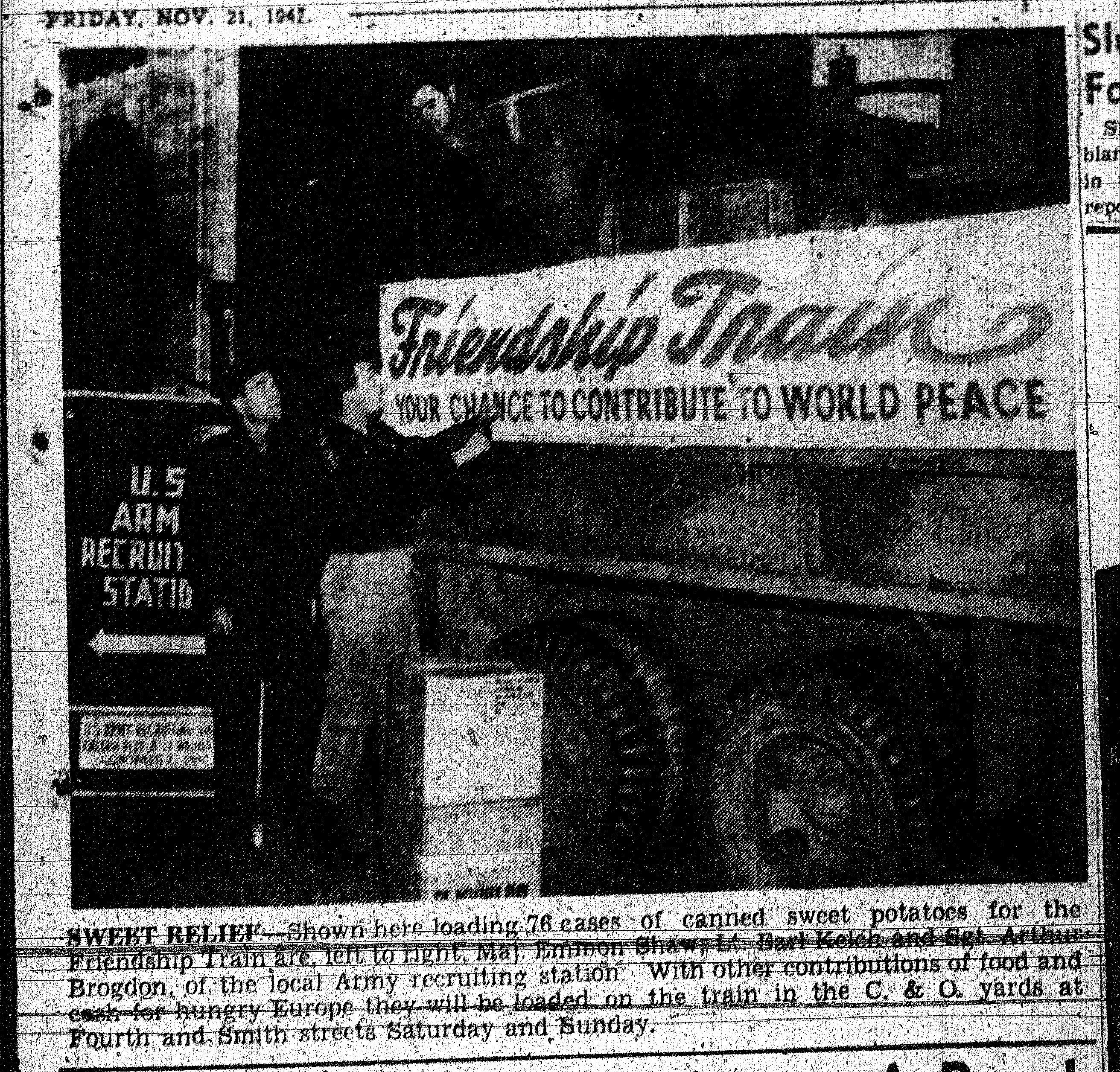
The Friendship Train and the "Silent Guest" Program were two ways Americans sought to build peace after World War II (Cincinnati Post reprint courtesy of the Cincinnati Public Library)

In Thanksgiving 1947 Americans were asked to take a “silent guest” into their homes, one of the hungry in Europe. The World War II devastated countries had been hit hard by drought and harsh winters causing food shortages. The silent guest plan was one way Americans came to the aid of the hungry and suffering.

On Thanksgiving Day Americans would figure what it would cost to feed a “silent guest” at their meal and then mail the donation to a committee in Plymouth, MA – the home of Thanksgiving.  Donations poured in and led to the purchase of many thousands of CARE packages of food going to the hungry in Europe.

This Thanksgiving we can answer the cries of the hungry whether it’s in the famine zone of East Africa, or in drought-ravaged Afghanistan, the Democratic Republic of the Congo  or Haiti. This holiday there may be those in your own city and state who are hungry.

You can take in a “silent guest” and make a donation to feed your guest at a number of charities.  Also included is a link to the online game Free Rice, where for every correct answer you get, 10 grains of rice are donated to the World Food Programme, paid for by advertisers, a modern way of taking in a “silent guest.”

1 Comment

Filed under Charity, global hunger

Cutting Food Aid Programs Dangerous to National Security

There is much debate in Congress on how much to cut military spending. But there is another vital area of our foreign policy at risk of budget cuts too: international food aid.

Fighting hunger is not often included in talks about national security. But it should be. Remember the famous World War II slogan, “Food will win the war and write the peace.” George Marshall said, “Hunger and insecurity are the worst enemies of peace.” Food formed the foundation of the famous Marshall Plan that spurred Europe’s recovery after the war.

While some members of Congress may think it prudent now to cut food aid programs to save a few dollars, think again. On the contrary, by investing now in nutrition and agriculture development, future humanitarian disasters can be averted, thereby reducing foreign assistance in the future. Nutrition for a generation of children means better educated societies, more stable societies and the chance for economic growth.

Investing in farmers allows them to build up the capacity to better resist drought. This is what can prevent famines from taking hold.

Reducing food aid will cost lives, increase the spread of disease, and weaken societies who are fighting poverty. Congress simply cannot cut food aid, in view of the famine striking East Africa, drought leveling Afghanistan, and malnutrition on the attack in Yemen. We have to remember that Haiti and other countries need food to remain on the road to recovery.

International food aid currently accounts for less than one tenth of one percent of the federal budget. So in essence, you are looking at an already relatively low-funded program that is being selected for potential cuts. You could actually increase the funding for these programs past current levels and put very little strain on the budget.

International food aid programs include the Food for Peace initiative started by President Dwight Eisenhower and the McGovern-Dole program which provides school meals. These programs got their start by members of the Greatest Generation who understood that food forms the basis of all reconstruction, peace and progress.

This is a lesson Congress should not forget as it forges the budget and how to spend on an essential aspect of our national security: fighting global hunger.

Learn more about the potential budget cuts at the World Food Program USA.

Article first published as Cutting Food Aid Programs Dangerous to National Security on Blogcritics.

Leave a comment

Filed under global hunger

Budget Debates in Congress Loom Over Yemen Crisis

Budget decisions made by the U.S. Congress in the coming weeks will have their effect on Yemen. Proposals for reducing international food aid would limit the U.S. ability to respond to the humanitarian crisis escalating in Yemen, already the poorest country in the Middle East.

Congress has proposed reducing funding for the U.S. Food for Peace plan, which in 2011 supported the UN World Food Programme’s (WFP) relief operation in Sana’a City and Northern Yemen. In addition, Food for Peace funded Save the Children’s voucher initiative, also in the North. This program showed promising results and if enough funding were available could be continued and expanded.

Currently, the UN World Food Programme and UNICEF are facing funding shortages for their relief programs in Yemen. The prospect of the U.S. decreasing its food aid budget is a forerunner of disaster for an already distressed humanitarian operation.

Before this year’s political unrest and violence unfolded, Yemen was already suffering a humanitarian crisis with high rates of child malnutrition. The year’s events have made this situation worse with prices of food and other basic goods on the increase. Food is becoming out of reach.

UNICEF recently reported “food security & nutrition indicators continue to be alarmingly low. Protein intake continues to decline, with increasing numbers of households reporting no consumption of meat (74.2%), fish (65.0%), chicken (34.2%), and eggs (43.3%).”

UNICEF, which surveys households in the Sana’a, Amran, and Hodeida governorates, highlights the alarming child malnutrition crisis. UNICEF says, “More households reported decreased number of meals among children <5yrs (33.6%) compared with the previous round (22.6%), with children in rural households being the most vulnerable to meal reduction (40.4%) compared with urban households (28.6%).”

The World Food Program USA is rallying support for increasing U.S. international food aid so there can be a stronger response for the crisis in Yemen and other countries.

WFP USA states, “Despite the fact that cuts to these critically important international programs cannot possibly make a meaningful contribution to reducing the debt or balancing the budget, unfortunately they are under threat this week as the Senate debates International Affairs accounts.”

A take action page has been set up to help citizens contact their representatives in Congress to oppose the budget cuts to international food aid.

Article first published as Budget Debates in Congress Loom over Yemen Crisis at Blogcritics.


Leave a comment

Filed under global hunger