Pakistan Tests Nuclear Missiles as Food Aid Low on Funds


By 2009, almost 50 percent of the Pakistani population, or 83 million people, were food insecure, up from 38 percent in 2003. In the aftermath of the flooding, it is believed that this figure may yet have risen to upwards of 90 million. (WFP/Amjad Jamal)

Pakistan is conducting nuclear missile tests and reportedly plans to increase its nuclear weapons arsenal. While it develops these armaments flood relief efforts for its own people remain low on funding.

The UN World Food Programme (WFP) is urgently seeking 15 million dollars as it tries to feed flood victims. It’s part of a larger relief operation to help the hungry in Pakistan who are suffering from conflict, natural disasters and poverty.

WFP Pakistan Country director Jean-Luc Siblot says, “We could scale up our response to reach up to 250,000 families – that’s 1.7 million people. But that would mean using food stocks earmarked for relief to the displaced population in the northwest of the country and these would have to be replenished by December – that means funding is needed now.” WFP depends on voluntary donations from governments and the public.

WFP reported earlier in the month that it had to cut its school feeding program in parts of Pakistan because of low funding. It also reported that the funding shortage would cause its food supply to run out in January. Pakistan made a contribution earlier this month to the WFP operation but clearly more can be done.

Pakistan’s spending on the arms race in South Asia could be used to help the poor and suffering within its own borders. Pakistan, as well as India and other states, have a responsibility to limit the proliferation of nuclear weapons and to fight hunger and poverty. India and Pakistan need more treaties and less arms testing. Neither country is a member of the Nuclear Non-Proliferation Treaty or the Comprehensive Nuclear Test Ban Treaty.

A report from the Nuclear Disarmament group Global Zero says, “Pakistan does not officially reveal the cost of its secret nuclear program. In 2009, a credible assessment by an investigative journalist with expertise in the subject provided information on which we can calculate the overall nuclear program budget (weapons and missile delivery systems) to be approximately $781 million – $300 million for the Pakistan Atomic Energy Commission and $481 million for the strategic missile delivery system. ”

Pakistan’s nuclear expenditures would easily pay for the cost of WFP’s 2013-2015 Protracted Relief and Recovery Operation, which is meant to feed some 7.3 million people in Pakistan at a cost of US $514 million dollars.

Leave a comment

Filed under global hunger

Food, Clothing, Tech, and Logistics All Crucial for Syrian Aid

Though many families have fled Homs, a few choose to return to their homes in the neighbourhood of Baba Amr despite the challenges. Of those who have fled from Homs to Aleppo,many were later forced to move along when the fighting intensified there as well (photo courtesy WFP/Abeer Etefa)

This week I have an article on the History News Network about why humanitarian aid is so critical for Syria. We have to look ahead too, with winter not too far around the corner.

If the conflict continues, humanitarian needs are only going to increase. When you add colder temperatures on top of this prospect, it is cause for great alarm. Winter clothing will be needed for refugees from the Syrian conflict, in addition to food and other basic items.

Here is some of the latest information from the UN World Food Programme (WFP) on its hunger relief efforts for Syrian war victims. In September WFP is feeding around 1.5 million people in 14 Syrian governorates affected by the conflict. WFP works through its partner the Syrian Arab Red Crescent.

WFP says, “The situation remains tense across the country with armed activities on-going in various governorates and on international roads causing WFP dispatches to be delayed and monitoring activities hindered especially in Idleb, Homs and Aleppo.”

WFP relies on voluntary donations from the international community. There have been generous donations already from the United States and other countries. But so much more is needed given the size of the emergency. That is why funding for the U.S. Food for Peace program, which is a major supporter of WFP, is so crucial.

WFP currently faces a $61 million shortage of funding in Syria. Another vital aspect of WFP’s work is in the area of communications and logistics. These measures help connect aid groups so they can better coordinate operations and transportation.

WFP reported last week, “Urgent funding is also needed to continue implementing activities under the Special Operation (SO) 200477, aimed at augmenting WFP’s capacity in logistics, communication and security amidst the increasingly challenging environment.”

In addition to relief activities inside Syria there is help needed for hundreds of thousands who have fled the country into neighboring Iraq, Lebanon, Jordan, and Turkey. WFP also needs additional funding for this operation.

Catholic Relief Services is also carrying on relief work to help the refugees, with their focus on Jordan and Lebanon. They are also urging people to contact Secretary of State Hillary Clinton to build support for helping the refugees and ending the conflict.

Article first published as Food, Clothing, Tech, and Logistics All Crucial for Syrian Aid on Blogcritics.

Leave a comment

Filed under global hunger

WFP to host Syrian hunger relief event on Google

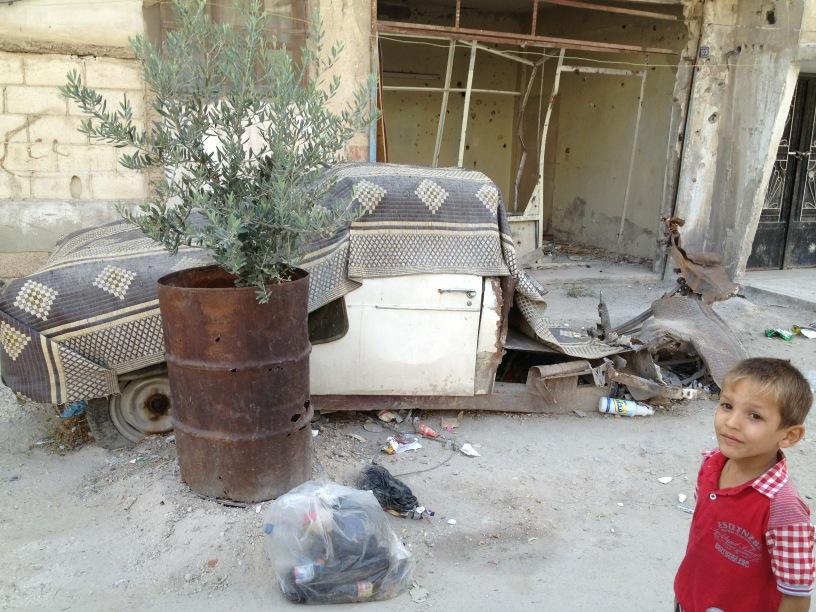
A family’s destroyed car surrounded by ruins in Baba Amr in Syria
Credits: WFP/Laure Chadraoui

The UN World Food Programme (WFP) and Google+ will be hosting an event at 12pm Eastern time on Thursday, September 20th where people can learn more about the growing humanitarian crisis in Syria. Using a Google + Hangout representatives from WFP will discuss how critical food aid is for refugees from the conflict in Syria.

WFP is trying to feed 1.5 million people in Syria this month as well as thousands who have fled to neighboring countries. Abeer Etefa, a WFP Middle East officer, will be in Damascus, Syria to discuss how the UN food agency is carrying out this complex and dangerous relief mission.

She will be joined by members of the media and will take questions. You can submit your questions on Google+ or Twitter using the hashtag #wfpsyria.

WFP says that event will be broadcast on their Google+ Page and on YouTube. Facing a funding shortage of 61 million dollars for its relief work, WFP hopes to rally global support for helping war victims in Syria and throughout the Middle East.

Leave a comment

Filed under global hunger

Hunger and Fear in the Sahel of Africa

A drought-ravaged field in the Keyes region of southwestern Mali. Already impoverished families lost their food supply and source of income because of the drought. Credits: WFP/ Daouda Guirou

There is a struggle for survival ongoing for millions of people suffering from hunger in the Sahel region of Africa. The UN World Food Programme (WFP) says that “one child in five in the Sahel dies before the age of five – malnutrition is an associated cause of more than 30% of these deaths.”

The Sahel includes the countries of Mali, Niger, Mauritania, Burkina Faso, Chad, Cameroon, the Gambia, and Senegal.

Drought and conflict have caused food shortages, and families can survive only with humanitarian aid as they await the next harvest. There have been some good rains recently to encourage the growing of food. These same rains have also produced flooding that has impacted over a million people in the Sahel.

Refugee Crisis from Mali Conflict

The Sahel food crisis is also complicated because of a massive flow of refugees from Mali. In Northern Mali there has been fighting between the government and armed extremist groups. As one victim told the director of the UN refugee agency (UNHCR), “Fear pushed me to leave my home. I saw people being killed in front of me when Gossi was taken over by armed groups at the end of June. I did not want to wait for my turn.”

The US State Department is alarmed by the increasing violence in Northern Mali and is urging a resolution to the conflict, stating, “We repeat the call on armed groups in northern Mali to renounce any connection with terrorist groups and enter into legitimate political negotiations on the basis of Mali’s territorial integrity.” There is significant fear of what may lie ahead should the chaos and hunger continue to proliferate in Mali and throughout the region.

The World Food Programme says it is feeding over 200,000 refugees in the surrounding countries. This includes Mauritania which is hosting over 100,000 refugees while struggling with its own hunger crisis.

The charity Save the Children is urging support for the refugees to prevent malnutrition in the camps. The children need food aid and also psychological and educational support to help them deal with the trauma.

Nutrition for Small Children Critical

Nutritional support for the smallest children is crucial in this crisis The lack of food for children under five years of age causes severe and irreversible physical and mental damage. Surveys being conducted right now by aid workers show high acute malnutrition rates in Senegal, Chad, Niger, and Mauritania.

Save the Children says that throughout the Sahel over one million children are at risk of severe malnutrition. A special food called Plumpy’Nut can save the children from the lifetime damage of malnutrition. Save the Children estimates that 1.5 million cartons of Plumpy’Nut are needed in the Sahel but funding is the issue. Aid agencies are voluntarily funded.

School Feeding to Help Communities

Providing food for children at school is a way to boost recovery for entire communities. The food offers an incentive for parents to send children back to school so it accomplishes both nutritional and educational objectives.

The World Food Programme hopes to resume school meals in the coming weeks in several Sahel nations. But will the funding and food supplies be there to allow these important programs to be carried out? In Mauritania, WFP is reporting a slight delay in its school feeding program due to food supply difficulties.

WFP is planning a major expansion of its school feeding in Mali. Aboubacar Guindo of WFP says the expansion will mean doubling the number of students it feeds in the Southern part of the country. He adds that the funding has yet to be secured.

Funding a Key Issue

Aid agencies need support from both governments and the public. What could be more devastating than not enough resources being dedicated to saving lives? WFP reports “a funding shortfall of US$ 300 million” for the region. Also a special operation for logistics in Mauritania remains completely underfunded, which could harm the delivery of aid.

WFP provides not only food but also logistical and technological support to improved aid delivery. The WFP Emergency Telecommunications cluster, for instance, has developed a radio system which will be implemented in Northern Mali to help improve coordination for the relief effort.

Recovery from one major drought is difficult enough. In the Sahel there have been a succession of droughts and the low resistance levels of the communities involved is a major reason for the crisis. Aid agencies are trying to find a way to provide emergency aid but also plant the seed for future food security.

Relief Funds for the Sahel Food Crisis:

Sahel Food Crisis Fund – World Food Programme

Mali Hunger Crisis Fund – Save the Children

West Africa/ Sahel Hunger Crisis Fund – Save the Children

Sahel Food Crisis Fund – Catholic Relief Services

Article first published as Hunger and Fear in the Sahel of Africa on Blogcritics

1 Comment

Filed under global hunger

Crusade Of Prayer for Peace

In September of 1961 the Archdiocese of Washington held a Crusade of Prayer for Peace. At this time the Cold War was well underway and the Soviet Union had recently tested a massive nuclear weapon. The United States would soon resume its nuclear test explosions as well. The Cuban Missile Crisis would follow in a year.

I found the prayer card in my late mother’s Saint Andrew Daily Missal.  She lived in the Washington, DC area at the time of the Prayer for Peace event. To read the prayer click on the card below.

Leave a comment

Filed under History, Uncategorized

Flooding, Conflict Victims Need Aid in Jonglei, South Sudan

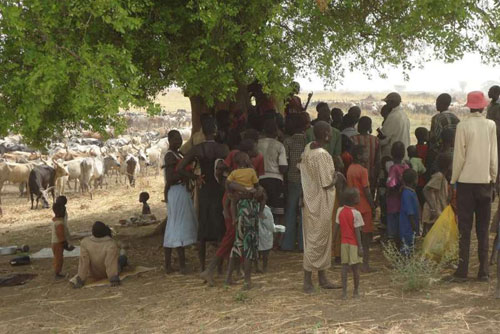
file photo of members of the Lou Nuer gather under the shade of a tree in Ethiopia after fleeing from South Sudan’s Jonglei state. (Credits: UNHCR/S.Tessema)

The United Nations reports that heavy rains and flooding have affected 125,000 people in Jonglei, the largest state in South Sudan. The flood victims are in desperate need of food, medicine and other aid but roads are impassable preventing the delivery of supplies. The UN says it will use a helicopter to access the hardest-to-reach areas.

Meanwhile, 4500 people have been displaced from Likuangole town after fighting between South Sudan’s army and a rebel group. Aid groups have yet to reach the victims according to the latest report from the UN.

In the past year Jonglei has suffered through natural disasters of flooding and drought in addition to conflict among rival tribes. Major fighting has take place between the Lou Neur and Murle tribes. The government launched a disarmament campaign earlier this year but the latest fighting shows this initiative is a long way from completion.

The recent disasters will escalate the hunger crisis in the already devastated country. The UN World Food Programme has estimated that at least 4.7 million could suffer from hunger in South Sudan this year.

Leave a comment

Filed under global hunger

In Search of Peace in South Sudan

Father Joseph Otto of Magwi, South Sudan holds mass every day, even if no one attends. If only all of South Sudan, or everywhere for that matter, could hear him when he reads “Blessed are the peacemakers” from the Gospel of Matthew in the Bible. For what South Sudan needs more than anything is apostles of peace.


Father Joseph Otto of St. Theresa Parish in Magwi, South Sudan (Photo by Karen Kasmauski for Catholic Relief Services) 

Conflict threatens South Sudan a year after it gained independence. There is fighting with its northern neighbor Sudan, which is causing a major humanitarian emergency with hundreds of thousands of refugees. The UN World Food Programme (WFP) is airlifting food to the displaced, including Plumpy’Sup to prevent the wasting of thousands of infants.

The longer the conflict goes on the greater the humanitarian nightmare. There needs to be a demilitarized border zone between South Sudan and Sudan and safe humanitarian access to reach all of the suffering.

There is also internal conflict. In Jonglei, the largest state in South Sudan, 24 soldiers were killed last month in attacks from an insurgent group.

The United Nations Mission in South Sudan (UNMISS) says it is “particularly concerned by the apparent emergence in Jonglei of an armed insurgency group linked to the militia leader David Yau Yau, which is believed to be acting in concert with groups of armed youths who have evaded the civilian disarmament operation in the state.”

Last year fighting between the Lou Nuer and Murle tribes escalated. People were killed or kidnapped, homes burned to the ground, and thousands displaced.


Displaced people in Pibor, Jonglei state (OCHA photo)This year the fledgling government began a major peace and disarmament initiative. Hilde F. Johnson, the Special Representative of the Secretary-General to South Sudan, says, “The widespread possession, and use, of illegal weapons by the communities and the proliferation of small arms constitutes a significant threat to peace and security in South Sudan, and is seriously exacerbating inter-communal violence in Jonglei…A pro-active reconciliation process and peaceful disarmament is the only way forward to maintain peace and security for the people of the area.”


Will disarmament of rival tribes occur throughout South Sudan? (United Nations photo)
The disarmament process has resulted in the release of some of the kidnapping victims. A mother who, along with her two-year old son, was rescued by the army during the disarmament campaign said, “I was thinking day and night about my village and parents…and almost lost hope of seeing (them).”

The tribal violence is not the only threat, though. Flooding has also struck Jonglei, causing more displacement and suffering for at least 68,000 people. The UN is continuing to assess this latest development as it tries to deliver humanitarian aid.

The road to peace in South Sudan has many twists, turns and rocks that have to be navigated. It starts by ending conflict among rival tribes, the theme of a series of peace conferences this year.

After one of these conference in Magwi County earlier this year, Sylvia Fletcher of UNMISS said, “The success of the new nation of South Sudan in large part will be determined by the capacity of peace between communities and the ability first for coexistence, [and] next for concerted development efforts that will engage all communities.”

It’s more than giving rival tribes a peaceful way to resolve differences; it’s also ending the hunger, poverty, and lack of education that cause desperation and chaos. A society cannot develop if its citizens are hungry and malnourished. In fact, malnutrition can stunt someone early in life to the point that they never recover.


Commitment to community fosters trust and peace in war-ravaged southern Sudan. Father Joseph Otto of St. Theresa Parish in Magwi greets a child after Mass. (Photo by Karen Kasmauski for CRS)

South Sudan needs national infant feeding and school lunch programs. The World Food Programme provided 355,000 schoolchildren with meals and take-home rations during July, a hopeful sign for South Sudan, particularly if this is the start of a self-sustaining national program.

A system of roads needs to be built connecting all corners of the country. These are the foundations of peace, development, and a sound economy. Small farmers must be allowed to grow their crops in peace.

Once the guns fall silent and disappear from South Sudan there is no telling how much the country could achieve. Other countries can continue to offer help, but ultimately the answer must come from the peacemakers within South Sudan.

See also An Independent Nation’s Parallel Path to Lasting Peace.

Leave a comment

Filed under Africa

McGovern-Dole Brings School Meals to Bangladesh

School meals programmes encourage parents to send girls to school and thus contribute to gender equality. (WFP/Shehzad Noorani)

A shipment of wheat from the United States Department of Agriculture (USDA) just arrived in Bangladesh and will help provide food for school children. The wheat, which is being unloaded at Chittagong Port on September 11th, will be used to produce high-energy biscuits.

The UN World Food Programme (WFP) will distribute the biscuits to 350,000 pre-primary and primary school children. WFP is working with the government of Bangladesh to provide school meals and eventually build a nationwide program.

The USDA donation of wheat is part of the McGovern-Dole International School Meals program, named after former senators George McGovern and Bob Dole.

Both senators McGovern and Dole have championed school feeding for children in the United States and overseas. The McGovern-Dole program is the leading source of funding for school feeding programs run by aid agencies like WFP. The US Congress decides how much funding to allocate to McGovern-Dole each year.

School feeding encourages parents to send their children to class and it provides an extra source of food which can help fight off malnutrition. Providing school meals abroad is a US tradition that goes back many years including the first two world wars.

Christa Räder, the WFP Representative in Bangladesh, says “This shipment will enable WFP to continue reaching children in the most poverty prone areas of Bangladesh. The strong support provided by USDA is helping children who would not otherwise be able to get an education with the opportunity to attend school regularly and to have the much needed micronutrient intake to grow up healthy.”

A WFP study revealed that the school feeding has a “substantial effect on reducing micronutrient deficiencies – which affect children’s ability to learn and fight diseases – through the provision of biscuits fortified with essential vitamins and minerals. ”

The US Ambassador to Bangladesh, Dan Mozena, said, “Our celebration today is about more than a mountain of donated wheat from America. We celebrate today partnership. Partnership between America and Bangladesh to nurture the children of Bangladesh, partnership to nurture the development of Bangladeshi children both physically and mentally, partnership to build the nation’s citizens of tomorrow.”

Mr. Md. Motahar Hossain, MP, Honourable State Minister said, “The programme is significantly contributing to improving enrolment and attendance and reducing drop outs. Thank you to the USDA for this assistance to the school feeding programme.”

Leave a comment

Filed under global hunger

What’s At Stake in Duck Regatta – The Tri-State’s Response To Hunger

The 18th annual Rubber Duck Regatta is this Sunday, September 2nd at 3pm. The ducks will be dropped from the Purple People Bridge into the Ohio River where they will begin a race along the Serpentine Wall. You can purchase a duck to compete in the race.

There is much at stake with this event, the largest single fundraiser for the Cincinnati Freestore Foodbank.

The Freestore provides emergency food aid for the hungry in the Tri-State. They depend on donations both from the public and the government. Hunger is a huge crisis in the area. A Feeding America study showed that in Hamilton County over 18 percent of the population suffers from hunger, or food insecurity.

This summer’s drought is having an impact on the cost of food, placing a further strain on the hungry and charities. However, the worst may be yet to come. The Department of Agriculture says the impact of food prices in stores “typically takes several months to occur, and most of the impact of the drought is expected to be realized in 2013.”

If food prices rise more people will fall deeper into hunger, having even less ability to put food on the table. Others who may be struggling to get by will also need food assistance. The Freestore will need all the support it can get to help those in need.

In addition, Congress is planning to scale back food stamps, which at a time of rising food prices and high unemployment is a recipe for disaster.

Fundraisers for the Freestore take on a great urgency when you consider the potential hunger crisis that is fast gathering.

The Freestore says, “For just $25 – the price of six ducks – the Freestore Foodbank can feed a family of four for an entire week.” You can help out the Freestore and buy a duck at their web site until 2 pm eastern time Sunday, September 2nd at www.freestorefoodbank.org


Leave a comment

Filed under Hunger in America

World Food Programme Urgently Seeks Donations for Afghanistan

WFP’s Food for Training Program in Afghanistan provides rations for street children at Aschiana Foundation Centers. Funding is needed by WFP and Aschiana to ensure these programs can be maintained and expanded to reach impoverished children. (photo courtesy WFP/Assadullah Azhari)

The UN World Food Programme (WFP) says it’s seeking “urgent contributions” for its food assistance programs in Afghanistan. WFP has only received 69 million of the 365 million dollars needed for the 2012 country program. The UN food agency relies entirely on voluntary donations.

To fight hunger and build food security in Afghanistan, WFP organizes Food for Work to improve agriculture, nutrition assistance for mothers and infants, and a school feeding program to help educate children. These initiatives are essential as nearly one third of the country is suffering from hunger and millions of others are on the brink.

During July, WFP provided school feeding to one million Afghan children and sponsored Food for Work projects focusing on watershed management, cleaning of irrigation systems and feeder roads rehabilitation. WFP fed over 150,000 people in the Mother & Child Health and Nutrition and TB programmes.

WFP’s ability to continue providing this food is in doubt as the agency “needs additional resources to avoid food pipeline breaks in wheat and High Energy Biscuits beginning in October 2012.”

Food prices remain high in Afghanistan and continued insecurity makes distribution of food a dangerous challenge. WFP is currently doing a Food Security and Livelihood Assessment to help plan its strategy going forward in Afghanistan.

Suggested by the author:

Leave a comment

Filed under global hunger