
Category Archives: global hunger

Families in Mali Running Out of Food

An archive picture of a little girl receiving food assistance at one of the WFP projects around the city of Timbuktu in northern Mali. (WFP/Shannon Hayes)

Families in Mali are running out of food with some reportedly eating meals “only made of cooked leaves” according to the UN World Food Programme. Mali, located in West Africa’s Sahel region, is one of the countries caught in a severe food crisis.

The World Food Programme (WFP) says there are 4.6 million people at risk of hunger in Mali. Drought has struck the country but so too has internal strife with a military coup earlier this year followed by increased rebellion in the Northern part of the country.

Secretary of State Hillary Clinton says, “Mali was, by most indicators, on the right path until a cadre of soldiers seized power a little more than a month before national elections were scheduled to be held. By some estimates, this could set back Mali’s economic progress by nearly a decade. It certainly created a vacuum in the North in which rebellion and extremism have spread, threatening not only people’s lives and the treasures of the past, but the stability of the region.”

The conflict has displaced 174,000 people within Mali and they need humanitarian aid. Even more Malians have been displaced to neighboring countries including Burkina Faso and Mauritania.

UNHCR High Commissioner António Guterres says, “We have now 257,000 refugees from Mali who are going through an enormous level of suffering and deprivation. They had to cross the borders of very poor countries that have very dramatic food security problems: Niger, Mauritania and Burkina Faso.”

WFP says it needs 55 million dollars to fund its relief work for those displaced inside Mali and the surrounding countries.

Within Mali, WFP has reached over 100,000 children with nutritional help including the food Plumpy’Sup. This peanut paste keeps small children from suffering devastating physical and mental damage from malnutrition.

Katie Seaborne of Save the Children says the charity is providing nutritional support in Mali, Niger and Burkina Faso. In Burkina Faso, where child malnutrition rates have increased this year, Save the Children is using both Plumpy’Sup and Plumpy’Nut, the latter generally used to treat the most severe cases of malnutrition.

Throughout the entire Sahel region of Africa, WFP is reporting a shortage of $320 million dollars in funding to provide food aid.

Where you can donate to hunger relief in the Sahel:

Sahel Food Crisis Fund- World Food Programme

Mali Hunger Crisis Fund- Save the Children
West Africa/ Sahel Hunger Crisis Fund- Save the Children

Sahel Food Crisis Fund- Catholic Relief Services

1 Comment

Filed under global hunger

South Sudan: Life-Saving Air Drops Bring Food to Starving Refugees

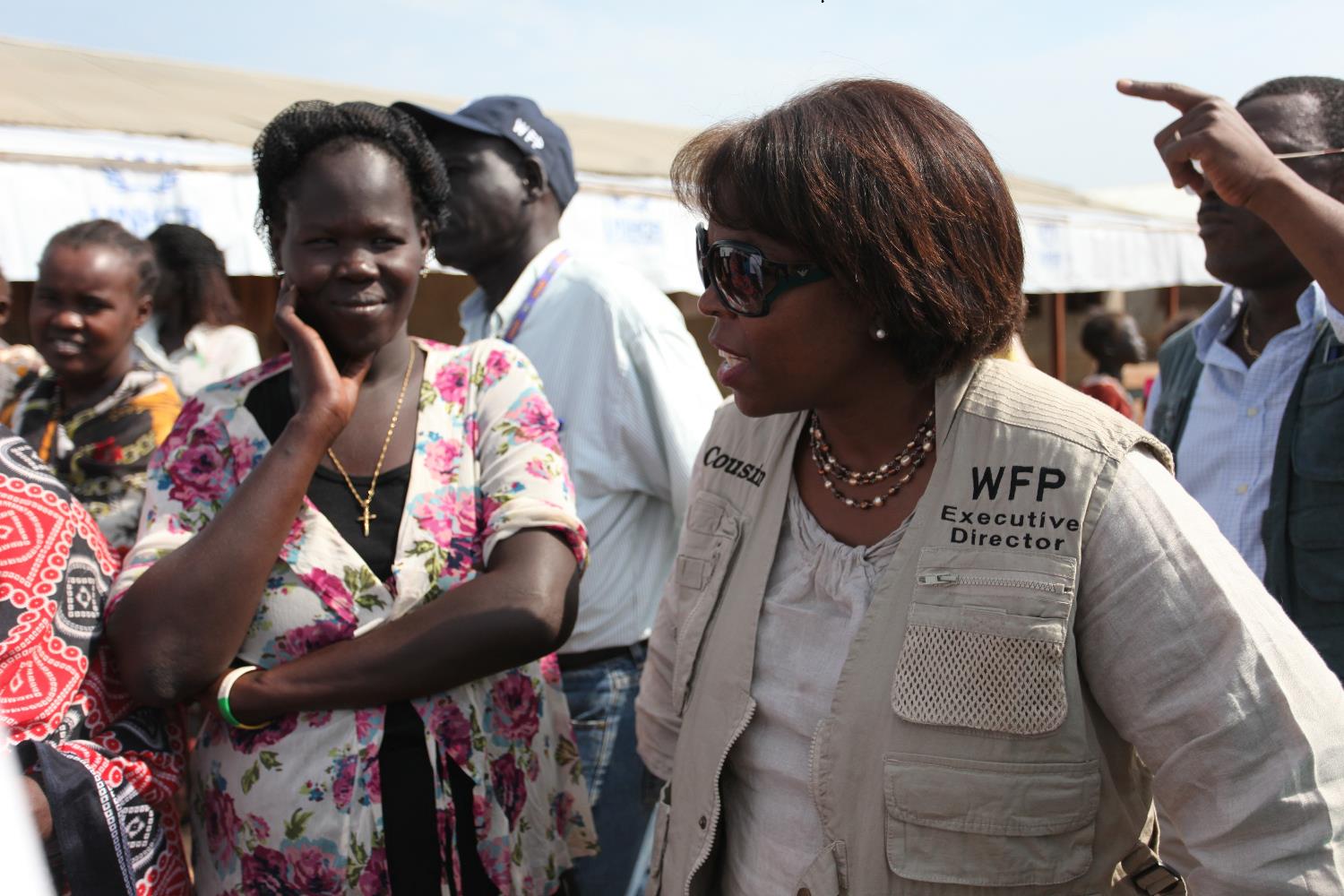
Executive Director Ertharin Cousin says WFP has started urgently needed food to refugees in South Sudan (World Food Programme photo)

The United Nations World Food Programme (WFP) has started life-saving air drops of food for refugees in South Sudan. Ertharin Cousin, the WFP director, said the air drops began today in Maban County of South Sudan‘s Upper Nile State.

Enough food was supplied to feed over 2,000 refugees for a month. More supplies are on the way. Cousin said today, “This is the first in a series of airdrops that aims to replenish rapidly diminishing food stocks for more than 100,000 people who have fled the fighting north of the border.”

Fighting in Blue Nile State and South Kordofan of Sudan has forced civilians to flee into South Sudan. The refugees are severely malnourished going for days without supplies after being driven from their homes by the violence. These are victims of the ongoing conflict between South Sudan and Sudan as both sides cannot win the peace despite numerous diplomatic efforts.

The air drops of food became necessary because of poor roads in South Sudan and the dramatic increase in the numbers of refugees. WFP is trying to feed millions of people throughout South Sudan, Sudan and Darfur. Drought and poverty alone are incredible challenges for civilians to overcome. The conflict between South Sudan and Sudan has further increased the numbers of hungry and malnourished.

Once Sudan and South Sudan end the conflict there is hope of rebuilding an area that holds much promise in the way of agriculture. Cousin adds, “We are working together in the quest not only to achieve a food secure nation, but also to help realise their agricultural potential to become the breadbasket of Africa.”

Leave a comment

Filed under global hunger

The Power of Film and Ending Child Hunger

This Sunday was the Global Hunger Summit in London hosted by British Prime Minister David Cameron. With the eyes of the world focused on the London Olympics, the idea was to shift some of that attention toward the global hunger crisis afflicting nearly one billion people.

Adrian Lovett, Europe Executive Director of ONE, says: “The Prime Minister and the Vice-President of Brazil deserve real credit for seizing this moment to insist on the same ambition in the race to end extreme hunger and malnutrition. For too long, this scourge has failed to receive the global attention it deserves. Efforts to provide children the nutrients they need to grow and thrive have been under-funded and under-resourced.”

But now that the summit is over, the action must begin with child feeding for infants and meals for school-age children.

First priority is to secure life-saving food for children under five years of age. At that age the children are most vulnerable to physical and mental damage from malnutrition. Then for children over five you start providing feeding programs at school to help them grow physically and mentally.

If every nation has a comprehensive school lunch program we could drastically reduce child hunger and poverty while giving every child a chance to learn or even become an Olympian. Interestingly, the last time the Olympics were held in London was in 1948 when Europe was struggling to recover from World War II. School meals played a big role in helping rebuild from the destruction

Back in 2008, I wrote a short film called “Ending Child Hunger: School Lunches for Kids Around the World.” The film premiered at the College of Mount St. Joseph in February of that year. Now today, the film has been updated with more material about why school lunches are so important. World leaders need to align their foreign policy in support of child feeding.

So sit back and enjoy the film. You will hear from lots of people including Dwight Eisenhower, Herbert Hoover as well as correspondents from the World Food Programme discussing school meals in developing countries. You will hear from those who benefit from the feeding programs the most: children and their families.

Ending Child Hunger: School Lunches for Kids Around the World from William Lambers on Vimeo.

Ending Child Hunger: School Lunches for Kids Around the World from William Lambers on Vimeo.

Article first published as The Power of Film and Ending Child Hunger on Blogcritics.

Leave a comment

Filed under global hunger, History

Special Food Can Save Malnourished Children in Yemen

If enough packets of supplementary plumpy are brought to Yemen it can allievate much of the child malnutrition ongoing there. The plumpy is easy to store since it requires no refrigeration and packets are ready to eat. (photo courtesy of Plumpyfield)

UNICEF Yemen is reporting stunting rates among children at 71.4 percent in the Rayma governorate of central Yemen. Children who are stunted by lack of nutrition fail to reach expected height and weight for their age.

Another UNICEF survey revealed global acute malnutrition rates among children in the Lahj governorate of southern Yemen at 23 percent. Children who suffer this malnutrition have lasting physical and mental damage unless they are treated.

Child malnutrition is severe throughout Yemen. UNICEF says, “967,000 children suffer from acute malnutrition. In certain areas of the country, the acute malnutrition rate exceeds 30 per cent, twice the emergency threshold.” Until this crisis is alleviated Yemen will not be able to gain stability for its future. The question is, what action can be taken?

A full supply of supplementary plumpy (plumpy’sup) food for all needy children in Yemen would provide the nation with a break from the malnutrition storm. Supplementary plumpy, and plumpy’doz, are peanut pastes designed to keep children from falling into the most severe levels of malnutrition. When children reach the most desperate stage of malnutrition they are generally fed life-saving plumpy’nut. Yemen needs a supply of plumpy’nut too to treat the most severe malnutrition cases.

But if the rest of the child population at risk of malnutrition can be reached with supplementary plumpy you can prevent this last resort.

Dr. Wisam Al-timimi of UNICEF Yemen says, “Supplementary plumpy is the 1st stage to treat the moderate cases of acute malnutrition (MAM).” UNICEF is teaming with the UN World Food Programme to increase coverage of supplementary plumpy and plumpy’doz for children under two years of age.

Navyn Salem of Edesia, which produces Plumpy’Nut and Plumpy’Sup, says it’s a “good strategy” to treat children ahead of time with Plumpy’Sup to prevent their dangerous descent into severe malnutrition. Salem says it “costs less and it is of course better for the children to be reached sooner than later.”

Funding, though, will be an obstacle, as donations are needed so UNICEF, WFP, and other aid agencies can get the necessary supplies. These agencies rely completely on voluntary donations which are often hard to get even though food aid is relatively inexpensive.

Both WFP and UNICEF are limited in plumpy supply due to funding constraints. As of last month UNICEF Yemen only had 30 percent of the funding it needed for a $24 million program to fight child malnutrition. With extra funding they would increase the defenses against child malnutrition.

Support from governments and the public would go a long way toward stabilizing the country and preventing a generation of children from being damaged from malnutrition in the first thousand days of life.

UNICEF Yemen has a relief fund that the public can use to contribute funds to the relief effort. The UNICEF programs needs more support. Susannah Masur of UNICEF USA says “it’s been very difficult to raise money for the nutrition crisis in Yemen.”

The public can also contact the UN World Food Programme and ask about direct donation to their operation in Yemen. Governments can work with UNICEF and WFP and provide donations to make sure they have the resources on the ground to help all the children in Yemen.

Article first published as Special Food Can Save Malnourished Children in Yemen on Blogcritics.

Leave a comment

Filed under global hunger

The Final Olympic Event: The Global Hunger Summit

Two-time Olympic silver medalist Paul Tergat says “As sports men and women, it is important for all of us to use our privileged positions to raise awareness about the challenges that some of the less fortunate among us have to face.” (photo courtesy of the World Food Programme)

This Sunday British Prime Minister David Cameron is hosting a summit on the global hunger crisis. This meeting, coming at the close of the London Olympics, hopes to draw the media spotlight toward the nearly one billion people worldwide who suffer from hunger and malnutrition.

For humanity, the most important Olympic event is this hunger summit. Ertharin Cousin, the director of the UN World Food Programme (WFP), says, “The Global Hunger Event comes at a time when the eyes of the world are focused on the pinnacle of human physical achievement at the London Olympics. For far too many children, a lack of food and nutrition means that, sadly, they will never have a chance to compete in life.”

Right now hunger is striking conflict-ravaged South Sudan and Sudan, Afghanistan, Yemen, and Haiti. In the Sahel region of Africa humanitarian aid is needed to prevent famine after a severe drought. Over in East Africa there is still tremendous hunger one year after drought struck the region leading to famine in Somalia.

Drought in the U.S. this summer may cause higher food prices for an extended period of time, making the global hunger fight that much harder to carry out. Aid agencies like WFP depend on voluntary donations from the government and the public to fight hunger.

But will governments be able to provide funds during tough economic times and needs at home? It’s important to remember that food aid is a relatively inexpensive foreign policy expense when you compare it to programs like nuclear weapons spending. Targeting food aid for budget cuts is barking up the wrong tree.

The last time London hosted the Olympics was in 1948, the same year the Marshall Plan started to rebuild Europe after World War II. Following the conflict, the world was on the brink of the most massive famine in history. Former U.S. president Herbert Hoover was appointed as food ambassador in 1946 to coordinate a global response to save millions of lives. UNICEF was created during this time period to meet the needs of children who suffered more than anyone from the war. In 1947 Austria, Italy, and France received pre-Marshall Plan aid so they could have enough food for the winter before the recovery program started.

The food aid provided to Europe offered the foundation for reconstruction. As former Army Chief and Secretary of State George Marshall said, ” Food is the very basis of all reconstruction. Hunger and insecurity are the worst enemies of peace.”

This Sunday in London the starving peoples of the world are hoping the Olympic spirit can come to their aid via the hunger summit.

Article first published as The Final Olympic Event: The Global Hunger Summit on Blogcritics.

Leave a comment

Filed under global hunger, History

Fight Global Hunger While Preparing for the SAT with Freerice

FreeRice has two goals: Provide education to everyone for free. Help end world hunger by providing rice to hungry people for free.

Believe it or not, school will be starting again very soon. This means for high school students it’s time to prepare for the SAT to help with their college applications. The next SAT test is scheduled for October 6, 2012. Others are to follow November 3 and December 1. It’s never too early to start doing some preparation.

During these coming months food prices globally will likely rise because of this summer’s drought. How does this global crisis connect to SAT test preparation? Actually it can, because if you use Freerice.com to prepare for the SAT you can help donate rice to the UN World Food Programme (WFP), the largest food aid organization.

Freerice is an online learning game where for every correct answer 10 grains of rice are donated to WFP, paid for by advertisers. The site has recently added an SAT preparation section in partnership with Kaplan. There are currently 500 questions in the Freerice SAT prep section.

Rene McGuffin, WFP senior spokesperson, says: “By playing the SAT subject on Freerice, students not only make a big impact on their test scores. They now also make a big impact on hunger. They build a brighter future for themselves while brightening the future for students like them around the world.”

Freerice also has vocabulary, chemistry, foreign languages, math, and other subjects available to play. You can also create teams. Your school, for instance, could create an SAT preparation team and keep track of how many grains of rice you have earned.

Worldwide there are nearly one billion people who suffer from hunger. This number could very well increase with a rise in food prices and continued conflict in countries like Sudan and Somalia. Playing Freerice is one way you can support the UN World Food Programme’s hunger relief efforts.

Freerice donations have supported hunger relief in Haiti and Cambodia, including school meal programs. It is school feeding that gives children in developing countries an opportunity to learn and build their future, much as students will be doing this fall by taking the SAT.

“Kaplan’s SAT questions help Freerice players to build their vocabulary, and playing Freerice helps the world’s most vulnerable populations reach their full potential,” said Nancy Roman, WFP Director of Communications, Public Policy and Private Partnerships.

Article first published as Fight Global Hunger While Preparing for the SAT with Freerice on Blogcritics.

Leave a comment

Filed under global hunger

Drought Pushes Food to Top of Agenda for Obama and Romney

As the presidential election season has arrived so too has the worst drought to strike the United States in decades. This year more than half of all counties have been declared disaster areas according to the U.S. Dept. of Agriculture. About 65 percent of U.S. farms are in the pathway of the drought which escalated significantly during July. (US Dept. of Agriculture)
Credit: US Dept. of Agriculture
Copyright: US Dept. of Agriculture

As the presidential election season has arrived so too has the worst drought to strike the United States in decades. This year more than half of all counties have been declared disaster areas according to the U.S. Dept. of Agriculture. About 65 percent of U.S. farms are in the pathway of the drought which escalated significantly during July.

As President Barack Obama and challenger Mitt Romney travel the country they will never be far from the drought’s impact. Farmers are feeling the strain of increased production costs to try and save as much of their crop as possible. Everyone will feel the drought’s impact with the expected increases in food prices. The full effect of the drought will be felt long after the summer has ended.

In a report on food prices USDA says, “We will likely see impacts within two months for beef, pork, poultry and dairy (especially fluid milk). The full effects of the increase in corn prices for packaged and processed foods (cereal, corn flour, etc.) will likely take 10-12 months to move through to retail food prices.”

Feeding America, the nation’s largest food aid organization, says 49 million people suffer from hunger. Increases in food prices will put further strain on families trying to put food on the table. Families on the border of food insecurity may soon fall in with the effect of food prices. High prices will also make it harder for emergency food banks to have food supplies on hand to help them. Safety nets for those in poverty will be essential to weather the latest storm of hunger.

But an increase in food prices will also harm of the most essential aspects of American foreign policy: fighting global hunger. The U.S. budget towards fighting global hunger is already facing cutbacks. If food prices are high globally, then these dollars will have reduced buying power to aid the world’s hungry. The budget for hunger fighting programs, which is less than one tenth of one percent of the federal budget, would need to be increased.

U.S. hunger fighting programs like Food for Peace are needed to stabilize crisis areas in Sudan, Afghanistan, East Africa, Yemen the Sahel region and Haiti. If food supplies are reduced then dangerous malnutrition could threaten lives in these areas, particularly small children who suffer lasting physical and mental damage without enough food. Without food there is no hope for peace and development in any of these areas.

The World Food Program USA and other aid groups are calling on the President and the Congress to appoint a global food security coordinator. The coordinator, or full time food ambassador, would be a top-level position at the National Security Council who would coordinate the entire government’s response to hunger.

Both Obama and Romney need to have fighting hunger at home and abroad a key theme in their vision for America. For hunger is fast gaining strength in a time of devastating drought.

Leave a comment

Filed under global hunger

WFP Facing Critical Funding Shortage for Syrian Relief

Even before the violence broke out in Syria, a food security survey found that 1.4 million people were struggling to meet their daily food needs. Many lived in areas currently affected by conflict. (WFP/ Salah Malkawi)

The UN World Food Programme (WFP) says its facing a “critical funding shortfall” of US $62 million dollars as it tries to feed victims of the conflict in Syria. The UN food agency depends entirely on voluntary donations from governments and the public.

WFP just sent aid to Aleppo, the largest city in Syria, after reports of food shortages following an increase in fighting between the Syrian government and rebels. A WFP press release says, “The humanitarian situation is deteriorating in Aleppo and food needs are growing rapidly, with heavy fighting entering its second week – forcing about 200,000 people to flee the city. ”

Working with the Syrian Red Crescent, WFP provided food aid to over 500,000 war victims during July. However, the violence in the country prevented WFP from reaching its target goal of 850,000 Syrians. A recent report also reveals that three million Syrians will need help during the coming months.

The fighting has taken its toll on the livelihoods of families, many of which were already at poverty level. Abdulla BinYehia of the UN Food and Agriculture Organization (FAO) says, “The most vulnerable families in Syria depend entirely or partly on agriculture and farm animals for food and income. They need emergency support, like seeds, repairs to irrigation systems, animal feed and healthcare.”

BinYehia warns, “If timely assistance is not provided, the livelihood system of these vulnerable people could simply collapse in a few months’ time. Winter is fast approaching and urgent action is needed before then.”

The White House released a statement this week highlighting a 12 million dollar donation of additional humanitarian aid to Syria. This donation will be distributed among various aid agencies working inside Syria including WFP. So far this fiscal year the US has donated 27 million dollars to the WFP relief operation in Syria. Many more donations are needed as there is no end in sight for the conflict.

As the White House stated, “The quickest way to end the bloodshed and suffering of the Syrian people is for Bashar al-Asad to recognize that the Syrian people will not allow him to continue in power, and to step aside to enable a peaceful political transition to a government that is responsive to the aspirations of the Syrian people.”

WFP is also feeding a growing number of refugees who have fled to neighboring countries. There is expected to be well over 100,000 Syrian refugees in Iraq, Turkey, Lebanon and Jordan by the end of this year.

Suggested by the author:

Leave a comment

Filed under global hunger

Donations Needed for Life-saving Air Drops of Food into South Sudan

WFP provides food assistance to refugees who arrive in Maban County in South Sudan’s Upper Nile State, Donations are needed to airlift more food to the starving refugees. (WFP/George Fominyen)

The UN World Food Programme (WFP) is appealing for 6.5 million dollars so it can provide life-saving airlifts of food to starving refugees in South Sudan. WFP relies entirely on voluntary donations from governments and the public.

WFP wants to air drop 2,000 metric tons of food into Maban County to make sure civilians fleeing fighting in Sudan’s Blue Nile State have enough food to survive. These refugees have fled to the Upper Nile State in South Sudan to escape the violence and find aid.

Chris Nikoi, the WFP director in South Sudan, says “WFP is pulling out all the stops to keep providing desperately needed food to refugees in Upper Nile State. People in camps have told me how they arrived weak and hungry after weeks of trekking and foraging in the forest before crossing the border. Our food assistance has been a lifeline to more than 100,000 refugees in Maban County, but continuing that lifesaving support will require some extraordinary measures given the size of the refugee influx into an area with limited infrastructure.”

WFP also plans to air drop 3,000 metric tons of food to the Yida refugee camps in Upper Nile State. The number of refugees there is fast increasing. Malnutrition rates, particularly among children, are alarming according to WFP and other aid groups.

If children do not receive enough nutritional support they will suffer lasting physical and mental damage.

The air lifts of food become necessary because of the poor roads in South Sudan, many of which become impassable when rain hits. Food that was pre-positioned in crisis areas by WFP was not enough because of the fast increasing numbers of refugees.

Challiss McDonough of WFP says “we do hope that the donors will recognize the importance and urgency of this situation.” WFP needs funds to provide the airlifts and also to maintain a steady flow of food supplies. The longer the conflict continues between South Sudan and Sudan the more food aid will be needed to save lives.

Leave a comment

Filed under global hunger

Backpacks Fight Hunger in America

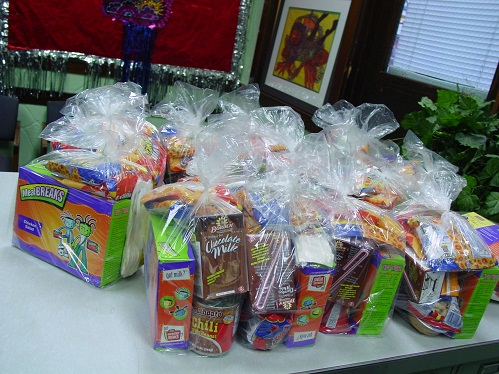
Food supplies for a Power Pack (Freestore Foodbank photo)

The Cincinnati Public Library says a plan to give children backpacks of food for weekends is off to an excellent start. Library branches, in partnership with the Cincinnati Freestore Foodbank, are hosting summer feeding sites to make sure no child goes hungry.

Over 25 percent of children in Ohio are considered hungry or “food insecure,” according to a study by Feeding America. Last month the Library decided to provide backpacks of food which children could take home on Fridays. This food is in addition to regular weekday meals at library branches throughout Cincinnati.

Diane Smiley, the youth services coordinator for the Library, says “Based on the numbers and anecdotal feedback from some of the sites, Friday attendance has spiked and all the backpacks are being distributed. We’re glad this additional resource is available to kids who are clearly in need.”

Karrie Denniston of Feeding America, the nation’s largest organization fighting hunger, says that adding backpack programs to summer feeding is generally a success: “It is becoming frequent actually. A lot of our summer programs run both.”

Backpacks ensure that needy children can have meals all week, and cut down the gaps in coverage that are so common when summer arrives. During the school year children have access to free and reduced-price meals through the federal school lunch and breakfast program. They also have access to backpack programs through their school. During the school year the Freestore Foodbank of Cincinnati runs a backpack program called the “Power Pack.” When summer comes and school is out, a replacement is needed.

The Freestore is planning expansion of its school year “Power Pack” program as well. The Cincinnati Public Library is also seeking to expand its role in alleviating child hunger and promoting education. Smiley says that “we’re looking at developing a community partnership that would provide free and healthy afterschool snacks to kids at our Homework Help sites.”

Article first published as Backpacks Fight Hunger in America on Blogcritics.

Leave a comment

Filed under global hunger