Monthly Archives: October 2011

Food for Afghan Schoolchildren Runs Out as Drought Strikes

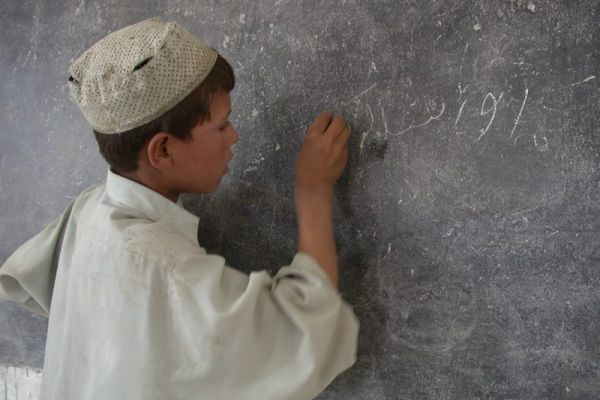
How can we expect to write the peace without basic food and education for Afghan children? Low funding for WFP has forced the reduction of school feeding programs in Afghanistan. (WFP/Ebadullah Ebadi)

As drought and high food prices have descended upon Afghanistan, safety nets have been taken away from children. Low funding for the UN World Food Programme (WFP) means 1.5 million Afghan children are no longer receiving a school feeding ration.

The situation is getting worse. WFP reports that the supply of fortified high energy biscuits for Afghan school children will run out by November. This will bring a halt to school feeding in Afghanistan and leave another 500,000 children without a school meal. A donation from India is expected to arrive in December, but this will allow for only a limited resumption of the program.

WFP depends entirely on voluntary donations by the international community. Since funding has run dry, all year they have been forced to reduce their school feeding and other food aid programs in Afghanistan.

While they have done this, drought conditions have set in around parts of the country causing food shortages. High food prices remain a threat to the entire impoverished Afghan population.

While hunger escalates in Afghanistan and around the world, the U.S. Congress is proposing reducing funding for the Food for Peace and other global hunger fighting programs.

Food is desperately needed right now in Afghanistan. The international community needs to support urgent food aid for the drought-affected areas. School feeding should be resumed at once and expanded where possible.

Afghanistan’s future cannot be built upon hunger, suffering, and a lack of education. Child feeding programs take on the utmost urgency as malnutrition and lack of education threaten an entire generation of Afghans.

Article first published as Food for Afghan Schoolchildren Runs Out as Drought Strikes on Blogcritics.

Leave a comment

Filed under global hunger

Japan’s Generosity-6 months after the earthquake

Japan has long been a major donor to the UN World Food Programme. Here is a photo of 2009 meeting announcing a donation to WFP operations in Tajikistan (WFP/Zia Ziauddin)

While Japan has faced enormous challenges since the earthquake struck one thing has not changed-their generosity. Japan continues to be a leader in fighting global hunger as evidenced by a recent donation to the UN World Food Programme. Around 400,000 impoverished families in Bangladesh will benefit from a September donation of 10 million dollars.

H.E. Mr. Tamotsu Shintosuka, Ambassador to Bangladesh says, “We hope the assistance will help poor people of Bangladesh who are the victims of natural disasters and climate change. We are pleased to assist WFP with this donation to help the poorest, most vulnerable and undernourished people of the country.”

Japan continues to reach out to help others countries just as they are rebuilding on the homefront. The charity Save the Children is in Japan providing relief supplies and helping kids deal with the trauma of the last 6 months. One mother remarked to Save the Children staff, “You have made my child smile again.”

Read an article in the Korea Times about Japan’s recovery and Save the Children’s work there.

Listen below to an audio message from Save the Children’s president Carolyn Miles.

Save the Children Reports from Japan- 6 Months after the Earthquake

Leave a comment

Filed under world hunger

Over 1 Million in Yemen Denied Emergency Food Rations

Aisha is an internally displaced Yemeni girl in Southern Yemen living in an elementary school. She is one of many Yemeni children who are suffering from hunger and displacement. WFP and other aid agencies need support in order to carry out child feeding and rehabilitation programs. (WFP/Abeer Etefa)

Over one million Yemenis did not receive emergency food rations in September because of low funding for the UN World Food Programme (WFP). The UN food agency depends on voluntary donations from the international community.

As food prices have risen dramatically in 2011, impoverished families have been pushed deeper into hunger. Reports have shown families resorting to skipping meals.

In late 2010 WFP drew up a plan to distribute emergency food rations to around 1.8 million Yemenis who were struggling to afford basics like bread. The idea was a safety net for vulnerable families to prevent malnutrition and disease from gaining strength.

Back in February, I wrote a letter in the New York Times urging acceptance and funding of the plan by the U.S. and international community. As 2011 evolved into a year of protests, instability, and skyrocketing prices, this food aid took on even more urgency.

However, funding has been so limited that seven food-insecure governorates (around 700,000 people) were not able to receive any distributions this year. The cuts deepened as 500,000 more Yemenis were left off the most recent round of food distributions in September.

About 1.2 million Yemenis who should have been receiving food rations from WFP last month did not. But this has been the reality of food assistance programs for Yemen. They have been underfunded as the hunger crisis continues to deepen.

In addition, WFP’s Food for Education program for children has only had two distributions in the last two years. Both of them have been limited and able to reach only part of the intended recipients.

This initiative gives children food rations to take home from school. It’s a great plan for eliminating hunger and keeping kids in class. However, this year’s WFP Food for Education distribution reached only 59,000 of 115,000 planned beneficiaries. The ration size also shrank from two items to one. A program that should be expanded to reach hundreds of thousands of additional children has been getting by on relative scraps for years now.

UNICEF also is suffering from severe funding shortages as they try to help Yemen tackle the crushing child malnutrition crisis. I have reported on these funding shortages on numerous occasions as children lacking in nutrition are at risk of lasting physical and mental damage. It’s clear that no favorable outcome for Yemen will come about unless child nutrition is made a priority.

Anthony Lake, UNICEF’s director, said this week, “Malnutrition rates were alarmingly high in the country even before the current violence broke out, and its impact on the poorest people has only been compounded by rising food prices and collapsing basic health services. Of 3.6 million children under five years of age in Yemen, at least 43 per cent are underweight and 58 per cent are stunted.”

Imagine if a generation of Yemenis were not malnourished. They could solve many of their societal and governmental problems on their own.

What if we gave them that chance? We could do that almost right away with a full supply of plumpy’nut to knock out all existing cases of child malnutrition. A food for education system would do wonders because school feeding promotes nutrition and learning.

If we take action on these fronts, Yemen has a chance for a prosperous and peaceful future. The alternative is to continue to ignore the cries of hunger, and children stunted in growth and mind. That road, we know, is full of peril for all.

Article first published as Over 1 Million in Yemen Denied Emergency Food Rations on Blogcritics.

Leave a comment

Filed under global hunger

Food for Peace, Brazil and the World Food Prize

One of this year’s World Food Prize winners is H.E. Luiz Inácio Lula da Silva, the former President of Brazil. His work fighting hunger included developing the national school feeding  program. An excerpt from the World Food Prize web site reads:

“The national School Feeding Program has had a far-reaching impact on reducing child malnutrition by providing nutritious meals to children in all grades of Brazil’s public schools across the country. Forty-seven million were being served in 2010, with a minimum of 30 percent of the food supplied from local farms. Child malnutrition fell 61.9 percent between 2003 and 2009, and all age groups experienced improved access to quality food.”

Brazil has come a a long way in its fight against hunger and developing its school feeding. Back in the 1960s Brazil got help from the U.S. Food for Peace program. Here is a photo of a milk shipment leaving for Brazil. George McGovern, a World Food Prize winner himself, is to the far right.

1962 Photo of the largest milk donation under the “Food for Peace” program leaving from Brooklyn, NY heading toward Brazil. Left to right is the Brazilian ambassador Roberto de Oliveira Campos; Capt. Timothy Harrington and George McGovern, the Food for Peace director. The milk will be used for maternal feeding and the school lunch program. (Library of Congress)

Today, Brazil supports school milk programs such as the one in Haiti. See my article Got Milk? Haiti’s Farmers and Now Schools Do.

Leave a comment

Filed under global hunger

Afghanistan 10 years later- Starvation Threatens War-Torn Country

October 7th marks the 10 year anniversary of the war in Afghanistan. And as if war has not been enough, famine is descending upon Afghans.

Drought has struck 14 provinces in Afghanistan. Crops have been ruined and food supplies are almost gone. The charity Oxfam says, “Nearly three quarters of the people living in the affected areas say that they will run out of food in less than two months.”

As famine conditions have strengthened, funding for UN World Food Programme (WFP) has diminished. The UN food agency relies entirely on voluntary donations.

WFP was forced to cut school meals for hundreds of thousands of Afghan children earlier this year. In a country deeply mired in poverty, school meals are a lifeline the children desperately need.

Afghanistan has one of the highest rates of hunger and malnutrition in the entire world. If this crisis, which is often ignored by policymakers, were given more attention many of Afghanistan’s ills could be remedied. For food is the foundation of peace, education and literacy, and maybe most of all hope. Hope and Afghanistan are two words not often associated.

There is talk of donor fatigue when it comes to Afghanistan and hunger relief in general, but this is nonsense. Food aid programs make up less than one tenth of one percent of the entire federal budget.

Congress has proposed reducing funding for the Food for Peace and other hunger fighting  programs. This is such a mistake when peace in Afghanistan and other parts of the world depend on fighting hunger.

After World War II, when a CARE package center was opened in downtown Cincinnati, Ohio people flocked there to buy food for hungry people overseas. The first one to do so was a former World War I infantryman.

The first World War saw immense human suffering from both warfare and the resulting famine, and this donor had compassion and first-hand understanding of their plight. Americans from that generation did not suffer from donor fatigue, and continued feeding the hungry during the war and afterwards. Following the Second World War millions more were saved, and Europe was rebuilt from the important foundation of food.

Today, we cannot forget about Afghanistan nor let the people suffer. On this 10 year anniversary of the war in Afghanistan, let’s work to win the peace. It can start with fighting hunger.

Article first published as Afghanistan 10 years later- Starvation Threatens War-Torn Country at Blogcritics.

Leave a comment

Filed under advocacy, Afghanistan, Congress, drought, global hunger, malnutrition, Oxfam, School feeding, The Roadmap to End Global Hunger, World Food Programme

Friendship Trains, Global Hunger and Plumpy’nut

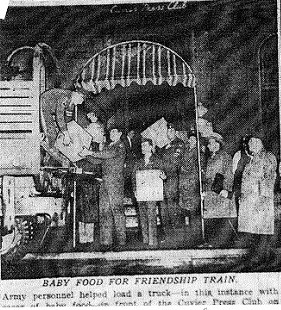
Baby Food for the Friendship Train in 1947.

A group of Army personnel went on a special mission in downtown Cincinnati, Ohio in the fall of 1947. This group of soldiers was helping to load boxes of baby food onto a truck. The following day a train was to roll into Cincinnati to pick up the food. Its destination: Europe.

World War II was over, but the peace was not yet won. Millions of people in the war-devastated countries were suffering from food shortages. Harsh winters and drought had followed the war. Reconstruction still had a way to go. Children were at severe risk of stunted growth if they could not get the right nutrients.

Americans took action. The Friendship Train, as it was called, went from coast to coast picking up food like the baby formula. One of the great achievements in American history was helping to rebuild Europe after World War II, and the Friendship Train was part of this.

The world scene now is no different, in the sense that food is needed to win the peace. If children are hungry, action has to be taken.

What better way to do so than a Friendship Train of plumpy’nut heading toward the areas of suffering and conflict around the globe? Plumpy’nut is the special peanut paste that rescues children from life-threatening malnutrition. The key is to get plumpy’nut to every child at risk from malnutrition so they can be saved.

Low funding and lack of political will are often what prevents this. While there are many great efforts ongoing among the public to raise funds and promote plumpy’nut, getting all the political leaders on board is essential. It has to be a team effort, as Josette Sheeran, the World Food Programme’s director, often points out.

A Friendship Train of plumpy’nut today could rescue every malnourished child whether it’s in East Africa, Sudan, Democratic Republic of the Congo, Yemen, Afghanistan, Guatemala, or any of the other suffering countries. It’s critical to reach the children because without nutrition in the first thousand days of life, they suffer lasting physical and mental damage.

It is unacceptable that low funding prevents foods like plumpy’nut from reaching malnourished children. Food aid is relatively inexpensive when it comes to foreign policy spending. Global hunger-fighting programs make up less than one-tenth of one percent of the entire U.S. federal budget.

So let’s get the Friendship Train rolling. All aboard with plumpy’nut. Save lives and help an entire generation of children to be healthy and strong enough to overcome the challenges their country may face.

Article first published as Friendship Trains, Global Hunger and Plumpy’nut on Blogcritics.

Leave a comment

Filed under advocacy, Books, drought, East Africa, East Africa drought, Europe, global hunger, History, malnutrition, plumpy'nut, School feeding, World Food Programme, World War II

October 5th, 1947 – A Television First To Save Europe From Starvation

President Harry Truman addressed the nation about the hunger crisis facing Europe (photo courtesy of the Truman Library)

On October 5, 1947 the first presidential address ever televised from the White House was delivered by Harry Truman. The President discussed the urgent hunger crisis facing Europe and how Americans could help through food conservation.

At that time Europe was struggling in its recovery from World War II. Rebuilding from the devastation was difficult enough, but a harsh winter followed by a drought during 1947 ruined crops. Food shortages were rampant and Europe needed food to survive and rebuild.

President Truman said of Europe, “The nations of Western Europe will soon be scraping the bottom of the food barrel. They cannot get through the coming winter and spring without help–generous help–from the United States and from other countries which have food to spare.

“I know every American feels in his heart that we must help to prevent starvation and distress among our fellow men in other countries…. Their most urgent need is food. If the peace should be lost because we failed to share our food with hungry people, there would be no more tragic example in all history of a peace needlessly lost.”

Food from the United States helped Europe get through the winter of 1947-1948 and helped set the foundation for the Marshall Plan. It was this initiative that brought about Europe’s recovery.

In addition to President Truman, other speakers for the program included Secretary of State George C. Marshall, Secretary of Agriculture Clinton P. Anderson, Secretary of Commerce W. Averell Harriman, and Charles Luckman, who was the Chairman of the Citizens Food Committee.

Read the full text of President Truman’s October 5, 1947 statement.

Listen to George Marshall’s remarks on October 5, 1947. (audio is faint)

Read how Americans fought hunger in Europe during the Fall of 1947:

Take in a Silent Guest this Thanksgiving (The 1947 Silent Guest Program to Buy CARE packages)

Transformational Leadership in Tackling Global Hunger Crisis (The Friendship Train of 1947)

Old Soldiers Never Die, They Just Fade Away…..And Fight Global Hunger (CARE Packages after World War II)

Leave a comment

Filed under drought, Europe, global hunger, Harry Truman, History, malnutrition, peace, World War II

Inside Yemen: Hunger from Conflict, High Food Prices

Aisha is an internally displaced Yemeni girl in Southern Yemen living in an elementary school. She is one of many Yemeni children who are suffering from hunger and displacement. WFP and other aid agencies need support in order to carry out child feeding and rehabilitation programs. (WFP/Abeer Etefa)

News about Yemen is dominating the airwaves following the killing of the Al Qaeda leader there. Far less reported is the suffering of those displaced by the fighting between the government and Al Qaeda-linked militants.

Abeer Etefa of the United Nations World Food Programme (WFP) just visited the southern port city of Aden and witnessed the terrible conditions in which displaced Yemenis are living.

See the full article and video at Blogcritics Magazine.

Leave a comment

Filed under Uncategorized, World Food Programme, Yemen