
There is a massive effort to stop famine from engulfing the Central African Republic. The UN World Food Programme (WFP) is leading the hunger relief mission in the war-devastated country.
Read the full article at Examiner.com
There is a massive effort to stop famine from engulfing the Central African Republic. The UN World Food Programme (WFP) is leading the hunger relief mission in the war-devastated country.
Read the full article at Examiner.com
Filed under global hunger
The singer Shakira knows how important food is for children, especially those victimized by conflict and poverty. Her own foundation in Colombia provides school meals.
Read the full article at Examiner.com
Filed under global hunger
Tom Vilsack, the Secretary of the U.S. Department of Agriculture (USDA), today announced grants that will provide school meals around the world. These grants are from the McGovern-Dole international school meals program.
Read the full article at Examiner.com
Filed under global hunger
The UN World Food Programme (WFP) said today that it’s losing funding for its school meals program in Haiti. WFP is the leading organization fighting hunger in Haiti and almost 70 other countries.
Read the full article at Examiner.com
Filed under global hunger

Paul Tergat (World Food Program USA photo)
Paul Tergat raced to victory in the 2003 Berlin Marathon. Then again he took first in the 2005 New York City Marathon. Tergat held the world record in the Marathon for years. He has won countless races including Cross Country titles and two Olympic Silver Medals.
How did he achieve all this? Training and hard work, yes. But something more than that. Tergat credits the school meals he received as a child growing up in Kenya. These were meals provided by the UN World Food Programme (WFP), the largest organization fighting global hunger.
I interviewed Paul on Thursday, one of the nicest people you can talk with, and a great sense of humor. Earlier he was stuck in the Washington, D.C. traffic, which unlike the government is not shut down. He wished his running shoes were with him, it would have been quicker to get around.
Tergat is in D.C. this week advocating for school meals for children around the world. Tergat knows best. He says without these meals he could never have achieved this amazing career as a runner, or as spokesperson and leader. He has become all those things because someone cared.
When Tergat was just seven WFP started bringing meals to his school, which was in an impoverished area of Kenya. The food was cornmeal as he recalls. It made such a difference to him and the other students. In fact, some of his classmates have gone on to become doctors and teachers.
With meals at school, it can give children a chance to fend off hunger and the opportunity to concentrate on learning. Tergat and his class are proof of that. So it’s no secret Tergat is advocating for school meals for children around the world.
He has met with members of Congress this week calling for more funding for the McGovern-Dole school meals program. This program currently is helping Kenya and other nations with school meals using relatively little funding. Food aid overall makes up less than one tenth of one percent of the federal budget.
Tergat is speaking at American University and George Washington University this week before winding up Friday with an event called The Role of School Feeding. This event will be hosted by the World Food Program USA and Catholic Relief Services. Both organizations are supporting school meals in Mali, another country devastated by poverty and war.
Tergat encourages students to find ways to support the work of the World Food Programme, and contribute what they can. Tergat is also supporting racing opportunities for children back in Kenya including competitions between towns.
We also discussed Charity Miles, a great way to run and support the World Food Programme using this free app.
I think what people can do, seeing his example, is to continually advocate for feeding children at school. So many times this basic meal gets lost in the shuffle with everything that is happening in government and around the world. Sometimes members of Congress even vote to cut school meals. That should never happen.
We all benefit if children get the opportunity they deserve. For children living in hunger and poverty, just getting some food at school changes their lives.
How many great runners and stories of inspiration never come to be because of hunger and poverty? This is something Paul Tergat realizes and carries with him. He made it. A helping hand was there to give him food which became the foundation of his success.
When WFP asked Paul to be an Ambassador Against Hunger in 2004 he jumped at the opportunity. He has never stopped running in a sense to achieve this goal of school meals for every child in the world.
Originally published at the Huffington Post.
Filed under global hunger

Emergency school feeding in Mali through the World Food Programme. Cuts by Congress to food aid could harm this program. (WFP/Daouda Guirou)
A child in the war-torn African nation of Mali just wrote a letter to the UN World Food Programme (WFP). Emergency school meals are being provided by the WFP in Northern Mali.
“Our parents are poor and tired,” the child wrote. “Thank you WFP who gave us food so we could work hard in school. We always count on God and you. With WFP it’s okay. The school in Barize thanks you.”
This food is nutrition for their mind and body. But also for their spirit and soul. Food is hope. WFP’s plan is to feed children but at the same time get them back in school and learning. It’s a strategy that is proven to work.
They are going full steam ahead at providing these meals through the rest of this year. Right now 120,771 students in Northern Mali get two meals a day: an enriched breakfast and a lunch. Volunteer cooks also receive take home rations.
It’s common sense that school meals are important, especially for a nation trying to find that road to peace after a war. Tragically, that does not always translate into funding for school meals. When international relations is discussed it seldom revolves around humanitarianism, the very thing people around the world need most.
For Syrian refugee children school feeding is one of the few things they can count on during this time of upheaval in the Middle East. The WFP is providing 2,000 children right now with school feeding at refugee camps in Jordan. They hope to expand to 30,000 by the end of the year. In Iraq over 4500 refugee children have received high-energy biscuits at school and summer camps.
WFP needs funding to make sure school meals continue the rest of this year and into next year. The UN food agency relies entirely on voluntary donations. That means budget decisions by the U.S. Congress have a dramatic effect. If funding disappears so too will the school meals. That is a silent tragedy that goes unseen.
In Mali, WFP has a homegrown school feeding project in the Southern part of the country. By helping small farmers become the providers of the meals, it helps build the future of the country, one where they can sustain themselves.
Catholic Relief Services (CRS) also has a school feeding program in Mali which is set to resume in October. Kristina Brayman of CRS reports the program will operate in 310 schools with an end goal of feeding 80,000 children.
The U.S. McGovern-Dole school lunch program supports this CRS initiative in Mali. The Congress will be deciding in the coming weeks how much funding to give McGovern-Dole. This will have a big impact on the future of school meals in U.S. foreign policy.
Some members of Congress want these budgets made responsibly and are desperately trying to get the fight against hunger at the top of the foreign policy agenda. Representative Betty McCollum (MN) recently introduced the Global Food Security Act. This would create a White House level coordinator to improve the U.S. response to world hunger.
The Act quotes a U.S. Intelligence report which states, ”Growing food insecurity in weakly governed countries could lead to political violence and provide opportunities for existing insurgent groups to capitalize on poor conditions, exploit international food aid, and discredit governments for their inability to address basic needs.”
It’s in everyone’s interests that we fight hunger and provide school meals around the world. A child who received school meals in Germany wrote after World War II, “If every people will help the other, like you does, we should have a lasting peace soon.”
That is what the world needs most of all now.
Filed under global hunger

The Dept. of Agriculture is trying to expand summer feeding throughout the country (courtesy USDA)
Summer is here and time for relaxation. But for millions of needy children across the United States, it is the summer months when they are most vulnerable to hunger.
The Food Research and Action Center states, “for every seven low-income students who depended on the National School Lunch Program during the regular 2011-2012 school year, only one child received summer meals in July 2012.”
Some U.S. counties do not even have a summer feeding site. So there is a huge gap in the U.S. child feeding program that will need innovation from both the public and the government to fix. In Cincinnati, Ohio, for example, public libraries are helping out as locations for distributing summer meals. More summer feeding sites, or other delivery methods, need to be established and there has to be adequate funding.
Summer meals for children are also missing in Haiti, where food is desperately needed. A series of storms and drought have damaged food production in an already impoverished country. The UN World Food Programme, which depends on voluntary funding, did not receive enough to provide summer feeding in Haiti nor a program for take home rations to help needy families.
The U.S. McGovern-Dole global school meals program is helping in Haiti as well as other countries including Mali and Afghanistan, but it needs to be expanded. Unfortunately, funding for McGovern-Dole is at risk as members of Congress are threatening cuts to food aid. This despite the fact that food aid makes up less than one tenth of one percent of the federal budget.
The program was named after the two former senators, George McGovern and Bob Dole, who during World War II witnessed the devastating effect of hunger on children and understood the importance of these initiatives in the global scene.
We should expect our representatives in Congress to make feeding the hungry overseas a top foreign policy priority.
Summer meals, both here at home and abroad, should be for all children. It’s a real test of our character as a society, do we care for the next generation and give them a helping hand.
In the United States you can call 1-866-3-HUNGRY or 1-877-8-HAMBRE (for Spanish speakers) to find the closest summer feeding sites or visit www.whyhunger.org/findfood.
Filed under global hunger
Emergency school feeding in Mali through the World Food Programme. Cuts by Congress to food aid could harm this program. (WFP/Daouda Guirou)
We know that globally there is a huge need for school lunch programs to fight child hunger. Yet, it’s the middle of June and there’s still no word on which countries will receive grants from the U.S. McGovern-Dole school lunch program. Last year the announcement took place in April and the previous year in May.
The McGovern-Dole program is run by the U.S. Dept. of Agriculture (USDA). However, the program is constantly under stress from potential funding cuts by Congress.
Bread for the World reported earlier this year that “234,000 children will have reduced or denied access to school feeding programs under the McGovern-Dole program” as a result of the sequestration cuts. It is believed that the sequestration is causing the delay in the announcement of the school feeding grants. The longer the delay, the longer hungry and malnourished children have to wait for the meals.
Aid groups, including Catholic Relief Services and the World Food Program USA, want funding for McGovern-Dole increased. They see the positive effects this program has in countries that are suffering from disasters, war, or long-standing poverty. This year’s Farm Bill legislation is the perfect opportunity to increase the level of funding and allow for more school meals in Afghanistan, Mali, Haiti and other countries where needs are massive.
WFP USA says it “has included an ask for McGovern-Dole of $300 million for FY14 in our overall global hunger and nutrition recommendations. Providing $300 million a year for McGovern-Dole would allow this program to reach 10% of the hungry school-aged children in need, increasing their nutritional status and increasing school attendance, especially for girls.” Recent funding levels for McGovern-Dole are around the $200 million mark.
Here in the United States the National School Lunch program is meant to fight off child hunger.
But what happens when summer arrives and schools close? The lunches are disappearing for many children. The Food and Research Action Center (FRAC) just released a report showing a huge gap in feeding coverage during the summer months.
The report says, “for every seven low-income students who depended on the National School Lunch Program during the regular 2011-2012 school year, only one child received summer meals in July 2012.”
Tom Vilsack, head of the U.S. Dept. of Agriculture (USDA), emphasizes, “We must do all we can to ensure that children get nutritious food year-round, so that they are ready to learn during the school year and have a greater chance to succeed.” Efforts by USDA and the public have slightly improved summer feeding participation but the gap in coverage is still huge.
Jim Weill, the president of FRAC, says, “USDA is providing strong leadership with its emphasis on improving summer meals, but Congress will need to fix some of the underlying problems in the programs in the 2015 Child Nutrition Reauthorization to truly repair the Summer Nutrition Programs. Congress must take a fresh look at the Summer Nutrition Programs and consider ways to improve this faltering program so it more effectively addresses hunger and obesity.”
The struggle to defeat hunger at home and abroad depends on school meals. Leaders, both from the government and the public, need to ensure these vital food programs are strengthened.
Filed under global hunger
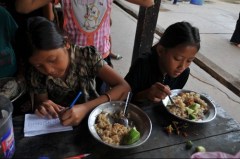
Using Charity Miles you can help support school feeding programs run by the World Food Programme
Credits:
WFP/Kongkea Chhoeun
In my last article, I wrote about Charity Miles and how you can use this free app to help raise donations to fight hunger and cancer.
Yesterday, I interviewed Alanna Imbach of the UN World Food Programme (WFP). She tells us more about how by walking, running or biking you can help support WFP, the world’s largest organization fighting hunger.
How did WFP connect with Charity Miles?
WFP is always on the lookout for innovative new ways to tackle global hunger issues, and engage people in efforts to reduce malnutrition and hunger. Charity Miles founder and brainchild, Gene Gurkoff, invited WFP to join up with this exciting new initiative early in 2012. When the game-changing phone application went live in June of this year, WFP was one of an initial nine top charities that walkers, runners and bikers can choose to support.
Give us an example of how funds raised through Charity Miles will help WFP feed the hungry?
It’s incredibly easy—and it’s free! When you use the Charity Miles app, your phone’s GPS is used to measure the distance that you cover during your walk or workout. WFP then receives 25 cents for each mile that you walk or run, or 10 cents for each mile biked. It may not sound like much, but with as little as 25 cents, WFP is able to provide a healthy meal to a child in school.
How easy is it for someone to join?
Using Charity Miles to support WFP in the fight against hunger is as simple as downloading the free application onto your iPhone or Android smartphone, then activating it while you enjoy your jaunt through the fresh outdoors. The app can be downloaded at charitymiles.org, and must be connected to an active Facebook account.
Do you see an increasing trend of support for WFP resulting from Charity Miles?
WFP’s partnership with Charity Miles is not just about raising money. It is also very much about raising awareness about global hunger, and empowering people to change the world by earning meals for hungry and malnourished kids in need, all while having fun. It has been great to see more and more people using Charity Miles as a launching pad to start conversations (and friendly competitions!) with their friends and colleagues about hunger in school and homes around the world.
Article first published as Interview: Alanna Imbach of the UN World Food Programme on Charity Miles Mobile App on Blogcritics.
Filed under global hunger
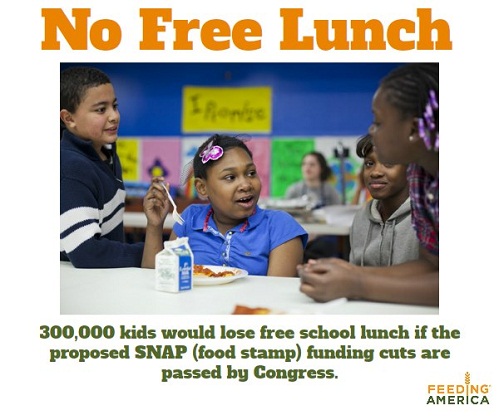 On Tuesday the charity Feeding America warned of the consequences of the House Agriculture Committee’s cuts to food stamps on the Farm Bill. The House committee currently plans to cut $16.5 billion from the Supplemental Nutrition Assistance Program (aka SNAP, or food stamps).
The cuts to food stamps would also mean that “nearly 300,000 children would lose their free school meals,” according to Feeding America. Children who were eligible for the free meals because their family received food stamps would lose access to a critical safety net.
Vicki Escarra, the president of Feeding America, asks, “What will households do to make up for this loss in food assistance? The vast majority of SNAP recipients have extremely low incomes – 20 percent of these households have no income at all…Proposed cuts would mean that some low-income Americans may literally go without food.”
The proposed cuts come at a time when 49 million Americans are suffering from hunger and unemployment rates are high.
For children and their families a free school meal is a safety net, especially in tough economic times. Since the early 1900s when Cincinnati school teacher Ella Walsh and other innovators started serving “penny lunches” to needy children, school feeding has evolved. By 1946 Harry Truman signed into law the National School Lunch Act leading to free or reduced-price lunches for children in need.
Today, child hunger is escalating in the United States and the loss of free school meals is a major blow to the fight to end hunger in America. Over 20 percent of children in the U.S. suffer from hunger, or “food insecurity,” according to Feeding America. Some counties in the U.S. have child hunger rates well over 40 percent.
Zavala County in Texas has over 48 percent of its children suffering from hunger, with Starr Country in Texas at just over 45 percent. Imperial County of California and Luna County in New Mexico are third and fourth on this list with 43 percent hunger rates. Yuma County in Arizona has 42 percent of its children suffering from hunger. The list goes on and on, with other counties well over 30 or 40 percent in child hunger rates.
Meanwhile the cuts to food stamps will mean an increased strain on already overstretched food banks. Escarra adds, “If these cuts to SNAP are passed, the food banks in Feeding America’s network will be even more overwhelmed with people seeking food assistance. The food pantries, soup kitchens, and other organizations that are served by Feeding America are already stretched to the limit.”
The full impact of this summer’s drought on food prices may not be felt for months. But if food prices become high over a significant period of time, then foodbanks will be stretched even more. The ranks of the hungry in the United States will struggle even more to find safety nets. Congress can change this by committing to ending hunger in America.
Brett Weisel, the director of advocacy for Feeding America, says that “supporting federal anti-hunger programs isn’t about giving a handout. It’s about providing help up. So that those in need can achieve more. When people in our communities don’t have enough food to get through the day, it costs us all. Hunger creates health problems. Children struggle to learn. Workers are less productive. Opportunities are lost.”
Article first published as House Plan Eliminates Free School Meals for Nearly 300,000 Children on Blogcritics.
Filed under Hunger in America


 Author William Lambers