Tag Archives: school feeding

Building the Future in Ivory Coast with School Meals

WFP has resumed school feeding in Ivory Coast. But will the funding pipeline be maintained by donors for the program to continue? (file photo by WFP/Ramin Rafirasme)

Secretary of State Hillary Clinton traveled to the Ivory Coast (Côte d’Ivoire) this week and spoke of hope for the future. Hope was something not often talked about when this African nation was embroiled in violence last year over a disputed election.

The fighting is now over. A chance for Ivory Coast to build a promising future has begun. Clinton said, “I am inspired by how quickly not only the government but the people have moved from the violence and conflict of last spring to successful legislative elections in December and to a commitment that is in the air to build a better future for all Ivoirians and particularly for the next generation.”

Hunger, though, is still a major threat in the Ivory Coast. A report from the UN Food and Agriculture Organization (FAO) said, “In spite of the improved security situation, food security remains a major concern. Access to food for many households is being constrained by the disruption of their livelihoods.”

Catherine Bragg, of the UN Office for the Coordination of Humanitarian Affairs (OCHA), told IRIN news, “I don’t want the world to move on and say everything in Côte d’Ivoire is fine.”

Humanitarian aid is critical for this country traveling the road to peace. A whole generation of children in the Ivory Coast needs nutrition and education, something many had to go without during the months of fighting and displacement. In January, the UN World Food Programme (WFP) started to provide school feeding to 600,000 children in 3,400 schools around the country. The initiative also provides food for about 25,000 voluntary teachers.

The school feeding gives these children a very important meal, which includes rice, of about 700 calories. Providing food at school boosts attendance rates not to mention class performance. So two key areas of Ivory Coast’s recovery are addressed with this program.

This free meal is of the utmost importance for so many impoverished families that lost so much during the conflict. Funding, though, is the critical issue going forward. WFP relies on voluntary donations from the international community. Food to reinforce peace depends on keeping the donor pipeline moving.

WFP says that the Ivory Coast school feeding program is only 11 percent funded. The program can run for the time being. However, by April supplies will be needed to maintain the school feeding. Donations now are critical because it can take several months for a donation to translate into delivered food. If no action is taken there is the the risk of children facing reduced rations or even losing their school meal come spring. This would impact the recovery process and the health and education of children.

As Clinton said while in the Ivory Coast, “Families need good schools to send their children to attend, everyone needs good healthcare, and I am very hopeful that the president’s agenda will help revitalize this dynamic, very important country at a time when we all need to do more to set a positive vision for the future.”

School meals are a vital building block for this vision. So it’s important that this program be supported and evolve into a national school feeding program for the Ivory Coast. Such a vision need not be too far off in the future, if the will exists now.

Article first published as Building the Future in Ivory Coast with School Meals on Blogcritics.

Leave a comment

Filed under global hunger

Food Aid for Tajikistan Held Up in Uzbekistan

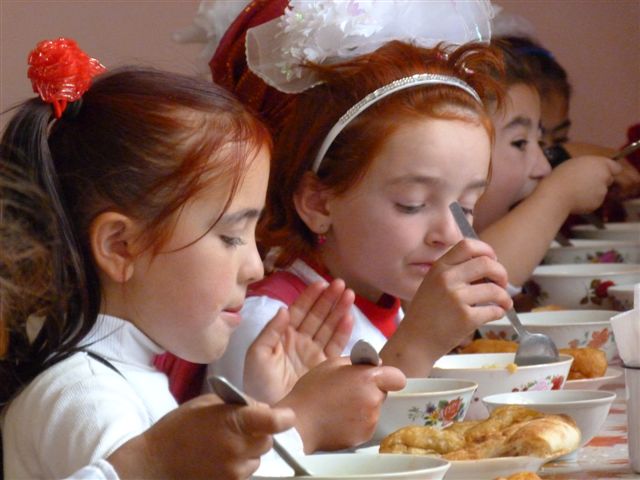
Food for the school feeding in Tajikistan has been limited because of the railway blockade in Uzbekistan. Low funding for WFP has also harmed the program this year. (World Food Programme photo)

The nation of Tajikistan needs food aid. Nearly half the population lives in poverty and food prices are high. In fact, earlier this year children in Tajikistan had their school meal ration reduced because of low funding for the UN World Food Programme (WFP). The WFP depends entirely on voluntary donations.

Some food was on the way to Tajikistan recently by railroad via the neighboring country of Uzbekistan. Yet, the food has been stalled in Uzbekistan for a month when there are hungry people in need. Why? Here are WFP Tajikistan country director Alzira Ferreira’s answers to questions about this situation.

Why are the WFP supplies for Tajikistan being held in Uzbekistan?

The WFP supplies are part of several hundred wagons stuck in Uzbekistan since 17 November. The issue affects all cargoes, both commercial and humanitarian. There are several different accounts of what happened in the Uzbekistan’s side of the rail line that connects that country with the southern Khatlon Region of Tajikistan. I believe the reasons reported in the press (explosion, mud flows, damaged rail bridge) are most likely an excuse for economic and political motives.

How long will it take for the repairs to be made and rail transport can resume?

The Uzbek rail authorities are not providing clear indications of when traffic will resume but have advised our suppliers, under whose responsibility the food is, to divert the wagons via Dushanbe. It does not look like there will be any immediate resumption of rail activity in that line. The other rail connections are not affected.

Are there alternatives such as some food being moved through by truck or air? Is Uzbekistan considering this possibility?

Yes, there are alternatives. Tajikistan is served by three rail lines from Uzbekistan: the one currently interrupted which serves the South, the most populous area of the country; another rail line connects Uzbekistan with Dushanbe and another connects with the northern Sughd Region. We have just made a decision to re-route the wagons intended for the South by rail to Dushanbe and then truck the food South. This brings additional transport costs but it is an alternative.

How much food supply does WFP have left for school feeding and other programs?

WFP still has supplies both in the South and Dushanbe (just over 1,000 tons) but they are insufficient to meet all the needs of planned programmes. For the next three months we need over 3,000 tons of food, so the food held in Uzbekistan is very much needed, and fast. Thus the decision to divert the stranded wagons and future deliveries via Dushanbe.

Article first published as Food Aid for Tajikistan Held up in Uzbekistan on Blogcritics.

Leave a comment

Filed under global hunger

Singing Telegrams, Congress and Food Aid

Congress is debating whether to reduce international food aid even as famine continues in East Africa (photo credit: World Food Program USA)

Western Union was in the news this week with its revival of the singing telegram – although updated to include e-mail delivery.

This company of course has a deep history of sending telegrams, whether the most urgent kind or the singing variety. One day in 1962 a Western Union telegram was sent to Congress urging them to save a program that provided school meals to children in Poland and Yugoslavia.

In June 1962, during the Kennedy administration, Congress was considering termination of aid to Poland and Yugoslavia, both under Communist control. Hugh D. Farley, the director of Church World Service, was upset with this prospect and sent a telegram to three Senators.

Farley urged the senators not to cut food aid programs in these two countries that were reaching over two million children with school meals. Orphanages and homes for aged were also receiving food support. Farley told the senators the cutting of aid would be “difficult for children to understand” and that “people to people” programs should be continued.

He also alerted George McGovern about the telegram. McGovern had been appointed by President Kennedy as the director of the Food for Peace program that oversaw these food aid initiatives. Food for Peace was started by President Dwight Eisenhower and President Kennedy continued and strengthened this program, placing special emphasis on school feeding.

McGovern wrote back to Farley the next day telling him of an amendment approved by the Senate “providing presidential authority for continued food assistance to Poland and Yugoslavia.” McGovern wrote, “I am sure that your expression to the Senators was helpful.”

Saving meals for children was the right thing to do in 1962 and it is right again in 2011. Church World Services is urging the same type of advocacy by citizens to tell Congress not to cut food aid programs in the upcoming budget. The Food for Peace program, as well as the McGovern-Dole school lunch program, are at risk of budget cuts.

With famine in East Africa and many other hunger crisis points unfolding, food aid needs to be bolstered, not reduced.

Church World Service says, “Further cuts to humanitarian foreign assistance will result in countless additional people going hungry and many more children losing their lives to preventable and treatable diseases. Preserving robust, well-targeted foreign assistance will save millions of lives, build self-reliance among the world’s most vulnerable, and help protect our own national security in the process.”

There is also quite a controversy over why Congress is making cuts to food aid since it already is such a relatively inexpensive program. Food aid makes up less than one tenth of one percent of the federal budget. International assistance programs, such as food aid and other programs like malaria treatments, come out to around 1 percent of the total budget. The relatively low cost of these aid programs is not widely known either.

Church World Service reports, “Polls show that many Americans believe that international assistance is 25 percent or more of U.S. spending. That makes it an easy target for members of Congress. But in fact, when these same Americans are asked how much U.S. aid for poor families abroad should be, they support levels between 6-10 percent!”

Save the Children, World Vision, the World Food Program USA and other agencies are urging Congress to save food aid from budget cuts. They are asking citizens to make their voices heard before it’s too late. Calls, e-mails, tweets, faxes are all being urged for reaching your representatives. A singing telegram? Well, if it works. Why not?

Article first published as Singing Telegrams, Congress and Food Aid on Blogcritics.

Leave a comment

Filed under global hunger, History

Thanksgiving, the Friendship Train, The Silent Guest…and Free Rice

The Friendship Train in November of 1947 collecting food for the hungry in Europe (Ames Historical Society)

Happy Thanksgiving!

My oped This Thanksgiving feed a silent guest and help build world peace is published today in newspapers.

It features the famous Friendship Train that collected food for the hungry in Europe after World War II.

Here are some links to the article:

San Francisco Chronicle

Wichita Eagle

Cleveland Plain Dealer

History News Network

Buffalo News

There are nearly one billion hungry people worldwide. There is hunger in Africa, Asia, the Middle East and even hungry people even here in the United States. Please consider feeding a “silent guest” this Thanksgiving, one of the world’s hungry people. You can donate the cost to feed that “silent guest” to a charity fighting hunger. Here is a list of some hunger fighting agencies.

Even a donation of one dollar can buy close to a week’s worth of meals for a child.

Another way to help is to play the online game Free Rice. It’s free for you to play. The donations of rice are paid for by advertisers on the site. The more you play the more you can help end world hunger!

Have a great holiday!!

William Lambers

FreeRice has two goals: Provide education to everyone for free. Help end world hunger by providing rice to hungry people for free.

Leave a comment

Filed under global hunger

Interview: Alain Homsy of the Norwegian Refugee Council in the Democratic Republic of the Congo

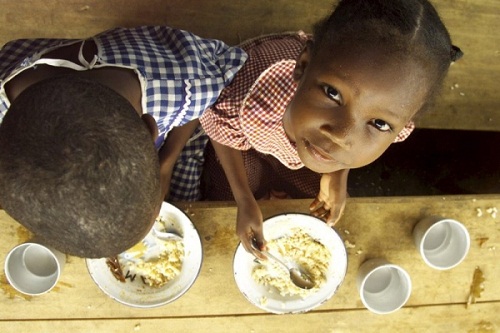
School feeding in the DRC (WFP photo)

The Democratic Republic of the Congo (DRC) has suffered through decades of instability and conflict. And as the country moves forward with elections and peace building, it must contend with hunger, poverty, and displacement.

The International Food Policy Research Institute calls the hunger crisis in DRC “extremely alarming.” In fact, its Global Hunger Index (GHI) report recently revealed that, “among the six countries in which the hunger situation worsened, the Democratic Republic of Congo stands out. Its GHI score rose by about 63% owing to conflict and political instability”.

Close to 2 million people have been displaced due to the conflict. A majority of these are located in the North and South Kivu areas of the DRC. And the same report shows that 70% of the population in DRC is undernourished – the highest rate in the world.

The Norwegian Refugee Council (NRC) is coming to the aid of children in the DRC through programmes like school feeding. School meals not only fight hunger and malnutrition, but give children a better chance at getting an education.

Alain Homsy, country director for the NRC in the Democratic Republic of the Congo, recently took time to answer some questions about its school feeding mission.

How many children are benefiting from the NRC school meals program in DRC?

In Grand North Kivu (Beni/Lubero Territories – 2011), in a total of 156 primary schools, 87,848 pupils (43,166 boys and 44,682 girls) have benefitted from the school feeding programme, along with 1,953 teachers (754 men and 1,199 women) and 970 cooks (833 men and 137 women). In addition, two NRC Youth Education Program centres also benefitted from the school feeding program with a total of 192 learners (94 boys and 98 girls).

In South Kivu (Mwenga Territory – 2011), in a total of 52 primary schools, 22,367 pupils (11,220 boys and 11,157 girls) have benefitted from school feeding, along with 524 teachers (445 men and 79 women) and 220 cooks (all women). In addition, one NRC Youth Education programme centre also benefitted from school feeding with a total of 192 learners (74 boys and 91 girls).

Have the meals had an effect on class attendance and performance?

In Grand North Kivu [where sending children to school is a priority for those who can afford it and satisfactory security conditions prevailed for most of past decade] thanks to school feeding, enrolment and attendance went up by an average of 28% in the academic year 2009-10, with a maximum of 63% and a minimum of 2%. The regular meal supply therefore appears to have a clear impact on attendance, although changing security conditions also affect attendance in a significant way. In terms of performances, impact of school feeding is more difficult to demonstrate as it is not solely linked to the quality or quantity of daily food intake, and is also clearly affected by other factors, amongst which is an obviously determining one, the class size. Therefore, in some areas with less populated schools (classes of 25-30), the proportion of pupils who graduated went up by 10 to 15% based on the directors’ verbal comments, while in areas where schools listed high numbers of students (classes of up to 58 pupils), graduation rates sometimes decreased by 80% in spite of school feeding.

In South Kivu [where sending children to school has not been a priority and security conditions were bad for most of the past decade due to presence of the Democratic Forces for the Liberation of Rwanda], thanks to school feeding, enrolment and attendance shot up by an impressive average of 119% – bearing in mind over 52 schools were covered from 2009 to 2011 – with a maximum of 248% and a minimum of 80%. On the other hand, six schools which were either temporarily occupied by Forces of the Democratic Republic of the Congo (FARDC) or located nearby temporary armed forces positions lost up to 20% of their pupils. In terms of performances, the proportion of pupils who graduated after school feeding introduction stands at an average 85.2% for girls and 89.1 % for boys, reportedly being an incremental increase of about 5% [school directors’ estimates – not fully documented].

In addition, it is worth remembering that all school feeding should be accompanied by regular, twice a year minimum, de-worming treatments so that food eaten effectively contributes to better child development and higher concentration and learning capacity.

How long does NRC expect to run this school feeding program? Do you anticipate being able to hand it over to the government or local community?

On a general note, emergency school feeding is indeed expected to have an impact on attendance and performances, as well fed kids not only have a higher concentration and learning capacity but also “they do not need to rush back home for a meal as soon as the school bell rings”, to quote from a Masabele primary school director. [The same teacher argued that school feeding is the main reason for an ever-growing number of registered children, and that it helps pupils stay in school after class hours where they can do homework instead of going straight home for food and being called upon by parents for home chores at the expense of studies.]

As such, taking into consideration current instability in DRC and potential renewed difficulties in connection with presidential elections due in November 2011, NRC believes that there will be continued need for emergency school feeding at least for the whole of the 2011-12 academic year, as it stimulates vulnerable children to attend classes and help schools cope with increased number of pupils both in displacement and return areas.

It is important to note that from The World Food Programme’s point of view, however, emergency school feeding is purely linked to nutritional considerations and therefore targeted to areas where indicators justify it. But in light of the recently revised Global Hunger Index, in which DRC ranks first, it is very unlikely that conditions may evolve for the better in Eastern DRC and therefore emergency school feeding should be extended.

Longer-term perspectives, in terms of handing over to local government, are extremely limited as so far even “free education for all” remains a remote dream in DRC. On the other hand, substitutes to emergency school feeding are currently studied by NRC, first involving gradual introduction of a cash and vouchers approach for schools as a first step towards reducing dependency on the WFP supply lines, while increasing efficiency and stimulating the economy by local purchases of food needed in a selection of pilot schools. Thereafter, self-sufficiency of these schools could be reinforced by developing improved school feeding programmes, including food production on school-owned land by parents of vulnerable children, who in return for their work would gain free or cheaper access to education for their kids and receive a share of the harvests. Additional features of such programmes will include introduction of more fuel-efficient kitchen use, both at school and home level, as well as small-scale animal husbandry for a diversified source of proteins and income-generating purposes.

For more information about the Norwegian Refugee Council visit www.nrc.no

Special thanks to Kaja Haldorsen and the field staff of the NRC in the Democratic Republic of the Congo for helping to coordinate the interview.

Article first published as Interview: Alain Homsy of the Norwegian Refugee Council in the Democratic Republic of the Congo on Blogcritics.

Leave a comment

Filed under global hunger

A School Lunch Hero for Disabled Children

In 1944 World War II was still raging. Students though at a school for disabled children in Cincinnati were facing their own daily struggles. Even having enough money for a school lunch was no easy task.

The school had a fund set up to provide lunches for the students. Keeping this fund resourced was the problem; that is, until the school received some help from someone very generous. As a result, the school lunch fund got a big boost which meant many more meals for the students.

Who was this mystery helper? It was one of their own students, 10 year old Charles Graff Jr. However, Graff had to study at home because he had the disease hemophilia. This is a disease where any slight cut could cause severe and even deadly bleeding. As Charles was confined to his home, a teacher from the school visited him there to give lessons.

Charles also had a hobby, collecting sales tax stamps. These were stamps placed on various items sold in stores, and you could redeem these stamps for cash from the government. So Charles kept collecting and as the Cincinnati Enquirer reported, he would give them to his teacher who would drop them off at the school. The tax stamps would then be redeemed, providing the school with a fund to buy the student lunches or sometimes even clothes.

Charles’s father, who worked at the Red Top Brewing Co., got co-workers involved to provide Charles with more stamps. More stamps meant more meals for the children.

Charles was ahead of his time. In 1944 there was no National School Lunch program; there was a limited luncheon program under President Roosevelt.

In 1946 President Harry Truman signed into law the National School Lunch Act, which provided free or reduced-price lunches for needy children all around the country. Healthier children meant better educated and more productive citizens for the future. It was a program built to last.

Charles, whose nickname was Bubbles, remained confined to his home and sometimes a wheelchair, due to his condition. That did not stop him though from being the “official” for many games his friends played on the street. Charles would officiate the games from his window.

The hemophilia took his life in 1950 at the age of 15. His legacy carries on. What Graff did in helping his classmates receive lunches is an example for all to follow. Fighting child hunger is about problem solving. You need people to find solutions, not excuses for why children cannot access basic foods.

Groups like Feeding America work to make sure children do not go hungry. This means strengthening the national school lunch program when required, or filling in gaps with after-school meals and summer feeding. For this reason, Charles Graff would make a great honorary ambassador for Feeding America.

Article originally published as Cincinnati’s School Lunch Hero for Disabled Children on Cincinnati.com and A School Lunch Hero for Disabled Children on Blogcritics.


Leave a comment

Filed under global hunger, History

Interview: Para Hunzai of the World Food Programme in Cambodia

The UN World Food Programme provides school meals to children in Cambodia (World Food Programme)

Para Hunzai of the UN World Food Programme (WFP) recently reported on the massive flooding taking place in Cambodia. Thousands of people have been displaced from their homes. Livelihoods have been lost as farm lands have been swept away. This crisis is taking a great toll on the many families in the country already living in poverty.

WFP provides assistance in Cambodia, including a school meals program which is a crucial safety net to help the poor overcome shocks like the floods. School feeding keeps children fed, healthy, and learning. Para recently took time to discuss the impact of this program and ways you can get involved to help feed and educate children in Cambodia.

How many children are currently receiving the WFP school meals?

During the coming school year (October 2011 – July 2012) 342,000 primary school children will receive hot nutritious breakfasts consisting of rice, yellow split beans, fish, salt and oil. Over 65,000 of the poorest families also receive a monthly scholarship of either 10 kg of rice per month or the cash equivalent of US$5 as an incentive to send children to school.

What has been the impact of the meals in terms of class attendance and performance?

An independent impact evaluation commissioned by WFP in 2010 showed that the impact of the school meals and food scholarship activities is evident on three levels:

Education: The impact of school meals was evident in higher enrolment (an analysis of Ministry of Education, Youth and Sports (MoEYS) data shows a 2-2.5 percent increase upon a school’s inclusion in the School Meals Programme, with a bigger increase for girls at 3 percent; furthermore, over the period 2002-2009 the increase in enrolment was 6.1 percent higher for schools that were part of the School Meals Programme); increased attendance (based on the household survey, food scholarship activities contributed to an annual increase of around 3 percent) and reduced drop-out rates (the School Meals Programme reduced drop-outs, especially in grades 2-4 by around 2.7 percent).

Nutrition: The School Meals Programme helped reduce morbidity among pupils in general and absence from school as a result of illness among girls. The potential for nutritional improvement through school meals was evidenced through a decrease in night blindness, attributed to the use of vitamin A-fortified vegetable oil.

Value-Transfer: The food scholarship constituted a predictable and regular value transfer to households worth 23.5 percent of household income. Among School Meals Programme beneficiaries the figure was 14 percent. Food scholarship activities enabled poor families to extend the period during which they did not have to buy rice and increased resilience to food shortages during lean periods, thereby reducing their vulnerability and increasing options for investing in assets. Households also confirmed that the food scholarship activities constituted a credible compensation for income lost if children were attending school, thereby reducing child labour.

Is there a plan to expand the program if needed?

WFP’s school meals and scholarship programme covers over 2,000 schools in 12 out of 24 provinces, reaching over half a million school children. Based on need, WFP’s Education Programme has been re-targeted to reach a greater number of children this school year. The Scholarship Programme is being scaled up from 900 to 2,000 schools (from 20,000 to 60, 000 households) (Oct 2011-July 2012). In addition, a pilot cash scholarship programme will reach 5,000 students in various schools. The expansion of the programme is reliant on resources and need and is re-assessed accordingly. WFP targets the most food-insecure provinces.

What are the prospects of a national school lunch program in Cambodia where all children can receive the meals?

They say breakfast is the most important meal of the day, this is especially true for children from poor households who sometimes eat little or no breakfast. This affects their ability to concentrate on lessons for the rest of the day. Therefore, WFP provides breakfasts before the school day commences. WFP has been implementing its school feeding programme in Cambodia since 1999. WFP is working closely with the Ministry of Education and with NGO partners to explore cost-effective options for possible nationwide scale-up in the future. Currently, WFP and the Ministry of Education target the poorest and most food insecure areas in 12 out of 24 provinces. There is currently no school lunch programme.

How can someone get involved and help school feeding in Cambodia?

Supporters of WFP can help create awareness of issues of food insecurity and malnutrition of vulnerable populations including primary school children in Cambodia. A recent national survey indicates that almost 40 percent of children under 5 are not as tall as they should be (stunted) and are not receiving the micronutrients needed to grow. Awareness-raising can be done by spreading the word of WFP activities through sharing communication and advocacy material published on the WFP website (for information on Cambodia, see http://www.wfp.org/countries/cambodia ).

WFP is 100 percent voluntarily funded, raising every dollar it spends. Donations are greatly welcome to ensure programmes continue to reach the desired impact. The website www.freerice.com is also a way to raise awareness, better your vocabulary, and raise money. The website lets users play word games. For every right answer users can donate rice directly to WFP beneficiaries including to the WFP school meals programme in Cambodia.

Article first published as Interview: Para Hunzai of the World Food Programme in Cambodia on Blogcritics.

Leave a comment

Filed under global hunger

Food for Afghan Schoolchildren Runs Out as Drought Strikes

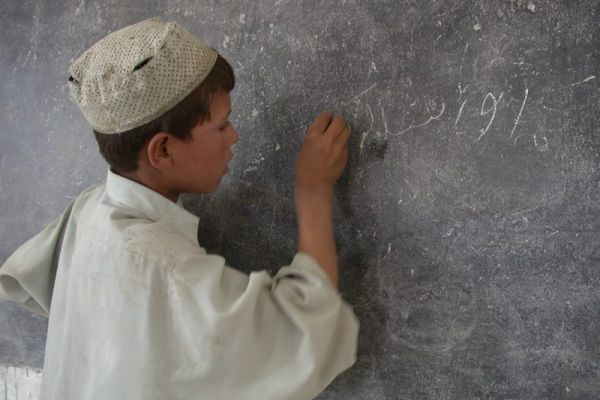
How can we expect to write the peace without basic food and education for Afghan children? Low funding for WFP has forced the reduction of school feeding programs in Afghanistan. (WFP/Ebadullah Ebadi)

As drought and high food prices have descended upon Afghanistan, safety nets have been taken away from children. Low funding for the UN World Food Programme (WFP) means 1.5 million Afghan children are no longer receiving a school feeding ration.

The situation is getting worse. WFP reports that the supply of fortified high energy biscuits for Afghan school children will run out by November. This will bring a halt to school feeding in Afghanistan and leave another 500,000 children without a school meal. A donation from India is expected to arrive in December, but this will allow for only a limited resumption of the program.

WFP depends entirely on voluntary donations by the international community. Since funding has run dry, all year they have been forced to reduce their school feeding and other food aid programs in Afghanistan.

While they have done this, drought conditions have set in around parts of the country causing food shortages. High food prices remain a threat to the entire impoverished Afghan population.

While hunger escalates in Afghanistan and around the world, the U.S. Congress is proposing reducing funding for the Food for Peace and other global hunger fighting programs.

Food is desperately needed right now in Afghanistan. The international community needs to support urgent food aid for the drought-affected areas. School feeding should be resumed at once and expanded where possible.

Afghanistan’s future cannot be built upon hunger, suffering, and a lack of education. Child feeding programs take on the utmost urgency as malnutrition and lack of education threaten an entire generation of Afghans.

Article first published as Food for Afghan Schoolchildren Runs Out as Drought Strikes on Blogcritics.

Leave a comment

Filed under global hunger

Over 1 Million in Yemen Denied Emergency Food Rations

Aisha is an internally displaced Yemeni girl in Southern Yemen living in an elementary school. She is one of many Yemeni children who are suffering from hunger and displacement. WFP and other aid agencies need support in order to carry out child feeding and rehabilitation programs. (WFP/Abeer Etefa)

Over one million Yemenis did not receive emergency food rations in September because of low funding for the UN World Food Programme (WFP). The UN food agency depends on voluntary donations from the international community.

As food prices have risen dramatically in 2011, impoverished families have been pushed deeper into hunger. Reports have shown families resorting to skipping meals.

In late 2010 WFP drew up a plan to distribute emergency food rations to around 1.8 million Yemenis who were struggling to afford basics like bread. The idea was a safety net for vulnerable families to prevent malnutrition and disease from gaining strength.

Back in February, I wrote a letter in the New York Times urging acceptance and funding of the plan by the U.S. and international community. As 2011 evolved into a year of protests, instability, and skyrocketing prices, this food aid took on even more urgency.

However, funding has been so limited that seven food-insecure governorates (around 700,000 people) were not able to receive any distributions this year. The cuts deepened as 500,000 more Yemenis were left off the most recent round of food distributions in September.

About 1.2 million Yemenis who should have been receiving food rations from WFP last month did not. But this has been the reality of food assistance programs for Yemen. They have been underfunded as the hunger crisis continues to deepen.

In addition, WFP’s Food for Education program for children has only had two distributions in the last two years. Both of them have been limited and able to reach only part of the intended recipients.

This initiative gives children food rations to take home from school. It’s a great plan for eliminating hunger and keeping kids in class. However, this year’s WFP Food for Education distribution reached only 59,000 of 115,000 planned beneficiaries. The ration size also shrank from two items to one. A program that should be expanded to reach hundreds of thousands of additional children has been getting by on relative scraps for years now.

UNICEF also is suffering from severe funding shortages as they try to help Yemen tackle the crushing child malnutrition crisis. I have reported on these funding shortages on numerous occasions as children lacking in nutrition are at risk of lasting physical and mental damage. It’s clear that no favorable outcome for Yemen will come about unless child nutrition is made a priority.

Anthony Lake, UNICEF’s director, said this week, “Malnutrition rates were alarmingly high in the country even before the current violence broke out, and its impact on the poorest people has only been compounded by rising food prices and collapsing basic health services. Of 3.6 million children under five years of age in Yemen, at least 43 per cent are underweight and 58 per cent are stunted.”

Imagine if a generation of Yemenis were not malnourished. They could solve many of their societal and governmental problems on their own.

What if we gave them that chance? We could do that almost right away with a full supply of plumpy’nut to knock out all existing cases of child malnutrition. A food for education system would do wonders because school feeding promotes nutrition and learning.

If we take action on these fronts, Yemen has a chance for a prosperous and peaceful future. The alternative is to continue to ignore the cries of hunger, and children stunted in growth and mind. That road, we know, is full of peril for all.

Article first published as Over 1 Million in Yemen Denied Emergency Food Rations on Blogcritics.

Leave a comment

Filed under global hunger

Afghanistan 10 years later- Starvation Threatens War-Torn Country

October 7th marks the 10 year anniversary of the war in Afghanistan. And as if war has not been enough, famine is descending upon Afghans.

Drought has struck 14 provinces in Afghanistan. Crops have been ruined and food supplies are almost gone. The charity Oxfam says, “Nearly three quarters of the people living in the affected areas say that they will run out of food in less than two months.”

As famine conditions have strengthened, funding for UN World Food Programme (WFP) has diminished. The UN food agency relies entirely on voluntary donations.

WFP was forced to cut school meals for hundreds of thousands of Afghan children earlier this year. In a country deeply mired in poverty, school meals are a lifeline the children desperately need.

Afghanistan has one of the highest rates of hunger and malnutrition in the entire world. If this crisis, which is often ignored by policymakers, were given more attention many of Afghanistan’s ills could be remedied. For food is the foundation of peace, education and literacy, and maybe most of all hope. Hope and Afghanistan are two words not often associated.

There is talk of donor fatigue when it comes to Afghanistan and hunger relief in general, but this is nonsense. Food aid programs make up less than one tenth of one percent of the entire federal budget.

Congress has proposed reducing funding for the Food for Peace and other hunger fighting  programs. This is such a mistake when peace in Afghanistan and other parts of the world depend on fighting hunger.

After World War II, when a CARE package center was opened in downtown Cincinnati, Ohio people flocked there to buy food for hungry people overseas. The first one to do so was a former World War I infantryman.

The first World War saw immense human suffering from both warfare and the resulting famine, and this donor had compassion and first-hand understanding of their plight. Americans from that generation did not suffer from donor fatigue, and continued feeding the hungry during the war and afterwards. Following the Second World War millions more were saved, and Europe was rebuilt from the important foundation of food.

Today, we cannot forget about Afghanistan nor let the people suffer. On this 10 year anniversary of the war in Afghanistan, let’s work to win the peace. It can start with fighting hunger.

Article first published as Afghanistan 10 years later- Starvation Threatens War-Torn Country at Blogcritics.

Leave a comment

Filed under advocacy, Afghanistan, Congress, drought, global hunger, malnutrition, Oxfam, School feeding, The Roadmap to End Global Hunger, World Food Programme