Tag Archives: school feeding

Special delivery of food for children in Guatemala

Many families are struggling in Guatemala. Poverty has worsened because of the coffee rust. This is a fungus which infects and destroys coffee leaves. Small farmers are not able to grow as much of the staple crop. Their incomes are lower, and this is very difficult considering the already existing poverty levels.

Read the full article at Examiner.

Leave a comment

Filed under global hunger

USDA kicks off drive for school meals worldwide

The U.S. Department of Agriculture (USDA) just announced a series of grants for school feeding in ten different countries. It’s part of an effort inspired by former Senators George McGovern and Bob Dole.

Read the full article at Examiner.com

Leave a comment

Filed under global hunger

You Can Help McGovern-Dole School Meals Campaign

The presidential campaigns of former senators George McGovern (1972) and Bob Dole (1996) have long taken residence in the history books. However, one campaign they started continues even after McGovern’s passing. It’s fighting world hunger by providing school meals to hungry children.

You can help this campaign by asking Congress to support the McGovern-Dole Food for Education program. This initiative, run by the U.S. Dept of Agriculture, provides school meals to hungry children around the world.

Read the full article at The Huffington Post.

Leave a comment

Filed under global hunger

Food and Education Can Change the World

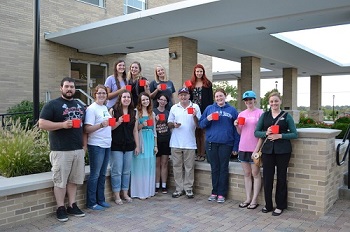
The UN Development Goals Class at the College of Mount St. Joseph (Dr. Jim Bodle)

The UN Development Goals Class at the College of Mount St. Joseph (Dr. Jim Bodle)

Last month I spoke to a unique class at the College of Mount St. Joseph in Ohio, one dedicated to ending hunger and poverty through the UN Development Goals. The class had attended Ban Ki-moon’s Youth Day presentation at the General Assembly.

As I prepared for the class a surprise came to me via twitter! It was a letter from a child in Mali, a country in Africa that has suffered through conflict and drought. The UN World Food Programme (WFP), which is providing school meals in Mali, forwarded a translation of the letter:

Hello papa et maman. After 11 months of occupation in North Mali by armed bandits we’re today on the path to school. Our parents are poor and tired.

Thank you WFP who gave us food so we could work hard in school. We always count on God and you. With WFP it’s okay. The school in Barize thanks you.

These school meals take on even more urgency in Mali with recent findings that show three out of every four households in the northern part of the country suffer from hunger. Both WFP and Catholic Relief Services are providing food for schoolchildren in Mali. Funding though is always an issue.

Food and education for children is something that clearly does not get enough attention, yet it’s one of our most important pathways to peace.

Ban Ki-moon told the Youth Day audience in August about his experiences growing up in war-time Korea. When it rained there were no classes because those were held outdoors. The school buildings had been destroyed during the fighting.

The Secretary General said the Korean children were hungry for food, but also hungry for knowledge. “It’s not only bread and butter” he said, “you need to have knowledge and education.” Getting children food and education is a top priority worldwide.

What better example than South Korea? During and after the war food was provided to children through the United Nations, CARE and other organizations. The U.S. Food for Peace program was founded after the Korean War. Millions of Korean children received school meals through Food for Peace.

History provides us even more advice. It was October 1st, 1947 when Secretary of State George Marshall said, “Hunger and insecurity are the worst enemies of peace.” He knew that peace after World War II stood no chance unless the enemy of hunger was defeated. Europe’s recovery was only possible under a foundation of food. School meals were a huge part of this recovery. That is a lesson we need to remember today.

It was a great opportunity to speak to the UN Development Goals class about food and education for children. Everyone in the class even received a Red Cup which is the World Food Programme’s symbol of school meals.

The school meals mean a lot to every country, from the United States to Yemen. The United States has its own national school lunch program, building upon years of effort. Now the U.S. Congress ironically is trying to undo that by eliminating some free school meals as part of its food stamp cuts.

That is why it’s so important that people advocate for what should be a basic right for children: school meals. The UN Development Goals class, with its emphasis on service learning, is well-equipped to carry on this message.

Next year Yemen will be starting their own national school lunch program with the help of WFP, a potential major turning point for a country mired in conflict and poverty.

Erin Koepke of the World Food Program USA said to me, “I love how there is a class dedicated to the Millennium Development Goals. If only all colleges and universities had a similar class.” I agree.

originally published at the Huffington Post

Leave a comment

Filed under global hunger

College Students Hear Message of Hope from UN Chief

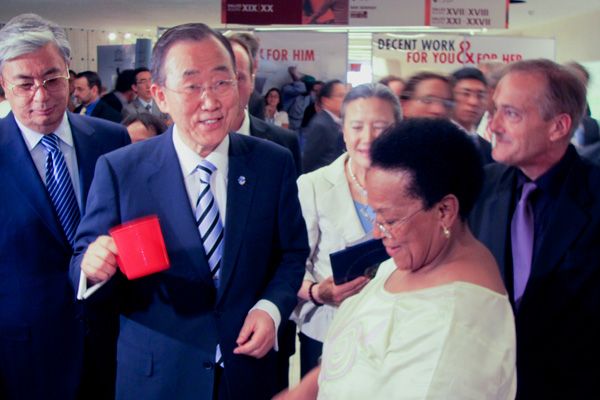
United Nations Secretary General Ban Ki-Moon holding the famous red cup which symbolizes the movement to provide all children worldwide with school meals. Mount St. Joseph students listed to presentations both at the United Nations and on campus about the importance of school meals in ending hunger and poverty (photo courtesy of the UN World Food Program)

United Nations Secretary General Ban Ki-Moon holding the famous red cup which symbolizes the movement to provide all children worldwide with school meals. Mount St. Joseph students listed to presentations both at the United Nations and on campus about the importance of school meals in ending hunger and poverty (photo courtesy of the UN World Food Program)

Last month College of Mount St. Joseph students traveled to the United Nations in New York. Their mission was to learn about the UN Development goals to end world hunger and poverty.

The students attended a presentation by UN Secretary General Ban Ki-Moon. The Secretary General talked about bread and butter. Not the appetizer kind. What he meant was how children around the globe needed food, but also education.

The Secretary General told the story about growing up during the Korean War. Schools were destroyed during the fighting and children attended class outdoors, under shade of trees. When it rained there was no class.

The Secretary General said how he and other children were hungry for food, but also for knowledge. “It’s not only bread and butter” he said, “you need to have knowledge and education.” Getting children an education is a top priority worldwide.

The Mount students, upon returning to campus, learned more about the importance of food and education for children. The story of war-time Korea further illustrated this point as former Cincinnati resident, Major Charles Arnold, led a UN civil assistance team that fed Korean refugee children. Without this food, the children would have suffered severe malnutrition.

The Charity CARE, with support from the U.S. Food for Peace program, provided millions of Korean children with school feeding over the decade following the war. This was a key strategy to fighting malnutrition and boosting school enrollment and learning.

Today, the United Nations World Food Program spearheads a global effort to provide all children with school meals. It’s called The Fill the Red Cup Campaign.

MSJ students received red cups from the World Food Program USA last week as a symbol of this school feeding movement. They also listened to historic messages from General Dwight Eisenhower, who spoke in 1948 at the United Nations Crusade for Children. Ike emphasized how starving children, scrapping for food, could not grow up to be apostles of peace. Food aid is essential now as it was after World War II.

The Mount campus currently fundraises for UN school feeding programs and Feeding America through its Charity Miles team. The UN class is planning to continue to spread Ban Ki-Moon’s message of hope, food and education for all.

article originally published at Cincinnati.com

Leave a comment

Filed under global hunger

Haiti Faces a Summer of Hunger

A series of disasters, coupled with low funding for aid agencies, places millions of Haitians at risk of severe hunger. (WFP/Stephanie Tremblay)

A series of disasters, coupled with low funding for aid agencies, places millions of Haitians at risk of severe hunger.
(WFP/Stephanie Tremblay)

The UN World Food Programme (WFP) confirmed today it will not be able to provide summer school feeding for children in Haiti.

The UN food agency, which depends on voluntary donations, is already short on resources for many of its programs to help Haiti recover from a series of disasters.

In addition, a WFP take-home ration plan for 200,000 school children lacks funding to get started. This food aid is essential for families suffering from severe hunger and it allows their children to stay in school.

There are 6.7 million people, over half the population, that suffer from hunger in Haiti. Alejandro Chicheri of WFP says that of this number, around 1.5 million Haitians face severe hunger. Drought and a series of storms severely damaged agriculture, placing already impoverished families under additional stress.

A report from the Famine Early Warning System stated, “despite the evident readiness of local farmers, poor seed availability is threatening the success of this year’s crops…. Poor households in many rural areas could still be facing a food shortage directly after the July harvest.”

The charity Live Beyond provides food, water and medicine in Haiti and says it is “providing bags of rice and beans” at its medical clinics, “to ensure that the sickest of the sick are able to continue living through this period of starvation.”

At a fundraising event, actress and activist Kimberly Williams-Paisley recently said, “The phrase you hear most often in the LiveBeyond Mobile clinics is ‘Mwen grangou’ or I am hungry.”

Meanwhile, the U.S. Congress is threatening to reduce funding for the Food for Peace and the McGovern-Dole programs, both which help Haiti. President Obama is urging Congress not to cut these aid programs, which already are a relatively tiny part of the federal budget.

The World Food Programme continues to work with the Haitian government to build a national school lunch program. WFP provides meals during the school year to hundreds of thousands of children. The goal is for Haiti to run this program entirely using locally produced food.

These goals though cannot be obtained unless Haiti has the food supply to endure the reconstruction.

Leave a comment

Filed under global hunger

Catholic Relief Services Wants McGovern-Dole Expanded to Fight World Hunger

McGovern-Dole funding is allowing CRS to provide school meals in war-devastated Mali, where poverty rates are high. (Kristina Brayman/CRS)

McGovern-Dole funding is allowing CRS to provide school meals in war-devastated Mali, where poverty rates are high. (Kristina Brayman/CRS)

Catholic Relief Services (CRS) has a long history of supporting school meals around the world, dating back to the World War II era. Now CRS is calling on Congress to fund the McGovern-Dole global school meals program at $250 million this year. Previous funding levels are around $205 million.

School meals make foreign policy sense. Sean Callahan of CRS recently stated before Congress, “Education and nutrition are inextricably linked to future economic growth.”

That is why CRS wants to see the McGovern-Dole initiative expanded. Haiti, Afghanistan and many other countries need support for school feeding. In Mali, where conflict and drought have devastated the lives of millions, school meals are a big part of aiding children.

CRS received a McGovern-Dole grant for Mali and it’s making a difference. At last report, CRS is “currently serving 310 schools in two regions and approximately 58,000 beneficiaries.” CRS provides meals as well as vitamins and medications to the school children.

Callahan adds, “The program has helped to increase school enrollment for girls by 41% and for boys by 22%. On average, students attended school 95% of the days classes were held.”

The CRS Mali program also has elements of local food production for providing the meals. This is key. Where possible, the food for school meals needs to come from local sources. This helps communities and furthers the stability of the program so that continued aid is not needed.

The UN World Food Programme (WFP) also is providing school meals in Mali. The UN food agency relies on voluntary funding but often struggles to receive it. Expanding McGovern-Dole, for instance, could allow an opportunity to support WFP and its school feeding in Mali.

The Congress will have an opportunity to increase the McGovern-Dole funding in the upcoming Farm Bill legislation.

Article first published as Catholic Relief Services Wants McGovern-Dole Expanded to Fight World Hunger on Blogcritics.

Leave a comment

Filed under global hunger

School Feeding Starts for Syrian Refugee Children

The UN World Food Programme (WFP) said today that school feeding has started for over 10,500 Syrian children in refugee camps in Jordan and Iraq. The goal is to boost nutrition and school attendance at the same time.

WFP is already reporting a 20 percent school attendance increase in the Jordan camps since the feeding began.

Muhannad Hadi, WFP’s Emergency Coordinator for the Syria crisis, says “Many Syrian children have already gone through an incredible ordeal — losing family members, crossing borders and living as refugees in neighbouring countries — and they need to be back in school. We use school feeding across the world to provide vital nutrition to children and encourage them to stay in school. We don’t want to see a lost generation of Syrian children who fail to reach their potential.”

At the Zaatari refugee camp in Jordan 6,000 children are receiving a mid-day snack in two UNICEF operated schools. Save the Children is assisting with distribution of the food. WFP plans to boost the Jordan program to reach 30,000 children. At the Domiz camp in Northern Iraq 4,500 children are receiving the nutritious snacks, which are fortified with 11 vitamins, 3 minerals and 450 calories. Plans are underway to increase the program in Iraq to 6,000 children.

WFP relies on voluntary funding and needs US $ 780,000 to continue the school feeding for the rest of the year. For the entire Syria relief mission WFP is short on US $ 113 million in funding to provide aid through June.

WFP has a relief fund where you can donate to help Syrian war victims.

Leave a comment

Filed under global hunger

School Meals Vital to Recovery in Burkina Faso

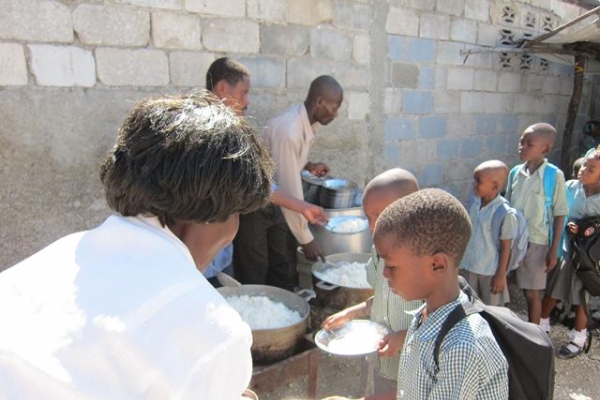
During the Sahel drought of 2012 children at the Tin-Ediar school in Burkina Faso line up for meals provided by the World Food Programme. The children are provided breakfast and lunch at school. (WFP/Anne Poulsen)

During the Sahel drought of 2012 children at the Tin-Ediar school in Burkina Faso line up for meals provided by the World Food Programme. The children are provided breakfast and lunch at school. (WFP/Anne Poulsen)

Many of us have seen drought at one time or another. Last summer a severe one scorched across much of the United States. The impact is hard, but imagine if you are a poor family in a developing country, dependent on crops for income and food. When drought strikes it destroys your food supply and you have almost nothing to fall back on.

This is what happened in the Sahel region of Africa last year when massive drought struck. The UN World Food Programme (WFP) in Burkina Faso says this caused many families to move to mining zones to find work. Their children would have to work too, meaning they would have to drop out of school.

WFP, though, had a school feeding plan to help families deal with the shock of drought and to keep the children in class. Last year in Burkina Faso, one of the Sahel countries, WFP fed 91,783 children breakfast and lunch at school and some girls received take-home rations. When food becomes scarce and high-priced as it did in the Sahel last year, food at school becomes a life-changer.

Burkina Faso had another emergency besides drought. The war in Mali created a number of refugees, some of whom fled to Burkina Faso. Ariane Waldvogel, the WFP deputy country director for Burkina Faso, says, “Malian refugee children were absorbed into local schools and received school meals…This assistance was key in not only improving the food security of the refugee children but also played a role in keeping relations between refugee and Burkinabé host communities peaceful.”

As 2013 unfolds school meals are still vital in Burkina Faso and throughout the region. School attendance in Burkina Faso’s Sahel region as a whole is low. WFP wants to expand its program to reach 100,000 children this year as it continues to help Burkina Faso recover. In time this program can help build a national school meals program, such as we have here in the United States.

WFP depends on voluntary donations, though. They need about U.S. $4.1 million to provide the meals this year. Some funding has been received from Switzerland and the United States.

Waldvogel says, “The additional US $1.7 million are urgently required to enable WFP to purchase and deliver food in time to ensure that school children resume school in October and continue to receive their two meals a day. Multi-year funding would be ideal for this programme, providing a steady funding stream, which would allow WFP to provide constant school feeding assistance throughout the academic year.”

The U.S. McGovern-Dole program, which funds school meals in developing countries, would be a great resource for Burkina Faso. It’s important that the U.S. Congress not reduce funding for this program as stipulated by the Sequester. School meals play a critical role bring stability throughout the world in areas impacted by drought and conflict. There is no better example of this than in the Sahel region of Africa.

Article first published as School Meals Vital to Recovery in Burkina Faso on Blogcritics.

Leave a comment

Filed under global hunger

Senator Brown Urges School Meals at Home and Abroad

Senator Sherrod Brown recently visited Haiti and saw what a difference school feeding makes for children. The school meals are funded by the U.S. McGovern-Dole program. (World Food Programme photo)

Senator Sherrod Brown recently visited Haiti and saw what a difference school feeding makes for children. The school meals are funded by the U.S. McGovern-Dole program. (World Food Programme photo)

United States Senator Sherrod Brown (D, OH) has been a long-time advocate for the school lunch program in Ohio and across the country. He is currently trying to expand summer feeding to reach more children in need.

Brown is also advocating for school meals abroad as an important piece of U.S. foreign policy. The News Record reported on Brown’s recent visit to Haiti. There the Senator saw the impact of school meals, funded by the US McGovern-Dole program, on Haitian children.

Named after former Senators George McGovern and Bob Dole, this program funds school meals in developing countries. The UN World Food Programme (WFP) received the McGovern-Dole grant for Haiti and distributes the food. Elizabeth Jennings of WFP says the McGovern-Dole funding “has been vital” in supporting school feeding in Haiti.

WFP relies on voluntary funding for its hunger relief programs in Haiti and other countries. These programs often face low funding levels. The McGovern-Dole grant has allowed WFP to feed about 300,000 Haitian children.

For many children in developing countries, school feeding might be the only meal they receive the entire day. McGovern-Dole funding allows millions of children in Haiti, Afghanistan, Mali and other countries to get food for education.

Although McGovern-Dole and other international food aid is less than one tenth of one percent of the federal budget, it is often targeted for cuts by some members of Congress. Bread for the World says that the sequester will mean “234,000 children will experience reductions from or be denied access to school feeding programs administered through the McGovern-Dole program.”

Senator Brown is urging that the U.S. continue to fund McGovern-Dole and other food aid programs.

Article first published as Senator Brown Urges School Meals at Home and Abroad on Blogcritics.

Leave a comment

Filed under global hunger