
Imagine if all the people in Ohio, New York, Pennsylvania and Michigan were forced to leave their homes. What if conflict displaced this entire population? It would be a gigantic humanitarian nightmare.
Read the full article at Examiner.
Imagine if all the people in Ohio, New York, Pennsylvania and Michigan were forced to leave their homes. What if conflict displaced this entire population? It would be a gigantic humanitarian nightmare.
Read the full article at Examiner.
Filed under global hunger
President Dwight Eisenhower started it. President Kennedy expanded it. Some members of Congress once sought to abolish it. It’s the Food for Peace program of the United States. The initiative has fed the hungry worldwide and saved millions of lives.
Read the full article at Examiner.
Filed under global hunger
On June 5, 1947, at Harvard University’s graduation, George Marshall delivered a speech calling for the rebuilding of war-devastated Europe. Marshall, the Secretary of State, said the United States had to stand “against hunger, poverty, desperation and chaos.”
Read the full article and watch video at Examiner.com
Filed under global hunger
The UN Food and Agriculture Organization (FAO) warned today of a severe hunger crisis in the Central African Republic (CAR). Conflict has ravaged the CAR since last year with nearly one million people displaced.
Read the full article at Examiner.com
Filed under global hunger
Congress will soon be voting on the new farm bill legislation. At that time, funding for programs that fight hunger locally and globally will be decided.
You may have seen in the news the typhoon in the Philippines that left millions without homes and food. In Syria, war has killed children not only because of the fighting, but because of malnutrition caused by the conflict. Food shortages are always the companion of war and disasters. Farming areas are often destroyed in these tragedies.
Read the full commentary in The Buffalo News
Filed under global hunger
When Congress gets back to work this month they need to finish the Farm Bill. A vital part of this legislation is the Food for Peace program, the largest source of funding for international food aid.

The UN World Food Programme, for example, depends on Food for Peace donations for many of its relief operations. It’s critical Food for Peace receive as much funding as possible, especially with hunger emergencies from the war in Syria, Central African Republic, South Sudan, Afghanistan and other areas.
In the following Q and A, David Kauck of Save the Children discusses what would be a good policy on the Farm Bill regarding Food for Peace. Kauck is Save the Children‘s Associate Vice President for Hunger and Livelihoods.
How does Save the Children feel about funding for the Food for Peace program?
Save the Children is strongly supportive of the Food for Peace program, which provides food aid to vulnerable children and families in the poorest countries in times of humanitarian crises or to tackle chronic hunger. However, we also acknowledge that the cost-effectiveness of these programs could be significantly improved with a few reforms (see our response to Question 2).
What would be a good plan for Food for Peace in 2014 on the Farm Bill?
For several years, Save the Children’s has advocated for common sense changes to U.S. food aid or the Food for Peace program. These changes would include eliminating restrictions on the use of local and regional food procurement; repealing inefficient shipping requirements; and scaling down food aid monetization over a period of time, accompanied by an equivalent increase in development assistance.
Support from the White House coupled with U.S. budget constraints posed by sequestration last year is causing bipartisan support for reform to grow. Early research shows that the reforms could provide considerable cost savings resulting in more aid to more children, greater flexibility to use the most appropriate approach available to assist people in need, and faster humanitarian response times. The cost-savings generated from reforms, when reinvested back into food aid, will provide food for an additional 2-4 million children and adults. The bottom line: food aid reform is good for kids.
What would be a good figure for the new Farm Bill?
We have copied and pasted below an excerpt from our FY 2014 appropriations priorities document, which details what we have asked for Food for Peace.
Food for Peace, P.L. 480 – Fund at $1.466 billion, including $35 million to reduce monetization – consistent with the FY14 Senate Agriculture Appropriations bill. The Food for the Peace (FFP) program is the primary vehicle providing U.S. emergency food aid and multiyear food security assistance to millions of children and families every year. These programs play a vital role in preventing famines, reversing acute and chronic child malnutrition, addressing displacement by conflict or natural disaster, and enabling vulnerable populations to build resilience against future shocks. Given the current high demand posed by Syria, Philippines and other crisis areas, we urge Congress to avoid any cuts to FFP whatsoever. We also urge Congress to support the Senate funding of $35 million within the overall Title II funding to reduce the need to monetize commodities to fund programs, which would increase chronic hunger program efficiency by 30 percent and result in reaching 800,000 more children in need.
And combined with the recommended efficiency improvement (allowing local purchase, some of which they did in Typhoon Haiyan relief) would make the money go even further?
Using cash transfers or buying food regionally or locally would drastically reduce the time and costs of transportation, shipping and handling and would result in up to $165 million in cost savings. The cost savings could be reinvested back into food aid, providing food to an additional 2-4 million children and families each year, at no extra cost. In addition, the food could be delivered three months faster than it takes today. Getting food to severely malnourished children more quickly is critical when they are on the brink of death.
The United States Agency for International Development (USAID) would also have greater resources available to secure and deliver more nutritious products. For example, USAID may include more ready-to-eat Plumpy Nut packets, which are filled with a nutrient-rich peanut paste that gives undernourished children a healthy boost. Indeed, reforms could create even more incentives for U.S. companies to produce more nutritious kinds of food aid.
Visit the Bread for the World advocacy action center for the Farm Bill.
Read the Q and A at Examiner.com
Filed under global hunger
The horrific numbers increase daily from the war in Syria. The UN now says that 6.3 million Syrians need life-saving food aid. The UN World Food Programme (WFP) requires $2 billion to feed them in 2014. If this war continues, these numbers will go up again.
“This is the worst humanitarian crisis that we have seen in decades, with every day more vulnerable Syrians pushed into hunger,” says Muhannad Hadi, Syria coordinator for WFP.
The U.S. Congress needs to act and boost our Food for Peace program to meet this Syrian emergency as well as others. As the new year approaches, the Philippines, Central African Republic, Mali, Democratic Republic of Congo, and South Sudan have been struck by conflict or natural disasters.
The Farm Bill legislation, which Congress will take up again in January, is where Food for Peace funding is decided.
WFP depends on Food for Peace as its largest single donor. It’s crucial that Congress support Food for Peace when you consider the ongoing humanitarian emergencies.World Food Day
David Kauck of Save the Children points out that reforms to Food for Peace must also be passed. “These changes would include eliminating restrictions on the use of local and regional food procurement; repealing inefficient shipping requirements; and scaling down food aid monetization over a period of time, accompanied by an equivalent increase in development assistance.”
When a disaster occurs, such as the typhoon in the Philippines, aid groups can sometimes use local food sources to feed those in need. Aid groups must have no restrictions on using this option.
Kauck adds, “Early research shows that the reforms could provide considerable cost savings resulting in more aid to more children, greater flexibility to use the most appropriate approach available to assist people in need, and faster humanitarian response times.”
The Farm Bill impacts both our domestic and foreign policies. A strong Farm Bill feeds the hungry both at home and abroad. Only in this way can we be strong as a nation, and also further global peace and stability.
Food aid is the only thing that will save children from damaging and even deadly malnutrition. Food is a force that can help restore peace.
We also know there is enough food on the planet for everyone, and no one, especially children, should be without.
Let’s remember that our decisions on food aid policy can change lives and make or break an entire generation in whole countries and regions. So let’s take the right action on the Farm Bill. Let us choose Food for Peace.
Read the full article at Yahoo! Voices
Filed under global hunger, Uncategorized

Congress is threatening to cut food aid in the Farm Bill.
We need a Farm Bill that fights hunger in America and preserves the food stamp (SNAP) program. There are millions of Americans struggling because of unemployment and low wages. Yet, SNAP cuts took effect November 1st and more might be on the way depending what Congress does.
Feeding America’s Bob Aiken says, “We’ve seen throughout our network of food banks the impact that these cuts are already beginning to have — with longer lines and an anticipated growth in need. Our food banks are stretched and charity alone can’t make up for this cut to federal assistance”
Cuts to food stamps is not going to create jobs and higher wages. In fact, it will harm hungry Americans and grocers where the stamps are redeemed. Part of the House proposal on SNAP also includes eliminating free school meals for 210,000 children. Why is nutrition and education being cut?
The Farm Bill is equally important for our foreign policy. The U.S. Food for Peace initiative is the single largest donor to the UN World Food Program, which fights hunger in over 70 countries.
Food for Peace donations feed people in the Philippines, Syria, Afghanistan, Sudan, Yemen, Haiti, Mali and many other countries. With so many wars and disasters ongoing more food is desperately needed. Children are starving in these countries.
They are not asking for much. They just want a life-saving treatment of Plumpy’Nut to prevent the irreversible effects of malnutrition. Or a child whose life could be changed if there could be a school meal. In the Democratic Republic of the Congo, the UN had to cut school meals and nutrition for children because of low funds.
As George Marshall once said, “hunger and insecurity are the worst enemies of peace.” That philosophy guided U.S. foreign policy during our Greatest Generation. Food was the driver of writing the peace. It should be that way today too.
Congress has to get its act together and pass a Farm Bill with a strong Food for Peace program. This should include local purchase of food as was done recently when a donation allowed WFP to buy rice from farmers in the Philippines.
The McGovern-Dole global school lunch effort also needs a boost. There are millions of hungry children whose lives could be changed by some school meals.
We can’t just drift along pretending there is not a major world hunger crisis ongoing that is a danger to everyone’s security.
Domestically, Congress needs to strengthen our nutrition programs. Our food banks need support as they help hungry Americans get back on their feet. Congress has to realize this and finish a responsible Farm Bill.
article originally published at The Huffington Post.
Filed under global hunger

Congress will decide budget amounts for food aid programs at home and abroad in the upcoming Farm Bill Credits: World Food Program USA
This week foodbanks across the country will be distributing food rations to the needy. Also this week a shipment from the U.S. Food for Peace program arrived in conflict-torn and impoverished Yemen. What do these two programs have in common besides fighting hunger?
Both initiatives depend on funding from federal programs in the upcoming Farm Bill legislation. Many food banks benefit from The Emergency Food Assistance Program (TEFAP) which sends donations to states for foodbanks to distribute. The Food for Peace program fights hunger overseas as a way to promote stability worldwide.
Congress will be deciding in the coming days how much to fund both of these hunger-fighting plans. Now is the time for people to let their representatives in government know that fighting hunger needs to be a priority of both our domestic and foreign policies.
Food is the basis of all things. Children in America suffering from hunger cannot learn and become the best they can be. Food can be a difference-maker for a child and his or her family, a safety net when tough economic times come.
Overseas, food is life-saving in areas of conflict and natural disaster, of which there are many ongoing – in South Sudan, the Democratic Republic of the Congo, Syria and elsewhere. When the conflicts end, food can give people and communities the stability they need to rebuild and make peace. Food can also make the difference there whether a child attends and finishes school.
While the face of hunger may be different from one country to the next, it is vitally important to combat the menace wherever it may be.
Ensuring funding for TEFAP and Food for Peace as well as the McGovern-Dole international school meals program are steps we can take without breaking the bank. Food aid programs are relatively inexpensive when compared to other programs. Annual spending on nuclear weapons for instance would beat Food for Peace and TEFAP by close to $50 billion.
There is enough food in the world to feed everyone, so why not fight hunger at home and abroad? This year’s Farm Bill is a great place to start by supporting TEFAP and Food for Peace.
Article first published as Fight Hunger at Home and Abroad in Farm Bill on Blogcritics.
Filed under global hunger
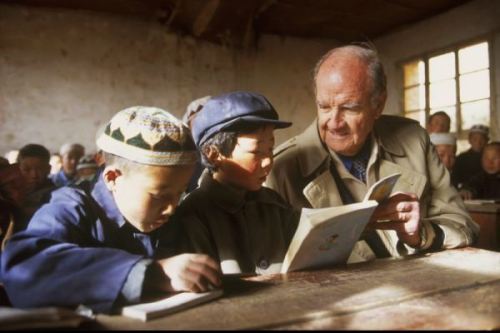
George McGovern, author of War Against Want and the Third Freedom, was named the United Nations World Food Programme’s first global ambassador against hunger. Credits: WFP
George McGovern passed away Sunday at 90 years old. He ran for President against Richard Nixon in 1972 and was a senator from South Dakota. But I remember him first for a book he wrote in 1964 called War Against Want: America’s Food for Peace Program.
McGovern was the director of Food for Peace under President Kennedy. This was the top U.S. program in fighting world hunger, started during the Eisenhower administration. McGovern’s book explored the history of Food for Peace and America’s leadership in fighting world hunger.
I ordered a copy from Amazon.com one day in 2006 after taking a leadership course at the College of Mount St. Joseph. Up until that point I really had no idea what Food for Peace was or very much knowledge about global hunger in general. What better introduction than War Against Want. Ever since getting that book, I have been writing about hunger issues.
In 2008, the Friends of the World Food Program held a teleconference with McGovern. I got the chance to talk with him and he told his story of how influenced he was by his experiences as a bomber pilot in World War II. He saw hunger in the war-torn countries and that planted the seed for him becoming an advocate for the needy.
McGovern was a leader who emerged from a World War II generation that understood how powerful a force hunger is in international relations. This wisdom helped the Greatest Generation navigate the treacherous waters of the post-war world.
When McGovern became the Food for Peace director in 1961 he hit the ground running and led a big expansion, especially with school feeding. Children in South Korea, Brazil, India, Poland and other countries received school meals during McGovern’s tenure. These countries are now donors to food aid.
The U.S. Food for Peace program led to the creation of an international version which is today known as the UN World Food Programme (WFP). McGovern was the one who got the ball rolling on this initiative, now the largest food aid organization in the world. The U.S. Food for Peace program is the single biggest donor to WFP. So the two programs work hand-in-hand in the global effort to end hunger.
McGovern remained active in fighting hunger even long after his days in government. He served as a goodwill ambassador for WFP. Josette Sheeran, the WFP director from 2007-2012, said: “I have treasured knowing him and feeling his incredible support.”
In 2000, an international school meals program was started by McGovern along with Senator Bob Dole. The McGovern-Dole program has fed millions of children in Haiti, Afghanistan, Yemen, Bangladesh and other locations. Each year McGovern-Dole grants are awarded to WFP and other hunger fighting organizations so they can provide school meals in developing countries. If you want to pay tribute to McGovern a great way would be to advocate for this program to be expanded. What better way to reach out to the world than through school meals?
As WFP’s current director Ertharin Cousin says, “George McGovern saw – way before anyone else – how the simple, sustained act of putting a meal in the hands of a poor child at school could change that child’s life and give them a chance at a better future.”
McGovern also was a leader in building the U.S. national school lunch program including summer feeding. At a Friends of WFP teleconference someone asked whether hunger should be fought first at home before going abroad. McGovern replied: Why not do both? There are after all enough resources in the world to reach all hungry people. Why give any quarter in the fight against hunger? He certainly did not.
While McGovern has moved on, his legacy remains, and also his spirit. You can see this when new advocates for ending world hunger emerge, ready to build on the foundation he left. McGovern’s story, in that sense, is far from over.
Article first published as George McGovern Championed Food for Peace on Blogcritics.
Filed under global hunger

 Author William Lambers