Tag Archives: Feeding America

House Plan Eliminates Free School Meals for Nearly 300,000 Children

On Tuesday the charity Feeding America warned of the consequences of the House Agriculture Committee’s cuts to food stamps on the Farm Bill. The House committee currently plans to cut $16.5 billion from the Supplemental Nutrition Assistance Program (aka SNAP, or food stamps).

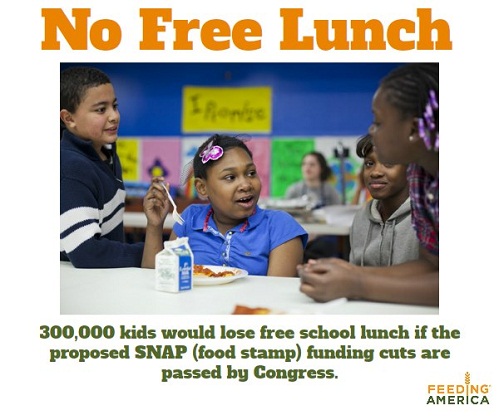
The cuts to food stamps would also mean that “nearly 300,000 children would lose their free school meals,” according to Feeding America. Children who were eligible for the free meals because their family received food stamps would lose access to a critical safety net.

Vicki Escarra, the president of Feeding America, asks, “What will households do to make up for this loss in food assistance? The vast majority of SNAP recipients have extremely low incomes – 20 percent of these households have no income at all…Proposed cuts would mean that some low-income Americans may literally go without food.”

The proposed cuts come at a time when 49 million Americans are suffering from hunger and unemployment rates are high.

For children and their families a free school meal is a safety net, especially in tough economic times. Since the early 1900s when Cincinnati school teacher Ella Walsh and other innovators started serving “penny lunches” to needy children, school feeding has evolved. By 1946 Harry Truman signed into law the National School Lunch Act leading to free or reduced-price lunches for children in need.

Today, child hunger is escalating in the United States and the loss of free school meals is a major blow to the fight to end hunger in America. Over 20 percent of children in the U.S. suffer from hunger, or “food insecurity,” according to Feeding America. Some counties in the U.S. have child hunger rates well over 40 percent.

Zavala County in Texas has over 48 percent of its children suffering from hunger, with Starr Country in Texas at just over 45 percent. Imperial County of California and Luna County in New Mexico are third and fourth on this list with 43 percent hunger rates. Yuma County in Arizona has 42 percent of its children suffering from hunger. The list goes on and on, with other counties well over 30 or 40 percent in child hunger rates.

Meanwhile the cuts to food stamps will mean an increased strain on already overstretched food banks. Escarra adds, “If these cuts to SNAP are passed, the food banks in Feeding America’s network will be even more overwhelmed with people seeking food assistance. The food pantries, soup kitchens, and other organizations that are served by Feeding America are already stretched to the limit.”

The full impact of this summer’s drought on food prices may not be felt for months. But if food prices become high over a significant period of time, then foodbanks will be stretched even more. The ranks of the hungry in the United States will struggle even more to find safety nets. Congress can change this by committing to ending hunger in America.

Brett Weisel, the director of advocacy for Feeding America, says that supporting federal anti-hunger programs isn’t about giving a handout. It’s about providing help up. So that those in need can achieve more. When people in our communities don’t have enough food to get through the day, it costs us all. Hunger creates health problems. Children struggle to learn. Workers are less productive. Opportunities are lost.”

Article first published as House Plan Eliminates Free School Meals for Nearly 300,000 Children on Blogcritics.

Leave a comment

Filed under Hunger in America

Drought Pushes Food to Top of Agenda for Obama and Romney

As the presidential election season has arrived so too has the worst drought to strike the United States in decades. This year more than half of all counties have been declared disaster areas according to the U.S. Dept. of Agriculture. About 65 percent of U.S. farms are in the pathway of the drought which escalated significantly during July. (US Dept. of Agriculture)
Credit: US Dept. of Agriculture
Copyright: US Dept. of Agriculture

As the presidential election season has arrived so too has the worst drought to strike the United States in decades. This year more than half of all counties have been declared disaster areas according to the U.S. Dept. of Agriculture. About 65 percent of U.S. farms are in the pathway of the drought which escalated significantly during July.

As President Barack Obama and challenger Mitt Romney travel the country they will never be far from the drought’s impact. Farmers are feeling the strain of increased production costs to try and save as much of their crop as possible. Everyone will feel the drought’s impact with the expected increases in food prices. The full effect of the drought will be felt long after the summer has ended.

In a report on food prices USDA says, “We will likely see impacts within two months for beef, pork, poultry and dairy (especially fluid milk). The full effects of the increase in corn prices for packaged and processed foods (cereal, corn flour, etc.) will likely take 10-12 months to move through to retail food prices.”

Feeding America, the nation’s largest food aid organization, says 49 million people suffer from hunger. Increases in food prices will put further strain on families trying to put food on the table. Families on the border of food insecurity may soon fall in with the effect of food prices. High prices will also make it harder for emergency food banks to have food supplies on hand to help them. Safety nets for those in poverty will be essential to weather the latest storm of hunger.

But an increase in food prices will also harm of the most essential aspects of American foreign policy: fighting global hunger. The U.S. budget towards fighting global hunger is already facing cutbacks. If food prices are high globally, then these dollars will have reduced buying power to aid the world’s hungry. The budget for hunger fighting programs, which is less than one tenth of one percent of the federal budget, would need to be increased.

U.S. hunger fighting programs like Food for Peace are needed to stabilize crisis areas in Sudan, Afghanistan, East Africa, Yemen the Sahel region and Haiti. If food supplies are reduced then dangerous malnutrition could threaten lives in these areas, particularly small children who suffer lasting physical and mental damage without enough food. Without food there is no hope for peace and development in any of these areas.

The World Food Program USA and other aid groups are calling on the President and the Congress to appoint a global food security coordinator. The coordinator, or full time food ambassador, would be a top-level position at the National Security Council who would coordinate the entire government’s response to hunger.

Both Obama and Romney need to have fighting hunger at home and abroad a key theme in their vision for America. For hunger is fast gaining strength in a time of devastating drought.

Leave a comment

Filed under global hunger

Freestore, Public Library Seek to Escalate Fight Against Hunger in Cincinnati

The Power Pack provides children food for weekends during the school year. (Freestore Foodbank photo)

The Cincinnati Freestore Foodbank and the Cincinnati Public Library each want to expand child feeding programs throughout the city. Their proposals follow a Feeding America study that showed over 25 percent of children in Ohio suffer from hunger or food insecurity. Within Hamilton County, Ohio the child hunger rate is just above 21 percent.

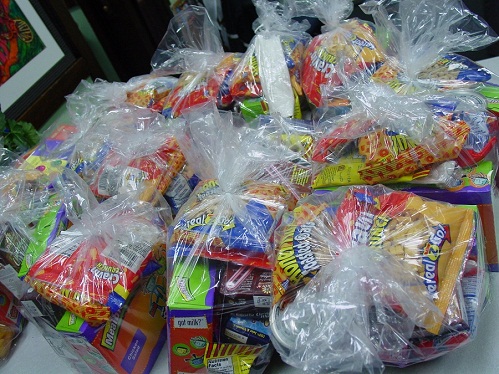
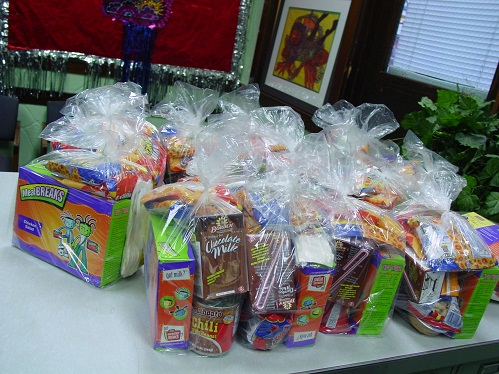
The Freestore wants to expand its school year Power Pack program for children. The Power Pack contains 9-12 non-perishable food items like cereal, fruit cups and pasta. It is provided to children so they can have food at their home over weekends when they cannot access the federal school lunch and breakfast program. It’s a way to ensure children do not suffer from hunger.

Kathy Greenberg of the Freestore says, “In the 2011-12 academic year, Power Packs were provided to the neediest 10% of our children in poverty in 90 schools. For the upcoming 2012-13 academic year, we will deepen our reach to 15% since the need continues to grow.” The schools are selected based on how much they participate in the federal free and reduced-price lunch program, which is a safety net for America’s kids established in 1946. Interestingly, some of the earliest school feeding in the country was pioneered by a Cincinnati school teacher named Ella Walsh in 1908.

The Cincinnati Public Library is also seeking to help out during this school year in ending child hunger. Diane Smiley, the Youth Services Coordinator for the Library, says “we’re looking at developing a community partnership that would provide free and healthy afterschool snacks to kids at our Homework Help sites…I’m hopeful that it will grow into a reality and maybe as early as the 2012-13 school year.”

This summer the Public Library is working with the Freestore to provide summer feeding as well as a backpack program so children can have a food supply for the weekends. The programs run by the Freestore and the Library will likely become even more significant with the rise in food prices resulting from the drought that has struck much of the country. Families will be in extra need of these food safety nets.

See also:

Ohio has childhood hunger crisis

Summer Feeding Means Summer Learning

Backpacks Fight Hunger in America

Article first published as Freestore, Public Library Seek to Escalate Fight Against Child Hunger in Cincinnati on Blogcritics.

Leave a comment

Filed under Hunger in America

Backpacks Fight Hunger in America

Food supplies for a Power Pack (Freestore Foodbank photo)

The Cincinnati Public Library says a plan to give children backpacks of food for weekends is off to an excellent start. Library branches, in partnership with the Cincinnati Freestore Foodbank, are hosting summer feeding sites to make sure no child goes hungry.

Over 25 percent of children in Ohio are considered hungry or “food insecure,” according to a study by Feeding America. Last month the Library decided to provide backpacks of food which children could take home on Fridays. This food is in addition to regular weekday meals at library branches throughout Cincinnati.

Diane Smiley, the youth services coordinator for the Library, says “Based on the numbers and anecdotal feedback from some of the sites, Friday attendance has spiked and all the backpacks are being distributed. We’re glad this additional resource is available to kids who are clearly in need.”

Karrie Denniston of Feeding America, the nation’s largest organization fighting hunger, says that adding backpack programs to summer feeding is generally a success: “It is becoming frequent actually. A lot of our summer programs run both.”

Backpacks ensure that needy children can have meals all week, and cut down the gaps in coverage that are so common when summer arrives. During the school year children have access to free and reduced-price meals through the federal school lunch and breakfast program. They also have access to backpack programs through their school. During the school year the Freestore Foodbank of Cincinnati runs a backpack program called the “Power Pack.” When summer comes and school is out, a replacement is needed.

The Freestore is planning expansion of its school year “Power Pack” program as well. The Cincinnati Public Library is also seeking to expand its role in alleviating child hunger and promoting education. Smiley says that “we’re looking at developing a community partnership that would provide free and healthy afterschool snacks to kids at our Homework Help sites.”

Article first published as Backpacks Fight Hunger in America on Blogcritics.

Leave a comment

Filed under global hunger

Summer Feeding Means Summer Learning

This summer the Cincinnati Public Library is hosting summer feeding programs at many of its branch libraries (Cincinnnati Public Library photo)

This summer the city of Cincinnati is trying to ensure that no child goes hungry. This is especially critical with Feeding America‘s recent report that over 25 percent of children suffer from hunger or “food insecurity” in Ohio.

Free meals for children ages 1-18 are being distributed at a number of sites across the city including Cincinnati Public Library branches.

Lisa Hamrick, the manager of the North Central Library branch, says, “I believe we have been incredibly successful in serving lunch to children who might otherwise not eat throughout the day. In fact, many of the children coming to eat lunch arrive at the library when we open at 10:00 (they are actually standing outside waiting for the doors to open) and many days they don’t leave until after 6:00 pm – occasionally they stay until we close at 9:00 pm.”

The North Central branch has served 625 meals to children so far this summer. In fact, according to Hamrick, children are discovering new foods like pita bread, green pepper slices, pears and liking them, a possible exception being hummus.

The US Dept of Agriculture, Cincinnati Public Schools, the Freestore Foodbank, Cincinnati Cooks, and other partners are providing the food for these library feeding programs.

Here’s some feedback on how the library summer feeding plan is going throughout the city. Diane Smiley, the Youth Services coordinator for the Public Library says, “The results are still mixed at this point. Several of our locations are drawing sizable numbers of children while others are having smaller numbers than we’d like so far.”

As is the case with the North Central branch the summer meals are leading to increased use of libraries. Smiley says, “many of our branches participating in the summer lunch program are encouraging the kids to also participate in the Library’s annual summer reading program.”

Debby Carrico, the manager for Elmwood Place library branch, says, “We have noticed an increase in use of the library both for circulation and use of our computers. Program attendance has gone up some as well, since they usually follow the lunches. ”

The Elmwood Place branch is seeing around 10-12 children daily receive the meals. Carrico adds, “Parents sometimes come with the children to help supervise and this is a plus because we rarely see the parents at this branch as they are working several shifts to survive financially. This has been a GREAT service to this neighborhood.”

Drew Pearson, the branch manager for the Bond Hill Library branch says, “we have seen increases in library use as well as Summer Reading participation. This summer our lunch program has averaged 18 participants a day…..Many of the children and teens who have enjoyed the free lunch have listened as staff promoted the opportunity to win prizes for reading. The grand prizes this summer have been very enticing.”

The link between summer food and reading and learning is strong. Tony Fairhead, the director of Childhood Food Solutions (CFS), works to bring summer feeding to hungry children in the Cincinnati area. CFS provides food to students at the Roll Hill Academy. Fairhead says, “Without summer food, we can’t really imagine the children will be able to return to school ready to learn. I think that summer food explains why we have seen this improvement from 25% to 76% for the vitally important third grade reading proficiency.

Fairhead explains, “Teachers provide the academics and Childhood Food Solutions, along with partners like Walmart, makes sure the kids have the nourishment they need during the summer break. We have been tracking reading and math proficiency and test achievement has been increasing since CFS began providing summer food. At Roll Hill, third grade reading proficiency has increased from 25% to 76% since summer food began in 2008.”

Fairhead says these results led the assistant principal at Roll Hill to exclaim two years ago, “Academics + Food = Achievement!”

The charity our Daily Bread, located in downtown Cincinnati, does not host an official summer feeding site but they do have a program called the Kids Club. It’s an after school program for children ages 5-13 and it runs during the summer as well. Children can get a meal, computer access and do arts and crafts projects. The charity relies on donations from the public to offer these programs.

Natalie Fields, the manager of the Deer Park library branch, says, “We serve an average of 10 children a day. Happily, some of those children are staying to attend library programs, participate in the Library’s Summer Reading Program, and use the Library’s resources. I’d say our overall library use and program attendance have seen a small increase so far as a result of the Summer Lunch Program.

Joan Luebering of the Sharonville branch says, “we do see a few new faces” using the library since the summer feeding began. Ned Heeger-Brehm of the Groesbeck branch library notices some new patrons as well since the start of summer feeding. Denise Scretchen of the Deer Park branch library notes the positive impact of the summer feeding with about 15-20 children attending every day it’s offered.

Liz Anderson, the children’s librarian at the Reading Branch Library, says they are serving about 10 children a day with meals. On one day they had as many as 28 children attend. She has noticed some increased use of the library especially when parents arrive with their children.

Frank Dugan, the manager of the Corryville Library, said that more kids came to library programs as a result of the summer feeding while it was offered. The Corryville branch, as well as some others, discontinued their summer feeding for lack of attendance.

There are issues that need to be addressed to determine how future summer feeding should take place and where. It must be determined why low attendance might occur at one site but not another. In some cases it may just be a case of awareness of the summer feeding availability.

With the summer heat though sometimes libraries lose out on attendance. For instance the Pleasant Ridge library branch had small figures of attendance for summer feeding. David Dukart, the manager of the Pleasant Ridge Library, said that they fed 20 children on a few days but most others they were in the range of 4-8 in attendance. However, the nearby Pleasant Ridge Pool’s summer feeding site served 256 meals in the first week of July alone. Regardless of where the meals are offered its vital they are available.

With school out children in need lose access to the free and reduced prices lunches offered through the national lunch program. But distribution of food during summer becomes a problem with schools closed. With hunger on the rise in Cincinnati and throughout the country it becomes vital to make sure safety nets are in place for the vulnerable.

The need for safety nets like school feeding will become even more important with the expected increase in food prices from this summer’s drought. If you can combine this need with learning it makes for a productive combo.

As Smiley says, “We hope to feed both their bodies and their minds!”

Hamrick says, “as challenging as this has been for us, it is also rewarding to have kids we know wouldn’t eat lunch, let alone a nutritious lunch, eat and leave with a smile because they are full and content.”

Starting this week the North Central branch and others will also be adding a “backpack” component. This is a special package of non-perishable food that children can take home to use over the weekends when the summer feeding at the library is not available.

Leave a comment

Filed under Hunger in America

Food Donations Needed for West Virginia

The Mountaineer Food Bank, a member of the Feeding America network, needs donations in the aftermath of storms that struck West Virginia. (Mountaineer Food Bank)

The storms and resulting power outages that struck West Virginia ruined food supplies. Emergency foodbanks are under pressure to keep up with the demand. Chad Morrison of the Mountaineer Food Bank says, “The next few months will be hard because many of the agencies gave out all of their food with more people coming.”

Even before the storms hit nearly 15 percent of West Virginia’s population was hungry or “food insecure.” A recent study by Feeding America showed that child hunger in the state was even higher at 21 percent. The storms have placed extra pressure on the food safety net program that exists to combat hunger in West Virginia.

Donations are starting to coming in from Feeding America, Kellogg and Walmart. The governor’s office is also hosting a statewide food drive. A lot more help is needed though. A summer feeding program for children in Jefferson County lost its food supply in the storms. The U.S. govt has not responded to a request to replace the lost food, over a week since a plea was issued.

You can donate to the Mountaineer Food Bank at their web site.

Leave a comment

Filed under Hunger in America

Food and Water Needed for Storm Victims in West Virginia, Ohio

Water being unloaded at the Athens Recreation Center July 02, 2012.
Photo credit: Ohio Department of Public Safety

West Virginia and Ohio are recovering from severe storms that caused widespread power outages. Both have declared states of emergency.

Richard Belisle of the Herald-Mail newspaper reported on Monday that 40,000 worth of food had been ruined in Jefferson County, West Virginia when the power went off. This food was meant for the summer feeding program for children.

Dr. Sheri Hoff of the Jefferson County Public Schools said Tuesday morning, “At this time, we have not been able to replace the lost food. We had hoped for assistance from the FDA but have not heard back yet.” Jefferson County has a childhood hunger rate of nearly 14 percent according to a Feeding America study making summer feeding programs very critical.

The Mountaineer Food Bank of West Virginia is working to bring aid to shelters as well as resume regular food distributions. Chad Morrison of the Mountaineer Food Bank in West Virginia says “We are up and running but will need more supplies to meet the need.”

Matthew 25: Ministries of Ohio is bringing water and ice to storm victims in the Charleston West Virginia area.Tim Mettey, Vice President and Disaster Relief Coordinator for Matthew 25, says “The scope of the storm’s damage is incredible. We’ve seen cars stranded by the side of the road, with anything white fluttering from the window to indicate that the occupants need help. Gas stations with power are limiting what each car can get in order to conserve supplies. I’m told that some people may not have their power restored until well after the 4th of July. We will be distributing water and ice to shelters all weekend long to help these people and will continue to help them as long as we are needed.”

Lisa Hamler-Fugitt of the Ohio Association of Foodbanks says, “we are working with emergency management and all food banks have been mobilized.”

To donate to the Mountaineer Food Bank visit their home page. You can also donate to Matthew 25: Ministries or Ohio Association of Foodbanks.

Leave a comment

Filed under Hunger in America

Foodbank Collecting Donations for Colorado Fire Victims

The Care and Share Foodbank is accepting donations to help feed Colorado fire victims.(Care and Share photo)

The Care and Share Foodbank of Colorado Springs, CO is helping provide emergency food aid to thousands of people displaced by wildfires. Care and Share, a member of the Feeding America network, helps needy families throughout Southern Colorado.

The fast-escalating wildfires have forced the evacuation of at least 32,000 people from their homes. The Waldo Canyon blaze, which started last week, has claimed homes near the city of Colorado Springs and the situation may worsen. The wildfires are being called among the most devastating in Colorado’s history.

Lynne Telford, Care and Share’s president, says the foodbank is providing assistance through the Red Cross, Salvation Army, emergency management, and partner agencies.

Care and Share is accepting food donations at its facility in Colorado Springs and monetary donations online at its web site. The agency is requesting canned and boxed meals such as macaroni and cheese, soups, beef stew, ravioli, cereal, cans of fruits and vegetables as well as basic hygiene items like toothpaste.

Colorado Springs is located in El Paso County where 15 percent of the population suffers from hunger according to a new study by Feeding America. El Paso County has a child hunger rate of 20 percent according to the same Feeding America study.

You can make a donation to help feed those displaced by the Colorado wildfires at www.careandshare.org.


Leave a comment

Filed under Hunger in America

The Stamp Out Hunger Drive: Helping to End Hunger in America

This Saturday provides an opportunity to end hunger in America, and it all starts at your mailbox. The National Association of Letter Carriers and the Campbell Soup Company are sponsoring the Stamp Out Hunger Drive. This Saturday, May 12th, citizens are asked to put out canned goods (non-perishable items) by their mailbox. The food will be collected by their mail carrier and then distributed to foodbanks.

The charity Feeding America says the Stamp Out Hunger Drive is the largest single food drive in the country. The event provides a significant boost to Feeding America’s network of emergency foodbanks across the country.

Sarah Cook of the Cincinnati Freestore Foodbank says that last year Stamp Out Hunger donations produced enough food for 80,000 meals provided to the area’s hungry. Denise Gibson of the Ozarks Food Harvest said 131,000 pounds of food were donated by citizens of Southwest Missouri via Stamp Out Hunger.

Terry Shannon, the President of the St. Mary’s Food Bank Alliance in Arizona says Stamp Out Hunger raises “Between 350,000 and 400,000 pounds (of food). It is the largest one day food drive for the food bank.” St. Mary’s provides aid throughout Arizona including supporting summer feeding for children in Maricopa County. The agency also assists Apache County, which has a 28% food insecurity rate, one of the highest in the country.

Dan Getman of the Food Bank of South Jersey said the event last year produced 119,550 pounds for their agency to distribute. Getman adds that Campbell’s Soup is sending out collection bags to homes in South Jersey to encourage donations.

Foodbanks all across the country need help as there are nearly 49 million people suffering from hunger.

The collection of canned goods can provide some quick relief especially at a time of the year when donations are generally down as compared to the holidays.

There is one extra thing Americans can do via the Stamp Out Hunger Drive. You could send a letter or an e-mail this Saturday to your representative in Congress asking them to fight hunger. You can remind them of the need to support the nation’s foodbanks as you will be doing on Stamp Out Hunger Day.

Nora Balduff of the Second Harvest Foodbanks of Ohio says Stamp Out Hunger “comes at a lean time of year for emergency food relief, after the Thanksgiving and Christmas holidays.” The Mid-Ohio Foodbank, West Ohio Foodbank, Akron-Canton Regional Foodbank, The Foodbank, Inc. (Dayton), and The Shared Harvest Foodbank (Fairfield) all benefit from Stamp Out Hunger.

Balduff adds that the event “also comes at a time when one of our federal partners in hunger relief, the U.S. House of Representatives, could vote on May 10th to cut SNAP/food stamp benefits by an average of $57.00 for a family of four by September 2012 (H.R. 4666)…Caring Ohioans do their part to end hunger, we need our federal partners to do the same.”

You can also ask your representative to take steps to improve the nation’s school feeding program, particularly during the summer months when many hungry children are not able to access school meals.

Ask your representative to pledge to fight hunger in America and also abroad where children are starving in Africa, Afghanistan, Yemen and other areas. Your elected officials can follow a tradition of Truman, Eisenhower and other leaders who supported ending hunger.

So this Saturday’s Stamp Out Hunger Drive can be a great success. By donating canned goods you can provide quick relief to our nation’s foodbanks as they struggle to keep up with the growing hunger crisis in America. Via a simple letter you can ask your elected officials in Congress to represent you and your desire to end hunger in America and all over the globe.

For more information visit Stamp Out Hunger.

Article first published as The Stamp Out Hunger Drive: Helping to End Hunger in America on Blogcritics.

Leave a comment

Filed under Hunger in America

Romney-Obama Battleground State Suffering from Hunger Crisis

Summer is coming and all eyes will be on Ohio since it’s the battleground state in the Barack Obama versus Mitt Romney presidential showdown.

What cannot be forgotten amid the election hype is that Ohio is suffering from a growing hunger crisis. A report released on Friday from Feeding America, the nation’s largest food aid organization, showed that 18.1 percent of Ohio’s population is suffering from hunger. Last year the rate was 17 percent. This “food insecurity” affects over 2 million people in the state.

Five Congressional districts in Ohio had hunger rates well above the Ohio average (districts 1,3, 9, 11, 17). Lisa Hamler-Fugitt, executive director at the Ohio Association of Second Harvest Foodbanks, says, “We believe that no one in our state should go hungry or try to survive without access to adequate amounts of healthy, nutritious food.”

The arrival of summer brings a new problem and it’s not just legions of reporters and campaign staffs trouncing through the state. When school ends many children lose access to one of the most important safety nets against hunger, the federal free or reduced price breakfast and lunch programs.

This is an issue in Ohio and across the nation as the dilemma becomes how to distribute the food with most schools closed during the summer months. New feeding sites or mobile pantries are some of the options that have been utilized, but still huge gaps remain.

Many needy children who receive the meals during the school year end up going without during the summer. A report from the Children’s Hunger Alliance showed that in Franklin County, Ohio there were over 78,000 children who received the free or reduced price school lunches in 2011. In the summer though just over 11,000 children received the meals. In some counties there were no summer feeding sites at all last year.

Summer is coming and all eyes will be on Ohio since it’s the battleground state in the Barack Obama versus Mitt Romney presidential showdown.

What cannot be forgotten amid the election hype is that Ohio is suffering from a growing hunger crisis. A report released on Friday from Feeding America, the nation’s largest food aid organization, showed that 18.1 percent of Ohio’s population is suffering from hunger. Last year the rate was 17 percent. This “food insecurity” affects over 2 million people in the state.

Five Congressional districts in Ohio had hunger rates well above the Ohio average (districts 1,3, 9, 11, 17). Lisa Hamler-Fugitt, executive director at the Ohio Association of Second Harvest Foodbanks, says, “We believe that no one in our state should go hungry or try to survive without access to adequate amounts of healthy, nutritious food.”

The arrival of summer brings a new problem and it’s not just legions of reporters and campaign staffs trouncing through the state. When school ends many children lose access to one of the most important safety nets against hunger, the federal free or reduced price breakfast and lunch programs.

This is an issue in Ohio and across the nation as the dilemma becomes how to distribute the food with most schools closed during the summer months. New feeding sites or mobile pantries are some of the options that have been utilized, but still huge gaps remain.

Many needy children who receive the meals during the school year end up going without during the summer. A report from the Children’s Hunger Alliance showed that in Franklin County, Ohio there were over 78,000 children who received the free or reduced price school lunches in 2011. In the summer though just over 11,000 children received the meals. In some counties there were no summer feeding sites at all last year.

This summer of 2012, with Ohio’s rate of hunger increasing, many children are at risk unless summer feeding expands quickly.

One possible solution might involve offering citizens of Ohio a chance to buy CARE packages for needy children so they can have food assistance during the summer. The packages could be purchased at stores or online and shipped to needy children by foodbanks. This would be like a summer version of a program run by the Freestore Foodbank of Cincinnati called the Power Pack which gives children foods like rice, milk, and canned fruit to take home for the weekend during the school year.

Perhaps it is fitting that so much election focus will be on Ohio this year as it can shine the light on the hunger crisis facing this state was well as the nation. Feeding America reports there are nearly 49 million Americans who suffer from hunger.

Ohio incidentally has a storied history in the fight against hunger. It dates back to the early 1900’s to Cincinnati school teacher Ella Walsh who was a pioneer in developing school feeding. This spirit continued with support for the Belgian Relief Commission during World War I to the Ohio Food Train which helped win the peace after World War II by feeding the hungry. More recently it’s the expansion of school breakfast programs in Cincinnati.

Ohio has an opportunity now to not only shape the course of the next presidency, but provide a turning point in the struggle to end hunger in America.

Article first published as Romney-Obama Battleground State Suffering from Hunger Crisis on Blogcritics.

Leave a comment

Filed under Hunger in America