FreeRice Wants You to Help Create Famous Quotes Section

Now you can ask the questions. Help us create a new “Famous Quotes” subject on Freerice.com that will include the words of well-known world leaders that have changed life and the course of history. (photo courtesy of FreeRice)

Millions of people have played the award-winning game FreeRice, but now you can help create a new subject category. FreeRice is inviting everyone to submit their favorite quotes to potentially be included in their new “Famous quotes” section.

FreeRice says, “The subject is dedicated to the words and thoughts of world leaders that have changed course of history.”

Visit the Free Rice site and suggest a quote. There are some basic guidelines to follow and you can submit as many quotes as you like, ten, twenty or one thousand.

Here is an example from the Free Rice site:

  • Example of an acceptable quote: “That’s one small step for [a] man, one giant leap for mankind.” – Neil Armstrong

What you will be doing is helping to fight world hunger. Every time someone plays FreeRice and gets a correct answer, ten grains of rice are donated to the UN World Food Programmme (WFP), the largest hunger fighting agency. So by creating this new section you will be spreading wisdom but also helping people living in extreme poverty. There are nearly one billion people suffering from hunger worldwide.

Visit the Suggest a Quote Page.

Leave a comment

Filed under global hunger

Movie industry can help end world hunger

The Hunger Games film recently teamed up with the World Food Programme and Feeding America. (United Nations)

Earlier this year former senator Chris Dodd, chairman of the Motion Picture Association of America, shared some great news about the movie industry. Dodd said, “Over the past five years, North American box office revenues are up six percent. This year has already begun with a tremendous start: as of April 19 – the box office was up 17 percent over the same period last year.”

The film industry is having great success. With that comes an opportunity to use its power to fight one of the greatest global threats: hunger and malnutrition. In fact, that is what the motion picture industry did when it was just getting started in the early 1900s.

During World War I (1914-1918) millions of people suffered from hunger as food supplies and farmlands were destroyed. American relief efforts, led by Herbert Hoover and many charities, came to the rescue.

Even after the fighting stopped hunger continued. Reconstruction from the war was a big enough task. The European nations were not yet able to produce enough food to sustain themselves. Hoover and other leaders had to find a way to fund aid for the hungry overseas.

The film industry did not sit idle. They took action. Theatres around the country hosted a special Sunday matinee on January 29, 1921 with proceeds going toward European relief. Motion picture actors made appearances encouraging people to attend the event. There was even a contest to see which theatre could collect the most donations.

Hoover’s memoir said the Motion Picture Campaign raised $169,000 to help feed Europe. This fundraising event coincided with a series of Invisible Guest Dinners that also raised funds. The invisible guest represented one of the hungry children in war-torn Europe.

This year the UN World Food Programme (WFP) and Feeding America teamed up with the Hunger Games film to raise awareness of the world’s nearly one billion hungry people. Rene McGuffin, senior WFP spokesperson, said, “The campaign was particularly successful in terms of raising awareness about hunger among the many fans and the general public. The campaign site, which included a public service announcement featuring the stars of the film, along with an interactive hunger quiz and several online contests, proved to be an effective tool for community engagement.”

In fact the campaign and film inspired some creative fundraising by schoolchildren, including this story on the WFP site. The Hunger Games film also inspired some canned good drives. The more of this kind of social action, the better.

At the time of World War I relief there was a great hope for peace, and for an end to both war and hunger. Those dreams have not been realized, at least not yet. It’s up to the current generation to keep up the struggle to achieve those goals. The film industry can be one of the leaders.

Article first published as Movie Industry Can Help End World Hunger on Blogcritics.

Leave a comment

Filed under global hunger

Plumpy’Doz Saving Children in Disaster Areas of Philippines

At an evacuation center in Metro Manila, a young beneficiary eats her first spoonful of Plumpy’Doz (WFP Philippines/Anthony Lim)

Flooding and conflict have displaced over one million people in the Philippines, placing children at extreme risk of malnutrition. The UN World Food Programme (WFP) is providing aid to civilians including a peanut paste for infants called Plumpy’Doz.

Plumpy’doz contains special nutrients and is easy to distribute since it requires no refrigeration or preparation. This food prevents children from suffering the severe malnutrition which causes lasting physical and mental damage. Plumpy’Doz comes in a small container, ready-to-eat with a spoon.

A WFP report says that 22,000 children were provided Plumpy’Doz in the National Capital Region, Region III and Region IV-A, areas which had suffered massive flooding from storms.

Meanwhile recent fighting between the Philippine army and separatist groups in Mindanao has displaced 35,000 more people. WFP is including 2.7 tons of Plumpy’Doz as part of its relief supplies.

The conflict in this region has taken its toll on the population and prevented development. WFP says there is a “poverty incidence of 47 percent among the population and with six out of the ten poorest provinces of the country located in Mindanao. Other basic indicators such as the rate of primary school completion and stunting among children under five are significantly worse compared to the rest of the country.”

Plumpy’Doz, along with other foods to fight malnutrition among small children, are vital to defeating hunger worldwide. If applied on a wide-enough scale it can keep children from falling into damaging levels of malnutrition. Only if entire generations are spared the damaging legacy of malnutrition can peace, food security and development move forward.

Leave a comment

Filed under global hunger

Syria: Humanitarian Crisis Worsens, WFP To Seek More Funding

Faiza Alabed holds her newborn, with her son by her side. The family fled the violence in Syria for the safety of Jordan. (Bill Lyons/CRS)

As fighting continues in Syria, humanitarian needs are increasing. The UN World Food Programme (WFP) reports, “there has been a recent dramatic increase in the number of people leaving their homes in search of safety with a number of them seeking shelter in schools across the country.”

WFP, through its partner the Syrian Arab Red Crescent, is feeding 850,000 people in 14 Syrian governorates. Funding for the relief mission is short $43 million dollars. As WFP plans to increase food distributions to 1.5 million civilians, even more funding will be required. WFP depends entirely on voluntary donations.

Many others Syrians are fleeing into neighboring countries including Jordan, Lebanon, Iraq and Turkey. The United Nations High Commissioner for Refugees (UNHCR) says there is a “major increase” in Syrians fleeing into Jordan. Last Thursday, a record 2, 200 Syrians crossed the border into Jordan. The average number of refugees arriving in Jordan had already increased to about 1000 a day and prior to that was around 400.

In just one week the number of refugees fleeing Syria into neighboring countries increased from 170,116 to 202,512. UNHCR spokesman Adrian Edwards says, “Further arrivals are expected.”

Catholic Relief Services (CRS) is providing aid to refugees in Jordan and Lebanon. Caroline Brennan of CRS recently interviewed some of the refugees. One of them told her, “We escaped in the middle of the night. God protected us. We came to Jordan with nothing-literally with the clothes on our backs. The most important thing is that our kids are safe. I didn’t even take my last paycheck when we left. I couldn’t look back.”

A recent UN study shows the long-term effect of this conflict. The reports says 3 million people in Syria will need assistance over the next 12 months. There are, “Large numbers of rural people of the central, coastal, eastern, northeast and southern governorates were found to have totally or partially lost their farming assets and livestock-based livelihoods and businesses, due to the on-going insecurity, coupled with a prolonged drought. ”

Resources will be needed to help those suffering in Syria as well as the ever-growing number of refugees.

Leave a comment

Filed under global hunger

Online Game Educates About World Hunger and Donates Rice

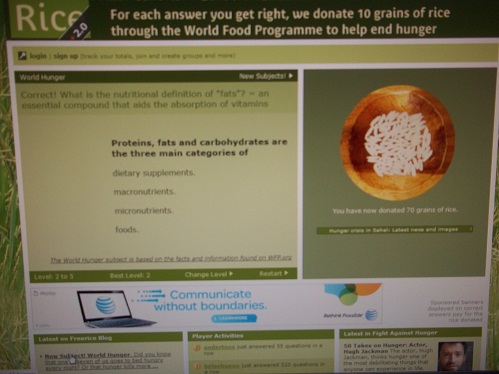
When you answer questions correctly while playing FreeRice a bowl fills up with rice, which will be sent to hungry people around the world. (photo from author’s collection)

This week the award-winning online game FreeRice added a new subject: world hunger. Players can now answer questions about hunger and malnutrition while helping collect donations of rice.

When you play FreeRice you answer questions in a variety of subjects including vocabulary, math, science and art. There is even an SAT preparation section. For each correct answer ten grains of rice are donated to the UN World Food Programme (WFP), paid for by advertisers on the site.

WFP is the world’s largest food aid organization and relies on donations to fight hunger in many countries around the globe.

Dr. Al Forsyth, who wrote most of the questions for the world hunger subject, says: “It’s always fun to see how smart you are, to show off your knowledge playing Freerice while contributing to a most worthy cause. But if the subject is really important, as world hunger surely is, how much better to also learn from playing the game. Playing “World Hunger” will help you understand why it is so important to fill that bowl with rice!”

With the school year starting up, teachers around the country have an extremely valuable tool to use in Freerice. Students can learn while tackling the toughest crisis facing the globe. Schools can even compete to see who answers the most questions correctly and donates the most rice.

I had the chance to write some of the questions for the world hunger subject, mainly about the history. If you read my article in the Des Moines Register titled Humanitarian Heroes, Both Large and Invisible and also my piece on the Russian Famine of 1921, you will be prepared for some of those questions. You can continue a great humanitarian tradition of fighting hunger by playing FreeRice.

You can start playing the World Hunger subject at Freerice.com.

Leave a comment

Filed under global hunger

UN Food Agency Aided World War I Reconstruction in Syria

The Hejaz Railway, which ran through Syria and Jordan, was damaged during World War One (photo courtesy Jordan Tourism Board)

The UN World Food Programme (WFP) did not start its operations until 1963. However, one of its earliest projects was helping rebuild from the destruction left over from World War I. The Hejaz Railway, which originally ran from Syria to Saudi Arabia, was damaged during the First World War of 1914-1918.

The WFP enacted a Food for Work project to help rebuild some still-damaged sections of the railway in Syria and Jordan. Workers were given food in exchange for their labor. The New York Times reported in 1964 that the food rations for this project would feed 750 workers for two years. Parts of the Hejaz railway are still operational to this day.

WFP continues Food for Work projects like this today to improve transportation which is essential for feeding a nation and building an economy. Without good roads or rails, food, medicine and critical supplies cannot move quickly or efficiently. Goods cannot be as easily exchanged. In South Sudan, for example, the lack of good roads has made food distributions that much more difficult in one of the world’s hungriest countries.

Conflict is raging within Syria again today with rebels battling the government. WFP says it “continues to provide food assistance to 850,000 beneficiaries in 14 Syrian governorates” through its partner the Syrian Arab Red Crescent. WFP, which relies on voluntary funding, needs donations to supply the food but also safe access so it can reach all those in need.

They are estimated to be at least 1.5 million people in Syria who will need food aid in the coming months as the fighting continues. There are also many Syrians fleeing into neighboring countries who will need assistance.

Article first published as UN Food Agency Aided World War I Reconstruction in Syria on Blogcritics.

Suggested by the author:

Leave a comment

Filed under global hunger, History

Charities Low on Funding to Help Suffering Children in Mali


Drought and conflict have caused massive displacement in Mali as families search for pasture. (photo courtesy WFP/ Daouda Guirou)

UNICEF says it’s only received 28 percent of its 58 million dollar emergency appeal to help conflict-torn Mali. The charity is providing nutrition, water, vaccinations and medicine to children suffering from the conflict and poverty.

A coup followed by a rebellion in Northern Mali has caused hunger and displacement for many thousands of families. Drought has also struck throughout Mali intensifying hunger and poverty.

UNICEF states, “Across the northern part of Mali, the global malnutrition rate is among the highest in the country. Schools have been closed for much of the year. Tens of thousands of families have been uprooted from their homes and exposed to violence and distress. Cholera has surfaced along the Niger River. Community coping mechanisms are being stretched to the extreme and risk failure, with negative consequences for children and women.”

The chaos has also placed children at risk of recruitment into rebel forces. UNICEF says it “calls on all parties to the conflict, leaders and community members to ensure that children are protected from the harmful impact of armed conflict and do not participate in hostilities.”

Families in Mali normally rely on stocks of food to help them through the summer lean season between harvests. These stocks would come from previous harvests. The drought though has meant far less food reserves to draw upon. Some reports show that families are resorting to eating cooked leaves. When drought hits families who are already living in poverty the impact is devastating.

Save the Children is working to rescue the most vulnerable in this hunger crisis. The charity is facing low funding having not achieved 50 percent of the fundraising goal for Mali.

Meanwhile the peak of the “lean season” is here with farmers and their families struggling to get food. Katie Seaborne, a Save the Children officer in Mali says, “I met with a woman called Mamou Traore in Diema of Kayes region in Southern Mali just on Thursday who explained how her husband’s crops lasted just one month. They have been trying to eke out a living ever since. Her four month old baby girl, Aissaita is now malnourished.”

Save the Children is supporting health centres which are treating these malnutrition cases including Aissaita. Without funding it will be difficult for Save the Children to carry on this work.

To donate to Save the Children visit their West Africa Hunger Crisis Fund.

For more information on UNICEF in Mali visit their web site.

Leave a comment

Filed under global hunger

World Humanitarian Day- Helping Others in Times of Despair

Today, August 19th, is World Humanitarian Day to honor those who help others even when facing incredible danger. August 19th was selected as World Humanitarian Day to coincide with the anniversary of the bombing of the UN headquarters in Iraq during 2003. That attack killed 22 UN staff members who were working to help reconstruct the country.

Humanitarians may be in lands far away from your home, or they may even be your next door neighbor. And there are people in need of help everywhere. It may be someone ill in your neighborhood or someone struggling to get food on the table.

There are conflicts ongoing all over the globe that are making innocent civilians homeless, hungry and in need of medicine. What they need is a humanitarian to come to their aid and countless times they do. In fact, there is humanitarian relief ongoing every second of every day. Right now, for example, the UN World Food Programme is carrying out airdrops in Southern Sudan bringing in food that is saving the lives of refugees.

The humanitarian chain starts at the front line in conflict or poverty zones with aid workers delivering supplies. This chain must be supported by donors even thousands of miles away from the front. In 1946, for example, a anonymous man in Cincinnati, Ohio donated an entire paycheck to help finance relief efforts to save war-torn Europe from famine.

Organizations like Catholic Relief Services and Save the Children deliver aid but also work to resolve conflicts that cause so many humanitarian disasters. The World Food Programme provides school meals around the world which give children nutrition and education so they can be lifted out of poverty.

On World Humanitarian Day you can find a way to support a charity helping others or maybe just lend a helping hand to a neighbor. Looking ahead, think of a way you can help a humanitarian cause throughout an entire year, perhaps even forming an organizations to go about that task. Or if you like games take a few minutes to play FreeRice which helps feed the hungry.

There are many ways you can help others so they are not alone in their struggle against life’s harshest challenges.

Leave a comment

Filed under global hunger

Families in Mali Running Out of Food

An archive picture of a little girl receiving food assistance at one of the WFP projects around the city of Timbuktu in northern Mali. (WFP/Shannon Hayes)

Families in Mali are running out of food with some reportedly eating meals “only made of cooked leaves” according to the UN World Food Programme. Mali, located in West Africa’s Sahel region, is one of the countries caught in a severe food crisis.

The World Food Programme (WFP) says there are 4.6 million people at risk of hunger in Mali. Drought has struck the country but so too has internal strife with a military coup earlier this year followed by increased rebellion in the Northern part of the country.

Secretary of State Hillary Clinton says, “Mali was, by most indicators, on the right path until a cadre of soldiers seized power a little more than a month before national elections were scheduled to be held. By some estimates, this could set back Mali’s economic progress by nearly a decade. It certainly created a vacuum in the North in which rebellion and extremism have spread, threatening not only people’s lives and the treasures of the past, but the stability of the region.”

The conflict has displaced 174,000 people within Mali and they need humanitarian aid. Even more Malians have been displaced to neighboring countries including Burkina Faso and Mauritania.

UNHCR High Commissioner António Guterres says, “We have now 257,000 refugees from Mali who are going through an enormous level of suffering and deprivation. They had to cross the borders of very poor countries that have very dramatic food security problems: Niger, Mauritania and Burkina Faso.”

WFP says it needs 55 million dollars to fund its relief work for those displaced inside Mali and the surrounding countries.

Within Mali, WFP has reached over 100,000 children with nutritional help including the food Plumpy’Sup. This peanut paste keeps small children from suffering devastating physical and mental damage from malnutrition.

Katie Seaborne of Save the Children says the charity is providing nutritional support in Mali, Niger and Burkina Faso. In Burkina Faso, where child malnutrition rates have increased this year, Save the Children is using both Plumpy’Sup and Plumpy’Nut, the latter generally used to treat the most severe cases of malnutrition.

Throughout the entire Sahel region of Africa, WFP is reporting a shortage of $320 million dollars in funding to provide food aid.

Where you can donate to hunger relief in the Sahel:

Sahel Food Crisis Fund- World Food Programme

Mali Hunger Crisis Fund- Save the Children

West Africa/ Sahel Hunger Crisis Fund- Save the Children

Sahel Food Crisis Fund- Catholic Relief Services

1 Comment

Filed under global hunger

House Plan Eliminates Free School Meals for Nearly 300,000 Children

On Tuesday the charity Feeding America warned of the consequences of the House Agriculture Committee’s cuts to food stamps on the Farm Bill. The House committee currently plans to cut $16.5 billion from the Supplemental Nutrition Assistance Program (aka SNAP, or food stamps).

The cuts to food stamps would also mean that “nearly 300,000 children would lose their free school meals,” according to Feeding America. Children who were eligible for the free meals because their family received food stamps would lose access to a critical safety net.

Vicki Escarra, the president of Feeding America, asks, “What will households do to make up for this loss in food assistance? The vast majority of SNAP recipients have extremely low incomes – 20 percent of these households have no income at all…Proposed cuts would mean that some low-income Americans may literally go without food.”

The proposed cuts come at a time when 49 million Americans are suffering from hunger and unemployment rates are high.

For children and their families a free school meal is a safety net, especially in tough economic times. Since the early 1900s when Cincinnati school teacher Ella Walsh and other innovators started serving “penny lunches” to needy children, school feeding has evolved. By 1946 Harry Truman signed into law the National School Lunch Act leading to free or reduced-price lunches for children in need.

Today, child hunger is escalating in the United States and the loss of free school meals is a major blow to the fight to end hunger in America. Over 20 percent of children in the U.S. suffer from hunger, or “food insecurity,” according to Feeding America. Some counties in the U.S. have child hunger rates well over 40 percent.

Zavala County in Texas has over 48 percent of its children suffering from hunger, with Starr Country in Texas at just over 45 percent. Imperial County of California and Luna County in New Mexico are third and fourth on this list with 43 percent hunger rates. Yuma County in Arizona has 42 percent of its children suffering from hunger. The list goes on and on, with other counties well over 30 or 40 percent in child hunger rates.

Meanwhile the cuts to food stamps will mean an increased strain on already overstretched food banks. Escarra adds, “If these cuts to SNAP are passed, the food banks in Feeding America’s network will be even more overwhelmed with people seeking food assistance. The food pantries, soup kitchens, and other organizations that are served by Feeding America are already stretched to the limit.”

The full impact of this summer’s drought on food prices may not be felt for months. But if food prices become high over a significant period of time, then foodbanks will be stretched even more. The ranks of the hungry in the United States will struggle even more to find safety nets. Congress can change this by committing to ending hunger in America.

Brett Weisel, the director of advocacy for Feeding America, says that supporting federal anti-hunger programs isn’t about giving a handout. It’s about providing help up. So that those in need can achieve more. When people in our communities don’t have enough food to get through the day, it costs us all. Hunger creates health problems. Children struggle to learn. Workers are less productive. Opportunities are lost.”

Article first published as House Plan Eliminates Free School Meals for Nearly 300,000 Children on Blogcritics.


Leave a comment

Filed under Hunger in America