Nuclear Weapons, the Great Lakes and Lake Champlain

Imagine living along Lake Ontario in the British colony of Canada. The year is 1813 and Great Britain and the United States are at war. It is a cool April morning. You peer out across the Lake to watch the sunrise. The waters are calm, the surrounding countryside quiet. You gaze up and down the Lake for American warships. There are none in sight…..but where are they?

Little do you know that a fleet of American warships is readying for battle. At Sackets Harbor in the eastern end of Lake Ontario, American soldiers are boarding warships. Crewmen prepare the rows of cannons that will be unleashing fury on Canadian forts and towns. Within hours, the American fleet will set out, heading west on Lake Ontario. Word reaches quickly up the Lake that the warships are coming. You notice a figure upon a distant hilltop, giving signals that warn of the impending attack. Soldiers prepare themselves for the coming fight and everyone else wisely heads for cover. Your heart pounding, you run to warn your family.

During the War of 1812, the Great Lakes and Lake Champlain were the scene of such terror with fierce naval battles and coastal assaults. The war ended in 1814 and if you lived upon the Lakes you probably would hope never to see a warship again. You would soon be granted your wish.

Sackets Harbor, NY during the War of 1812 (U.S. Naval Historical Center)
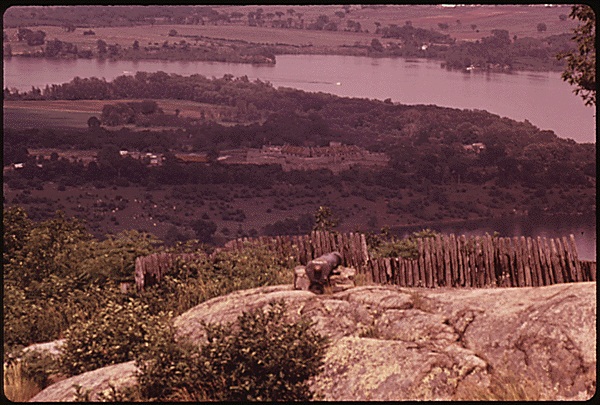
View from the top of Mount Defiance overlooking Fort Ticonderoga and Lake Champlain. (National Archives)

When President James Monroe prepared his first annual message to Congress in 1817, he had some good news. He announced an agreement between the U.S. and Great Britain that disarmed the Great Lakes and Lake Champlain. Now, with the Rush-Bagot agreement, naval warships would virtually disappear from the Lakes.

Monroe stated, “By this arrangement useless expense on both sides and, what is of still greater importance, the danger of collision between armed vessels in those inland waters, which was great, is prevented.”

President Monroe knew the Rush-Bagot agreement would spare the U.S. and Britain from a dangerous naval arms race. That objective was accomplished and went a long way toward improving British-American relations. But the story does not end there. The lessons of the Rush-Bagot agreement would also be applied during the nuclear arms race of the Cold War.

It was 1963, just one year removed from the Cuban Missile Crisis which brought the Soviet Union and the United States to the brink of nuclear war. The near holocaust placed an increased urgency on controlling the nuclear arms race. Focus shifted to achieving a treaty which would ban nuclear weapons testing, an effort started during the Eisenhower administration and carried over to his successor, John F. Kennedy. Such a treaty could improve relations between the two adversaries and place some restriction on armaments development. In July 1963, the Soviet and American negotiations produced the Limited Test Ban Treaty, which banned nuclear tests in the atmosphere, underwater and in outer space. President Kennedy viewed it as”a step towards peace- a step towards reason- a step away from war.”

Nuclear Weapons Test during the 1950s. (National Archives photo)

Yet, although the Limited Test Ban Treaty was signed, it still needed to be ratified by the U.S. Senate to take effect. Not everyone agreed the treaty was a step in the right direction. Some believed it would weaken America’s national security by limiting development of nuclear armaments. Back in 1817, the same argument could have been made against the Rush-Bagot agreement since it did deprive the U.S. of naval forces on the Lakes, which proved so vital to its successes during the War of 1812.

Before the Senate would vote on the Limited Test Ban, it held hearings to listen to testimony from key experts. Among those called to testify was Harold Stassen, former disarmament advisor to President Eisenhower. Stassen would invoke the lessons of the Rush-Bagot agreement to support ratification of the Limited Test Ban. Why? Stassen did so because of the Rush-Bagot agreement’s effectiveness as an arms control measure makes its lessons timeless.
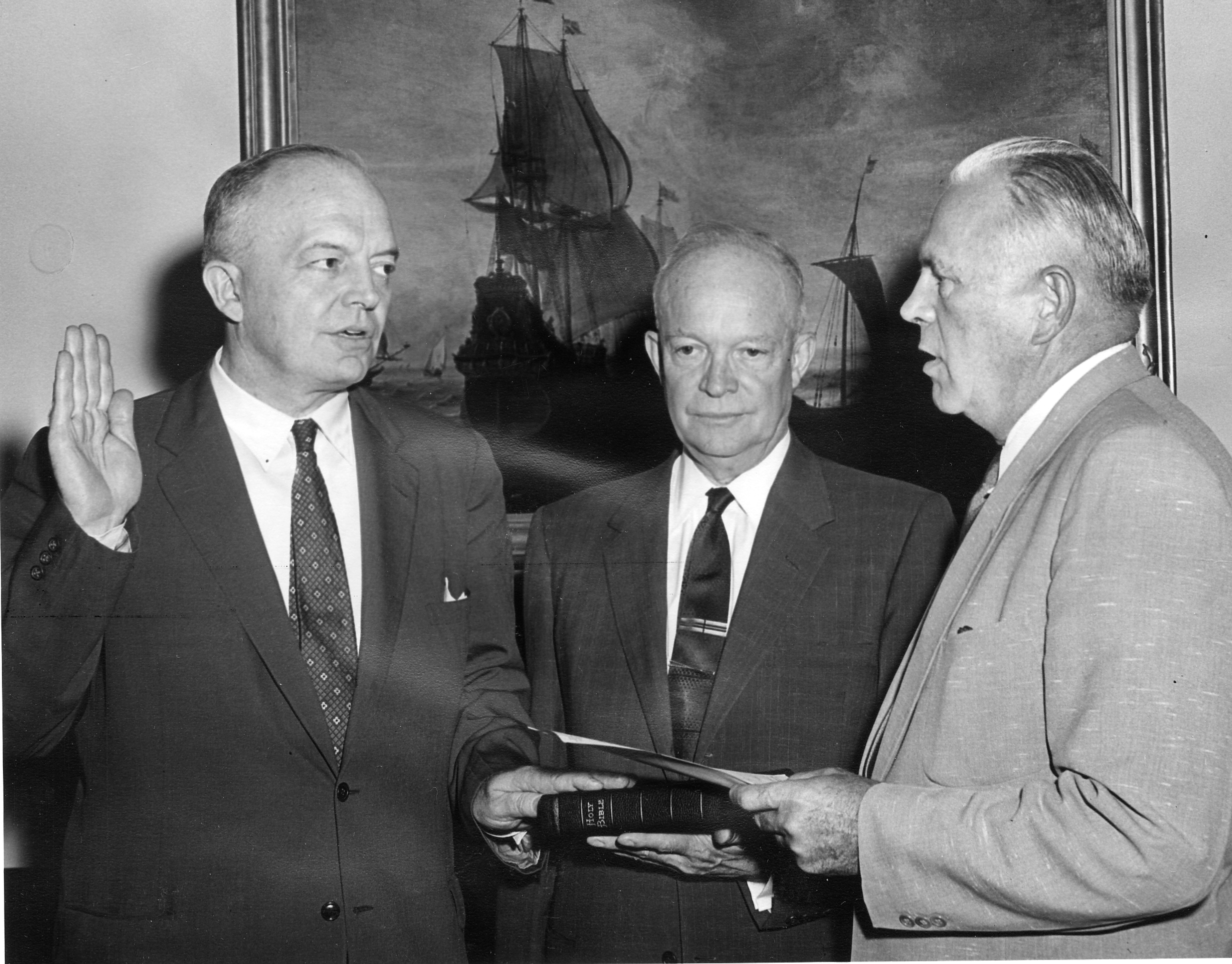
Harold Stassen (far left) being sworn in to represent the U.S. in disarmament negotiations in 1955. (Eisenhower Library)

The Rush-Bagot agreement also set a precedent for including a termination clause in an arms control treaty. This would allow either nation to legally withdraw from the treaty should its national security become threatened. A termination clause was seen as vital in the case of the Limited Test Ban Treaty due to the unpredictability of the nuclear arms race.

When asked by Senator Frank Carlson about the termination clause of the Limited Test Ban Treaty Stassen replied,”I don’t think it is generally recalled that we have the right in relation to the old Rush-Bagot Treaty over the arms limitation of the Great Lakes with Canada which was in 1817, still in force, and it is the forerunner of the peaceful border with Canada. It came after the War of 1812 and there was great difficulty and fighting. President Monroe took the leadership and the military of that day, many of them sincerely had misgivings and said, how can we defend the United States if we can’t arm the Great Lakes, and President Monroe said, let’s do it but let’s put on a 6-month termination clause…it is a right within a treaty, in other words, within the terms of the contract, under which you can bring the contract to a close, and I think the Joint Chiefs are right in this kind of a world situation to have a safeguard of that kind…”

The Rush-Bagot Treaty at Fort Niagara overlooking Lake Ontario (author's collection)

The example of the Rush-Bagot agreement supported arguments for a limited Nuclear Test Ban Treaty. Stassen was among those whose testimony helped achieve the treaty’s passage in the Senate, thereby providing a respite from the Cold War and a dramatic turnaround from the Cuban Missile Crisis.

President Kennedy Signs the Limited Nuclear Test Ban Treaty in October, 1963 (National Archives)

Reporters Gather Around the Limited Test Ban Treaty (National Archives)

President Reagan’s arms control director, Eugene Rostow, speaking before the Senate in 1981, used the example of Rush-Bagot as inspiration that arms control could be achieved with the Soviet Union.

Rostow stated that the Rush-Bagot Treaty was”rather dull.” But he was actually praising the agreement saying the very fact it was dull”is the most convincing evidence of its success.” Rostow added”it was by no means self-evident in 1817 that the Agreement would work. The passions of the Revolutionary War and the War of 1812 survived and rankled. There was great tension between the United States and Great Britain over Canada on several occasions during the nineteenth century. In these periods, the Rush-Bagot agreement was a genuine influence for restraint….where there is a general political understanding about the limits of rivalry, arms control agreements can help to prevent friction and conflict from degenerating into war.” The Reagan administration achieved the Intermediate-Range Nuclear Forces (INF) Treaty with the Soviet Union in 1987. The INF Treaty eliminated both countries’ medium and shorter-range nuclear missiles which had been dangerously deployed in Europe.

Today, the Rush-Bagot concept of avoiding a dangerous and expensive arms competition will be very appealing for President Obama as he forges his foreign policy. The staggering costs of nuclear weaponry, as much as 52 billion annually according to a 2008 Carnegie Endowment for International Peace report, make disarmament even more desirable. Obama is likely to start by trying to ratify the Comprehensive Nuclear Test Ban Treaty (CTBT) which would ban all test explosions including underground.

When one visits Rush-Bagot memorials such as the one at Fort Niagara, NY they will learn about a key turning point in British-American relations. But it goes even deeper than that. The Rush-Bagot agreement is a pillar in the history of arms control and its lessons can be applied to the international crises of today.

Arms control and disarmament can play a role in establishing peace among nations. As John Quincy Adams said about the idea of an arms race on the Great Lakes,”the moral and political tendency of such a system must be to war and not to peace.” The Rush-Bagot agreement and its timeless lessons can help in the never-ending struggle to achieve peace among nations.

Rush-Bagot Memorial at Fort Niagara in New York (author's collection)


article published at History News Network.

Original version of article published at Fortress Niagara in June, 2004. View the article below.

Page 1 page 2 page 3 page 4

Read more of the the testimony of Eugene Rostow where he talks about the Rush-Bagot agreement. (courtesy Cincinnati Public Library)

The Road to Peace: From the Disarming of the Great Lakes to the Nuclear Test Ban Treaty

Available at Google Ebookstore, Amazon.com or Barnes and Noble

Leave a comment

Filed under arms control, Comprehensive Nuclear Test Ban Treaty, CTBT, disarmament, Dwight Eisenhower, Fort Niagara, Great Lakes, Harold Stassen, Lake Champlain, nuclear arms control, nuclear testing, nuclear weapons, peace, Rush-Bagot Agreement, War of 1812

Humanitarian Aid Needed Long After Guns Fall Silent

10-month old Sara has been found to be malnourished, and will receive treatment to make her strong and healthy again. Even before the conflict, already one in three children under 5 years old in Côte d'Ivoire was suffering from chronic malnutrition (Photo: Annie Bodmer-Roy/Save the Children)

Earlier this year I wrote several stories about the conflict in the Ivory Coast. A disputed presidential election led to violence which displaced hundreds of thousands of people in the West African nation. While the post election violence has subsided, the scars remain. Hunger is still on the attack.

Annie Bodmer-Roy of Save the Children says, “The international perception is that because levels of violence have died down and the country has a president, the crisis is now resolved. This is not the case. Our teams are on the ground, speaking to children and their families and witnessing the horrible conditions that these people are still living in – we know that the humanitarian crisis is far from over.”

As we honor World Humanitarian Day , this is an important concept to note, not just for the Ivory Coast but for any conflict-affected area. Hunger and sickness are the companions of warfare. These scourges last much longer than the actual fighting itself. The Ivory Coast is one of these examples.

Think of your own community and how daily life plays itself out. And then imagine the unthinkable, a war striking. Basic things that you see every day, like food deliveries and shopping at stores, would cease. Housing would be destroyed, leaving many trying to find basic shelter. Imagine large-scale displacement, on foot mostly, as fuel deliveries have stopped. Farms that produce food may be damaged. Health clinics may be destroyed or unable to get deliveries because transportation systems are not functioning. Medical care would decline.

Once a war ends, these repairs to basic life must begin. It’s bad enough for any community to go through such a rebuilding process, but imagine areas that were already impoverished. Their resiliency would be far less. The same reconstruction pains often take place with recovery from natural disasters. In East Africa, for instance, recovery from the massive drought there will take years.

The key is maintaining focus on areas once the headline-grabbing conflict ends. For example, in Yemen very little coverage is given to the hundreds of thousands of displaced persons from the Sa’ada War in the northern part of the country. The fighting there too has subsided, but great suffering remains. In Southern Sudan, many are still struggling to recover from conflict with the North. Fighting earlier this year displaced hundreds of thousands of people. But you hear little of their plight in the headlines.

World Humanitarian Day is to honor the dedication of those helping in the many crisis points around the globe. It’s also a time to remember that humanitarian aid is still needed even long after the guns fall silent in a war zone. Just because news coverage wanes in an area does not mean the suffering does as well. It’s important to support humanitarian efforts in conflict or disaster zones to finish the job of reconstruction.

Coming soon, an interview with Annie Bodmer-Roy as she gives the latest on the situation in the Ivory Coast. She will discuss how Save the Children is helping communities fight hunger and overcome the effects of conflict. You can donate to Save the Children’s relief mission in the Ivory Coast here.

(Listen to Annie  Bodmer-Roy of Save the Children discuss the post-conflict humanitarian crisis in the Ivory Coast in an interview in May with the BBC. )

Sara receives a supply of plumpy'nut: Genevieve, 34, heads home from the local health clinic with her son Komène and her daughter Sara, 10 months, asleep wrapped up against her mother’s back in the town of Guezon, western Ivory Coast. Genevieve has just received a bag full of plumpy’nut, a peanut paste packed with vitamins and minerals, designed to help babies like Sara recover from malnutrition. (photo: Annie Bodmer-Roy/Save the Children)

Plumpy'nut is a special peanut paste used to treat severe child malnutrition in small children. Countries suffering from conflict, natural disasters, or poverty need adequate supplies of plumpy'nut to combat child malnutrition. The plumpy'nut requires no cooking and can be easily stored and distributed. Children who suffer malnutrition in the first 1,000 days will have lasting physical and mental damage. (Photo: Annie Bodmer-Roy/Save the Children)

Article first published as Humanitarian Aid Needed Long After Guns Fall Silent on Blogcritics.

Leave a comment

Filed under Ivory Coast, malnutrition, Save the Children, Sudan, West Africa, Yemen

Haiti: Keeping Focused on Fighting Hunger

Tropical storm Emily just passed through Haiti, fortunately never developing into a hurricane. But it should serve as a reminder that Haiti is still very vulnerable to the shock of these storms. It’s important to build up Haiti’s resiliency so it can better withstand the risk of flooding that comes with these heavy rains.

The UN World Food Programme (WFP), as it seeks to help Haiti boost its food production, sponsors projects aimed at preventing damage to agriculture from flooding.

In addition, other WFP Food/Cash for Work projects are aimed at rubble removal, still very much a task even more than a year after the earthquake. There is still a long way to go in Haiti’s reconstruction. That is why the World Food Programme is urging support for its programs in Haiti. Malnutrition and poverty are still massive challenges for Haitians to overcome

WFP’s Stephanie Tremblay reports that the agency is facing a funding shortage for its programs. Without this funding, programs to protect the poor and boost agriculture and other projects will be at risk. WFP’s biggest project, school feeding, will be in jeopardy without funding.

Tremblay says, “We need an additional $14 million to purchase food – that will cover the needs of our school meals and nutrition programs – It also includes a take-home ration that we give students at the beginning of the school year to help families cope with back-to-school costs.”

WFP currently is reaching 1.1 million students with school meals as it helps the government build a national program. There is a long way to go to provide school meals for all children in Haiti.

Currently, there are many children in Haiti not yet enrolled in school. A national school lunch program needs to be developed to reach all these children. The food is what encourages parents to send their children to school.

Principal Sister Bernadette says Haitian children would “simply be too weak to study if they weren’t able to eat something at school. It’s important for them to have a meal here, most of them come from very poor families.” Marie Anika, 8, speaks for all children worldwide when she says, “It would be terrible if we didn’t get a meal at school. I really wouldn’t like that.”

WFP also needs $27 million to keep its cash/food for work projects, which are critical to the reconstruction, moving in the right direction.

The media spotlight may have moved on from Haiti, but the tremendous need is still very much present.

Article first published as Haiti: Keeping Focused on Fighting Hunger on Blogcritics.

Leave a comment

Filed under malnutrition, plumpy'nut, School feeding

Somali Child: I Just Want to Go to School Again

Mindy Mizell of World Vision is traveling through the Horn of Africa to report on the relief efforts for famine and drought victims. Amid so much chaos and horror Mizell finds rays of hope, such as 13-year-old Abdillahi, a Somali refugee living in Dadaab, Kenya. His family was forced to flee Somalia to find food and escape the violence.

Here is a child confronted with war and famine and Mizell said he never uttered a single complaint or talked about how unfortunate he was. Instead, he remained positive and upbeat.

Mizell writes, “I guess I expected him to say that he wanted more food, more water, better clothes or maybe a soccer ball. Instead, Abdillahi told me he wanted to go to school again! Not only did Abdillahi believe he had a bright future, but he spent several minutes advocating on behalf of his Somali friends and telling me that they all needed to go to school in order to find good jobs someday.”


World Vision’s Mindy Mizell interviews Abdillahi, 13, in the Dadaab refugee camp. (World Vision photo)

Young Abdillahi just pointed the way to what can end hunger and build peace in the Horn of Africa: education and food.

In responding to the drought in East Africa, it’s vital to ensure that all children can receive school meals and an education. This is extremely challenging, especially in areas where there are refugees and host communities all with great needs.

Lisa Doherty of UNICEF explains, “In some cases there have been massive influxes of communities and school-aged children into urban areas where there aren’t school facilities to absorb them all.”

UNICEF states that “school feeding, provision of learning materials and teacher incentives and additional learning spaces are the top priorities in order to ensure that children can access learning opportunities, many for the first time.”

Rozanne Chorlton, UNICEF Somalia Representative says, “Education is a critical component of any emergency response. Schools can provide a place for children to come to learn, as well as access health care and other vital services. Providing learning opportunities in safe environments is critical to a child’s survival and development and for the longer term stability and growth of the country.”

This is similar to what the U.S. Army did after World War II. For example, in Vienna, Austria, the U.S. military government helped reopen schools and start a feeding program. They did not want children roaming the streets, and giving them food at school was a top priority with post-war malnutrition rates climbing. The Army and food ambassador Herbert Hoover recognized the such programs were critical and needed to be strengthened and expanded. School feeding provided by the Allies and others after the war was a key defense, as famine threatened to attack many nations at that time.

Today, school meals play an urgent role in providing for refugee children in East Africa. Sandra Bulling of CARE says, “we are currently planning to set up lunch programs for the accelerated learning program of newly arrived refugee children, many of whom have never been to school before.”

Aid agencies are mobilizing to help children through this crisis and open the door to a better life in the future. But will there be enough funding? Fighting hunger and building children’s education is an area of neglect in the foreign policy of many governments. How do you change this?  It’s up to the public to tell their representatives in government that it should be a top priority for all children to receive school meals and an education.

That is what can make a difference in the long term for children in East Africa and elsewhere who just want to go to school again.

See videos from the World Food Programme’s WeFeedback page.


Article first published as Somali Child: I Just Want to Go to School Again on Blogcritics.

Leave a comment

Filed under drought, East Africa, East Africa drought, Kenya, malnutrition, School feeding, Somalia, Uncategorized, UNICEF, World Vision, World War II

Plumpy’nut in Somalia – An Update from CESVI

Elizabeth Stoltz of Plumpy’nut Press just interviewed Irene Moora, a Nutrition Specialist from CESVI, an Italian humanitarian organization, who just returned from Galkayo, Somalia. Learn about the use of the miracle food in the famine relief mission in Somalia.

Read the interview at Plumpy’nut Press.

Leave a comment

Filed under East Africa, malnutrition, plumpy'nut, Somalia

Ending Hunger: When You Feed a Child You Feed the Future

U.S. Air Force plane dropping food into the Nazi-occupied Netherlands in 1945 (National Archives)

U.S. Air Force plane dropping food into the Nazi-occupied Netherlands in 1945 (National Archives)

In May 2010, I published an article about the historical airlift of food into the Nazi-occupied Netherlands at the end of World War II. Truck convoys of food for the hungry followed these missions which continued throughout the liberation.

Think of what the food meant to each individual child: an opportunity — a future. Take, as an example, one young girl living in the Netherlands at that time. Many children of her generation were lost because of the war and the food shortages that came with it. In the case of the Nazi-occupied Netherlands, this became a tragedy known as the hunger winter of 1944-1945.

This girl was one of those suffering from malnutrition as the war was drawing to an end. Fortunately, she and many others would benefit from the food brought in by the Allies. Subsequent to this relief would come aid from the United Nations Relief and Rehabilitation Administration (UNRRA).

The young girl, upon growing up, said, “A child is a child in any country, whatever the politics… there is no complicated diplomacy, when a child is starving. It’s simple. And we better do something about it. For our sakes too. That is if we want to continue to call ourselves human.”

Her name was Audrey Hepburn. The food made a great difference in her life, an example of the magic that can happen when a child is fed. Hepburn, late in her life, worked as an ambassador for UNICEF. This organization was created in the aftermath of World War II because of the crisis facing so many children. The Marshall Plan is known as the reconstruction of Europe. Well, UNICEF was a Marshall Plan for the rehabilitation of children after the war, and forever changed those war-devastated countries.

There is a whole generation of children today who deserve the same opportunity to find what treasures they possess. Today, the cries of children are coming from East Africa, Democratic Republic of the Congo, Yemen, Haiti, Sudan, Afghanistan, and many other countries. This is why it is so imperative that universal child feeding programs be developed through an international alliance.

The goal would be for each country to have a self -sufficient national school meal and infant feeding program. No single initiative could do more to save lives, prevent disease, and build peace in today’s world.

A whole generation could be fed for a relatively minimal cost. A whole generation could write the history of their country through educational achievement, progress, and development, all because we decided today their bodies and minds should be fed.

Article originally published as When You Feed A Child You Feed the Future at Blogcritics

A message from UNICEF:
UNICEF Goodwill Ambassador Audrey Hepburn holds a severely malnourished child at a UNICEF-assisted feeding centre in Baidoa. “For many it’s too late, but for many, many more we can still be on time,” said Ms. Hepburn, after witnessing the impact of famine on Somalia’s children in 1992.Nineteen years later, famine is again spreading, and over a million children urgently require aid.The Horn of Africa’s children need our help. You can join UNICEF’s effort by visiting Horn of Africa Crisis Page.

You can receive more UNICEF photos from the Horn of Africa on your iPhone by visiting: http://www.unicef.org/phot​​​​ography


(photos courtesy of UNICEF)

Leave a comment

Filed under Afghanistan, drought, East Africa, History, School feeding, UNICEF, World War II

Interview: Catholic Relief Services in Afghanistan

CRS distributes lambs to impoverished farmers and trains them to care for their animals. Photo: Laura Sheahen/CRS Read more: http://blogcritics.org/culture/article/interview-catholic-relief-services-in-afghanistan/page-4/#ixzz1V9nRBB3J

Afghans face a daily struggle against poverty. The basics of food, water, medicine, education and shelter are hard to reach for millions in the country. It is the war against poverty in Afghanistan which is often overlooked.

Catholic Relief Services (CRS) is trying to make a difference and help lift Afghans out of the poverty trap. Laura Sheahen, CRS Asia information officer, helped coordinate the following interview with the CRS Afghanistan team. They offer a look inside daily life in Afghanistan.

Tell us about some of the families you met in Afghanistan and the struggles they face.

CRS sees all kinds of families really struggling just to stay warm and fed in winter, and to grow food in the summer. The weather can be quite extreme and finding water is often an issue. Afghans also struggle to get to market-either to buy or sell food-given the road system, which is bumpy and rocky at the best of times. In some areas, roads are often completely impassable during the long, snowy winters. So just getting staple foods is a huge challenge, as is getting medical care.

What effect has the increase in food prices in Afghanistan had on the communities there?

When families can’t afford food, what happens in rural areas is that they sell livestock, which is basically their insurance policy against even bigger disasters. If they sell their goat to buy flour, for example, they have nothing to sell when they need money for an urgent trip to the far-off hospital. And, of course, some families with nothing to sell are simply going hungry.

Malnutrition is a problem for at least a third of children in Afghanistan, according to World Health Organization statistics.

In some areas, needy families are sending their teenage or young adult sons to places like Iran and Pakistan to work, which is not something they want to do.

What are some programs CRS is running to help tackle poverty in Afghanistan?

Since water is such an issue, CRS helps farmers improve irrigation systems, dig canals, and so forth. CRS also builds water systems so that remote villages have tapstands. CRS links farmers to local markets and businesses, teaching them how to grow, transport, and sell produce effectively. For example, we taught farmers how to grow strawberries under plastic-tarp greenhouses in winter. They get a high price for their berries in spring.

CRS organizes groups of women and give them the basics they need to start small businesses, like baking snacks or sewing curtains. So for the bakery we’d build them a special clay oven and give them a stock of flour to start with, for example. When women can make a little money, it helps the whole household.

What are the great challenges in terms of education for Afghan children?

After decades of war and the repressive rule of the Taliban, Afghanistan’s education system has been left without an adequate number of schools and qualified teachers. Literacy levels in Afghanistan are extremely low, with only 28% of the overall population estimated to be literate–meaning that finding teachers can be extremely difficult, especially in the most remote and rural parts of the country.

Distance is a huge factor. Out on the plains of Afghanistan, or in the mountains, people might live dozens of miles away from any town, much less a public school.

In some cases families are concerned about their daughters going to school. It’s not just a cultural issue-they could be worried about their daughter’s safety as she walks 4 miles of uninhabited territory to get to school.

What is CRS doing to help improve the education system for Afghans?

CRS works with villages to create schools, especially in remote areas where girls cannot easily reach public schools. CRS trains the teachers, provides the books and supplies, and does whatever it takes to get a school going.

To start a school, CRS meets with parents and community members to discuss their interest in education. Community members then commit to providing a space for a classroom– typically a room in a villager’s house–and help identify a teacher.

CRS also provides a class kit (e.g., blackboard, chalk, water cooler), a student kit (e.g., notebooks, textbooks, pencils) and a teacher kit (lesson plan book, pens, etc). We also work with the Ministry of Education to receive government textbooks and use this government curriculum.

By creating the village schools close to home, and by talking with mothers and fathers, we get community buy-in and support. It’s a large factor in overcoming the barrier of distance which ensures that girls can attend.

That’s one reason we think we have so many girls studying in CRS-created schools. We always talk everything through with the villagers and discuss their concerns.

The teacher training we provide is really key. Teachers learn to teach using interactive methods, instead of asking children to do rote memorization. Teachers learn how to prepare lesson plans and learn basic classroom management. We offer a series of workshops to build their teaching skills, especially for reading and math. CRS staff visit the teachers on a regular basis to follow up and ensure that teachers are able to apply these new teaching methods in the classroom.

We provide textbooks and supplies like a blackboard and chalk. The schools would founder without some of these basic materials, due to cost and due to the distance villagers would have to go to get the materials.

Another thing that’s making a huge difference is our “box of books” library system. Basically, we give each school we create a metal lockbox full of several dozen educational books-stories about animals, for example.

The children treat these books like gold. They borrow them from the box and read them to their families at home.

CRS helps form Parent-Teacher Associations which monitor the class to make certain it has the necessary supplies and to check on teacher and student attendance.

With this strong focus on community participation and quality of education, CRS has made education available to 13,500 children (64% girls) in 340 communities in remote and rural areas of Afghanistan. We’ve also supported over 700 teachers with training and mentoring services.

Because we work closely with Afghanistan’s Ministry of Education, we’ve ensured that children enrolled in our schools are recognized as part of the formal government system.

How can someone get involved with the work of CRS in Afghanistan?

You can learn more, or donate, at Catholic Relief Services

Article first published as Interview: Catholic Relief Services in Afghanistan on Blogcritics.

Leave a comment

Filed under Afghanistan, Catholic Relief Services

East Africa Famine: An Interview with Laura Sheahen and Sara A. Fajardo of Catholic Relief Services

At a GIZ hospital at a refugee camp in Kenya, a severely malnourished Somali refugee child receives treatment. (Photo by Laura Sheahen/Catholic Relief Services)

The famine and drought striking East Africa have created one of the worst humanitarian tragedies of this generation. Thousands of children have starved to death and many more are in grave peril from malnutrition.

Somalis are desperately fleeing into Kenya and Ethiopia in the search for food, only these countries are also suffering from food shortages. With the unrelenting drought, the crisis could get much worse. Children are suffering from severe malnutrition. Aid agencies are struggling to keep up.

Catholic Relief Services (CRS) is one of the aid groups in a race to save lives. CRS officers Laura Sheahen, who just visited one of the refugee camps in Kenya, and Sara A. Fajardo, took time to discuss the massive relief effort underway.

How is Catholic Relief Services helping the victims of famine and drought in East Africa?

Sara A. Fajardo: To give just a few examples, we are currently helping to feed more than a million people in Ethiopia and have launched projects in Isiolo and Wajir, Kenya and about to launch projects in Mandera where the drought’s impact has been severe. Some of the pastoralist communities living there have lost 50-100 percent of their livestock. These projects include rehabilitating wells, assisting with school-feeding programs and working on conflict mitigation projects between different pastoralist communities who may be trying to access the same limited resources.

In the Dadaab Refugee area we will be working through partners to distribute around 10,000 hygiene kits to arriving refugees. As part of our “do no harm” approach to humanitarian aid, we will also be providing assistance to the host communities surrounding the Dadaab refugee camps. These communities have also been severely impacted by the drought but are often overlooked because of the seemingly more pressing needs of the incoming refugees. Tensions can often flare up when one community perceives another as receiving assistance while they are left to fend for themselves. We will provide them with water and food aid and work with them to help weather the difficult months ahead.

Even before this drought hit, Catholic Relief Services was on the ground working to help communities prepare for this current emergency. In Kenya our staff has been working over the past three years alone to provide 91 water points to local communities, helped to create tree nurseries with more than 3.7 million seedlings, worked to get more than 2,500 miles of agricultural terraces built, and provided more than 108,000 female goats to our beneficiaries.

In Ethiopia we’ve worked over the past eight years to fight the effects of recurrent drought by drilling wells 1,000 feet into the earth. In much of Ethiopia, water runs below the surface in underground caverns as deep as 1,000 feet. This water is difficult, but not impossible to access. A recent visit to the field revealed that 95 percent of 28 wells CRS has constructed are still operational. The difference between communities with water sources and those without is remarkable. The livestock are plumper and produce more milk, which in turn means that the people themselves are nourished better. People in these areas rely less on food aid and more on their own means.

Somali refugees at Dagahaley refugee camp in Dadaab, Kenya. Following a severe drought, many families faced starvation and left Somalia on foot. Thousands of refugees are flooding into Dadaab every week. (Photo by Laura Sheahen/Catholic Relief Services)

You met some of the refugees escaping from Somalia, what are some of the stories they told you about what they have faced?

Laura Sheahen: Almost every refugee I spoke to had a horror story about the long walk from Somalia to Kenya. Armed bandits are a huge problem, and the vast majority of refugees I spoke to had been robbed at gunpoint. There has been an appalling number of rapes as well.

Some of the refugees were robbed not just of the little food and clothing they carried, but the actual clothes they were wearing; they are walking naked. People fleeing the famine and war in Somalia are also fighting off lions and hyenas in the night.

And of course, walking for weeks in the bush, under a baking sun and with no food, is bringing refugees to the brink of collapse even when they don’t meet bandits or wild animals.

What do you see is the greatest risk to refugees at these camps? Is it spread of disease, malnutrition?

Laura Sheahen: Right now, just keeping up with the food and water needs is a gargantuan task. The refugee camps in Kenya near the border have existed for years because Somalia has been troubled and dangerous for so long. But because of the drought, the camps are overflowing now and it’s hard to get food to everyone quickly enough. Waterborne diseases will be a problem if sanitation for the newcomers isn’t worked out fast. Any contagious diseases–anything that spreads when too many weak, hungry people are crowded together–could be an issue. For example, there was a recent outbreak of measles.

How many more refugees potentially could arrive?

Sara A. Fajardo: It’s hard to say. Currently the United Nations High Commission for Refugees estimates that between 1300-1500 new refugees are arriving daily. Aid agencies of course would prefer to help Somalis stay in their own countries. Whenever people are forced to migrate, it places them at undue risk for rape, theft, or other forms of exploitation. There is also the very real possibility of families becoming separated. In the measure that is possible the humanitarian aid community would like to provide direct assistance in the towns in villages most affected by the drought in order to avoid anyone having to make this often life-threatening trek.

How long do you think the refugees, as well as the host communities, will require extensive international assistance?

Sara A. Fajardo: This is a problem that will not be resolved over night. Droughts are cyclical in eastern Africa and their frequency (due to a variety of factors) is on the rise. Even if it rains tomorrow and the crops start growing, it will be quite awhile before things stabilize to the point where people can harvest enough food to sustain a family. It’s also important to remember that many of the drought-affected communities are pastoralists and rely on livestock for their survival. The UN estimates that it can take up to 5 years for herds of livestock to regenerate to a point that they can be relied as a consistent source of food. This emergency will require short, medium and long-term solutions, but of course the eventual goal of all concerned is to help people become self-reliant and not aid reliant.

Article first published as East Africa Famine: An Interview with Laura Sheahen and Sara A. Fajardo of Catholic Relief Services on Blogcritics.

You can donate to the Catholic Relief Services East Africa Emergency Fund.

Leave a comment

Filed under Catholic Relief Services, drought, East Africa, East Africa drought, Kenya, Somalia, Uncategorized

Canada Fighting Famine from World War II to East Africa

A convoy of trucks of Allied food supplies moving into German-occupied territory along the road from Wageningen to Rhenan, Netherlands, 3 May 1945. Credit: Credits: (Credit: Capt. Alex M. Stirton / Canada. Dept. of National Defence / Library and Archives Canada / PA-13441

Determination. We hear that word often in sports and in business. But what does it mean when it comes to saving lives? Amid harsh, rainy weather conditions on April 29, 1945 on an airfield in Great Britain, we found out.

It was World War II. A flight crew of seven boarded a Royal Air Force plane on a mission. Five of the men were from Ontario, Canada. One of them, the pilot, Robert Upcott of Windsor, made final preparations for take-off.

Only these men were not taking part in an enemy raid. They were on a mission to bring food to starving people in Nazi-occupied Netherlands. Millions of Dutch citizens were enduring what is known as “The Hunger Winter” of 1944-1945, as they awaited the final defeat of Nazi Germany by the Allied Forces.

Read the full article at Yahoo! Associated Content

Leave a comment

Filed under East Africa drought, History, World War II

Edesia and World Vision-Two Organizations Helping East Africa

The Providence Journal just published an editorial about the famine in Somalia. Their piece mentions two organizations, Rhode Island based Edesia and World Vision, who are working to provide desperately needed aid to East Africa.

You can donate to Edesia’s Horn of Africa fundraiser here.

You can donate to World Vision at their web site.

Also check out my July 25th, oped in the Providence Journal as well as their other coverage of the famine.

Bernard Beaudreau: Again, famine horror in Horn of Africa

Click here: Editorial: SOS from Somalia | Editorials | projo.com | The Providence Journal

Leave a comment

Filed under Uncategorized