Category Archives: History

International Women’s Day, Words for Peace and Food for Education

North Andover, Massachusetts where Anne Bradstreet resided (author's collection)

My hometown of Andover, Massachusetts was once a remote outpost in the wilderness, long before there was a bustling Northeast United States. One of the town’s earliest settlers was a wife, mother, and also a writer. Her name was Anne Bradstreet and in 1650 she had a book of poetry published all the way overseas in London.

This was quite an achievement especially when you consider those times. A woman being educated, much less being an author, was not something particularly welcomed.

Carol Majahad of the North Andover Historical Society told me, “It was rare for a woman to be as educated as Anne was in her day.” One of Bradstreet’s poems “gives a good reflection of popular opinion at the time.”

I am obnoxious to each carping tongue
Who says my hand a needle better fits,
A poet’s pen all scorn I should thus wrong,
For such despite they cast on female wits;
If what I do prove well, it won’t advance,
They’l say it’s stol’n, or else it was by chance,

Wendy Martin, in her book An American Triptych, wrote that in Bradstreet’s era, “women who stepped beyond their domestic confines by means of literature, whether by reading or writing, risked being branded as dangerous to themselves and society.”

What if such attitudes had prevented Bradstreet’s work from being published or distributed? Or prevented her from receiving an education in the first place? She might never have become a writer or been published. Her achievement might never have been shared with the world. How many others never got an opportunity?

This is a struggle not unique to Bradstreet’s time. As International Women’s Day arrives, there are women all across the globe who are being deprived of education and opportunities. This may be because of the poverty they live in, but it can also be due to deep-rooted societal beliefs.

Recently I learned of an organization called the Afghan Women’s Writing Project. This was started by novelist Masha Hamilton in order to give Afghan women a voice, one for which they have to struggle.

The first thing I noticed about the Project was that the family names of the Afghan women published on the site had to be concealed. These women must submit their work in secret from their families and friends. The locations of these authors are also kept hidden. Why? There are those in Afghanistan who disapprove of women being educated or telling their story through writing. Their personal information is kept hidden out of fear for their safety.

One of the Afghan women published on the site, Fatima A., writes:

I am from a country that kills girls’ talents,
From a society that doesn’t want women to work outside the house
From trying to teach those people
From knowing that everyone is not and cannot be the person you want them to be.

Another Afghan woman, Shogofa, tells of a meeting with a new friend, writing: “She has taught me that I am bereaved but strong, and that I have the right to talk, to think.”

Another one of the writers, Roya, says in a poem titled “The Cemetery of my Identity”:

There is no world.
I live in the prison
under my burqa
no permission to breathe the air.
I am a woman

Roya also sums up what having a voice through the Afghan Women’s Project means when she says, ”Thanks to God that I have the writing blog now.”

Many women across the globe need a voice, opportunities, and acceptance. If they do not get them, they will not advance and neither will their society.

Two years ago, with the encouragement of the UN World Food Programme office in Washington, D.C., I started a series of interviews profiling school feeding programs in developing countries. One of the constant themes was what food and education can do for girls. When take-home rations are included with these programs, the girls all of a sudden become breadwinners for their families. They become healthier and receive an education.

If you want to support a cause that can change the world, especially for girls, then look no further than school feeding. Yet, the policies of governments around the world have not emphasized this enough.

What can someone do on International Women’s Day? Show your voice of support for those who are struggling to have their own. Write a note of encouragement at the Afghanistan Women’s Writing Project for its authors. Write something on your own website for your readers. Write to your government officials in support of programs that help girls, like school feeding.

If women in Afghanistan can risk everything to write their thoughts and feelings, then certainly others can write these letters of support. If everyone does, it might make International Women’s Day more than just a single-day event, and the start of a new era of hope and opportunity.

article first published as International Women’s Day and the Search for Opportunity, Education and Acceptance on Blogcritics

Leave a comment

Filed under History

Fighting Hunger in America and the Penny Lunch Tradition

Hunger is on the rise in America. The Conference of Mayors recently reported that 86 percent of surveyed cities have seen increases in the need for emergency food aid. These findings coincide with a United States Department of Agriculture report that 20 percent of children in the United States are hungry.

To turn the tide, we need to rekindle the passion and innovation of those who started the fight to end hunger in America more than a century ago.

In 1908 a Cincinnati school teacher, Ella Walsh, saw that her students were struggling. They looked pale. The students were not getting enough to eat. This obviously had serious health as well as educational repercussions. They could not learn on an empty stomach.

Walsh could see malnutrition before her eyes. But she did not just “file it and forget it.” She took action. She got some cooking materials together, found a room, arranged a table, and started serving what came to be known as the “penny lunch.”

This was one of the first attempts to provide school feeding for children. When the school superintendent stopped by to see Walsh’s program in action, he called it a major breakthrough in solving the “problem of the underfed child.”

And it caught on. A doctor quoted in the Cincinnati Post said the penny lunch programs were “like the measles: started, you cannot stop them.” Educators around the United States and even other countries started penny lunch programs. During the Great Depression, these meals were an ever-so-vital safety net.

Over the years, these early efforts at school feeding were strengthened, and in 1946 Harry Truman signed into law the National School Lunch program. Upon signing the legislation, Truman said, “No nation is any healthier than its children.”

Today millions of school children receive free or low price meals because of this initiative that had its earliest roots in the penny lunch. But just enacting this legislation was not enough. Congress had to make improvements when needed.

In 1968, for instance, Senators Bob Dole and George McGovern, who had witnessed the effect of child hunger in war-torn Europe, started a committee to bolster the existing national school lunch program so more needy children could take part. Their work added millions of children to a new national breakfast program and expanded summer feeding initiatives.

But despite these efforts the journey to end child hunger is far from complete. There are still huge gaps in participation in the national school breakfast and summer feeding; and when summer comes and schools close the drop in participation is dramatic.

In 2010, according to Feeding America, 20.6 million low-income children received free or reduced-price meals through the National School Lunch Program, but just 2.3 million participated in summer feeding. When schools close for the summer distribution of food becomes a huge problem.

Fixing this problem requires a combination of innovation, like Ella Walsh showed, and government support, as demonstrated by McGovern and Dole.

For instance, communities can help set up sites for summer feeding. If enough people volunteer and help spread the word about summer feeding, the problem of food distribution can largelybe solved at the local level. Mobile food pantries for summer are another option, but need support.

In Cincinnati, the tradition of school feeding started by Walsh continues with the universal free breakfast program for public schools. It’s called “Grab and Go,” and it gives every student a free meal in the morning. The program is supported by the U.S. Department of Agriculture, school boards, and donations by businesses and organizations. If more school systems adopted this program across the country, it would mean significant health and educational benefits for students.

Lisa Hamler-Fugitt of Second Harvest Foodbanks of Ohio says governments at all levels should do their part in “implementing universal free breakfast programs as the cornerstone of true education reform.”

When Ella Walsh kicked off the penny lunch to combat hunger, she said, “It is wonderful to watch the improvement in the children who have heretofore been underfed. Their little faces are rounded out and they are healthy, active human beings, interested in their work, progressing rapidly, a contrast to the pale, listless child of a few months before.”

The effect of this meal is just as important today. We know what a difference school feeding can make. Now there must be action to ensure that no child goes hungry and we that we continue America’s quest to end hunger.

Originally distributed by the History News Service.

Leave a comment

Filed under History, Hunger in America

Starting a Peace Race with the Comprehensive Nuclear Test Ban Treaty

Fears of a nuclear-armed Iran may provoke a Middle East arms race, one that would place even more burdens on an impoverished region.

We see a similar scenario in Asia with India and Pakistan, where malnutrition rates are high while spending on nuclear weapons continues. The World Food Programme’s relief operation for flood-ravaged Pakistan has faced severe funding shortages.

At the same time, costly nuclear missile tests by Pakistan and India have gone forward; and in North Korea there have been famine conditions as the country has developed its nukes.

We need to challenge all these countries. But not to an arms race; rather to what President Kennedy called a “peace race.” This is our best hope for unifying the world in eliminating the threat of nuclear weapons and lifting this burden off all peoples.

This unity must first begin at home between Democrats and Republicans. A starting point should be ratifying a pact eliminating all nuclear weapons testing, finally finishing a job started long ago by Presidents Eisenhower and Kennedy.

Back in 1963 when Kennedy put before the Senate a treaty with the Soviet Union limiting nuclear weapons testing, he gained strong support from the other side of the aisle. Republican Senator Everett Dirksen met with President Kennedy to help him win over key votes for treaty approval.

Former President Dwight Eisenhower, a Republican who actually started the road toward the treaty during his administration, lent his support in the form of a letter to the Senate. Eisenhower urged the treaty be passed as “people are frightened… world fears and tensions are intensified. There is placed upon too much of mankind the costly burdens of an all out arms race.”

Expensive and dangerous nuclear weapons: Dwight Eisenhower talking about pursuit of a nuclear test ban treaty in March of 1960 (audio and photo courtesy of the Eisenhower Library)

The Limited Test Ban Treaty won approval from the Senate one year after the Cuban Missile Crisis when the US and Soviets almost went to nuclear war. The 1963 treaty was a first step towards arms control in the fast-escalating nuclear age.

President Kennedy signs the Limited Test Ban Treaty in October, 1963 in the Treaty Room at the White House (courtesy Kennedy Library)

But decades later, what Ike and Kennedy started is not yet finished. The Comprehensive Nuclear Test Ban Treaty(CTBT) still needs to be ratified. This treaty goes a step further than the limited one of 1963 and bans all nuclear test explosions, including underground. The United States and seven other nations have yet to approve this treaty for it to take effect. Russia has already ratified it.

The U.S. Senate rejected the treaty in 1999 and the bipartisan cooperation of 1963 was absent, with almost all Republicans voting together against it. Now, in 2012, is the time to reconsider ratification for the sake of America’s national security.

Resuming nuclear weapons testing places additional costs on an arsenal that already costs Americans at least $52 billion a year. Progress toward nuclear disarmament is needed to reduce this burden which drains our treasury. But costs alone are not the only issue.

What would Russia and China’s reaction be should we resume nuclear weapons tests? As the Russian deputy foreign minister said, his country intends to fully comply with its CTBT commitment, “if other nuclear states do likewise.” But if we resume nuclear testing, will Russia follow? What will China do? Would a new arms race come next?

The CTBT is an important step toward nuclear disarmament, because you reach a wall in arms reductions if you are leaving the door open to new nuclear testing and development.

A CTBT would increase momentum toward gaining a disarmament agreement with Russia on tactical nuclear weapons, and offer hope of arms reductions in Asia, where China and rivals India and Pakistan have nuclear weaponry.

Arms Control Under Secretary Ellen Tauscher says, “Nowhere would these constraints be more relevant than in Asia, where you see states building up and modernizing their forces. A legally binding prohibition on all nuclear explosive testing would help reduce the chances of a potential regional arms race in the years and decades to come.”

But without a commitment to end nuclear weapons testing, it is far less likely such agreements will ever take place. Unity among the nuclear states is also needed to implement diplomatic pressure to get North Korea and Iran to abandon their nuclear ambitions.

One way Kennedy gained support for the limited test ban treaty was to ensure that the U.S. would commit to extensive research into technologies needed to ensure the reliability of the nuclear arsenal.

Today, there are opportunities to quell fears that the CTBT is not verifiable, and that nations could cheat the treaty. As Jonathan Medalia writes in a Congressional Research Service report, the U.S. could add additional planes for its nuclear detection system operated by the U.S. Air Force. This Atomic Energy Detection System has been place since the start of the Cold War, even detecting the Soviet Union’s first tests in 1949 and 1951.


The Air Force’s WC-135 Constant Phoenix aircraft collects air samples from areas around the world where nuclear explosions have occurred. (U.S. Air Force photo)Enhancing our own technical means would complement the treaty’s existing monitoring system which, even though not fully operational, detected North Korea’s 2006 and 2009 nuclear tests.

In ratifying the CTBT, the U.S. can join Russia and urge other nations to follow their lead and take further measures to reduce nuclear weapons. As diplomat Gerard Smith once wrote, “In urging others not to acquire this awesome capacity, the United States and Russia may persuasively say that they have found it expensive, dangerous and, ultimately, useless.”

Nuclear weapons in the world is a shared risk among all nations, for the cost of the armaments, the danger of terrorist theft, and the international tensions are a burden all countries feel. It is in the interest of all nations to end nuclear testing once and for all, and work toward further agreements reducing the nuclear menace.

Article first published as Starting a Peace Race with the Comprehensive Nuclear Test Ban Treaty on Blogcritics.

Leave a comment

Filed under History, nuclear weapons

American Epic Highlights War, Peace, and Child Hunger

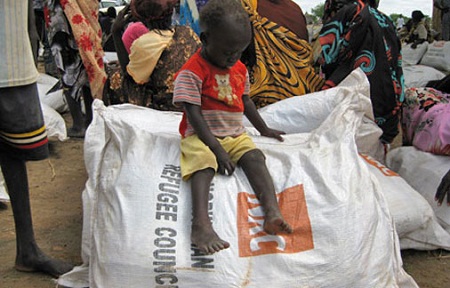
This child in Sudan is receiving food aid from the Norwegian Refugee Council (NRC). Many more children in the world are in need of food safety nets. (NRC Sudan photo)

Herbert Hoover’s book American Epic Volume Four gives a country-by-country breakdown of the siege of hunger after World War II. Detailed reports reveal the crisis of child hunger and the desperate race to find solutions.

The book is a great history of the World War II era and the fight to save millions from starvation after the fighting had ended. It tells a story not often covered in the histories of this time period.

But I think the book represents more than an outstanding history. It’s something we can learn from in today’s struggle to win peace.

When I saw Hoover’s book a few years ago, I asked: Why not have something like this today? Why not have a country-by-country look at all-important child feeding? I felt this was not being covered enough in the news. The “silent tsunami” of high food prices had struck and the number of hungry children worldwide was fast growing.

So I contacted Jennifer Parmelee of the UN World Food Programme (WFP) in Washington, D.C. I presented my idea and it took off from there. It led to the creation of an interview series covering school feeding programs worldwide and then the book Ending World Hunger.

Laura Sheahen of Catholic Relief Services/Caritas also was very instrumental in helping develop the series. The feature continues online at Blogcritics today with its most recent update including the Norwegian Refugee Council providing school meals in the Democratic Republic of the Congo.

The idea is to bring the issue of child hunger into the spotlight and talk about solutions, and to connect the issues of hunger and nutrition to the pursuit of peace and development. This is something American Epic does.

A school meal program for Germany saved that country after World War II and it can do the same for others today.

Yet hunger has not been made enough of a priority and low funding plagues relief operations in Afghanistan, Yemen, Ivory Coast, Haiti, Sudan, and other nations. In East Africa, critical months lie ahead in saving the region after the massive drought last year.

In Sudan food is vital to the peace process. Whether it’s the nutritious peanut paste plumpy’nut (or plumpy’sup for malnourished infants), food for school age children, or agricultural development, it can mean the difference between peace and conflict.

Currently, low funding for the United Nations World Food Programme (WFP) has led to reductions in its school feeding for Afghan children. In Benin, WFP is able to feed only 64 percent of children in the school feeding program. The funding shortages again limit the reach of the program.

There is a lot more that can be done to fight hunger around the globe.

Hoover’s American Epic showed what a food ambassador could do to rally cooperation, both domestically and internationally, for fighting hunger, and why it’s so important that child feeding programs get the support they need. Nutrition matters.

As Hoover said, “Civilization marches forward upon the feet of healthy children. We cannot have recovery of civilization in nations with a legacy of stunted bodies or distorted and embittered minds.”

I think the Congress needs to think of this when they are drawing up the new budget. Think of what the consequences will be of reducing U.S. international food aid – what that will mean for future generations, and what it will mean for our prospects for peace.

I think that is a key lesson to take from Hoover’s American Epic.

Article first published as American Epic Highlights War, Peace, and Child Hunger on Blogcritics.

Leave a comment

Filed under global hunger, History

Remembering the Horn of Africa This Holiday Season

The UN World Food Programme and CARE team up to provide food to refugees who have fled Somalia (WFP/Mariko Hall). Both of these agencies are accepting donations for East Africa.

President Obama issued a statement last week thanking Americans who had donated to relief efforts in the Horn of Africa this year. He also cautioned that much more needs to be done to overcome the humanitarian tragedy of 2011.

Obama said, “As we enter the season of giving and renewal, more than 13.3 million people in Ethiopia, Kenya, and Somalia remain in urgent need of humanitarian assistance amid the worst drought the region has seen in 60 years. The heartbreaking accounts of lives lost and of those struggling to survive remind us of our common humanity and the need to reach out to people in need.”

The U.S. has a great tradition of leading the fight against famine wherever it occurs. In 1946, just a year after World War II ended, the threat of massive famine loomed over the globe as food supplies were running low. In this case, the paths of the U.S., Somalia, and Ethiopia crossed briefly.

Herbert Hoover, who was appointed food ambassador during this crisis, first reviewed the food supply of as many nations as possible. In this report were listed Somaliland and Ethiopia. Hoover writes “of self-sufficient nations in Africa, we classified Egypt, Ethiopia, Liberia, and Somaliland, with a total population perhaps of 35,000,000 people.”

There were no reports of drought that year in East Africa. Of course, any country not in food deficit at that time was a huge relief with the impending worldwide famine. It was going to be enough of a challenge to meet the food needs of the war-devastated countries.

Whether or not there is a drought is all about luck. In 1946 there was luckily none in East Africa. This year a different story–a huge drought.

What does not depend on luck though is how well nations are prepared to deal with drought. Many actions can be taken by the international community to help build up the resilience of farmers in developing countries so that when drought does hit, it is not catastrophic. Food reserves can also be in place to prevent a year of setbacks from drought and keep a country moving toward food security.

So, this is one of the lessons of this year. Invest in farmers today to avoid the famine of tomorrow.

Article first published as Remembering the Horn of Africa this Holiday Season on Blogcritics.

Leave a comment

Filed under global hunger, History

This Christmas Feed a Silent Guest and End World Hunger

The Providence-based Edesia will be making plumpy'nut this Christmas Eve to feed malnourished children in Chad (photo courtesy of Edesia)

Imagine if every person gave a gift this Christmas to a “silent guest,” one of the world’s hungry. During Christmas 1947, Americans did just that, continuing the successful “silent guest” program started in Thanksgiving of that year by a former aspiring actress named Iris Gabriel.

People imagined a “silent guest” at their holiday meal, and donated the cost of the imaginary food plate to buy a CARE package. These packages fed many thousands in countries overseas rebuilding from World War II.

This Christmas Eve a company called Edesia will be making packages of plumpy’nut to send to the African nation of Chad. Food is out of reach for the many poor in Chad, a country where drought and conflict have taken their toll. The smallest children pay the heaviest price unless the outside world intervenes with foods like plumpy’nut.

Plumpy’nut is a special package of food that saves infants from succumbing to dangerous malnutrition. There is no more important gift these children can receive.

Edesia accepts donations so you can help them fill this plumpy’nut order to Chad.One dollar actually buys several little packages, or sachets, of plumpy. Their plant has also produced this peanut paste for East Africa, Yemen, Guatemala, Haiti and Pakistan. Aid agencies like the World Food Programme, UNICEF and others distribute the plumpy’nut in these countries.You can make “silent guest” donations to these organizations at their respective web sites.

There are also ways you can feed a silent guest simply by playing on your computer. If you play the online game Free Rice, 10 grains of rice are donated to the hungry every time you get a correct answer. The rice is paid for by advertisers on the site.

There are many ways you can give a holiday gift to a silent guest at your holiday celebration. Happy Holidays!

See also Commentary in the San Francisco Chronicle: What you can do today to help end world hunger.

Article first published as This Christmas Feed a Silent Guest and End World Hunger on Blogcritics.

Leave a comment

Filed under global hunger, History

War Horse Set During World War I Era of Hunger and Suffering

A new movie called War Horse, directed by Steven Spielberg, opens this Christmas. The film is set during World War I, what actress Emily Watson vividly describes as the useless slaughter of so many young men. (see her interview with Jen Dalton of WKRC News)

Millions perished from the advanced weaponry unleashed in the world’s first global war. But that was not the only threat facing France, Belgium and other countries caught in the conflict.

With the chaos of fighting came the disruption of food supplies. Hunger and famine are the companions of war. Millions more people in Europe would have perished had not humanitarian aid come to the rescue.

France was among the countries where the suffering was immense. Herbert Hoover, who organized World War I relief, wrote “the free world had little comprehension of the suffering of France during almost four years of continuous war. When the curtain was raised at the armistice, there came into view destroyed cities, homes and farms. A belt of once fertile land on both sides of the trench lines was so torn that it required years for restoration.”

The Commission that provided relief to Belgium during the war also provided aid to more than two million people in Northern France. This meant food for malnourished children, expectant mothers and other vulnerable people on whom hunger could inflict the most damage.

For when a child is malnourished the damage, both physical and mental, is irreversible. This child malnutrition is widespread in many countries today including Somalia, Afghanistan, Yemen, Pakistan, Sudan, Chad and others.

During World War I, aid had to be rushed to save children from potentially deadly malnutrition. Generosity and compassion were more powerful in the end than the evil death machines of World War I.

It was the Red Cross providing meals to school children in France or helping the wounded. Or on the individual level, a woman in Cincinnati, Ohio who, instead of buying flowers for a deceased friend’s grave, decided to donate the money to the Belgian Relief Commission. Even a couple dollars fed a child for months, and saved their life during the hunger of World War I.

There are many stories of tragedy and triumph in World War I. The film War Horse depicts the challenges people faced during this ever-tumultuous period in history, one that changed the world. And to this day, the pursuit of world peace, longed for by the Lost Generation of World War I, continues.

Article first published as War Horse Set During World War I Era of Hunger and Suffering on Blogcritics.


Leave a comment

Filed under global hunger, History

The Battle of the Bulge and Fighting Global Hunger

Troops of the United States 7th Armored Division advance along a road towards St. Vith in Belgium, retaken in the final liquidation of the Battle of the Belgian Bulge., 02/09/1945 Credits: National Archives

It was December, 1944 when the Battle of the Bulge started in World War II. Germany launched its last big offensive against the surging allied armies which had landed in Europe on D-Day. While this massive battle unfolded, another war was also taking place in Europe, a war against hunger and famine.

Hunger was everywhere. At Christmas time, a Belgian father published an open letter to General Eisenhower and the American soldiers. He thanked them for sharing food from their ration kits with hungry Belgian children.

At nearly the same moment in Finnmark (northern Norway) the Allies were rushing humanitarian aid to help those left homeless and hungry after the Nazis burned the region while in retreat. The charities American Relief for Norway, the Red Cross and Save the Children also came to the rescue of Norway for emergency aid and reconstruction.

The Netherlands, occupied by the Nazis, was entering what is known as the “hunger winter” of 1944-1945 as it waited for liberation. In December of 1944, General Dwight Eisenhower issued orders for relief supplies to be built up and ready to distribute in the Netherlands as soon as liberation took place.

The Battle of the Bulge caused such suffering that food supplies had to be diverted to Belgium to feed the hungry there. The Netherlands’ supply had to be built back up. As the war continued into early 1945, conditions deteriorated in the Netherlands with people dying from starvation.

In April of 1945 the Allies reached agreement with the German occupiers to begin airlifting food supplies into the Netherlands. Truck convoys of aid soon followed. Germany surrendered in May 1945. The famine in the Netherlands would have claimed far more lives if the Allies had not stored enough food supplies to enact a huge relief operation.

Hunger relief continued long after the guns fell silent in World War II. One lesson learned from World War II and the Battle of the Bulge was that even under the most difficult of circumstances, the most destructive war ever, the U.S. and their allies were able to keep up a fight against hunger and save lives.

The humanitarian effort displayed in behalf of the suffering victims of World War II provides an excellent example for present leadership to follow, as hunger continues to be the deadly companion of conflict and poverty around the globe.

This is tragically evident in many countries today from Sudan to Afghanistan, Yemen, Libya and other crisis points. The United Nations World Food Programme, directed by Josette Sheeran, feeds war victims in these countries daily. Josette’s father James served with the U.S military in the Battle of the Bulge and contributed to post-war hunger relief in France.

Article first published as The Battle of the Bulge and Fighting Global Hunger on Blogcritics.

Leave a comment

Filed under global hunger, History

When Santa, Rudolph and Eisenhower Took on Global Hunger

Christmas is coming and all eyes are on the sky for Rudolph, his fellow reindeers and, of course, Santa Claus. Back in 1953 Santa’s sled was extra heavy, with hundreds of thousands of food packages for the hungry worldwide.

That year President Dwight Eisenhower started “Operation Reindeer.” He wanted to build goodwill with Christmas food packages to fight global hunger. Everyone got involved. Charities, the U.S. military and also the public took part in either buying the CARE packages or making the deliveries.

Germany, Japan, Austria, Korea, and Italy were some of the countries that received the Christmas food gifts. All of these nations had recently been scarred by war and were trying to overcome the resulting poverty.

“Operation Reindeer” was an opening chapter in the U.S. Food for Peace era. What better way to build a peaceful world than by ensuring all could have the food and nutrition they needed to survive and develop?

When Eisenhower took office, the United States had a growing surplus of food. Worldwide, though, there were hungry people. It made sense to send this food abroad to the needy.

The food would mean something more too. It would connect Americans to people overseas. Food would form a friendship. Food would unite. Food would be a bridge to peace.

Someone who received an Operation Reindeer package in Germany said, “It reminds us that we have not been forgotten.” One German wrote, “tell Americans that they have admirers in Germany.”

In Austria, a governor said that “his country is very grateful and the only reason that recovery has been so miraculous has been due to U.S. aid and friendship.” Another remarked, “this food package program makes the man on the street in Austria appreciate the friendship of the U.S.”

After Operation Reindeer ended, one of the officials was asked, “Why isn’t such a program wider in scope?” Observers of Operation Reindeer felt that more publicity about the program would have further enhanced this public diplomacy outreach.

Also, it would highlight the needs in these countries. In Italy, Mr. Newton Leonard, sent by the U.S. to observe the aid, wrote, “we wished that the packages weighed a hundred pounds for we realized how quickly the contents of the packages would be consumed by the hungry and ill children and adults.” Leonard recommended a Supplemental Nutritional Assistance Program with emphasis on child feeding, including school meals.

Operation Reindeer was only a quick relief program and it was discontinued after 1954 in favor of longer lasting projects. What was needed was steady aid and this is what evolved in the coming years. One reporter remarked they fired Santa for Christmas but instead gave him a year-round job.

What followed in Italy was Food for Peace with school feeding for millions. Japan, South Korea, Brazil, Peru, India and others also received school meals during the Eisenhower and Kennedy administrations.

Food for Peace programs, whether school meals or other projects, helped turn many countries from recovery mode to self-sufficiency. They are now donors to hunger fighting programs around the globe.

Today, though, there are still many people around the world suffering from hunger. We still need the Food for Peace spirit that was so strong during the immediate years after World War II.

There are nearly 1 billion people worldwide who suffer from hunger. With that kind of suffering and deprivation, peace and development cannot take hold. In Afghanistan, for instance, over 7 million people are estimated to suffer from hunger and many millions more on the brink of this despair. These statistics were tabulated before the recent drought struck that country, putting millions of others at risk.

Food is the best road to peace in that country for without it people cannot work, cannot grow, cannot learn and cannot thrive. It’s the same story in Sudan, Ivory Coast, Niger, Yemen, Haiti, the Democratic Republic of the Congo and other countries mired in instability and poverty. If we feed their hungry and build their agricultural capacity, it’s our best hope of building stable and prosperous countries, and having them as lasting friends and allies of the United States.

Food is what unites all peoples across the globe, for all people and nations need it to survive and develop. There is no better gift we can give this Christmas or year round than food for the world’s hungry.

Article first published as When Santa, Rudolph, and Eisenhower Took on Global Hunger on Blogcritics.

Leave a comment

Filed under global hunger, History, Uncategorized

Singing Telegrams, Congress and Food Aid

Congress is debating whether to reduce international food aid even as famine continues in East Africa (photo credit: World Food Program USA)

Western Union was in the news this week with its revival of the singing telegram – although updated to include e-mail delivery.

This company of course has a deep history of sending telegrams, whether the most urgent kind or the singing variety. One day in 1962 a Western Union telegram was sent to Congress urging them to save a program that provided school meals to children in Poland and Yugoslavia.

In June 1962, during the Kennedy administration, Congress was considering termination of aid to Poland and Yugoslavia, both under Communist control. Hugh D. Farley, the director of Church World Service, was upset with this prospect and sent a telegram to three Senators.

Farley urged the senators not to cut food aid programs in these two countries that were reaching over two million children with school meals. Orphanages and homes for aged were also receiving food support. Farley told the senators the cutting of aid would be “difficult for children to understand” and that “people to people” programs should be continued.

He also alerted George McGovern about the telegram. McGovern had been appointed by President Kennedy as the director of the Food for Peace program that oversaw these food aid initiatives. Food for Peace was started by President Dwight Eisenhower and President Kennedy continued and strengthened this program, placing special emphasis on school feeding.

McGovern wrote back to Farley the next day telling him of an amendment approved by the Senate “providing presidential authority for continued food assistance to Poland and Yugoslavia.” McGovern wrote, “I am sure that your expression to the Senators was helpful.”

Saving meals for children was the right thing to do in 1962 and it is right again in 2011. Church World Services is urging the same type of advocacy by citizens to tell Congress not to cut food aid programs in the upcoming budget. The Food for Peace program, as well as the McGovern-Dole school lunch program, are at risk of budget cuts.

With famine in East Africa and many other hunger crisis points unfolding, food aid needs to be bolstered, not reduced.

Church World Service says, “Further cuts to humanitarian foreign assistance will result in countless additional people going hungry and many more children losing their lives to preventable and treatable diseases. Preserving robust, well-targeted foreign assistance will save millions of lives, build self-reliance among the world’s most vulnerable, and help protect our own national security in the process.”

There is also quite a controversy over why Congress is making cuts to food aid since it already is such a relatively inexpensive program. Food aid makes up less than one tenth of one percent of the federal budget. International assistance programs, such as food aid and other programs like malaria treatments, come out to around 1 percent of the total budget. The relatively low cost of these aid programs is not widely known either.

Church World Service reports, “Polls show that many Americans believe that international assistance is 25 percent or more of U.S. spending. That makes it an easy target for members of Congress. But in fact, when these same Americans are asked how much U.S. aid for poor families abroad should be, they support levels between 6-10 percent!”

Save the Children, World Vision, the World Food Program USA and other agencies are urging Congress to save food aid from budget cuts. They are asking citizens to make their voices heard before it’s too late. Calls, e-mails, tweets, faxes are all being urged for reaching your representatives. A singing telegram? Well, if it works. Why not?

Article first published as Singing Telegrams, Congress and Food Aid on Blogcritics.

Leave a comment

Filed under global hunger, History