Category Archives: global hunger

This Christmas Feed a Silent Guest and End World Hunger

The Providence-based Edesia will be making plumpy'nut this Christmas Eve to feed malnourished children in Chad (photo courtesy of Edesia)

Imagine if every person gave a gift this Christmas to a “silent guest,” one of the world’s hungry. During Christmas 1947, Americans did just that, continuing the successful “silent guest” program started in Thanksgiving of that year by a former aspiring actress named Iris Gabriel.

People imagined a “silent guest” at their holiday meal, and donated the cost of the imaginary food plate to buy a CARE package. These packages fed many thousands in countries overseas rebuilding from World War II.

This Christmas Eve a company called Edesia will be making packages of plumpy’nut to send to the African nation of Chad. Food is out of reach for the many poor in Chad, a country where drought and conflict have taken their toll. The smallest children pay the heaviest price unless the outside world intervenes with foods like plumpy’nut.

Plumpy’nut is a special package of food that saves infants from succumbing to dangerous malnutrition. There is no more important gift these children can receive.

Edesia accepts donations so you can help them fill this plumpy’nut order to Chad.One dollar actually buys several little packages, or sachets, of plumpy. Their plant has also produced this peanut paste for East Africa, Yemen, Guatemala, Haiti and Pakistan. Aid agencies like the World Food Programme, UNICEF and others distribute the plumpy’nut in these countries.You can make “silent guest” donations to these organizations at their respective web sites.

There are also ways you can feed a silent guest simply by playing on your computer. If you play the online game Free Rice, 10 grains of rice are donated to the hungry every time you get a correct answer. The rice is paid for by advertisers on the site.

There are many ways you can give a holiday gift to a silent guest at your holiday celebration. Happy Holidays!

See also Commentary in the San Francisco Chronicle: What you can do today to help end world hunger.

Article first published as This Christmas Feed a Silent Guest and End World Hunger on Blogcritics.

Leave a comment

Filed under global hunger, History

War Horse Set During World War I Era of Hunger and Suffering

A new movie called War Horse, directed by Steven Spielberg, opens this Christmas. The film is set during World War I, what actress Emily Watson vividly describes as the useless slaughter of so many young men. (see her interview with Jen Dalton of WKRC News)

Millions perished from the advanced weaponry unleashed in the world’s first global war. But that was not the only threat facing France, Belgium and other countries caught in the conflict.

With the chaos of fighting came the disruption of food supplies. Hunger and famine are the companions of war. Millions more people in Europe would have perished had not humanitarian aid come to the rescue.

France was among the countries where the suffering was immense. Herbert Hoover, who organized World War I relief, wrote “the free world had little comprehension of the suffering of France during almost four years of continuous war. When the curtain was raised at the armistice, there came into view destroyed cities, homes and farms. A belt of once fertile land on both sides of the trench lines was so torn that it required years for restoration.”

The Commission that provided relief to Belgium during the war also provided aid to more than two million people in Northern France. This meant food for malnourished children, expectant mothers and other vulnerable people on whom hunger could inflict the most damage.

For when a child is malnourished the damage, both physical and mental, is irreversible. This child malnutrition is widespread in many countries today including Somalia, Afghanistan, Yemen, Pakistan, Sudan, Chad and others.

During World War I, aid had to be rushed to save children from potentially deadly malnutrition. Generosity and compassion were more powerful in the end than the evil death machines of World War I.

It was the Red Cross providing meals to school children in France or helping the wounded. Or on the individual level, a woman in Cincinnati, Ohio who, instead of buying flowers for a deceased friend’s grave, decided to donate the money to the Belgian Relief Commission. Even a couple dollars fed a child for months, and saved their life during the hunger of World War I.

There are many stories of tragedy and triumph in World War I. The film War Horse depicts the challenges people faced during this ever-tumultuous period in history, one that changed the world. And to this day, the pursuit of world peace, longed for by the Lost Generation of World War I, continues.

Article first published as War Horse Set During World War I Era of Hunger and Suffering on Blogcritics.


Leave a comment

Filed under global hunger, History

The Battle of the Bulge and Fighting Global Hunger

Troops of the United States 7th Armored Division advance along a road towards St. Vith in Belgium, retaken in the final liquidation of the Battle of the Belgian Bulge., 02/09/1945 Credits: National Archives

It was December, 1944 when the Battle of the Bulge started in World War II. Germany launched its last big offensive against the surging allied armies which had landed in Europe on D-Day. While this massive battle unfolded, another war was also taking place in Europe, a war against hunger and famine.

Hunger was everywhere. At Christmas time, a Belgian father published an open letter to General Eisenhower and the American soldiers. He thanked them for sharing food from their ration kits with hungry Belgian children.

At nearly the same moment in Finnmark (northern Norway) the Allies were rushing humanitarian aid to help those left homeless and hungry after the Nazis burned the region while in retreat. The charities American Relief for Norway, the Red Cross and Save the Children also came to the rescue of Norway for emergency aid and reconstruction.

The Netherlands, occupied by the Nazis, was entering what is known as the “hunger winter” of 1944-1945 as it waited for liberation. In December of 1944, General Dwight Eisenhower issued orders for relief supplies to be built up and ready to distribute in the Netherlands as soon as liberation took place.

The Battle of the Bulge caused such suffering that food supplies had to be diverted to Belgium to feed the hungry there. The Netherlands’ supply had to be built back up. As the war continued into early 1945, conditions deteriorated in the Netherlands with people dying from starvation.

In April of 1945 the Allies reached agreement with the German occupiers to begin airlifting food supplies into the Netherlands. Truck convoys of aid soon followed. Germany surrendered in May 1945. The famine in the Netherlands would have claimed far more lives if the Allies had not stored enough food supplies to enact a huge relief operation.

Hunger relief continued long after the guns fell silent in World War II. One lesson learned from World War II and the Battle of the Bulge was that even under the most difficult of circumstances, the most destructive war ever, the U.S. and their allies were able to keep up a fight against hunger and save lives.

The humanitarian effort displayed in behalf of the suffering victims of World War II provides an excellent example for present leadership to follow, as hunger continues to be the deadly companion of conflict and poverty around the globe.

This is tragically evident in many countries today from Sudan to Afghanistan, Yemen, Libya and other crisis points. The United Nations World Food Programme, directed by Josette Sheeran, feeds war victims in these countries daily. Josette’s father James served with the U.S military in the Battle of the Bulge and contributed to post-war hunger relief in France.

Article first published as The Battle of the Bulge and Fighting Global Hunger on Blogcritics.

Leave a comment

Filed under global hunger, History

When Santa, Rudolph and Eisenhower Took on Global Hunger

Christmas is coming and all eyes are on the sky for Rudolph, his fellow reindeers and, of course, Santa Claus. Back in 1953 Santa’s sled was extra heavy, with hundreds of thousands of food packages for the hungry worldwide.

That year President Dwight Eisenhower started “Operation Reindeer.” He wanted to build goodwill with Christmas food packages to fight global hunger. Everyone got involved. Charities, the U.S. military and also the public took part in either buying the CARE packages or making the deliveries.

Germany, Japan, Austria, Korea, and Italy were some of the countries that received the Christmas food gifts. All of these nations had recently been scarred by war and were trying to overcome the resulting poverty.

“Operation Reindeer” was an opening chapter in the U.S. Food for Peace era. What better way to build a peaceful world than by ensuring all could have the food and nutrition they needed to survive and develop?

When Eisenhower took office, the United States had a growing surplus of food. Worldwide, though, there were hungry people. It made sense to send this food abroad to the needy.

The food would mean something more too. It would connect Americans to people overseas. Food would form a friendship. Food would unite. Food would be a bridge to peace.

Someone who received an Operation Reindeer package in Germany said, “It reminds us that we have not been forgotten.” One German wrote, “tell Americans that they have admirers in Germany.”

In Austria, a governor said that “his country is very grateful and the only reason that recovery has been so miraculous has been due to U.S. aid and friendship.” Another remarked, “this food package program makes the man on the street in Austria appreciate the friendship of the U.S.”

After Operation Reindeer ended, one of the officials was asked, “Why isn’t such a program wider in scope?” Observers of Operation Reindeer felt that more publicity about the program would have further enhanced this public diplomacy outreach.

Also, it would highlight the needs in these countries. In Italy, Mr. Newton Leonard, sent by the U.S. to observe the aid, wrote, “we wished that the packages weighed a hundred pounds for we realized how quickly the contents of the packages would be consumed by the hungry and ill children and adults.” Leonard recommended a Supplemental Nutritional Assistance Program with emphasis on child feeding, including school meals.

Operation Reindeer was only a quick relief program and it was discontinued after 1954 in favor of longer lasting projects. What was needed was steady aid and this is what evolved in the coming years. One reporter remarked they fired Santa for Christmas but instead gave him a year-round job.

What followed in Italy was Food for Peace with school feeding for millions. Japan, South Korea, Brazil, Peru, India and others also received school meals during the Eisenhower and Kennedy administrations.

Food for Peace programs, whether school meals or other projects, helped turn many countries from recovery mode to self-sufficiency. They are now donors to hunger fighting programs around the globe.

Today, though, there are still many people around the world suffering from hunger. We still need the Food for Peace spirit that was so strong during the immediate years after World War II.

There are nearly 1 billion people worldwide who suffer from hunger. With that kind of suffering and deprivation, peace and development cannot take hold. In Afghanistan, for instance, over 7 million people are estimated to suffer from hunger and many millions more on the brink of this despair. These statistics were tabulated before the recent drought struck that country, putting millions of others at risk.

Food is the best road to peace in that country for without it people cannot work, cannot grow, cannot learn and cannot thrive. It’s the same story in Sudan, Ivory Coast, Niger, Yemen, Haiti, the Democratic Republic of the Congo and other countries mired in instability and poverty. If we feed their hungry and build their agricultural capacity, it’s our best hope of building stable and prosperous countries, and having them as lasting friends and allies of the United States.

Food is what unites all peoples across the globe, for all people and nations need it to survive and develop. There is no better gift we can give this Christmas or year round than food for the world’s hungry.

Article first published as When Santa, Rudolph, and Eisenhower Took on Global Hunger on Blogcritics.

Leave a comment

Filed under global hunger, History, Uncategorized

Food Aid for Tajikistan Held Up in Uzbekistan

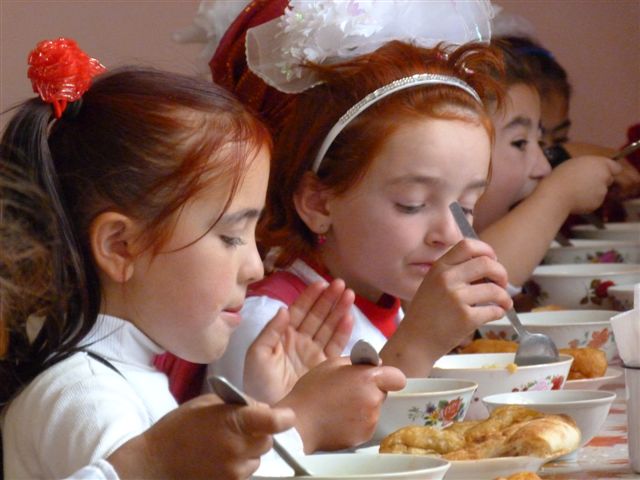
Food for the school feeding in Tajikistan has been limited because of the railway blockade in Uzbekistan. Low funding for WFP has also harmed the program this year. (World Food Programme photo)

The nation of Tajikistan needs food aid. Nearly half the population lives in poverty and food prices are high. In fact, earlier this year children in Tajikistan had their school meal ration reduced because of low funding for the UN World Food Programme (WFP). The WFP depends entirely on voluntary donations.

Some food was on the way to Tajikistan recently by railroad via the neighboring country of Uzbekistan. Yet, the food has been stalled in Uzbekistan for a month when there are hungry people in need. Why? Here are WFP Tajikistan country director Alzira Ferreira’s answers to questions about this situation.

Why are the WFP supplies for Tajikistan being held in Uzbekistan?

The WFP supplies are part of several hundred wagons stuck in Uzbekistan since 17 November. The issue affects all cargoes, both commercial and humanitarian. There are several different accounts of what happened in the Uzbekistan’s side of the rail line that connects that country with the southern Khatlon Region of Tajikistan. I believe the reasons reported in the press (explosion, mud flows, damaged rail bridge) are most likely an excuse for economic and political motives.

How long will it take for the repairs to be made and rail transport can resume?

The Uzbek rail authorities are not providing clear indications of when traffic will resume but have advised our suppliers, under whose responsibility the food is, to divert the wagons via Dushanbe. It does not look like there will be any immediate resumption of rail activity in that line. The other rail connections are not affected.

Are there alternatives such as some food being moved through by truck or air? Is Uzbekistan considering this possibility?

Yes, there are alternatives. Tajikistan is served by three rail lines from Uzbekistan: the one currently interrupted which serves the South, the most populous area of the country; another rail line connects Uzbekistan with Dushanbe and another connects with the northern Sughd Region. We have just made a decision to re-route the wagons intended for the South by rail to Dushanbe and then truck the food South. This brings additional transport costs but it is an alternative.

How much food supply does WFP have left for school feeding and other programs?

WFP still has supplies both in the South and Dushanbe (just over 1,000 tons) but they are insufficient to meet all the needs of planned programmes. For the next three months we need over 3,000 tons of food, so the food held in Uzbekistan is very much needed, and fast. Thus the decision to divert the stranded wagons and future deliveries via Dushanbe.

Article first published as Food Aid for Tajikistan Held up in Uzbekistan on Blogcritics.

Leave a comment

Filed under global hunger

Plotting the 2012 War Against Hunger in Yemen

The term PRRO 200038 stands for Protracted Relief and Recovery Operation and includes the emergency safety net (ESN) plan of food rations discussed in this article as well as nutritional support such as plumpy'nut and plumpy'doz for infants, and Food for Work Projects. Other WFP programs, not included on this map, feed displaced persons

Last month the UN World Food Programme (WFP) held a meeting in Rome to discuss strategy for fighting a growing hunger crisis in Yemen. The WFP’s executive board approved a $32 million budget increase for its plan to distribute rations to families suffering from high food prices. The total budget for this 2011-2012 operation stands at over 122 million dollars.

A WFP document states, “This budget revision is for: i) continuation of a seasonal emergency safety net for 1.2 million severely food-insecure households during the 2012 hunger season; and ii) 4,486 mt of additional food for emergency response in 2012 in view of the deteriorating socio-political situation.”

Malnutrition and lack of basic goods is the most serious threat facing the country. Catherine Bragg of the United Nations said last week, “Humanitarian needs are expected to deteriorate over the next year and we must do everything we can to make sure that these needs are not overshadowed by the political agenda.”

While WFP approved the budget increase, it all hinges on whether donors come through. The World Food Programme relies entirely on voluntary donations from governments and the public.

In 2011, for example, WFP planned to feed 1.8 million Yemenis as part of the aforementioned safety net operation. Funding was low and some entire governorates had to be dropped from the program. At one point over a million Yemenis did not even receive the food rations during a scheduled distribution.

The low funding for WFP Yemen unfolded at the same time food prices increased during political instability. It’s important to remember that even before the year of unrest in Yemen took shape, millions were already deeply mired in hunger and poverty. The turn of events during Yemen’s “Arab Spring” took a bad situation and made it worse.

WFP will also need funding in 2012 to feed Yemenis displaced by conflict both in Northern and Southern Yemen. Food for education programs, which have received almost no funding for two years, need to be restarted. No national school lunch program has been established, nor a universal infant feeding program. These programs can provide a way to defeat malnutrition among children and also increase literacy, class attendance and most importantly completion of education.

In addition, Food for Work projects to help agricultural rehabilitation need to go forward. But it all depends on whether the international community will donate. Yemen cannot achieve political stability and peace amid a storm of hunger. Despite this reality, hunger fighting programs lacked funding in 2011. Will the new year be a repeat?

There is some hope. Germany recently made a 30 million dollar donation to WFP in Yemen. Will other nations follow this lead and help provide food security for Yemenis during a period of political upheaval?

That is a critical question as 2011 comes to a close. It takes on even more urgency when you consider that the United States Congress is proposing reducing funding for the Food for Peace and McGovern-Dole school lunch programs. Both are potential major resources for funding hunger relief in Yemen. If they are cut back, it could prove to be very damaging during the coming year where so much is on the line in Yemen.

Article first published as Plotting the 2012 War Against Hunger in Yemen on Blogcritics.

Leave a comment

Filed under global hunger

Singing Telegrams, Congress and Food Aid

Congress is debating whether to reduce international food aid even as famine continues in East Africa (photo credit: World Food Program USA)

Western Union was in the news this week with its revival of the singing telegram – although updated to include e-mail delivery.

This company of course has a deep history of sending telegrams, whether the most urgent kind or the singing variety. One day in 1962 a Western Union telegram was sent to Congress urging them to save a program that provided school meals to children in Poland and Yugoslavia.

In June 1962, during the Kennedy administration, Congress was considering termination of aid to Poland and Yugoslavia, both under Communist control. Hugh D. Farley, the director of Church World Service, was upset with this prospect and sent a telegram to three Senators.

Farley urged the senators not to cut food aid programs in these two countries that were reaching over two million children with school meals. Orphanages and homes for aged were also receiving food support. Farley told the senators the cutting of aid would be “difficult for children to understand” and that “people to people” programs should be continued.

He also alerted George McGovern about the telegram. McGovern had been appointed by President Kennedy as the director of the Food for Peace program that oversaw these food aid initiatives. Food for Peace was started by President Dwight Eisenhower and President Kennedy continued and strengthened this program, placing special emphasis on school feeding.

McGovern wrote back to Farley the next day telling him of an amendment approved by the Senate “providing presidential authority for continued food assistance to Poland and Yugoslavia.” McGovern wrote, “I am sure that your expression to the Senators was helpful.”

Saving meals for children was the right thing to do in 1962 and it is right again in 2011. Church World Services is urging the same type of advocacy by citizens to tell Congress not to cut food aid programs in the upcoming budget. The Food for Peace program, as well as the McGovern-Dole school lunch program, are at risk of budget cuts.

With famine in East Africa and many other hunger crisis points unfolding, food aid needs to be bolstered, not reduced.

Church World Service says, “Further cuts to humanitarian foreign assistance will result in countless additional people going hungry and many more children losing their lives to preventable and treatable diseases. Preserving robust, well-targeted foreign assistance will save millions of lives, build self-reliance among the world’s most vulnerable, and help protect our own national security in the process.”

There is also quite a controversy over why Congress is making cuts to food aid since it already is such a relatively inexpensive program. Food aid makes up less than one tenth of one percent of the federal budget. International assistance programs, such as food aid and other programs like malaria treatments, come out to around 1 percent of the total budget. The relatively low cost of these aid programs is not widely known either.

Church World Service reports, “Polls show that many Americans believe that international assistance is 25 percent or more of U.S. spending. That makes it an easy target for members of Congress. But in fact, when these same Americans are asked how much U.S. aid for poor families abroad should be, they support levels between 6-10 percent!”

Save the Children, World Vision, the World Food Program USA and other agencies are urging Congress to save food aid from budget cuts. They are asking citizens to make their voices heard before it’s too late. Calls, e-mails, tweets, faxes are all being urged for reaching your representatives. A singing telegram? Well, if it works. Why not?

Article first published as Singing Telegrams, Congress and Food Aid on Blogcritics.

Leave a comment

Filed under global hunger, History

Abraham Lincoln and the Fight Against Global Hunger

A poster during the World War I hunger crisis featuring President Lincoln and a quote from his second inaugural message in 1865. (National Archives)

The Friendship Train that fought global hunger has been the subject of my recent articles in the Des Moines Register and San Francisco Chronicle. Someone who remembered the Friendship Train told me, “Everybody loves trains.”

The Associated Press reported back in 1948 there were two people in Nebraska that had a “complaint” about the Friendship Train. They were disappointed it could not make a stop in their area. So what did they do? They started their own train.

They called it the Abraham Lincoln Friendship Train. The charity Church World Service came to support this train through its Christian Rural Overseas Program (CROP). Today this same group operates hunger walks all around the country which support food aid both at home and abroad.

In 1948, the Abraham Lincoln Friendship Train got its start in Lincoln, Nebraska and went across the Midwest picking up more food for Europe. More trains followed. States like Ohio had their own train picking up wheat and dried milk to be shipped on to Europe for the holidays.

The response was so great that train delays took place because so much food was being donated by Americans. Newspaper reports at that time estimated over 2000 train carloads of food were collected.

While this grassroots effort was ongoing, the Marshall Plan to rebuild Europe was under way. This was American peacemaking at its finest. It came from all Americans, whether they were leaders in Washington D.C. or farmers in the Midwest. With nations in such distress after the war, Americans responded with generosity and friendship.

This is a sharp contrast to plans today by the Congress to reduce international food aid when there are countries that are suffering deeply in hunger, malnutrition and poverty.

What hope do the world’s nearly 1 billion hungry people have without food and nutrition? What hope do we have for peace if another generation is stunted in growth and mind because of lack of food?

It was fitting one of the food trains for peace back in 1948 was named after Lincoln. It was he who said, “With malice toward none, with charity for all.” Lincoln asked Americans “to do all which may achieve and cherish a just and lasting peace, among ourselves, and with all nations.”

There is no more important step toward this goal than feeding the hungry.

Article first published as Abraham Lincoln and the Fight Against Global Hunger on Blogcritics.

Leave a comment

Filed under global hunger, History

Thanksgiving, the Friendship Train, The Silent Guest…and Free Rice

The Friendship Train in November of 1947 collecting food for the hungry in Europe (Ames Historical Society)

Happy Thanksgiving!

My oped This Thanksgiving feed a silent guest and help build world peace is published today in newspapers.

It features the famous Friendship Train that collected food for the hungry in Europe after World War II.

Here are some links to the article:

San Francisco Chronicle

Wichita Eagle

Cleveland Plain Dealer

History News Network

Buffalo News

There are nearly one billion hungry people worldwide. There is hunger in Africa, Asia, the Middle East and even hungry people even here in the United States. Please consider feeding a “silent guest” this Thanksgiving, one of the world’s hungry people. You can donate the cost to feed that “silent guest” to a charity fighting hunger. Here is a list of some hunger fighting agencies.

Even a donation of one dollar can buy close to a week’s worth of meals for a child.

Another way to help is to play the online game Free Rice. It’s free for you to play. The donations of rice are paid for by advertisers on the site. The more you play the more you can help end world hunger!

Have a great holiday!!

William Lambers

FreeRice has two goals: Provide education to everyone for free. Help end world hunger by providing rice to hungry people for free.

Leave a comment

Filed under global hunger

Eisenhower’s Thanksgiving Mission

General Dwight Eisenhower (NATO photo)

General Dwight Eisenhower needed rest. It was the first Thanksgiving since the end of World War II in 1945 and the general was suffering from bronchitis. With the holiday, you would think Ike could get his much-needed recovery time. But not so. On this Thanksgiving Day, Eisenhower was called for a special mission in Washington, D.C.

The Congress was holding a hearing on whether to provide additional funding for the United Nations Relief and Rehabilitation Administration (UNRRA). It was UNRRA that was helping provide food and other humanitarian aid to millions of people suffering in the aftermath of World War II. But it was not a sure thing the Congress was going to grant more money to this relief effort.

Congressman Sol Bloom of New York called upon Eisenhower to testify in the hearing. With Eisenhower’s busy schedule in Washington that week, Ike had planned to submit just a written statement. But when it came clear that Eisenhower could decide the fate of UNRRA funding, he agreed to appear in person. General Walter Bedell Smith had cabled Eisenhower stating that without UNRRA, “there is no repeat no agency to which we can turn to assist actively in carrying out our responsibilities in connection with the care of displaced persons.” Ike replied, “Thoroughly understand. My testimony will be strong.”

Eisenhower made some late edits and additions to a statement the War Department had prepared for him. On Thanksgiving morning he appeared before the House Committee on Foreign Affairs.

Congressman Bloom introduced Eisenhower, stating that the general was appearing against doctors orders and needed to get back to bed as soon as possible. But before that, Ike read his statement in support of UNRRA reminding Congress, “There are few places in Europe today where people are not cold, hungry and apprehensive of the future” and that “the ravished nations of the world are looking to UNRRA for their relief.”

Ike’s testimony was pivotal in swaying Congress to provide more funding for UNRRA which allowed aid to war-torn countries like Italy, Austria, and Greece. One of the countries in desperate need of aid was visited by Eisenhower in September, 1945, Poland.

Devastated by the war Poland needed food, medicine, clothing and the rebuilding of so many destroyed cities and towns. The U.S. Ambassador to Poland, Arthur Bliss Lane, saw the suffering in Poland and knew how important UNRRA aid was. Lane wrote, “the most terrible sight of all was that of the one-legged children…whose legs or arms were carried away by bombs, or whose gangrened limbs were amputated in mercy.”

Lane added, “There is no doubt that the help furnished by UNRRA and other humanitarian organizations … created a great spiritual bond between the Polish people and Western civilization. The distribution of packages was a constant reminder to the Poles that the West had not forgotten their plight and that the West, especially the United States, was helping as in the past.”

Humanitarian aid from UNRRA, the U.S. army, charities like Catholic Relief Services, CARE, UNICEF, and so many other organizations helped establish the foundation for European recovery and peace.

The lesson of Eisenhower’s Thanksgiving mission is essentially one of Food for Peace. Ike stated, “now that the fighting has ceased and the danger is less obvious, it is perhaps difficult for people in this country to visualize the desperate needs of the people of Europe and the necessity, if our military victory is to have lasting significance, of our successfully completing the job of making a peaceful world. ”

We didn’t forget about Europe after World War II, and today we cannot forget the hunger that afflicts over 900 million people throughout the globe. Whether it’s in Afghanistan, Sudan, Nepal or Iraq, it is vital that hunger and poverty are defeated if we hope to have peace.

originally published at History News Network.

Leave a comment

Filed under global hunger, History