Category Archives: global hunger

When St. Patrick’s Day Meant Food for the Hungry in France

Last week I wrote an article on Cincinnati.com about the Pope and the Friendship Train. When the Train crossed America in 1947 picking up food for Europe’s hungry, it was not able to make it as far north as Maine. They had to come up with another way to take part and they seized the opportunity.

The Bath Iron Works in Maine was working on replacing the French fleet lost during World War II. They had just finished and were about to send the ships over to France. But why send them empty?

So, the Maine Rotary Clubs went to work and filled up the first ship with food and other supplies. This included 107 tons of food and even seeds for spring planting of crops.  The name of this ship was the St. Patrick.  It arrived in France during March, 1948 close to the time of St. Patrick’s Day. Happy St. Patrick’s Day!

Leave a comment

Filed under global hunger, History

Pope Can Unite World in Ending Hunger

Pope Francis can unite the world in ending hunger (Vatican photo)

Pope Francis can unite the world in ending hunger (Vatican photo)

Pope Francis can be a powerful leader in uniting all people and faiths in ending world hunger.

For any perceived differences that might exist among world religions and their followers certainly disappear when it comes down to the basic staple of food. Everyone on the planet needs access to food. The saving of human lives, the improvement of standards of living, and peacebuilding all rest first and foremost on food.

In 1920 when people were suffering from hunger in the aftermath of World War I, Pope Benedict XV praised a newly formed “European Relief Council” calling it “truly wonderful and providential” as it fed the hungry. The Pope said praised it “seeing that your work is not confined to any one people, but that it embraces all that are in need without distinction.”

This relief council had brought together organizations including the National Catholic Welfare Council and the Jewish Joint Distribution Committee. When a famine struck Russia in 1921 these groups continued their relief work saving countless lives. Pope Benedict sent trainloads of food and rallied support to help the starving people.

After World War II churches served as collection points where people dropped off donations of food to be shipped overseas to starving people in Europe and Asia. There were many countries still suffering from the destruction of the war. The hungry were not forgotten.

Pope Pius XII said, “We must not allow death to engrave on millions of tombs of innocent children the tragic words of accusation: The little ones have asked for bread and there was no one to break it to them.” Around this time a new organization called Catholic Relief Services got its start.

The Pope embraced ingenuity in fighting hunger, whether it was the CARE package of food which people sent overseas or the Friendship Train. This was the train that crossed America during 1947 collecting food for the hungry in Europe, which helped fuel the reconstruction of a continent.

Pope Pius said when the food arrived in Italy, “Such a cheering contrast in the news of recent days has been the conception of the idea of a Friendship Train and its immediate and generous reception over the entire area of the United States, resulting in the donation of an impressively large quantity of foodstuffs destined and dispatched without delay for the relief of the hungry.”

Now today, the resources exist more than ever to help the 870 million people worldwide who are suffering. These are people starving in the war-affected areas of South Sudan and Sudan, in Syria, and other countries impacted by conflict, drought and poverty. They are small children, who because they cannot get nutrition early in life either perish or suffer lasting physical and mental damage. Many of these children can be saved if more resources and effort are dedicated to fighting hunger.

Last year, the director of the UN Food and Agriculture Organization, José Graziano da Silva, met with religious leaders trying to build unity in the fight against global hunger. There should be a shared commitment on the part of world religions to eradicate world hunger. The new Pope has the great opportunity to make this happen.

“For I was hungry and you gave me food.” Jesus called for the starving and poor to be fed and we each have the opportunity to carry out this mission every day. Hunger must not be a condition considered inevitable, not when we have the ability to end it. What is needed is the spirit and faith to win the struggle against man’s ancient enemy, hunger.

Article first published as Pope Can Unite World in Ending Hunger on Blogcritics.

Leave a comment

Filed under global hunger

Mali and Mauritania: War, Drought and School Meals

As the new U.S. Secretary of State John Kerry says, “There has to be an African solution” to the crisis in Mali. The Malian government, backed by French forces, has been striking Al Qaeda-linked militants who had occupied the northern part of the country.

That solution, a lasting peace, will be hard to find if children are hungry, malnourished and not able to even attend school. Their future is being made in a country where hundreds of thousands have been displaced by the war. There was also a severe drought last year which placed even more burden on already impoverished families.

No food, no school. That is the reality in Mali as described by a UN World Food Programme officer. Families are just looking for ways to survive. If you can provide food at school the children will come, and this holds the key to the country’s future.

The World Food Programme (WFP) is launching emergency school feeding in the northern part of Mali. This will feed close to 70,000 children throughout the conflict-affected area. WFP is already feeding 113,000 children in the southern part of the country.

Will there be funding? That is a big question, because WFP relies on voluntary funding from governments and the public. Right now this operation is only 20 percent funded.

The neighboring country of Mauritania is also feeling the impact of the war, having taken in over 70,000 Malian refugees. This creates a great strain on communities that were already suffering in poverty and drought.

The World Food Programme has a school feeding operation in Mauritania to help both the host communities and refugees. The problem is again funding. Last year, WFP was forced to reduce the number of feeding days as well as the size of the food rations. Sophie Ndong, of WFP in Mauritania, says that last year “primary school children were assisted during 80 days only instead of the 160 days planned.”

The funding woes continue for Mauritania as 2013 gets underway. WFP wants to feed 149,128 children school meals but no funding has arrived except for a donation from the University of Guelph of 318,916 emergency meals for primary school children.

WFP also plans to provide school meals to 18,000 refugee children at the Mbera camp and 28,290 children from the surrounding host community. The program costs about $612,000 but no funding has come in.

The plans are there but the resources are not. Catholic Relief Services has school feeding in Mali, making use of a grant from the U.S. McGovern-Dole program. An expansion of this program’s reach could help fund the WFP programs as well and feed hundreds of thousands more children.

Children suffer the most in a crisis because hunger causes them to become stunted in growth and mind. Feeding the children becomes so vital, and if done at school it becomes food for education, and food for hope.

Article first published as Mali and Mauritania: War, Drought and School Meals on Blogcritics.

Leave a comment

Filed under global hunger

Food Rations Reduced for Displaced Persons in Yemen

Food rations have been reduced for displaced persons in Yemen (WFP/Abeer Etefa)

Food rations have been reduced for displaced persons in Yemen (WFP/Abeer Etefa)

Efforts to build stability in Yemen are being undermined by cuts in food rations to displaced persons throughout the country. The UN World Food Programme (WFP) is facing a funding shortage for its entire emergency operation in Yemen, which provides food aid to millions. WFP relies entirely on voluntary donations.

In February, WFP was forced to reduce rations for 300,000 displaced persons and returnees in the North and South of the country. WFP spokesperson Barry Came said: “Without the ration cuts, WFP would have run out of wheat by late March and many other commodities by mid-April.”

In Southern Yemen, people are returning to their homes in Abyan province, trying to rebuild after the fighting between the government and Al Qaeda. The reduced rations will place an extra strain on these war victims.

WFP needs US$33 million urgently to finance its displaced persons relief. Its overall Yemen relief program faces a US$170 million shortfall in funding. This includes distributing rations to food-insecure families and providing aid to malnourished children. The organisation also has a Food for Education program that needs to be expanded.

Without funding, the threat of more ration cuts or even program suspensions loom.

Half of the population in Yemen suffers from food insecurity and five million suffer from severe hunger. The hunger is most dangerous to children who, if they do not get the right nutrition, will suffer lasting physical and mental damage. If food ration cuts continue Yemen could easily see an increase in an already dire situation of child malnutrition.

WFP, the largest food aid organization, is facing challenging relief missions around the globe, many of which are short on funding. The war in Syria has created a growing humanitarian crisis that is also in desperate needs of resources.

The US Food for Peace program, the largest single donor to WFP, is under the risk of cuts by the Congress. This will make it more difficult to fight hunger and build stability in Yemen and many other countries.

Article first published as Food Rations Reduced for Displaced Persons in Yemen on Blogcritics.

Leave a comment

Filed under global hunger

Saving the Children in South Sudan

Save the Children is treating severely malnourished infants at its nutrition centers in Eastern Equatoria and Jonglei, two states in South Sudan suffering from hunger emergencies. (Save the Children photo)

Save the Children is treating severely malnourished infants at its nutrition centers in Eastern Equatoria and Jonglei, two states in South Sudan suffering from hunger emergencies. (Save the Children photo)

Save the Children staff knew something was wrong. It was last November in Eastern Equatoria of South Sudan, just after the harvest, when it was less likely for families to need food assistance. Malnourished children were still being brought to Save the Children nutrition centers at an alarming rate, though.

Crops had failed because of “low and erractic rainfall” according to the United Nations. Families were running out of their usual food supply and were starting to resort to using wild fruits to survive.

Fact-finding missions sent by the UN into parts of Eastern Equatoria confirmed the increasing levels of hunger. It could get much worse too. The upcoming “lean season” between harvests is generally when food supply is at its lowest.

At its Kapoeta nutrition center during January, Save the Children saw 114 infants with severe malnutrition and another 210 children with more moderate malnutrition. Severely malnourished children are given a nutritious peanut paste called Plumpy’nut.

Without the right nutrition infants can suffer lasting physical and mental damage or death. Having enough stock of a food like Plumpy’Nut is essential to humanitarian aid operations. For no long-term solution to ending hunger or building peace can be found with malnourished and stunted children.

Save the Children is also responding to another hunger emergency in South Sudan. Cattle raids in Jonglei, the largest state in South Sudan, have killed or displaced thousands of people who are in need of aid.

These cattle raids in Jonglei took place in Akobo County and are the latest in a series of internal conflicts within the state.

Save the Children is providing aid in Akobo East. This is an area that struggles with food security. Helen Mould of Save the Children points out that the internal conflict has escalated deadly malnutrition in this area. People fleeing violence in Akobo West head toward the east. Mould says, “Host communities are sharing food stocks, but this is adding pressure on an already stressed situation. As a coping mechanism it appears many children are eating just one meal a day and families are relying on wild fruits for their food.”

The effect of this violence drives communities deeper into hunger. Displaced farmers, for instance, will not be able to plant crops in 2013.

The humanitarian tragedy continues. There is such poverty in South Sudan so there is little resistance to shocks such as drought or even flooding. When you add the conflict, often over scarce resources, you add another dimension driving the hunger crisis. South Sudan desperately needs food and peace.

Save the Children has a crisis fund set up to save lives in South Sudan.

Article first published as Saving the Children in South Sudan on Blogcritics.

Leave a comment

Filed under global hunger

The Candy Bombers is More Than A History Lesson

Former Defense Secretary Robert M. Gates, left, and Mike Rhodes, greet retired Air Force Col. Gail Halvorsen, right, prior to the dedication of the Defense Humanitarian Relief Corridor in the Pentagon, May 19, 2009. During the Berlin Airlift, Halvorsen earned the nickname "Candy Bomber" for his dropping candy-laden parachutes from his aircraft to Berlin children. (DoD photo by Navy Petty Officer 1st Class Molly A. Burgess

Former Defense Secretary Robert M. Gates, left, and Mike Rhodes, greet retired Air Force Col. Gail Halvorsen, right, prior to the dedication of the Defense Humanitarian Relief Corridor in the Pentagon, May 19, 2009. During the Berlin Airlift, Halvorsen earned the nickname “Candy Bomber” for his dropping candy-laden parachutes from his aircraft to Berlin children. (DoD photo by Navy Petty Officer 1st Class Molly A. Burgess

At at time when budget cuts by Congress threaten aid to the needy overseas, The Candy Bombers brings history to life while offering lessons for the present. By Andrei Cherny, it tells the story of the Berlin Airlift of 1948, during the early years of the Cold War. After the guns of World War II fell silent Germany lay in ruins and was occupied by the Allies and Soviet Russia. The capital city of Berlin rested deep inside the Soviet-held area of Germany.

In June, 1948, the Soviets cut off ground access to Berlin, which meant no supplies could get in. What would America do? Using force to get the supplies in meant the threat of World War III. A retreat from Berlin, and allowing the Soviets to take over, would be a disaster.

Instead America chose to airlift supplies into the city. The book tells about how this plan came into action and how it saved Berlin from starvation. It also tells a tale of what the Berlin Airlift meant to children who received magical air drops filled with candy from American planes.

German children who were terrified of American planes during the war now celebrated them. A letter from one child read: “Suddenly we saw about ten white parachutes coming out of the sky! One of them set down at the roof of our house. There were three stripes chocolate in the parachute. My sister, mother, and grandma were very glad about the chocolate too! I want to thank you for your love to the German kids.”

The book is not just about telling the history of major event of the Cold War. It reminds people to apply past to present, at a time when we need some guidance and leadership. The introduction of the book tells about how when the 9/11 disaster struck there was such sadness and outpouring of support for America coming from Berlin. They remembered when America came to their aid after the war. As one woman, who was a child during the Berlin Airlift, said, ” I love Americans.”

America sent food, CARE packages, school meals, reconstruction projects through the Marshall Plan all along months of Berlin Airlift supplies. These acts saved Germany, changed the world and remind us that peace is obtained through reaching out a helping and caring and giving hope.

Article first published as The Candy Bombers Is More Than a History Lesson on Blogcritics.

Leave a comment

Filed under Books, global hunger

College Class to Help Feed the Hungry

It was Helen Keller who said, “Alone we can do so little, together we can do so much.” I recently used that great quote while speaking to a class at the College of Mount St. Joseph (MSJ).

The students there are going to help fight global hunger by playing FreeRice and walking Charity Miles as part of their Cincinnati Authors course. Ashley Eilers of the MSJ school paper reports on this service learning set up by Professor Jeff Hillard.

With FreeRice the students will be raising donations for the UN World Food Programme (WFP), the largest agency fighting hunger. The FreeRice donations will feed children in Niger, a country that suffered a severe drought and near famine last year. With Charity Miles, the free cell phone app that generates donations when you exercise, the students will help both WFP and Feeding America.

The Mount’s Leadership Pathways program had a FreeRice event earlier this year. It was a student in last year’s Cincinnati Authors class, Elizabeth Paff, whose enthusiasm put this plan in motion.

Paff did not have a cell phone with internet connectivity so she was unable to download and use the Charity Miles app. That did not stop her, though. She did her own form of Charity Miles, running and fundraising for Plumpy’nut to feed malnourished children. Since October we have raised donations for over 1,300 meals for Feeding America, the World Food Programme, and Edesia through our combined Charity Miles program.

Last week I ran to the Anderson Ferry Food Pantry in Delhi, Ohio. It’s part of the Cincinnati Freestore Foodbank’s network of agencies fighting hunger in the area. The Pantry is short on donations while they have seen an increase in demand, a familiar scene across the country, with over 50 million Americans food-insecure.

A walk or run to your local food pantry, using Charity Miles, might be a good way to raise money and find out what is happening with hunger in your community. If there is a food shop nearby you might be able to finish your run there and purchase some supplies for the pantry as well.

Sherrie Kleinholz, a great advocate for the homeless, and I teamed up for a food drive last summer that benefited the Anderson Ferry Pantry as well as Our Daily Bread, and the Care Barrel at Our Lady of Victory Church. The food drive was in honor of my mother who passed away from cancer. One of the donors was scheduled shortly for surgery but still took the time to gather food and leave it out for pickup. Kleinholz also spoke to the Cincinnati Authors class prior to my presentation.

Feeding America is encouraging everyone to get involved in the Together We Can Solve Hunger campaign. The best ideas to help fight hunger are the ones you adapt or create on your own. So get involved as soon as you can.

Article first published as College Class to Help Feed the Hungry on Blogcritics.

Leave a comment

Filed under global hunger

Together We Can End Hunger

John Young, former president of the Cincinnati Freestore Foodbank, has spent a lifetime helping others. It was very early in his humanitarian career that he discovered how you can end hunger and poverty.

As a teenager he volunteered at a hospital one day to feed elderly patients, some very close to death. It was a difficult task and made him a little unsure about going back again. But when he did return for a second day, he saw the joy from the patients because someone cared enough to come back to help them.

Young learned that that is how you make a difference, you get involved and stay connected. If enough people do that hunger and poverty can be eliminated.

The answer to the societal problem of hunger can be found right here in your own backyard. The Freestore Foodbank, for instance, has provided a safety net, and a way out, for people in Cincinnati suffering from hunger. Those solutions are found in the strength of volunteers coming forward like Young did and then going on to become leaders.

There is enough food for everyone in the world, and we can do a much better job preventing food waste. So ending hunger is not something where a miracle cure has to be discovered. It’s a case of stepping up the effort and getting more people involved.

Using the award-winning online game FreeRice, College of Mount St. Joseph (MSJ) students are answering questions in a variety of subjects like vocabulary and science. Every correct answer means 10 grains of rice donated to the UN World Food Programme. The rice is being sent to the school feeding program in Niger, a country that suffered from severe drought and is hosting refugees from the war in Mali. For many children in these impoverished, developing countries, the school meal might be the only one they receive the whole day.

Last fall I did a story on Ithaca College and how they make use of FreeRice as part of their hunger relief program called Food for Thought.

There are many ways now that people, schools, and organizations can get involved to end hunger. There is even a free app people can download onto their smartphones called Charity Miles. When your walk, run, or bike the app keeps track of your distance and for every mile a donation is made to Feeding America or the World Food Programme. You select the charity and the results get posted to your Facebook page. There are lot of athletes and teams so the potential for Charity Miles is amazing.

Charity Miles is partnering with Feeding America for the Together We Can Solve Hunger Campaign. “The campaign provides people with simple, easy ways to engage in the fight against hunger,” said Shannon Traeger, spokesperson for Feeding America. “With more than 50 million Americans living at risk of hunger, including more than one in five children, we’re encouraging everyone to do their part.”

Find a way to get involved and fight hunger. Educate others and get them involved too. This dedication can make a difference in ending hunger here at home and across the globe. The solution to this menace to mankind is right here in front of us.

Article first published as Together We Can End Hunger on Blogcritics.

Leave a comment

Filed under global hunger

Feeding the Future of Yemen

Somali refugee children in Yemen having school breakast from the World Food Programme (WFP/Barry Came)

Somali refugee children in Yemen having school breakast from the World Food Programme (WFP/Barry Came)

When you can fight hunger and give a child hope at the same time, you can change the world. We have seen this time and time again over the years with school feeding.

For Yemen, feeding and educating its children is crucial to building the stability and peace it needs. The UN World Food Programme (WFP) has some innovative ways of helping Yemen achieve this.

First is through a Food for Education program which accomplishes two goals at once. To encourage attendance of girls to class, WFP provides take-home food rations. This not only boosts the attendance at school, but helps feed an entire family. You fight hunger and you boost education with one act.

With about 10 million Yemenis facing hunger, food assistance programs like this are desperately needed.

WFP spokesperson Barry Came says 53,000 girls are currently receiving the rations. When you add the fact that their entire family benefits, then 371,000 Yemenis are being helped with this food. The rations consist of wheat and vegetable oil which are distributed in two or three rounds over the course of the school year.

The problem becomes keeping this initiative funded, which has been very difficult for some years. WFP was not even able to run the program for a period of time. In addition, more children could be reached with additional funding.

WFP relies on voluntary funding from governments and the public. A grant, for instance, from the U.S. McGovern-Dole school meals program could make a significant difference in the reach of Food for Education. Right now the program is short $5 million.

WFP also has school feeding for refugee children. Thousands of Somalis have fled the conflict and hunger in their homeland, to find refuge in Yemen. WFP is helping refugee children by providing meals at school.

At the Kharaz refugee camp, in the deserts of southern Yemen, WFP is feeding about 4,500 Somali boys and girls at two primary schools. In addition, WFP is also feeding 4,500 more children, many of which are Somalis, at a school in the Al Basateen district of Aden.

Came says all children at the school receive the meals “in the belief that it helps to integrate the two communities.” The school feeding for Somali refugees currently faces a $1.7 million shortage in funds.

No nation can progress without healthy and educated children. School feeding provides an opportunity for Yemen to make progress, but it will depend on the support of the international community going forward.

Article first published as Feeding the Future of Yemen on Blogcritics.

Leave a comment

Filed under global hunger

Food for Work, Winter Rations Crucial in Kyrgyzstan


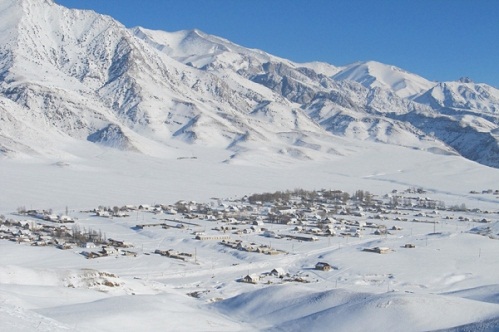
The passage to Kosh-Bulak is open for a short three-month period and impassable the rest of the year, leaving the village in complete isolation. (WFP/Ulan Raimkulov)

The passage to Kosh-Bulak is open for a short three-month period and impassable the rest of the year, leaving the village in complete isolation. (WFP/Ulan Raimkulov)

Kyrgyzstan is a nation that has suffered through ethnic conflict and instability. Hunger is on the rise too with 25 percent of the population food-insecure. The price of food, particularly wheat flour, has dramatically increased placing further strain on these families.

The UN World Food Programme (WFP) is helping provide food aid which is especially crucial in the winter months. Elizabeth Zalkind of WFP says three-month rations are provided to 231,000 people in impoverished areas which become nearly impossible to reach during harsh winter. The people need this food literally to survive.

With so much hunger and poverty in these communities, as well as the ethnic tensions, people look for hope. Food for Work projects sponsored by WFP offer a way to tackle these societal problems. These are initiatives where workers are provided food rations while they complete projects aimed at building communities.

One Food for Work (aka Food for Assets) project helped restore an easier passage to the village of Kosh-Bulak, which becomes hard to reach during winter. This was done using concrete rings to reinforce the passage, with help provided by the United Nations Development Project. Connecting communities is key to building their economy.

WFP has also sponsored projects feeding 115,000 people in Kyrgyzstan including re-forestation, rehabilitation of irrigational networks, riverbank reinforcement, restoration of mud flow canals.

Food for Work offers a way to reduce hunger while working on these projects, which in time can reduce or eliminate the amount of aid needed. In Kyrgyzstan the projects have an extra benefit of bringing together people from different ethnic groups. This helps build peace while reducing the poverty that threatens everyone.

Much work needs be done to reduce hunger in Kyrgyzstan and with WFP relying on voluntary funding that becomes a major issue. WFP believes food security could worsen come spring when the winter rations they provided run out.

Article first published as Food for Work, Winter Rations Crucial in Kyrgyzstan on Blogcritics.

Leave a comment

Filed under global hunger