Tag Archives: Yemen

Silent Threat of Hunger Gravest to Yemen

A young Yemeni woman shows her World Food Programme cash transfer card at the Hajjah Post Office. The cash allows her to buy food and medicine for her family. Many Yemenis depend entirely on aid agencies as poverty escalates. (WFP/ Ali Al-Homeidy)

Of all the perils facing Yemen, from political unrest to Al Qaeda, it’s the silent threat of hunger that is the most dangerous.

The UN World Food Programme (WFP) says 5 million Yemenis are facing severe hunger. That number is about equal to the population of Massachusetts. Lubna Alaman, WFP county director says, “almost one quarter of the Yemeni population needs emergency food assistance now.”

An additional 5 million Yemenis are on the brink of joining the severe hunger ranks as they too face “food insecurity.” About 10 million Yemenis are facing either severe or moderate hunger. Now you are talking about a starving population equal to that of Massachusetts, Connecticut and New Hampshire.

Even before the Arab Spring unfolded, Yemen suffered from hunger and high rates of malnutrition. Efforts to provide humanitarian aid were underfunded. Then the country, already the poorest in the Middle East, plunged further toward chaos.

Protesters called for the removal of long-time President Saleh and political unrest and violence followed. Al Qaeda stepped up attacks in Southern Yemen, causing massive displacement.

Food prices rose sharply in 2011 across the globe. Since Yemen imports a great deal of its food supply, the country fell victim once again to what WFP calls a “silent tsunami.” Yemeni families started to skip meals and this increased malnutrition.

This hunger attack is devastating the future of Yemen, it’s children. In the governorate of Al Mahweet, WFP says 63.5% of the children are suffering from stunted growth. This lack of food impairs a child’s ability to grow and learn. The future of Yemen is therefore stunted.

UNICEF in Yemen has been warning that child malnutrition rates were beginning to rival famine ravaged Somalia. Humanitarian aid is slow to come in and help. UNICEF has not received enough of the miracle food plumpynut, which can save many thousands of Yemeni infants from damaging malnutrition.

The WFP does not even have half of the funding it needs to provide relief to hungry Yemenis. Food for Work and school feeding, initiatives that can build Yemen’s future, cannot get off the ground. And WFP may need more resources as the curtain is lifted off a hungry and malnourished population.

Hunger may be silent, but it can topple Yemen faster than any other force. Until the international community helps Yemen overcome this enemy, the country will spiral backwards. A country hungry and weak cannot progress.

Hunger, along with its companion chaos, leaves the door open for extremist forces like Al Qaeda to gain strength. Are we willing to take that risk?

Article first published as Silent Threat of Hunger Gravest to Yemen on Blogcritics.

Leave a comment

Filed under global hunger

Yemen’s Instability Could Be Fixed by Food Aid

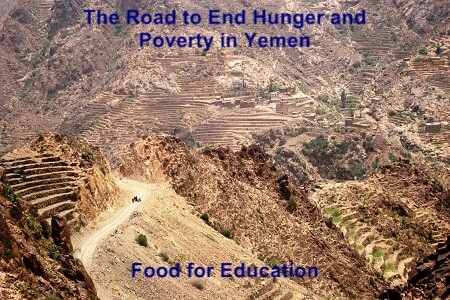
The Road to End Hunger in Yemen (WFP/Maria Santamarina)

Yemen is in the midst of a humanitarian disaster and little is being done to heed the warnings. Already the poorest country in the Middle East, Yemen has child malnutrition rates that rival famine-ravaged Somalia.

Maria Calivis, regional director of UNICEF says, “This year alone, half a million children in Yemen are likely to die from malnutrition or to suffer lifelong physical and cognitive consequences resulting from malnutrition if we don’t take action. Malnutrition is preventable. And, therefore, inaction is unconscionable.”

This level of suffering, on top of political instability, has the potential to plunge the country into complete chaos, a chilling prospect considering al Qaeda’s presence there.

Yemen remains key in the struggle to defeat al Qaeda and extremism, much the same as Korea, Greece, Germany and others were in the struggle to win the Cold War and push back communism. In Korea and Germany, millions of children were given meals in their schools as part of our policy of backing those nations. In fact, General Lucius Clay thought school meals for German kids was about the most important act we did in reconstruction.

During the Cold War, the U.S. helped initiatives to boost agricultural production and build roads in South Korea. Today in Yemen, similar projects are much needed to strengthen the country, but they do not have enough funding to go forward.

In the case of Greece, the U.S. supplied aid, but not just military. Special focus was given hunger relief, both during World War II and in the reconstruction. Greece was plundered during World War II by the Germans. The retreat of the Nazis was not the end, as civil war broke out. Communist forces threatened to take over.

With this chaos and violence came suffering for the people. Former president Herbert Hoover, who organized aid for Greece, said Greece’s people “are sick and hungry.” Enter the United Nations, UNICEF, CARE, Greek relief committees and the Marshall Plan. All of these provided humanitarian aid to help Greece through a period of severe hunger and conflict.

A 1947 U.S. report warned that if the flow of relief supplies to Greece stopped, “chaos would result.” Humanitarian aid fortunately continued.

The newly created UNICEF, for instance, provided milk to Greek schoolchildren as part of an effort to build a nationwide school feeding program. UNICEF was founded on the belief that rehabilitation of children needed to be an international priority.

Today, UNICEF is trying to provide plumpy’nut, a special peanut paste to save Yemeni children from potentially deadly malnutrition. However, low funding prevents them from reaching the vast majority of mouths.

Low funding has forced the UN World Food Programme to scale back food programs for children as well as other hunger relief efforts. In the summer of 2010, the White House admitted that relief efforts in Yemen were “woefully underfunded.” The U.S. has not been able to rally enough international efforts to meet this growing crisis, despite the strategic significance of keeping Yemen afloat.

Congress, meanwhile, is threatening to reduce funding for the Food for Peace program. This would greatly harm U.S. foreign policy as hunger can easily lead to chaos.

Counterterrorism advisor John Brennan says, “As we have seen from Afghanistan in the 1990s to Yemen, Somalia and the tribal areas of Pakistan today, al Qaeda and its affiliates often thrive where there is disorder or where central governments lack the ability to effectively govern their own territory.”

Disorder has no better ally than hunger. How can we expect Yemen to build a peaceful, stable future when the population suffers from dangerous malnutrition that crushes mind and body? For any country to flourish, the most important ally in their quest for peace is food.

Originally published at History News Network

Leave a comment

Filed under global hunger

How a Silent Guest Can Help Save Hungry Yemen

In a letter to the New York Times last February, I wrote about an emergency safety net plan to feed millions of hungry Yemenis suffering from high food prices.

Since that time, child malnutrition in some parts of Yemen has increased so much as to rival famine-ravaged Somalia.

Maria Calivis, UNICEF’s regional director, says, “This year alone, half a million children in Yemen are likely to die from malnutrition or to suffer lifelong physical and cognitive consequences resulting from malnutrition if we don’t take action. Malnutrition is preventable. And, therefore, inaction is unconscionable.”

Calivis adds, “Conflict, poverty and drought, compounded by the unrest of the previous year, the high food and fuel prices, and the breakdown of social services, are putting children’s health at great risks and threatening their very survival.”

Neither UNICEF nor the UN World Food Programme (WFP) received enough funding during 2011 to carry out their full hunger relief missions in Yemen.

These UN agencies rely on voluntary donations from the international community. If donors do not contribute, then hunger relief missions have to be scaled back or in some cases halted.

So what can someone do? Take action! UNICEF has a relief fund for Yemen. The World Food Program USA is also hosting a Yemen fund. You can even sign a petition to help WFP fight hunger in Yemen.

Or you can take in a “silent guest.” Starting in the holidays of 1947, the United States helped starving countries with a “silent guest” program. At mealtime, people were asked to imagine a silent guest at their table. Then they could mail the cost for feeding that silent guest to a committee in Plymouth, Massachusetts. This donation would buy a CARE package which was sent to hungry people in war-devastated Europe.

Today, maybe at your next meal, you could take in an infant child in Yemen who needs plumpy’nut to prevent potentially deadly malnutrition. You could send that donation to UNICEF which provides the plumpy so it can help treat all the cases of child malnutrition in the country.

Some of the countries who benefited from silent guest donations back in 1947 were Italy, Austria, France, and Greece. At that time Greece was recovering from a famine and facing a civil war.

Another country helped by the silent guest program was Germany. It is Germany that today has taken the lead in helping fight hunger in Yemen with a recent donation of $31 million to the WFP mission.

WFP will need over $200 million to feed millions of Yemenis during 2012. The rest of the international community should follow Germany’s lead.

The donation from Germany will help the emergency safety net plan which includes rations for 1.8 million Yemenis and also plumpy for infants. A school feeding program which has faced severe cuts over the last couple of years is getting a restart too.

The WFP Food for Education plan, which distributed take-home rations to schoolchildren, was suspended in 2010 and did not resume until May of 2011. Then it was a limited distribution, not even close to the previous levels of about 115,000 students. These rations benefited the children and their families. It’s food for the body and the mind as it keeps children in school and learning reading, math, science, and writing.

As significant as Germany’s recent donation is, it will be able to help revive Food for Education only to almost half of what it once reached in terms of students.

Lubna Alaman, director of WFP Yemen, says “The Food for Girls’ Education [program] is targeting only 53,000 girls and their families, and the food will be distributed for three school terms in 2012.”

So there is a long way to go to get all these hunger relief plans fully active again.

The choice with Yemen is simple. Invest now and avert an epic disaster like Somalia faced. We can save a generation of children in Yemen from the malnutrition that damages or even kills them in the first years of life.

Or drift along, pretending that Yemen will somehow turn out OK with an average response to humanitarian needs. It won’t, because no nation can have peace, political stability, and development on empty stomachs and malnourished bodies and minds.

Article first published as How a Silent Guest Can Help Save Hungry Yemen on Blogcritics.

Leave a comment

Filed under global hunger

Interview: Rajia Sharhan of UNICEF Yemen

UNICEF Nutrition Officer Dr. Rajia Sharhan holds a young child at a therapeutic feeding centre in Sana'a, the Yemeni capital. (UNICEF Yemen/2011/Halldorsson)

In my interview with Geert Cappelaere of UNICEF, we see the widescale crisis of child health and malnutrition in Yemen. Dr. Rajia Sharhan witnesses this crisis unfold daily as a nutrition specialist for UNICEF Yemen.

Dr. Sharhan works at a health clinic and also trains other medical care workers throughout the country. She recently took time to answer some questions about her work at the clinic. Her insight gives us at least some idea of the challenges facing Yemeni families, and also some solutions.

How far do people travel to the clinic?

It depends on the district distance from their village to the health center. Sometimes they need two hours by car to reach it.

Is accessibility a problem for families trying to get medical care?

Yes it is, especially in the last few months when fuel increased in price so families’ priority was food not health.

What if a medical condition is not able to be treated at your clinic?

The child has to be referred to the therapeutic feeding center and gets medical attention in the same hospital.

Do you see a lot of children who are underweight for their age?

Yes, a lot, around 50%.

What is the most common ailment you see in children at the clinic? Is it something that is preventable?

Many suffer from diarrhoea. It’s preventable by ensuring that the water given to the child is clean and hygiene is promoted.

How much does literacy play a role in how parents care for their children?

It plays a role, as many illiterate mothers don’t know the proper feeding practices and importance of breast feeding and proper complementary feeding. Maybe we use the media (radio) because all mothers everywhere listen to it while cooking, and this may help in increasing the awareness.

Can you describe the use in Yemen of plumpy’nut (the special peanut paste that rescues children from malnutrition).

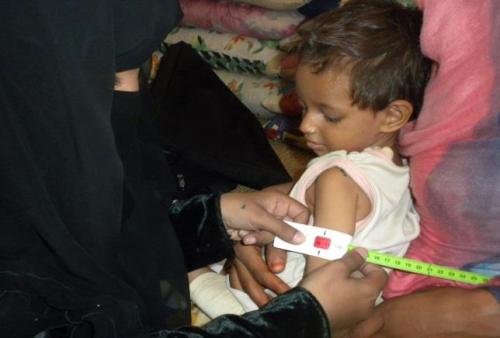
The volunteers at the village level in Abbs go to identify children with malnutrition. During the regular biweekly work of a volunteer in a village, using Mid Upper Arm Circumference (MUAC), when a child is identified with a MUAC of 11 cm, the volunteer gives a referral card and advises the mother or the caretaker to immediately refer that child the nearest Outpatient Therapeutic Care (OTP) program, which in Abbs is the district rural health center.

The mother has to go there by car so they rent one. The mother and child arrive at the waiting area of the health clinic and give the referral card. Then the child is weighed and the height is measured and if the Z score is -3 standard deviations according to the table chart for malnutrition, the child is admitted to the OTP after an appetite test for plumpy’nut is done to make sure there are no complications (fever, loss of appetite, or any disease causing deterioration of the consciousness of the child).

If the child passes the appetite test then a further clinical checkup is done and the child is given a one-week ration of plumpy’nut which is around 21-28 sachets per week (3 to 4 sachets per day), according to the child’s weight and height. The child then returns to the village but has to go the health center every week to get weighed and to be given the ration of plumpy’nut. Because of the constraints of transportation sometimes the child is given a two-week ration. The volunteers continue their screening and follow up with the children enrolled in the program.

The child is cured after eight weeks.

You can donate to help Yemen at UNICEF USA.

Article first published as Interview: Rajia Sharhan of UNICEF Yemen on Blogcritics.

Leave a comment

Filed under global hunger

UNICEF starts relief fund for children in Yemen

UNICEF USA has started a relief fund to help the suffering children of Yemen. You can donate to the fund here.

Children are suffering the effects of malnutrition and displacement after a year of political instability, as well as fighting between the government and militant groups. Some families are even living in caves after fleeing violence.

“Don’t be afraid, we are not going to harm you, we are here to take care of you,” says Hana to the little girl who clutches her doll, afraid of the strangers who have come to her house. Do they want to take her away from her mom? But Hana and her colleague are enumerators and are here to see if little Fatima is malnourished, if she needs treatment. Sadly a quick measurement of her arm with a special tape shows she is much thinner than she should be at her age. “Fatima has severe malnutrition,” says Hana. “We have to refer her immediately to the outpatient therapeutic center so she can get appropriate care.” Rasha Al-Ardi/UNICEF Hodeidah/2011

The latest UNICEF report showed that “58,338 severely acute malnourished children were treated… in the past 11 months.”

However, countrywide it is estimated that 4 million children suffer from severe malnutrition. Many more resources such as plumpy’nut are needed for UNICEF to treat these children.

Read more about UNICEF’s response to the crisis in Yemen in my interview with director Geert Cappelaere.

first published at Global Hunger Examiner.

Leave a comment

Filed under global hunger

Interview: Geert Cappelaere of UNICEF on the Humanitarian Crisis in Yemen

“Don’t be afraid, we are not going to harm you, we are here to take care of you,” says Hana to the little girl who clutches her doll, afraid of the strangers who have come to her house. Do they want to take her away from her mom? But Hana and her colleague are enumerators and are here to see if little Fatima is malnourished, if she needs treatment. Sadly a quick measurement of her arm with a special tape shows she is much thinner than she should be at her age. “Fatima has severe malnutrition,” says Hana. “We have to refer her immediately to the outpatient therapeutic center so she can get appropriate care.” Rasha Al-Ardi/UNICEF Hodeidah/2011

Most of the spotlight on Yemen is focusing on whether embattled President Ali Abdullah Saleh should be given medical treatment in the United States. Tragically lost in this debate are millions of Yemenis who are suffering from hunger, malnutrition, and disease.

The UN World Food Programme (WFP) estimates that over 7 million Yemenis (1/3 of the population) suffer from hunger. This figure is believed to be even higher considering the past year of unrest and violence in the country. Malnutrition rates among children are high, causing stunted physical and mental growth or even leading to death.

This year of political turmoil and protests against long-time president Saleh has led to shortages of basic goods and increased food prices. Aid agencies, who are low on funding, are struggling to keep up with the increasing calls for help.

Yemen is on the verge of a humanitarian disaster and little is being done to heed the warnings. The level of human suffering has the potential to plunge the country into complete chaos which would easily destroy hopes for peace and strengthen the Al-Qaida branch there.

As President Obama’s counterterrorism advisor John Brennan says, “As we have seen from Afghanistan in the 1990s to Yemen, Somalia and the tribal areas of Pakistan today, al-Qa’ida and its affiliates often thrive where there is disorder.”

UNICEF is trying desperately to provide aid to the most vulnerable segment of Yemen’s population: Children. In the following interview Geert Cappelaere, director of UNICEF in Yemen, discusses the fast-developing humanitarian crisis and how we can take action.

The recent United Nations report revealed a 31.7% Global Acute Malnutrition in Yemen’s Hodeidah Governorate. Isn’t that a malnutrition rate similar to the worst areas of starvation inside Somalia? Could Yemen be the next Somalia?

Yemen, unfortunately, has the highest rate of chronic malnutrition in the world with close to 60% of children reported as stunted. In some parts of Yemen, global acute malnutrition rates are indeed equal than in parts of drought and famine struck Horn of Africa, with 30% of those under 5 years of age being wasted (globally acute malnourished). Severely acute malnutrition levels are approaching 10% in certain pockets of the country. So the levels of chronic and acute malnutrition amongst Yemeni children are unprecedented in most part of the world.

Certainly, Yemen could be the next Somalia and very soon, if the world keeps watching with no action. UNICEF has been ringing the bell very loudly that we do not want the situation of children to turn into a humanitarian disaster.

Do UNICEF and other aid agencies have a full picture what is happening with hunger and malnutrition especially in rural, more isolated areas? Could the Hodeidah malnutrition findings tragically be the tip of the iceberg in Yemen?

UNICEF and humanitarian workers on the ground have made it clear that Yemen, which is already chronically underdeveloped, is on the verge of a humanitarian disaster. The situation is much worse than what people could imagine. Also our collective response has not been up to the challenge. Limited funding has led to a reduction in assistance, negatively impacting the nutrition and food security status of families already facing protracted displacement.

The recent findings of the UNICEF survey coming from Hodeidah are consistent with those findings coming from Hajja, for instance, and other parts of the country. Nearly one third of children surveyed suffer from either moderate or severe acute malnutrition – of which nearly 10 percent were severe cases. Wherever we go, wherever we survey, wherever we assess, we come to the same conclusions: levels of acute malnutrition in Yemen are incredibly high.

Yemen has suffered through war in the North between the government and rebels and recent fighting in the South with militants. This on top of tremendous political instability and violence this year. What kind of psychological toll is this taking on children growing up amid such displacement and violence?

Yemen is a country where children represent more than half of the population, which means more than 12 million. They bear the brunt of underdevelopment and a looming disaster. UNICEF is very concerned about the impact on children of years of underdevelopment, multiple wars and more recently a deep political crisis.

Even after intensive efforts by UNICEF, government and partners to bring children back to schools, nearly a quarter of a million children across Yemen face difficulties attending school. More than 180 schools in different parts of the country have been occupied or attacked by armed forces and armed groups, or are occupied by displaced communities.

The situation has significantly impacted the psychosocial well-being of children. In the conflict-affected northern governorates, one in three children reported feeling unsafe, sad or frustrated, suffered from diminished hope, fear, anger and hatred as well as experiencing difficulty sleeping. One in four experienced difficulties concentrating, and establishing trustful relationships. A household bi-weekly survey shows a sharply increased level of fear in places like Hodeidah when violence erupted in Sanaa – asserting that conflict affects all children throughout the country in some way or another.

How is UNICEF planning to aid children in Yemen during 2012? Do you have the needed resources?

Our humanitarian action plan for 2012 focuses on mainly relief operation giving a top priority to the fight against malnutrition. We have extended investments in WASH (water, sanitation and hygiene for schools), Education, Health and Child Protection. While keeping the focus on immediate relief operations, we shall not miss a single opportunity for re-engaging on mid- and longer term development.

UNICEF doubled its funding requirement in 2012 from that of last year to USD 49.6 million. We need all possible assistance to have it funded in a timely manner.

Tell us about the significance of plumpy’nut for Yemeni children.

It is one of the Ready-to-Use-Therapeutic Food (RUTF) life-saving food products that are designed to address the therapeutic needs of severely malnourished children. The fact that it does not need any preparation when giving it to children has tremendously been instrumental to reach out to remote areas where there are no health facilities and high rate of illiteracy among parents. Any adult can feed a malnourished child with ease, however, health workers need to follow on the progress and recovery to prevent any relapse.

How can people reach out and help UNICEF aid children Yemen? Can someone get involved?

Any possible help is welcome. I am glad to announce that individuals and organizations can make donation to Yemeni children online through this link.

We need also that the voice of Yemeni children is heard and that media is taking the lead to inform donors about the dire humanitarian needs in this country.

Is there a certain story or family in Yemen that stands out in your mind when you think of the plight of the country?

Well. They are numerous, and stories are generally similar. I would rather focus on the entire cohort of under-five children- who are about 4 million – who all need equal attention and care.

You can donate to help Yemen at UNICEF USA.

Article first published as Interview: Geert Cappelaere of UNICEF on the Humanitarian Crisis in Yemen on Blogcritics.

Leave a comment

Filed under global hunger

Plotting the 2012 War Against Hunger in Yemen

The term PRRO 200038 stands for Protracted Relief and Recovery Operation and includes the emergency safety net (ESN) plan of food rations discussed in this article as well as nutritional support such as plumpy'nut and plumpy'doz for infants, and Food for Work Projects. Other WFP programs, not included on this map, feed displaced persons

Last month the UN World Food Programme (WFP) held a meeting in Rome to discuss strategy for fighting a growing hunger crisis in Yemen. The WFP’s executive board approved a $32 million budget increase for its plan to distribute rations to families suffering from high food prices. The total budget for this 2011-2012 operation stands at over 122 million dollars.

A WFP document states, “This budget revision is for: i) continuation of a seasonal emergency safety net for 1.2 million severely food-insecure households during the 2012 hunger season; and ii) 4,486 mt of additional food for emergency response in 2012 in view of the deteriorating socio-political situation.”

Malnutrition and lack of basic goods is the most serious threat facing the country. Catherine Bragg of the United Nations said last week, “Humanitarian needs are expected to deteriorate over the next year and we must do everything we can to make sure that these needs are not overshadowed by the political agenda.”

While WFP approved the budget increase, it all hinges on whether donors come through. The World Food Programme relies entirely on voluntary donations from governments and the public.

In 2011, for example, WFP planned to feed 1.8 million Yemenis as part of the aforementioned safety net operation. Funding was low and some entire governorates had to be dropped from the program. At one point over a million Yemenis did not even receive the food rations during a scheduled distribution.

The low funding for WFP Yemen unfolded at the same time food prices increased during political instability. It’s important to remember that even before the year of unrest in Yemen took shape, millions were already deeply mired in hunger and poverty. The turn of events during Yemen’s “Arab Spring” took a bad situation and made it worse.

WFP will also need funding in 2012 to feed Yemenis displaced by conflict both in Northern and Southern Yemen. Food for education programs, which have received almost no funding for two years, need to be restarted. No national school lunch program has been established, nor a universal infant feeding program. These programs can provide a way to defeat malnutrition among children and also increase literacy, class attendance and most importantly completion of education.

In addition, Food for Work projects to help agricultural rehabilitation need to go forward. But it all depends on whether the international community will donate. Yemen cannot achieve political stability and peace amid a storm of hunger. Despite this reality, hunger fighting programs lacked funding in 2011. Will the new year be a repeat?

There is some hope. Germany recently made a 30 million dollar donation to WFP in Yemen. Will other nations follow this lead and help provide food security for Yemenis during a period of political upheaval?

That is a critical question as 2011 comes to a close. It takes on even more urgency when you consider that the United States Congress is proposing reducing funding for the Food for Peace and McGovern-Dole school lunch programs. Both are potential major resources for funding hunger relief in Yemen. If they are cut back, it could prove to be very damaging during the coming year where so much is on the line in Yemen.

Article first published as Plotting the 2012 War Against Hunger in Yemen on Blogcritics.

Leave a comment

Filed under global hunger

Budget Debates in Congress Loom Over Yemen Crisis

Budget decisions made by the U.S. Congress in the coming weeks will have their effect on Yemen. Proposals for reducing international food aid would limit the U.S. ability to respond to the humanitarian crisis escalating in Yemen, already the poorest country in the Middle East.

Congress has proposed reducing funding for the U.S. Food for Peace plan, which in 2011 supported the UN World Food Programme’s (WFP) relief operation in Sana’a City and Northern Yemen. In addition, Food for Peace funded Save the Children’s voucher initiative, also in the North. This program showed promising results and if enough funding were available could be continued and expanded.

Currently, the UN World Food Programme and UNICEF are facing funding shortages for their relief programs in Yemen. The prospect of the U.S. decreasing its food aid budget is a forerunner of disaster for an already distressed humanitarian operation.

Before this year’s political unrest and violence unfolded, Yemen was already suffering a humanitarian crisis with high rates of child malnutrition. The year’s events have made this situation worse with prices of food and other basic goods on the increase. Food is becoming out of reach.

UNICEF recently reported “food security & nutrition indicators continue to be alarmingly low. Protein intake continues to decline, with increasing numbers of households reporting no consumption of meat (74.2%), fish (65.0%), chicken (34.2%), and eggs (43.3%).”

UNICEF, which surveys households in the Sana’a, Amran, and Hodeida governorates, highlights the alarming child malnutrition crisis. UNICEF says, “More households reported decreased number of meals among children <5yrs (33.6%) compared with the previous round (22.6%), with children in rural households being the most vulnerable to meal reduction (40.4%) compared with urban households (28.6%).”

The World Food Program USA is rallying support for increasing U.S. international food aid so there can be a stronger response for the crisis in Yemen and other countries.

WFP USA states, “Despite the fact that cuts to these critically important international programs cannot possibly make a meaningful contribution to reducing the debt or balancing the budget, unfortunately they are under threat this week as the Senate debates International Affairs accounts.”

A take action page has been set up to help citizens contact their representatives in Congress to oppose the budget cuts to international food aid.

Article first published as Budget Debates in Congress Loom over Yemen Crisis at Blogcritics.


Leave a comment

Filed under global hunger

Emergency Child Malnutrition Rates in Yemen

Children in Yemen are wasting away as conflict and a struggle for power continue in the beleaguered country. UNICEF just released findings from a nutrition study in the Abyan governorate in Southern Yemen. They found a shocking Global Acute Malnutrition rate among 18.6 percent of the children. The emergency threshold number is considered 15 percent.

When children do not receive proper nutrition, their growth is stunted in body as well as mind. They became more susceptible to illness.

While the South is suffering with malnutrition, so too is the North. In this area years of conflict between the government and rebels has taken its toll on the population. UNICEF says that “In Sa’ada, high malnutrition rates continue to be identified and children referred for treatment.

Out of a total of 234 children screened, 47 were referred to a therapeutic feeding center, while 128 were enrolled in outpatient therapeutic care (75% admission rate for severe acute malnutrition).”

A number of households in Yemen are reporting family members going to bed hungry. UNICEF says the capital Sana’a reported the highest percentage of household members going to bed hungry due to lack of food (67.5%) compared (to) Amran (45%) and Hodeida (25%). Food prices have risen steeply in recent months putting an extra crushing burden on the poor.

Even before this year of political unrest, hunger was a crisis in Yemen. This year had deepened this catastrophe to the highest levels of emergency.

Funding remains low for hunger relief missions by the UN World Food Programme and UNICEF. These agencies depend entirely on voluntary funding from the international community.

Supplies of the miracle food plumpy’nut, which can stave off malnutrition, are not available to all children. Funding for UNICEF and WFP would need to be increased. Without this supply, another generation of children will be burdened with long-term physical and mental impairment.

Leave a comment

Filed under global hunger

WFP Director Warns of Hunger Threat Stalking Yemen

During her keynote address at the 25th anniversary of the World Food Prize on October 13, WFP’s Executive Director Josette Sheeran said, "Most of the world is not placed to handle the volatility in food prices and supplies. (WFP/Rene McGuffin)

Josette Sheeran, the UN World Food Programme (WFP) director, warns of a humanitarian disaster unfolding in Yemen. Sheeran said last week, “Rising food prices and political instability have left millions of people in Yemen hungry and vulnerable. Malnutrition is stalking the lives of women and children.”

WFP says that even before this year’s political unrest, “more than 50 percent of Yemeni children were chronically malnourished and more than 13 percent were acutely malnourished.”

This year’s chaos in Yemen has made it much harder for these children to gain access to needed foods. Lack of nutrition for children stunts physical and mental growth.

Lubna Alaman, WFP’s Representative in Yemen, says, “The challenges to reach and meet the urgent needs of the most vulnerable are huge, especially in the midst of a very volatile security situation.”

WFP is feeding displaced persons in Southern Yemen and also in the North, where years of conflict have left nearly half a million people struggling in hunger and poverty.

Nationwide, WFP is running a safety net operation to reach nearly 1.8 million Yemenis impacted by high food prices. However, low funding has severely limited the reach of this mission. WFP relies on voluntary funding from the international community.

Sheeran says that “WFP food assistance provides vital nutrition and stability at a time of great need.” If the program becomes fully funded, more Yemenis can be reached.

While Yemen is immersed in hunger and instability, the U.S. Congress is proposing reducing international food aid programs as part of budget cuts. The savings will be minimal and the consequences disastrous. Food aid programs currently make up less than one tenth of one percent of the federal budget.

Hunger and malnutrition are silent, but are so powerful that they can devastate a population within weeks if left unchecked; or they can slowly weaken the people through prolonged malnutrition. Yemen is caught in this trap.

The international community has to act now to put in place the safety nets which can save Yemen from hunger and malnutrition. There cannot be true change in Yemen as long as malnutrition has free reign.

Article first published as WFP Director Warns of Hunger Threat Stalking Yemen at Blogcritics Magazine.

Leave a comment

Filed under global hunger