Tag Archives: World Food Programme

Mali and Mauritania: War, Drought and School Meals

As the new U.S. Secretary of State John Kerry says, “There has to be an African solution” to the crisis in Mali. The Malian government, backed by French forces, has been striking Al Qaeda-linked militants who had occupied the northern part of the country.

That solution, a lasting peace, will be hard to find if children are hungry, malnourished and not able to even attend school. Their future is being made in a country where hundreds of thousands have been displaced by the war. There was also a severe drought last year which placed even more burden on already impoverished families.

No food, no school. That is the reality in Mali as described by a UN World Food Programme officer. Families are just looking for ways to survive. If you can provide food at school the children will come, and this holds the key to the country’s future.

The World Food Programme (WFP) is launching emergency school feeding in the northern part of Mali. This will feed close to 70,000 children throughout the conflict-affected area. WFP is already feeding 113,000 children in the southern part of the country.

Will there be funding? That is a big question, because WFP relies on voluntary funding from governments and the public. Right now this operation is only 20 percent funded.

The neighboring country of Mauritania is also feeling the impact of the war, having taken in over 70,000 Malian refugees. This creates a great strain on communities that were already suffering in poverty and drought.

The World Food Programme has a school feeding operation in Mauritania to help both the host communities and refugees. The problem is again funding. Last year, WFP was forced to reduce the number of feeding days as well as the size of the food rations. Sophie Ndong, of WFP in Mauritania, says that last year “primary school children were assisted during 80 days only instead of the 160 days planned.”

The funding woes continue for Mauritania as 2013 gets underway. WFP wants to feed 149,128 children school meals but no funding has arrived except for a donation from the University of Guelph of 318,916 emergency meals for primary school children.

WFP also plans to provide school meals to 18,000 refugee children at the Mbera camp and 28,290 children from the surrounding host community. The program costs about $612,000 but no funding has come in.

The plans are there but the resources are not. Catholic Relief Services has school feeding in Mali, making use of a grant from the U.S. McGovern-Dole program. An expansion of this program’s reach could help fund the WFP programs as well and feed hundreds of thousands more children.

Children suffer the most in a crisis because hunger causes them to become stunted in growth and mind. Feeding the children becomes so vital, and if done at school it becomes food for education, and food for hope.

Article first published as Mali and Mauritania: War, Drought and School Meals on Blogcritics.

Leave a comment

Filed under global hunger

Food Rations Reduced for Displaced Persons in Yemen

Food rations have been reduced for displaced persons in Yemen (WFP/Abeer Etefa)

Food rations have been reduced for displaced persons in Yemen (WFP/Abeer Etefa)

Efforts to build stability in Yemen are being undermined by cuts in food rations to displaced persons throughout the country. The UN World Food Programme (WFP) is facing a funding shortage for its entire emergency operation in Yemen, which provides food aid to millions. WFP relies entirely on voluntary donations.

In February, WFP was forced to reduce rations for 300,000 displaced persons and returnees in the North and South of the country. WFP spokesperson Barry Came said: “Without the ration cuts, WFP would have run out of wheat by late March and many other commodities by mid-April.”

In Southern Yemen, people are returning to their homes in Abyan province, trying to rebuild after the fighting between the government and Al Qaeda. The reduced rations will place an extra strain on these war victims.

WFP needs US$33 million urgently to finance its displaced persons relief. Its overall Yemen relief program faces a US$170 million shortfall in funding. This includes distributing rations to food-insecure families and providing aid to malnourished children. The organisation also has a Food for Education program that needs to be expanded.

Without funding, the threat of more ration cuts or even program suspensions loom.

Half of the population in Yemen suffers from food insecurity and five million suffer from severe hunger. The hunger is most dangerous to children who, if they do not get the right nutrition, will suffer lasting physical and mental damage. If food ration cuts continue Yemen could easily see an increase in an already dire situation of child malnutrition.

WFP, the largest food aid organization, is facing challenging relief missions around the globe, many of which are short on funding. The war in Syria has created a growing humanitarian crisis that is also in desperate needs of resources.

The US Food for Peace program, the largest single donor to WFP, is under the risk of cuts by the Congress. This will make it more difficult to fight hunger and build stability in Yemen and many other countries.

Article first published as Food Rations Reduced for Displaced Persons in Yemen on Blogcritics.

Leave a comment

Filed under global hunger

Together We Can End Hunger

John Young, former president of the Cincinnati Freestore Foodbank, has spent a lifetime helping others. It was very early in his humanitarian career that he discovered how you can end hunger and poverty.

As a teenager he volunteered at a hospital one day to feed elderly patients, some very close to death. It was a difficult task and made him a little unsure about going back again. But when he did return for a second day, he saw the joy from the patients because someone cared enough to come back to help them.

Young learned that that is how you make a difference, you get involved and stay connected. If enough people do that hunger and poverty can be eliminated.

The answer to the societal problem of hunger can be found right here in your own backyard. The Freestore Foodbank, for instance, has provided a safety net, and a way out, for people in Cincinnati suffering from hunger. Those solutions are found in the strength of volunteers coming forward like Young did and then going on to become leaders.

There is enough food for everyone in the world, and we can do a much better job preventing food waste. So ending hunger is not something where a miracle cure has to be discovered. It’s a case of stepping up the effort and getting more people involved.

Using the award-winning online game FreeRice, College of Mount St. Joseph (MSJ) students are answering questions in a variety of subjects like vocabulary and science. Every correct answer means 10 grains of rice donated to the UN World Food Programme. The rice is being sent to the school feeding program in Niger, a country that suffered from severe drought and is hosting refugees from the war in Mali. For many children in these impoverished, developing countries, the school meal might be the only one they receive the whole day.

Last fall I did a story on Ithaca College and how they make use of FreeRice as part of their hunger relief program called Food for Thought.

There are many ways now that people, schools, and organizations can get involved to end hunger. There is even a free app people can download onto their smartphones called Charity Miles. When your walk, run, or bike the app keeps track of your distance and for every mile a donation is made to Feeding America or the World Food Programme. You select the charity and the results get posted to your Facebook page. There are lot of athletes and teams so the potential for Charity Miles is amazing.

Charity Miles is partnering with Feeding America for the Together We Can Solve Hunger Campaign. “The campaign provides people with simple, easy ways to engage in the fight against hunger,” said Shannon Traeger, spokesperson for Feeding America. “With more than 50 million Americans living at risk of hunger, including more than one in five children, we’re encouraging everyone to do their part.”

Find a way to get involved and fight hunger. Educate others and get them involved too. This dedication can make a difference in ending hunger here at home and across the globe. The solution to this menace to mankind is right here in front of us.

Article first published as Together We Can End Hunger on Blogcritics.

Leave a comment

Filed under global hunger

Feeding the Future of Yemen

Somali refugee children in Yemen having school breakast from the World Food Programme (WFP/Barry Came)

Somali refugee children in Yemen having school breakast from the World Food Programme (WFP/Barry Came)

When you can fight hunger and give a child hope at the same time, you can change the world. We have seen this time and time again over the years with school feeding.

For Yemen, feeding and educating its children is crucial to building the stability and peace it needs. The UN World Food Programme (WFP) has some innovative ways of helping Yemen achieve this.

First is through a Food for Education program which accomplishes two goals at once. To encourage attendance of girls to class, WFP provides take-home food rations. This not only boosts the attendance at school, but helps feed an entire family. You fight hunger and you boost education with one act.

With about 10 million Yemenis facing hunger, food assistance programs like this are desperately needed.

WFP spokesperson Barry Came says 53,000 girls are currently receiving the rations. When you add the fact that their entire family benefits, then 371,000 Yemenis are being helped with this food. The rations consist of wheat and vegetable oil which are distributed in two or three rounds over the course of the school year.

The problem becomes keeping this initiative funded, which has been very difficult for some years. WFP was not even able to run the program for a period of time. In addition, more children could be reached with additional funding.

WFP relies on voluntary funding from governments and the public. A grant, for instance, from the U.S. McGovern-Dole school meals program could make a significant difference in the reach of Food for Education. Right now the program is short $5 million.

WFP also has school feeding for refugee children. Thousands of Somalis have fled the conflict and hunger in their homeland, to find refuge in Yemen. WFP is helping refugee children by providing meals at school.

At the Kharaz refugee camp, in the deserts of southern Yemen, WFP is feeding about 4,500 Somali boys and girls at two primary schools. In addition, WFP is also feeding 4,500 more children, many of which are Somalis, at a school in the Al Basateen district of Aden.

Came says all children at the school receive the meals “in the belief that it helps to integrate the two communities.” The school feeding for Somali refugees currently faces a $1.7 million shortage in funds.

No nation can progress without healthy and educated children. School feeding provides an opportunity for Yemen to make progress, but it will depend on the support of the international community going forward.

Article first published as Feeding the Future of Yemen on Blogcritics.

Leave a comment

Filed under global hunger

Food for Work, Winter Rations Crucial in Kyrgyzstan


The passage to Kosh-Bulak is open for a short three-month period and impassable the rest of the year, leaving the village in complete isolation. (WFP/Ulan Raimkulov)

The passage to Kosh-Bulak is open for a short three-month period and impassable the rest of the year, leaving the village in complete isolation. (WFP/Ulan Raimkulov)

Kyrgyzstan is a nation that has suffered through ethnic conflict and instability. Hunger is on the rise too with 25 percent of the population food-insecure. The price of food, particularly wheat flour, has dramatically increased placing further strain on these families.

The UN World Food Programme (WFP) is helping provide food aid which is especially crucial in the winter months. Elizabeth Zalkind of WFP says three-month rations are provided to 231,000 people in impoverished areas which become nearly impossible to reach during harsh winter. The people need this food literally to survive.

With so much hunger and poverty in these communities, as well as the ethnic tensions, people look for hope. Food for Work projects sponsored by WFP offer a way to tackle these societal problems. These are initiatives where workers are provided food rations while they complete projects aimed at building communities.

One Food for Work (aka Food for Assets) project helped restore an easier passage to the village of Kosh-Bulak, which becomes hard to reach during winter. This was done using concrete rings to reinforce the passage, with help provided by the United Nations Development Project. Connecting communities is key to building their economy.

WFP has also sponsored projects feeding 115,000 people in Kyrgyzstan including re-forestation, rehabilitation of irrigational networks, riverbank reinforcement, restoration of mud flow canals.

Food for Work offers a way to reduce hunger while working on these projects, which in time can reduce or eliminate the amount of aid needed. In Kyrgyzstan the projects have an extra benefit of bringing together people from different ethnic groups. This helps build peace while reducing the poverty that threatens everyone.

Much work needs be done to reduce hunger in Kyrgyzstan and with WFP relying on voluntary funding that becomes a major issue. WFP believes food security could worsen come spring when the winter rations they provided run out.

Article first published as Food for Work, Winter Rations Crucial in Kyrgyzstan on Blogcritics.

Leave a comment

Filed under global hunger

Interview: Dr. Al Forsyth on Helping and Learning with FreeRice

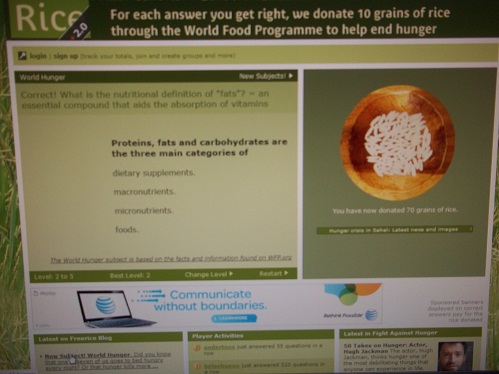
When you answer questions correctly while playing FreeRice a bowl fills up with rice, which will be sent to hungry people around the world. (photo from author's collection)

When you answer questions correctly while playing FreeRice a bowl fills up with rice, which will be sent to hungry people around the world. (photo from author’s collection)

FreeRice is the amazing online game where you feed the hungry while answering questions in vocabulary and other subjects. Currently, FreeRice donations are going to Niger to help feed schoolchildren.

Last year I had the opportunity to collaborate with the FreeRice team at the UN World Food Programme (WFP). We were discussing a potential new history subject.

It was during those discussions that Dr. Al Forsyth, a retired Weber State University professor, came up with the idea of a world hunger section for the game. This week I interviewed him to learn more about how he took this idea and turned it into a subject now appearing on FreeRice.

How did you first get involved with FreeRice and creating the global hunger section?

I think the concept of FreeRice – learning and helping – is brilliant. As a retired professor of teacher education, [I thought] the concept was very appealing and I wanted to be involved. While contributing to a new FreeRice subject, History, it occurred to me that an important piece of FreeRice’s “curriculum” was missing. The existing subject area list offered players a standard selection of academic subjects, yet visiting the World Food Programme site opened one’s eyes to much new information about the organization’s focal issue, world hunger. Why not offer that as a FreeRice subject? A World Hunger subject would allow the player to not only contribute to reducing world hunger by correctly answering questions, but also to learn about this supremely important issue.

Perhaps a little new knowledge would lead to a desire for more, to exploring the World Food Programme website, and even to discovering new ways to contribute to solving the problem. Fun, learning, commitment, engagement – that’s the sequence that I thought a World Hunger subject area on FreeRice might lead to.

Fortunately the World Food Programme person overseeing FreeRice liked the idea as well, and after the idea traveled through the required channels at WFP, it was adopted. Using WFP’s site and related links for much of my content, I developed 340 multiple-choice questions. WFP then thoroughly reviewed these questions for relevance, appropriateness and accuracy, eventually reducing the list to the current 285 questions.

When you created the section did you learn some things that surprised you about global hunger?

The questions I developed were of four basic types: definitions of terms related to world hunger; geographic information (countries and regions vis-a-vis world hunger); numbers showing the breadth and depth of world hunger; and lists (e.g., 5 causes of hunger, 10 top causes of death by disease, #1 cause of mental retardation and brain damage worldwide). The content of the numbers questions was most surprising: I had no idea of the seriousness of the issue, the extent of world hunger. These numbers brought into sharp focus the close correlation between hunger and other factors such as poverty, population, infant mortality, life expectancy. In fact, these questions were very difficult to write, as the information was shocking – and I wanted the player answering the question to be shocked by their new learning, so the correct multiple choice answer was often the most outrageous one. These questions are easy to answer: just choose the most shocking answer.

How do you recommend teachers utilize the global hunger subject in their classes?

Obviously, there are few, if any, courses in World Hunger in pre-collegiate public education. It is not a subject in the standard curriculum. And yet it is an issue central to the human experience, and as such it touches many parts of that curriculum. Any subject relating to people and how they live relates to world hunger: social studies, of course, but also English, other languages (as they expose students to other cultures), science (biological, chemical and physical aspects of hunger). And math, as a tool for opening understanding via numbers, can certainly be applied to the topic of world hunger. So, the subject of world hunger can be a central theme that unites diverse curricular areas.

The teacher can choose the content upon which standard subject areas can focus: world hunger would be an excellent choice. It is knowledge that contributes to understanding how the world works and where each individual fits into the global picture. And applying knowledge about world hunger can lead to engagement with one of humankind’s most pressing problems, and to the personal satisfaction of making a positive difference in the world. In other words, the payoff for placing world hunger at the center of the curriculum and teaching English, social studies, languages, sciences and math using content related to world hunger can be tremendous, both educationally and personally.

Another question is how best to use FreeRice World Hunger questions in the classroom. It could be a required activity for students, to prepare them with a base of knowledge about the subject, gained in a rather haphazard way, before learning about world hunger in a more orderly, sequenced fashion. It could also be a review, after formal learning has taken place. Personally, I would recommend that teachers introduce students to FreeRice, then turn them loose. They are naturally competitive and eager for empowerment, for the chance to do something really important while also learning. Seeing that bowl fill with rice can be a powerful, powerful motivator for learning – and for doing good.

Article first published as Interview: Dr. Al Forsyth on Helping and Learning with FreeRice on Blogcritics.

Leave a comment

Filed under global hunger

Skip Super Bowl Commercials, play FreeRice and Feed the Hungry

FreeRice has two goals:  Provide education to everyone for free.  Help end world hunger by providing rice to hungry people for free.

FreeRice has two goals: Provide education to everyone for free. Help end world hunger by providing rice to hungry people for free.

The Super Bowl is tonight but with it comes a lot of extras like commercials. Instead of watching these million dollar ads, you could take those few minutes and feed the hungry at Freerice.com.

FreeRice is an award-winning game where you answer questions in vocabulary, math, science, literature, art and other subjects. For each correct answer ten grains of rice are donated to the UN World Food Programme, the largest agency fighting hunger. The rice is paid for by advertisers on the site.

FreeRice donations are currently going to Niger, to help feed schoolchildren in the drought- stricken country. Niger is also host to thousands of refugees from the war in Mali.

If everyone took a few minutes during commercials to play, lots of rice could be raised to feed the hungry. It can be a FreeRice Super Bowl.

Leave a comment

Filed under global hunger

War, Drought, and Hunger in Mali

WFP/Jane Howard

WFP/Jane Howard

As conflict in Mali escalates so too does hunger and displacement in the African nation. The UN Refugee Agency warns “that stepped up aid was vital to prevent a worsening of the humanitarian situation.”

Mali’s government, backed by French forces, has launched an offensive against rebels associated with Al-Qaeda in the northern part of the country. Victoria Nuland of the U.S. State Department says, “it’s absolutely critical to stop the offensive of terrorist groups toward southern Mali, to prevent the collapse of the government.”

There are reports of rebel forces carrying out executions and amputations of civilians. In the conflict-affected areas food and fuel are in short supply.

Over 230,000 have been displaced inside Mali while over 140,000 people have fled to other countries in the Sahel region of Africa. Mali and its neighbors have suffered recently from drought so these are countries already in a weakened state. Critical to war and drought relief is feeding programs, especially those for children who are the most vulnerable to malnutrition.

The UN World Food Programme is running an emergency operation which provides “food assistance, nutritional support and emergency school feeding to 564,000 vulnerable people affected by the crisis.” This includes Plumpy’Sup, a peanut paste used to prevent deadly malnutrition in children under the age of five.

WFP is in desperate need of funding close to US $ 200 million dollars for both its operation inside Mali as well as relief for refugees who have fled to other countries.

The McGovern-Dole program, named after former Senators George McGovern and Bob Dole, is also funding school meals for children in Mali. Catholic Relief Services (CRS) received the funding and provides the food.

Helen Blakesley of CRS says the program is feeding more than 75,000 children at primary and secondary schools in the Mopti and Koulikoro areas.

Kristina Brayman, who runs the CRS school feeding in Mali says, “It means children receive a hot, nutritious meal each day, using US donated food complemented by both local foods from school gardens and purchased through funds collected by the community. Without that food, many students would not eat a square meal at all. It motivates parents to send their children to school, especially girls, and means the children are able to grow, develop, and maximize their learning potential. It really is essential.”

The McGovern-Dole program will have its future funding decided in the US Congress soon. The program in Mali is an example of what a difference this humanitarian aid can make.

As the conflict and hunger persist in Mali the international community will need to support aid agencies.

Article first published as War, Drought, and Hunger in Mali on Blogcritics.

Leave a comment

Filed under global hunger

Running to Feed Syrian Refugees

    tweet2568FlagPost a commentWilliam LambersWilliam Lambers, Yahoo! Contributor NetworkJan 29, 2013 "Share your voice on Yahoo! websites. Start Here."Using Charity Miles you can raise money for the World Food Programme just by running, walking or biking. Your results are posted to your Facebook page.

Using Charity Miles you can raise money for the World Food Programme just by running, walking or biking. Your results are posted to your Facebook page.

On Thursday, I went for a run in 20-degree temperatures to raise money for the UN World Food Programmme (WFP). The WFP is the largest food aid organization in the world and currently feeding Syrian refugees, among many other relief missions in conflict and disaster zones.

Think of the Syrian refugees who are suffering from hunger and cold as we speak. Having fled their war-torn homeland they are seeking refuge in neighboring countries. Aid agencies, who are lacking funding, are struggling to feed, clothe and shelter them. Some of them arrived at refugee camps only to be uprooted again by fierce winter storms.

Using the Charity Miles app I ran 5.9 miles for the fundraiser. This means a donation of 14 meals by Charity Miles to WFP. So far WFP has received donations of more than 21,846 school meals from just this one app. These donations are going to the area of greatest need among WFP programs.

The United Nations says a record number of Syrian refugees, 30,000 of them, have arrived at the Za’atri camp in Jordan since the start of the year. This crisis is fast escalating and with no end to the war in sight the humanitarian situation could get much worse. Aid agencies need more support from the international community.

Most of us are far away from this humanitarian disaster in the Middle East. You feel more helpless the further the distance. You can donate to a Syrian relief fund set up by WFP. Or if you use Charity Miles you can exercise and raise funds.

For many of us who work out anyway, why not add on this component? It’s easy to use. You just download the app onto your phone, connect it to your facebook account and start exercising. Whole sports team could use it during their practices and raise money for the World Food Programme.

The NFL teams, for example, could take an hour out of Super Bowl week and run a mile and raise tons of meals that way using Charity Miles. The NFL took part last year in the Famine, War, Drought campaign with the U.S. Agency for International Development (USAID). Using Charity Miles would be an easy way to expand that partnership.

Humanitarian needs are massive in the world today with so many conflicts ongoing. There are ways to be involved relatively easily.

Article first published as Running to Feed Syrian Refugees on Blogcritics.

Leave a comment

Filed under global hunger

Millions of Syrians and Yemenis Suffer From Hunger, Cold

Zaatari refugee camp in Jordan, currently home to 30,000 Syrians who have fled recent fighting in the country. Some 75% of the camp's inhabitants are women and children.Credits: WFP/Jonathan Dumont

Zaatari refugee camp in Jordan, currently home to 30,000 Syrians who have fled recent fighting in the country. Some 75% of the camp’s inhabitants are women and children. Credits:
WFP/Jonathan Dumont

It was just several years ago that Syria was helping refugees from the fighting in Iraq. Now it is Syrians taking refuge in Iraq and other countries as the war between rebels and President Assad’s forces continues.

Victoria Nuland, spokesperson for the U.S. State Department, said this week, “For nearly two years, the Assad regime has brutalized its own people…Assad has lost all legitimacy and must step aside to enable a political solution and a democratic transition that meets the aspirations of the Syrian people.”

Syrians are fleeing daily to Iraq, Lebanon, Turkey, Egypt, and Jordan. Not only do they have to fight hunger but also cold weather.

Um Raed, a mother who recently arrived at Zaatari camp in Jordan, said, “It’s cold, unbelievably cold. My son has only a short sleeved shirt – the clothes he had on when we escaped our country.”

The United Nations High Commission for Refugees is trying to provide shelter, blankets, and clothing for the refugees. This has not been an easy task with hundreds of thousands of Syrians in need and funding low.

This month storms hit the Zaatari camp, flooding and blowing over tents. Syrians who had just gone through the trauma of being displaced from their homeland were dealt another blow. Conditions will continue to be tough for the coming winter months.

Laure Chadraoui, a spokesperson for the UN World Food Programme in Jordan (WFP), said, “The temperature drops here as low as minus two or minus three [Celsius] sometimes, especially at night.” WFP gives food aid to the refugees.

WFP says it might need to feed 750,000 Syrians refugees this year. Meanwhile, inside Syria WFP is feeding about 1.5 million victims trapped by the fighting. This mission is made more difficult by the ongoing violence but also by funding difficulties.

Meanwhile, in Yemen, as the nation undergoes political transition half of the country does not have access to clean water and 10 million people suffer from hunger. A United Nations report said, “Out of the 1 million children suffering from acute malnutrition more than 150,000 may die if they do not receive immediate assistance.”

The same report also says, “Extreme poverty, volatile food and commodity prices and an increase of the cost of living will further reduce access to food, basic services and livelihoods for millions of Yemenis.”

Aid agencies like the UN World Food Programme (WFP) and UNICEF will need funding to help Yemen fight off the hunger crisis. These agencies rely on donor governments and the public.

The U.S. Food for Peace program is the largest single supporter of WFP. If the U.S. Congress supports Food for Peace in upcoming budget negotiations, it can lead to more donations to fight hunger in Yemen and elsewhere.

The UN warns, “There can be no sustainable transition in Yemen without the full support for the humanitarian response.”

Humanitarian aid is a crucial part of achieving peace and stability whether in Syria or Yemen.

Article first published as Millions of Syrians and Yemenis Suffer from Hunger, Cold on Blogcritics.

Leave a comment

Filed under global hunger