Tag Archives: World Food Programme

Feed a “Silent Guest” from the Philippines

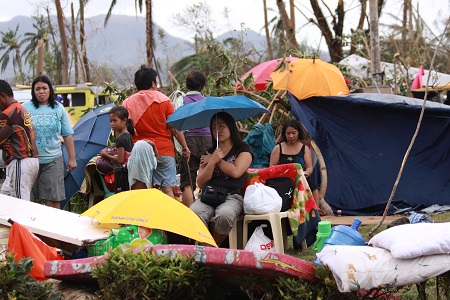
The UN World Food Programme and other aid groups are rushing aid to those displace by the typhoon. World Food Programme. (WFP/Praveen Agrawal)

The UN World Food Programme and other aid groups are rushing aid to those displace by the typhoon. (WFP/Praveen Agrawal)

Right now there are millions of people suffering from hunger in the Philippines after the super typhoon. There is no food, water or electricity in storm hit areas. Humanitarian agencies are rushing to get aid to the suffering.

What can you do to help? You can follow the great American tradition of feeding a “silent guest” at your next meal.

Set an extra plate or just use your imagination. Figure out how much it would cost to feed a “silent guest” at your next meal and send that amount to a charity. You could send it to Save the Children or Catholic Relief Services, two charities that were providing aid when the “Silent guest” program was first active after World War II.

You could donate to UNICEF or the World Food Programme, Or any charity of your choice.

There is another way you can feed a “silent guest” from the Philippines. This comes by way of a free app called Charity Miles and Lifeway Foods. You download the Charity Miles app, select World Food Programme as your charity. Then you just run, walk or bike and funds are raised for WFP, paid for out of a corporate sponsorship pool.

Lifeway Foods, in response to the Philippines disaster, is increasing its sponsorship of Charity Miles and offering an incentive. Whenever you use the app Lifeway will donate an additional 25 cents per mile (up to $20,000) to the World Food Programme.

Charity Miles is a free an easy way you can feed a “silent guest.” Just bring your smartphone and your heart.

The “silent guest” tradition got its start in 1947 when the fate of war-devastated Europe rested upon food for the hungry. A one-time aspiring actress, Iris Gabriel, proposed the plan to Governor Robert Bradford of Massachusetts. It took off around Thanksgiving time and it led to people buying “CARE packages” to feed the hungry in Europe.

Governors around the country mobilized their respective states. Today, we are seeing a similar development. Governor Bob McDonnell of Virginia issued a statement today encouraging citizens to donate what they can.

You can help build the pipeline of food that WFP is going to need for some time. A shipment from the U.S. Food for Peace program just left Miami with high energy biscuits to be distributed by WFP. We also need to make sure the Congress increases Food for Peace funding in the upcoming Farm Bill legislation.

Let’s all take in a “silent guest” and help feed the storm victims in the Philippines.

originally published at the Huffington Post.

Leave a comment

Filed under global hunger

Special Foods Fight Malnutrition in Syria

Plumpy'Doz is being used to treat malnutrition in Syria (Wolrd Food Programme)

Plumpy’Doz is being used to treat malnutrition in Syria (World Food Programme)

As the war continues in Syria, so does the risk of deadly malnutrition for children. Special-nutrient rich foods, like those being distributed by the UN World Food Programme (WFP) can save their lives.

Spokesperson Laure Chadraoui told me last week that WFP is distributing “Plumpy’Doz for children, 6-59 months, residing in collective centers and Nutributter in the North east of Syria to children 6-23 months for the prevention of micro-nutrient deficiencies.”

Plumpy’Doz is a nutritional supplement designed for children most at risk of malnutrition. The Nutributter is described by one its producers as being like a “daily multi-vitamin in a peanut paste” for children 6 months to 2 years of age.

Both the Plumpy’Doz and the Nutributter are ready-to-eat foods specifically designed for areas suffering from conflict, disaster or extreme poverty. No cooking or special storage is required for this food to be eaten, making their distribution easier. A system of factories, including Providence-based Edesia, produce these miracle foods.

These foods prevent children from suffering malnutrition. Children under the age of five will suffer lasting physical and mental damage if they become malnourished. So this concept of prevention is so vital in terms of planning a humanitarian response in distressed parts of the globe.

Around 300,000 children in Syria will benefit from the Plumpy’Doz and Nutributter provided by WFP. The Nutributter is being donated by the United States as part of a continuing relief effort.

It’s critical that aid agencies maintain the pipeline of this food, especially in a crisis as desperate as the one in Syria. The hunger facing Syria is so severe that the needs of the population will grow as the conflict continues. With access to parts of Syria being restricted by the government it remains an unknown as to the extent of malnutrition in these areas. Much more food aid may be required.

It’s also less costly to bring in Plumpy’Doz and Nutributter earlier rather than having to resort to Plumpy’nut which is used to treat the most severe cases of malnutrition.

WFP relies on voluntary funding and needs around U.S. $30 million dollars a week to feed Syrian war victims. Decisions made by the U.S. Congress on food aid budgets will have a major impact on Syria and other war and disaster afflicted nations.

Plumpy’Doz and high energy biscuits are also being provided to Syrian refugee children in Iraq. Save the Children is also operating a large-scale infant and young child feeding program in Jordan.

originally published at the Huffington Post.
Leave a comment

Filed under global hunger

Food and Education Can Change the World

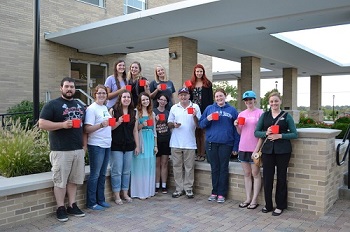
The UN Development Goals Class at the College of Mount St. Joseph (Dr. Jim Bodle)

The UN Development Goals Class at the College of Mount St. Joseph (Dr. Jim Bodle)

Last month I spoke to a unique class at the College of Mount St. Joseph in Ohio, one dedicated to ending hunger and poverty through the UN Development Goals. The class had attended Ban Ki-moon’s Youth Day presentation at the General Assembly.

As I prepared for the class a surprise came to me via twitter! It was a letter from a child in Mali, a country in Africa that has suffered through conflict and drought. The UN World Food Programme (WFP), which is providing school meals in Mali, forwarded a translation of the letter:

Hello papa et maman. After 11 months of occupation in North Mali by armed bandits we’re today on the path to school. Our parents are poor and tired.

Thank you WFP who gave us food so we could work hard in school. We always count on God and you. With WFP it’s okay. The school in Barize thanks you.

These school meals take on even more urgency in Mali with recent findings that show three out of every four households in the northern part of the country suffer from hunger. Both WFP and Catholic Relief Services are providing food for schoolchildren in Mali. Funding though is always an issue.

Food and education for children is something that clearly does not get enough attention, yet it’s one of our most important pathways to peace.

Ban Ki-moon told the Youth Day audience in August about his experiences growing up in war-time Korea. When it rained there were no classes because those were held outdoors. The school buildings had been destroyed during the fighting.

The Secretary General said the Korean children were hungry for food, but also hungry for knowledge. “It’s not only bread and butter” he said, “you need to have knowledge and education.” Getting children food and education is a top priority worldwide.

What better example than South Korea? During and after the war food was provided to children through the United Nations, CARE and other organizations. The U.S. Food for Peace program was founded after the Korean War. Millions of Korean children received school meals through Food for Peace.

History provides us even more advice. It was October 1st, 1947 when Secretary of State George Marshall said, “Hunger and insecurity are the worst enemies of peace.” He knew that peace after World War II stood no chance unless the enemy of hunger was defeated. Europe’s recovery was only possible under a foundation of food. School meals were a huge part of this recovery. That is a lesson we need to remember today.

It was a great opportunity to speak to the UN Development Goals class about food and education for children. Everyone in the class even received a Red Cup which is the World Food Programme’s symbol of school meals.

The school meals mean a lot to every country, from the United States to Yemen. The United States has its own national school lunch program, building upon years of effort. Now the U.S. Congress ironically is trying to undo that by eliminating some free school meals as part of its food stamp cuts.

That is why it’s so important that people advocate for what should be a basic right for children: school meals. The UN Development Goals class, with its emphasis on service learning, is well-equipped to carry on this message.

Next year Yemen will be starting their own national school lunch program with the help of WFP, a potential major turning point for a country mired in conflict and poverty.

Erin Koepke of the World Food Program USA said to me, “I love how there is a class dedicated to the Millennium Development Goals. If only all colleges and universities had a similar class.” I agree.

originally published at the Huffington Post

Leave a comment

Filed under global hunger

Feed Syria’s Starving War Victims

WFP is trying to feed millions of Syrian war victims (WFP/Marco Frattini)

WFP is trying to feed millions of Syrian war victims (WFP/Marco Frattini)

Where there is war there is hunger. In Syria children have died because of chemical weapons, but also because they could not get enough food. Weakened, illness overtook them.

Isra from Syria says, “This war…is killing people slowly. We used up all our supplies of food – I could only give my children one or two mouthfuls of rice to keep them going. I just cried at night.”

The civil war in Syria has created a new enemy for the people: hunger. Syria’s agriculture has been ruined and many bakeries have been destroyed by shelling. The seeds of war have been planted for famine.

The United Nations World Food Program (WFP) is facing its largest hunger relief mission. WFP is trying to feed three million Syrians this month, but faces extreme difficulty in moving life-saving aid because of the violence.

Many people are blocked off from aid by the Syrian government. Save the Children says the numbers of hungry are likely much higher, possibly 10.5 million Syrians in seven governorates alone. Save the Children warns, “As the destruction continues, these numbers will grow: children who once relied on three healthy meals a day will go to bed hungry, afraid, feeling abandoned by the world outside.”

There are also two million Syrians who have fled to Iraq, Jordan, Turkey, Egypt and Lebanon. They totally depend on international aid.

The World Food Program needs about $ US 30 million a week to provide food aid for Syrian war victims. The UN food agency is also trying to feed millions of hungry in Yemen, Afghanistan, Mali, South Sudan, Darfur, Haiti and other countries leveled by conflict or natural disasters.

As the world tries to negotiate an end to the war, we must also press the Syrian government to allow full access to the hungry. In addition, WFP and other aid agencies must have the funding they need to bring relief.

It’s overwhelming for any individual to look at the size of this crisis. But everyone can have an impact, even some of the simplest measures can help. The free smartphone app Charity Miles raises money for the World Food Program. Just going out for a walk, run or bike can raise funds for WFP, which is an agency that relies entirely on voluntary funding. It’s free for you, the funds are donated from a corporate sponsorship pool.

Using this app I have raised hundreds of meals for WFP just by running or walking. I know it’s a small amount, but it’s better than feeling helpless. Laure Chadraoui, a WFP rep working on Syrian relief, told me “What you do makes us all very proud, we need every penny indeed.”

It’s also important to make an impact statement. That’s what needed to keep the focus of leaders in bringing an end to the war and negotiating agreements on humanitarian access. It can help motivate the Congress to pass key legislation like the Global Food Security Act, so hunger remains a top foreign policy priority.

What happens in communities can have a powerful impact globally. In the fall of 1947 people across the USA donated food for the Friendship Train. This outpouring had a powerful influence on Congress as it debated aid to rebuild war-torn Europe.

Senator Arthur Vandenberg said the Friendship Train, “demonstrates our instinct, our tradition, and our impulse to feed the hungry and to heal the sick; and personifies the friendliness which is the genius of a lasting peace.” That holiday season Americans did not stop either, they fed a “silent guest” at Thanksgiving and Christmas which led to more CARE packages for the hungry. The famous Marshall Plan followed and rebuilt Europe from the ashes of war.

Every generation’s horrors can be overcome by its heroes. During World War I collections were held to provide relief in Belgium and other suffering countries. Even after the war people responded to pleas from Herbert Hoover and General John J. Pershing to feed the “invisible guest”: a hungry child. The Motion Picture Industry even held a major fundraiser at the same time.

As Helen Keller once said, “Alone we can do so little, together we can do so much.” Every little bit can go a long way. Understanding this is what makes a leader. Now is the time for action as our generation faces its great challenges in war, humanitarianism and the quest for peace.

Originally published at the Huffington Post.

Leave a comment

Filed under global hunger

College Students Hear Message of Hope from UN Chief

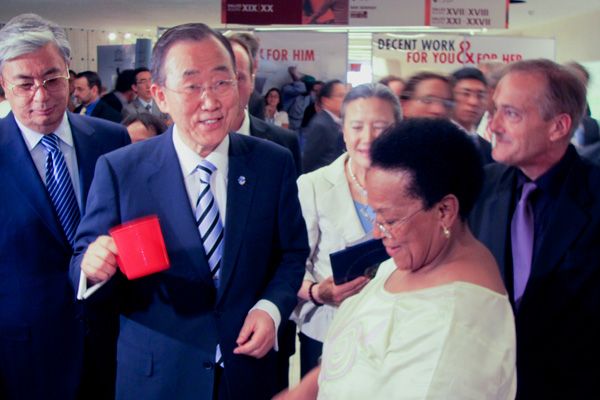
United Nations Secretary General Ban Ki-Moon holding the famous red cup which symbolizes the movement to provide all children worldwide with school meals. Mount St. Joseph students listed to presentations both at the United Nations and on campus about the importance of school meals in ending hunger and poverty (photo courtesy of the UN World Food Program)

United Nations Secretary General Ban Ki-Moon holding the famous red cup which symbolizes the movement to provide all children worldwide with school meals. Mount St. Joseph students listed to presentations both at the United Nations and on campus about the importance of school meals in ending hunger and poverty (photo courtesy of the UN World Food Program)

Last month College of Mount St. Joseph students traveled to the United Nations in New York. Their mission was to learn about the UN Development goals to end world hunger and poverty.

The students attended a presentation by UN Secretary General Ban Ki-Moon. The Secretary General talked about bread and butter. Not the appetizer kind. What he meant was how children around the globe needed food, but also education.

The Secretary General told the story about growing up during the Korean War. Schools were destroyed during the fighting and children attended class outdoors, under shade of trees. When it rained there was no class.

The Secretary General said how he and other children were hungry for food, but also for knowledge. “It’s not only bread and butter” he said, “you need to have knowledge and education.” Getting children an education is a top priority worldwide.

The Mount students, upon returning to campus, learned more about the importance of food and education for children. The story of war-time Korea further illustrated this point as former Cincinnati resident, Major Charles Arnold, led a UN civil assistance team that fed Korean refugee children. Without this food, the children would have suffered severe malnutrition.

The Charity CARE, with support from the U.S. Food for Peace program, provided millions of Korean children with school feeding over the decade following the war. This was a key strategy to fighting malnutrition and boosting school enrollment and learning.

Today, the United Nations World Food Program spearheads a global effort to provide all children with school meals. It’s called The Fill the Red Cup Campaign.

MSJ students received red cups from the World Food Program USA last week as a symbol of this school feeding movement. They also listened to historic messages from General Dwight Eisenhower, who spoke in 1948 at the United Nations Crusade for Children. Ike emphasized how starving children, scrapping for food, could not grow up to be apostles of peace. Food aid is essential now as it was after World War II.

The Mount campus currently fundraises for UN school feeding programs and Feeding America through its Charity Miles team. The UN class is planning to continue to spread Ban Ki-Moon’s message of hope, food and education for all.

article originally published at Cincinnati.com

Leave a comment

Filed under global hunger

The World Needs More School Meals

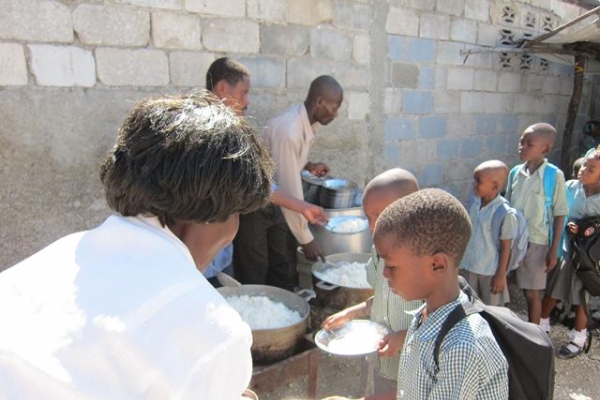
Emergency school feeding in Mali through the World Food Programme. Cuts by Congress to food aid could harm this program. (WFP/Daouda Guirou)

Emergency school feeding in Mali through the World Food Programme. Cuts by Congress to food aid could harm this program. (WFP/Daouda Guirou)

A child in the war-torn African nation of Mali just wrote a letter to the UN World Food Programme (WFP). Emergency school meals are being provided by the WFP in Northern Mali.

“Our parents are poor and tired,” the child wrote. “Thank you WFP who gave us food so we could work hard in school. We always count on God and you. With WFP it’s okay. The school in Barize thanks you.”

This food is nutrition for their mind and body. But also for their spirit and soul. Food is hope. WFP’s plan is to feed children but at the same time get them back in school and learning. It’s a strategy that is proven to work.

They are going full steam ahead at providing these meals through the rest of this year. Right now 120,771 students in Northern Mali get two meals a day: an enriched breakfast and a lunch. Volunteer cooks also receive take home rations.

It’s common sense that school meals are important, especially for a nation trying to find that road to peace after a war. Tragically, that does not always translate into funding for school meals. When international relations is discussed it seldom revolves around humanitarianism, the very thing people around the world need most.

For Syrian refugee children school feeding is one of the few things they can count on during this time of upheaval in the Middle East. The WFP is providing 2,000 children right now with school feeding at refugee camps in Jordan. They hope to expand to 30,000 by the end of the year. In Iraq over 4500 refugee children have received high-energy biscuits at school and summer camps.

WFP needs funding to make sure school meals continue the rest of this year and into next year. The UN food agency relies entirely on voluntary donations. That means budget decisions by the U.S. Congress have a dramatic effect. If funding disappears so too will the school meals. That is a silent tragedy that goes unseen.

In Mali, WFP has a homegrown school feeding project in the Southern part of the country. By helping small farmers become the providers of the meals, it helps build the future of the country, one where they can sustain themselves.

Catholic Relief Services (CRS) also has a school feeding program in Mali which is set to resume in October. Kristina Brayman of CRS reports the program will operate in 310 schools with an end goal of feeding 80,000 children.

The U.S. McGovern-Dole school lunch program supports this CRS initiative in Mali. The Congress will be deciding in the coming weeks how much funding to give McGovern-Dole. This will have a big impact on the future of school meals in U.S. foreign policy.

Some members of Congress want these budgets made responsibly and are desperately trying to get the fight against hunger at the top of the foreign policy agenda. Representative Betty McCollum (MN) recently introduced the Global Food Security Act. This would create a White House level coordinator to improve the U.S. response to world hunger.

The Act quotes a U.S. Intelligence report which states, ”Growing food insecurity in weakly governed countries could lead to political violence and provide opportunities for existing insurgent groups to capitalize on poor conditions, exploit international food aid, and discredit governments for their inability to address basic needs.”

It’s in everyone’s interests that we fight hunger and provide school meals around the world. A child who received school meals in Germany wrote after World War II, “If every people will help the other, like you does, we should have a lasting peace soon.”

That is what the world needs most of all now.

Leave a comment

Filed under global hunger

Food Security is Security

School meals are an important part of WFP's emergency response to the conflict in Mali. They give children like these an added reason to attend school while providing them with the calories and nutrition they need to be healthy. (WFP/Daouda Guirou)

School meals are an important part of WFP’s emergency response to the conflict in Mali. They give children like these an added reason to attend school while providing them with the calories and nutrition they need to be healthy. (WFP/Daouda Guirou)

Last week Ertharin Cousin, the director of the UN World Food Programme, said “food security is security.” If you are responsible for food aid budgets, such as our elected officials, these words are what you need to know.

Any country’s well being rests first and foremost on food. Without it you cannot have a functioning economy and your children will be stunted in growth and mind. When hunger escalates, it can lead to violence further setting back the society. Food means peace.

Yet, time and time again members of Congress take to cutting food aid budgets. Some even propose amendments to abolish entire food aid programs. They might as well just eliminate American foreign policy, for you cannot have one unless you fight hunger.

As George Marshall once wrote, “Hunger and insecurity are the worst enemies of peace.” He knew what nations in distress needed as their foundation for recovery and peace. Marshall’s plan was indeed a successful approach. We know that today Afghanistan, Yemen, Haiti, Syria and other nations will not have peace or development without the basics of food.

When Cousin made her statement she was in the Middle East. She added, “Food security is a vital component for sustained peace across the region.” Palestine, Syria, Yemen, Egypt and other parts of the region are facing a severe hunger crisis.

Right now as the Congress considers the Farm Bill they have to think in terms of our foreign policy as a whole. We need a strong Food for Peace program. This initiative is the largest supporter of the World Food Programme, which is the agency on the frontline of hunger everyday.

We need a strong international school lunch program as well. When you can mix food with education it is a powerful tool. Food aid reforms need to pass to improve the efficiency of these programs.

It’s not a matter of political sides either. Democrats, Republicans and Independents can all back the fight against hunger. That is the way it’s been done before. That is how it should be now.

Remember after World War One, what a young lieutenant from the American Relief Administration said after being told a food aid mission was practically impossible. He said, “Yes, we can.” No politics there. He was doing his duty, not just as a soldier but as a human being.

We should expect no less from our elected officials when they are making decisions that impact the lives of millions of people worldwide and our own national security.

Leave a comment

Filed under global hunger

Haiti Faces a Summer of Hunger

A series of disasters, coupled with low funding for aid agencies, places millions of Haitians at risk of severe hunger. (WFP/Stephanie Tremblay)

A series of disasters, coupled with low funding for aid agencies, places millions of Haitians at risk of severe hunger.
(WFP/Stephanie Tremblay)

The UN World Food Programme (WFP) confirmed today it will not be able to provide summer school feeding for children in Haiti.

The UN food agency, which depends on voluntary donations, is already short on resources for many of its programs to help Haiti recover from a series of disasters.

In addition, a WFP take-home ration plan for 200,000 school children lacks funding to get started. This food aid is essential for families suffering from severe hunger and it allows their children to stay in school.

There are 6.7 million people, over half the population, that suffer from hunger in Haiti. Alejandro Chicheri of WFP says that of this number, around 1.5 million Haitians face severe hunger. Drought and a series of storms severely damaged agriculture, placing already impoverished families under additional stress.

A report from the Famine Early Warning System stated, “despite the evident readiness of local farmers, poor seed availability is threatening the success of this year’s crops…. Poor households in many rural areas could still be facing a food shortage directly after the July harvest.”

The charity Live Beyond provides food, water and medicine in Haiti and says it is “providing bags of rice and beans” at its medical clinics, “to ensure that the sickest of the sick are able to continue living through this period of starvation.”

At a fundraising event, actress and activist Kimberly Williams-Paisley recently said, “The phrase you hear most often in the LiveBeyond Mobile clinics is ‘Mwen grangou’ or I am hungry.”

Meanwhile, the U.S. Congress is threatening to reduce funding for the Food for Peace and the McGovern-Dole programs, both which help Haiti. President Obama is urging Congress not to cut these aid programs, which already are a relatively tiny part of the federal budget.

The World Food Programme continues to work with the Haitian government to build a national school lunch program. WFP provides meals during the school year to hundreds of thousands of children. The goal is for Haiti to run this program entirely using locally produced food.

These goals though cannot be obtained unless Haiti has the food supply to endure the reconstruction.

Leave a comment

Filed under global hunger

Why FreeRice is so important for Niger

FreeRice has two goals:  Provide education to everyone for free.  Help end world hunger by providing rice to hungry people for free.

FreeRice has two goals: Provide education to everyone for free. Help end world hunger by providing rice to hungry people for free.

When you go online to play the award-winning game FreeRice you are currently helping feed school children in Niger. This is a country in the Sahel region of Africa where the UN  World Food Programme says, “2.5 million people are in a permanent state of food insecurity, unable to meet basic food requirements even under normal conditions.”

Millions of others also suffer from hunger during different periods of the year, between harvests for example. With such extreme hunger and poverty parents may withdraw their  children from school, unless there is the incentive of food.

Here is an excerpt of a report from the World Food Programme:

The school feeding programme successfully encourages enrollment and attendance of children,  and reduces drop-out rates, in primary schools in structurally  vulnerable areas of Niger through the provision of cooked meals. In  order to address the gender gap in enrollment and reduce drop-out rates,  WFP provides a dry, take-home family ration to girls enrolled and attending the final  years of primary school. At the request of the Government, WFP and UNICEF are working to expand in nomadic areas.”

By playing FreeRice you are helping children get food and education. With the SAT tests coming up in June, millions of high school students in the U.S. could actually prepare for this test and help Niger by using the FreeRice SAT prep section.

Start playing at FreeRice.com.

Leave a comment

Filed under global hunger

Aid Groups Need Access to Starving People in Sudan’s South Kordofan State

Thousands have been displaced by the conflicts in South Kordofan and Blue Nile states in Sudan. These areas are facing a hunger crisis and aid groups need access. Credit: UNHCR

Thousands have been displaced by the conflicts in South Kordofan and Blue Nile states in Sudan. These areas are facing a hunger crisis and aid groups need access. Credit: UNHCR

This week the UN World Food Programme (WFP) announced it had started distributing aid in Sudan‘s conflict-affected Blue Nile state. Previously WFP had not been granted access to this area where rebels (SPLM-N) are fighting Sudan’s government.

Now food aid must be allowed into South Kordofan state which, like Blue Nile, has been devastated by this same conflict. There are reports of tremendous suffering in South Kordofan. Yet aid is not allowed to go through.

View slideshow: Hunger and displacement from conflicts in South Kordofan and Blue NileIn a joint statement in March, U.S. Secretary of State John Kerry, Norwegian Foreign Minister Espen Barth Eide, and UK Foreign Secretary William Hague said: “We remain deeply concerned by the security and humanitarian situation in Southern Kordofan and Blue Nile states in Sudan. It is imperative that both Sudan and the Sudan People’s Liberation Movement North (SPLM-N) seize the opportunity of direct talks to address the urgent need for a cessation of hostilities, humanitarian access to all areas, and the longer-term political solution. We welcome SPLM-N’s acceptance of the invitation to direct talks and urge the Government of Sudan to do the same, without pre-conditions.”

Currently, the World Food Programme and aid groups are able to operate only in the government-held areas of South Kordofan. Save the Children Sweden has done nutrition screenings for children under five years old in parts of South Kordofan under government control. So far 89,482 have been screened with around 15,000 of the children either moderately or severely malnourished. Plumpy’Nut, a special peanut paste, is being used to treat the children. Without the treatment children will suffer lasting physical and mental damage from malnutrition.

With reports of people living off roots and leaves in the conflict zones of South Kordofan, malnutrition rates would be expected to go much higher. The World Food Programme and other aid groups need access to all of South Kordofan.

Meanwhile, funding is urgently needed for the relief effort in Blue Nile. WFP Sudan Country Director Adnan Khan, speaking of Blue Nile, says, “While we continue to strive for access to all areas, this is still a major breakthrough which will enable us to assist those who continue to be displaced by the conflict or those who have decided to return to their homes and are in dire need of food assistance. For this immediate response, we will need an additional US $20.5 million which will be used to buy 17,000 metric tons of food.”

Article first published as Aid Groups Need Access to Starving People in Sudan’s South Kordofan State on Blogcritics.

Leave a comment

Filed under global hunger