
Tag Archives: plumpy’nut

Ithaca’s Food for Thought Takes on Global Hunger

Amanda Riggio, former Food For Thought member and Ithaca College student, conceived an event, “Rise Up for Rice,” where students could gather together and answer trivia questions at freerice.com to help eradicate world hunger. (Food for Thought photo)

New York is full of great history and heroes. During the fall of 1947, for example, the Friendship Train rolled through the state collecting food for the hungry in war-torn Europe.

Today, not far from where the Friendship Train made its New York stops, students at Ithaca College are also collecting donations to feed the hungry. One way they accomplish this is through an online trivia game called FreeRice.

Every time you answer a question correctly playing FreeRice, ten grains of rice are donated to the UN World Food Programme. And the Friendship Train is one of the questions in this game!

Ithaca College has a dedicated organization to fighting world hunger called Food for Thought. Back in 2010 I wrote a story on Elizabeth Stoltz who founded this hunger-fighting group.

Stoltz had set up an event for the Ithaca community called the Walk for Plumpy’nut, a fundraiser to provide life-saving food to malnourished children. This event has continued ever since collecting thousands of dollars each year to purchase Plumpy’nut. She was also running a magazine called Plumpy’nut Press.

Since that time Food for Thought has expanded its reach in feeding the hungry. In addition to the annual Walk for Plumpy’nut it has started the Rise up for Rice challenge using the FreeRice game. Two of Food for Thought’s current officers, Lethia McFarland and Lindsey Smith, recently shared some of the groups accomplishments in the following interview.

Who developed the idea of the Rise Up For Rice Challenge?

Amanda Riggio, former Food For Thought member and Ithaca College student, conceived an event, “Rise Up for Rice,” where students could gather together and answer trivia questions at freerice.com to help eradicate world hunger.

How many players participated in the Rise Up For Rice Challenge this year?

Unfortunately, we cannot measure the number people participated this year, given that many people did so remotely, but we did raise 43,590 grains of rice collectively.

Did you have a tournament involving different teams too?

We did not. Everyone who participated logged in under the same account “riseupforrice,” so that we could best track the impact.

How many grains of rice did you raise this year?

43,590 grains (over four times the amount that we raised last year!)

How did you promote the event on campus?

We actively promoted the event via social media, including Facebook and Twitter. To supplement this, we also designed small pamphlets and distributed them throughout campus.

Do you have members participating from outside the campus?

It could have been a possibility, but unfortunately, we could not measure that affirmatively.

Can people still take part in Rise up For Rice all year long?

Yes! We encourage students to play on the day of Rise up for Rice, but the account is open all year long.

Rise up for Rice was preceded by another event on campus called Walk for Plumpy’nut? How did that event go this year?

At our 6th Annual Walk for Plumpy’nut on Sunday, October 7th, we welcomed 109 people and walked together in solidarity to fight childhood hunger. We were able to raise over $4,100 dollars, as well as obtain 40 sponsors for this year’s walk. All of the proceeds will go directly to Concern Worldwide to buy Plumpy’nut for distribution in therapeutic feeding centers across Ethiopia. Plumpy’nut, a ready-to-use therapeutic food, will be used to help treat severely malnourished children. Overall, we hosted a successful event, thanks to the gracious support of the Ithaca community.

Article first published as Ithaca’s Food for Thought Takes on Global Hunger on Blogcritics.

Leave a comment

Filed under global hunger

Special Food Can Save Malnourished Children in Yemen

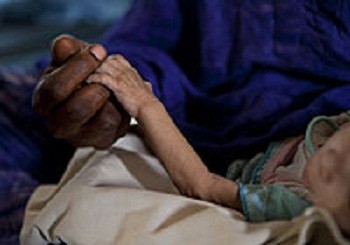
If enough packets of supplementary plumpy are brought to Yemen it can allievate much of the child malnutrition ongoing there. The plumpy is easy to store since it requires no refrigeration and packets are ready to eat. (photo courtesy of Plumpyfield)

UNICEF Yemen is reporting stunting rates among children at 71.4 percent in the Rayma governorate of central Yemen. Children who are stunted by lack of nutrition fail to reach expected height and weight for their age.

Another UNICEF survey revealed global acute malnutrition rates among children in the Lahj governorate of southern Yemen at 23 percent. Children who suffer this malnutrition have lasting physical and mental damage unless they are treated.

Child malnutrition is severe throughout Yemen. UNICEF says, “967,000 children suffer from acute malnutrition. In certain areas of the country, the acute malnutrition rate exceeds 30 per cent, twice the emergency threshold.” Until this crisis is alleviated Yemen will not be able to gain stability for its future. The question is, what action can be taken?

A full supply of supplementary plumpy (plumpy’sup) food for all needy children in Yemen would provide the nation with a break from the malnutrition storm. Supplementary plumpy, and plumpy’doz, are peanut pastes designed to keep children from falling into the most severe levels of malnutrition. When children reach the most desperate stage of malnutrition they are generally fed life-saving plumpy’nut. Yemen needs a supply of plumpy’nut too to treat the most severe malnutrition cases.

But if the rest of the child population at risk of malnutrition can be reached with supplementary plumpy you can prevent this last resort.

Dr. Wisam Al-timimi of UNICEF Yemen says, “Supplementary plumpy is the 1st stage to treat the moderate cases of acute malnutrition (MAM).” UNICEF is teaming with the UN World Food Programme to increase coverage of supplementary plumpy and plumpy’doz for children under two years of age.

Navyn Salem of Edesia, which produces Plumpy’Nut and Plumpy’Sup, says it’s a “good strategy” to treat children ahead of time with Plumpy’Sup to prevent their dangerous descent into severe malnutrition. Salem says it “costs less and it is of course better for the children to be reached sooner than later.”

Funding, though, will be an obstacle, as donations are needed so UNICEF, WFP, and other aid agencies can get the necessary supplies. These agencies rely completely on voluntary donations which are often hard to get even though food aid is relatively inexpensive.

Both WFP and UNICEF are limited in plumpy supply due to funding constraints. As of last month UNICEF Yemen only had 30 percent of the funding it needed for a $24 million program to fight child malnutrition. With extra funding they would increase the defenses against child malnutrition.

Support from governments and the public would go a long way toward stabilizing the country and preventing a generation of children from being damaged from malnutrition in the first thousand days of life.

UNICEF Yemen has a relief fund that the public can use to contribute funds to the relief effort. The UNICEF programs needs more support. Susannah Masur of UNICEF USA says “it’s been very difficult to raise money for the nutrition crisis in Yemen.”

The public can also contact the UN World Food Programme and ask about direct donation to their operation in Yemen. Governments can work with UNICEF and WFP and provide donations to make sure they have the resources on the ground to help all the children in Yemen.

Article first published as Special Food Can Save Malnourished Children in Yemen on Blogcritics.

Leave a comment

Filed under global hunger

How a Silent Guest Can Help Save Hungry Yemen

In a letter to the New York Times last February, I wrote about an emergency safety net plan to feed millions of hungry Yemenis suffering from high food prices.

Since that time, child malnutrition in some parts of Yemen has increased so much as to rival famine-ravaged Somalia.

Maria Calivis, UNICEF’s regional director, says, “This year alone, half a million children in Yemen are likely to die from malnutrition or to suffer lifelong physical and cognitive consequences resulting from malnutrition if we don’t take action. Malnutrition is preventable. And, therefore, inaction is unconscionable.”

Calivis adds, “Conflict, poverty and drought, compounded by the unrest of the previous year, the high food and fuel prices, and the breakdown of social services, are putting children’s health at great risks and threatening their very survival.”

Neither UNICEF nor the UN World Food Programme (WFP) received enough funding during 2011 to carry out their full hunger relief missions in Yemen.

These UN agencies rely on voluntary donations from the international community. If donors do not contribute, then hunger relief missions have to be scaled back or in some cases halted.

So what can someone do? Take action! UNICEF has a relief fund for Yemen. The World Food Program USA is also hosting a Yemen fund. You can even sign a petition to help WFP fight hunger in Yemen.

Or you can take in a “silent guest.” Starting in the holidays of 1947, the United States helped starving countries with a “silent guest” program. At mealtime, people were asked to imagine a silent guest at their table. Then they could mail the cost for feeding that silent guest to a committee in Plymouth, Massachusetts. This donation would buy a CARE package which was sent to hungry people in war-devastated Europe.

Today, maybe at your next meal, you could take in an infant child in Yemen who needs plumpy’nut to prevent potentially deadly malnutrition. You could send that donation to UNICEF which provides the plumpy so it can help treat all the cases of child malnutrition in the country.

Some of the countries who benefited from silent guest donations back in 1947 were Italy, Austria, France, and Greece. At that time Greece was recovering from a famine and facing a civil war.

Another country helped by the silent guest program was Germany. It is Germany that today has taken the lead in helping fight hunger in Yemen with a recent donation of $31 million to the WFP mission.

WFP will need over $200 million to feed millions of Yemenis during 2012. The rest of the international community should follow Germany’s lead.

The donation from Germany will help the emergency safety net plan which includes rations for 1.8 million Yemenis and also plumpy for infants. A school feeding program which has faced severe cuts over the last couple of years is getting a restart too.

The WFP Food for Education plan, which distributed take-home rations to schoolchildren, was suspended in 2010 and did not resume until May of 2011. Then it was a limited distribution, not even close to the previous levels of about 115,000 students. These rations benefited the children and their families. It’s food for the body and the mind as it keeps children in school and learning reading, math, science, and writing.

As significant as Germany’s recent donation is, it will be able to help revive Food for Education only to almost half of what it once reached in terms of students.

Lubna Alaman, director of WFP Yemen, says “The Food for Girls’ Education [program] is targeting only 53,000 girls and their families, and the food will be distributed for three school terms in 2012.”

So there is a long way to go to get all these hunger relief plans fully active again.

The choice with Yemen is simple. Invest now and avert an epic disaster like Somalia faced. We can save a generation of children in Yemen from the malnutrition that damages or even kills them in the first years of life.

Or drift along, pretending that Yemen will somehow turn out OK with an average response to humanitarian needs. It won’t, because no nation can have peace, political stability, and development on empty stomachs and malnourished bodies and minds.

Article first published as How a Silent Guest Can Help Save Hungry Yemen on Blogcritics.

Leave a comment

Filed under global hunger

Sahel Food Crisis: Race Against Time to Save Lives

A mother attends to her severely malnourished child at an inpatient feeding centre in Mao, Chad. Credit: UNICEF Chad/2011/ Esteve

In the Sahel region of Africa millions of people are caught in a severe hunger crisis. Niger, Mauritania, Chad, Burkina Faso and Mali are primarily the countries affected right now.

Drought has reduced food production, and high prices reign over the existing food supply. For families living in poverty, food is out of reach. UNICEF says more than a million children under five years of age will need to be treated for severe malnutrition in the region.

If the international community does not act now, the situation will get much worse. Action has to be taken well before the lean season between harvests, which could start as early as February or March. The UN World Food Programme (WFP) says, “food security problems in the lean season lead to significant peaks in acute malnutrition and mortality, taking it beyond critical levels.”

It can take months for a donation to translate into food on the ground. So donors need to come forward quickly to help avert a disaster in the Sahel.

Navyn Salem of Edesia, whose organization produces plumpy’nut food aid, points out that if donors wait until the ultimate disaster strikes, it leads to very expensive airlifts of emergency food aid. That is money that could have been used to purchase more food and shipped at lower cost months earlier.

Right now WFP is facing a tough time funding its relief operations as hunger is on the rise in many parts of the globe. In Niger, WFP had to increase its funding requirements to feed over 3 million people, one million higher than previous estimates. So far, less than half of the required funding has been received to provide the food aid.

Denise Brown, WFP country director, warns “Unusually high food prices are affecting needy people who are facing growing difficulties as they struggle to feed themselves and their children. I am deeply worried about the food situation deteriorating in the coming months and we cannot sit back and wait for the worst to come.”

The US Food for Peace program, started by Dwight Eisenhower, has been able to send some funds for Niger relief. However, the US Congress has been threatening to reduce future funding for Food for Peace despite the massive global hunger crisis now unfolding.

In Chad, cereal production in 2011 decreased 50 percent compared to 2010, according to the Food and Agriculture organization. Who becomes the most vulnerable when such a food crisis hits? It’s the smallest children under five years of age.

A WFP report says, levels of acute malnutrition were at a “critical” level in 6 out of 11 regions surveyed in Chad. Other areas were categorized as having “Serious” levels of malnutrition. The smallest infants in this danger zone run the risk of lifetime physical and mental damage unless food aid can reach them in time.

UNICEF says, “What is going to be required to save lives is the sweet, peanut-based therapeutic food known as ‘Plumpy Nut’, enough nutrition professionals in the field to work the feeding centres, and a string of other interventions that bring more food into communities.”

The Sahel region is in need though of more than emergency food aid. There has to be a way to build up the resilience of the region to future droughts, and gradually reduce the need for outside assistance. When the current crisis stabilizes, investments in the small farmer will need to move forward. Only this food security investment can prevent another hunger crisis of this magnitude.

Article first published as Sahel Food Crisis: Race Against Time to Save Lives on Blogcritics.

Leave a comment

Filed under global hunger

UNICEF starts relief fund for children in Yemen

UNICEF USA has started a relief fund to help the suffering children of Yemen. You can donate to the fund here.

Children are suffering the effects of malnutrition and displacement after a year of political instability, as well as fighting between the government and militant groups. Some families are even living in caves after fleeing violence.

“Don’t be afraid, we are not going to harm you, we are here to take care of you,” says Hana to the little girl who clutches her doll, afraid of the strangers who have come to her house. Do they want to take her away from her mom? But Hana and her colleague are enumerators and are here to see if little Fatima is malnourished, if she needs treatment. Sadly a quick measurement of her arm with a special tape shows she is much thinner than she should be at her age. “Fatima has severe malnutrition,” says Hana. “We have to refer her immediately to the outpatient therapeutic center so she can get appropriate care.” Rasha Al-Ardi/UNICEF Hodeidah/2011

The latest UNICEF report showed that “58,338 severely acute malnourished children were treated… in the past 11 months.”

However, countrywide it is estimated that 4 million children suffer from severe malnutrition. Many more resources such as plumpy’nut are needed for UNICEF to treat these children.

Read more about UNICEF’s response to the crisis in Yemen in my interview with director Geert Cappelaere.

first published at Global Hunger Examiner.

Leave a comment

Filed under global hunger

This Christmas Feed a Silent Guest and End World Hunger

The Providence-based Edesia will be making plumpy'nut this Christmas Eve to feed malnourished children in Chad (photo courtesy of Edesia)

Imagine if every person gave a gift this Christmas to a “silent guest,” one of the world’s hungry. During Christmas 1947, Americans did just that, continuing the successful “silent guest” program started in Thanksgiving of that year by a former aspiring actress named Iris Gabriel.

People imagined a “silent guest” at their holiday meal, and donated the cost of the imaginary food plate to buy a CARE package. These packages fed many thousands in countries overseas rebuilding from World War II.

This Christmas Eve a company called Edesia will be making packages of plumpy’nut to send to the African nation of Chad. Food is out of reach for the many poor in Chad, a country where drought and conflict have taken their toll. The smallest children pay the heaviest price unless the outside world intervenes with foods like plumpy’nut.

Plumpy’nut is a special package of food that saves infants from succumbing to dangerous malnutrition. There is no more important gift these children can receive.

Edesia accepts donations so you can help them fill this plumpy’nut order to Chad.One dollar actually buys several little packages, or sachets, of plumpy. Their plant has also produced this peanut paste for East Africa, Yemen, Guatemala, Haiti and Pakistan. Aid agencies like the World Food Programme, UNICEF and others distribute the plumpy’nut in these countries.You can make “silent guest” donations to these organizations at their respective web sites.

There are also ways you can feed a silent guest simply by playing on your computer. If you play the online game Free Rice, 10 grains of rice are donated to the hungry every time you get a correct answer. The rice is paid for by advertisers on the site.

There are many ways you can give a holiday gift to a silent guest at your holiday celebration. Happy Holidays!

See also Commentary in the San Francisco Chronicle: What you can do today to help end world hunger.

Article first published as This Christmas Feed a Silent Guest and End World Hunger on Blogcritics.

Leave a comment

Filed under global hunger, History

She Wanted to Mourn, But Chose to Save A Life

In my article Armistice Day, World Peace and Feeding the Hungry, I talk about the amazing work of the Belgian Relief Commission. They fed the hungry in Belgium, as well as Northern France, during World War One and in its aftermath.

One of its anonymous donors was a woman who wanted to buy flowers for a friend’s grave. She wanted to mourn. But she also was aware of the Belgian relief fund which had been collecting donations. She considered the two choices and decided to spend the 2 dollars on the Belgian relief fund. The Cincinnati Enquirer reported, “The possibility of saving a child in Belgium from starvation was the reason given” for her donation.

Two dollars in 1917 was worth about 2 months’ of meals. Frederick Chatfield, Cincinnati Branch Commissioner for relief in Belgium, reported the anonymous woman’s donation in an article discussing contributions and shipping. He said, “Cincinnati has responded splendidly to our appeal.”

The food sustained millions trapped by the fighting of World War One. In an article published by the newspaper in late 1916, Milton Brown wrote from Belgium, “Herbert Hoover, who heads the commission, is a remarkable man. He describes his job as feeding a kitten with a 40-foot pole, the kitten being in a cage between two hungry lions.”

On this Armistice Day, a two dollar donation could actually achieve close to two weeks’ worth of meals in countries suffering from conflict, natural disaster or extreme poverty. It could mean plumpy’nut to save small children from potentially deadly malnutrition; or it could mean school meals that not only prevent malnutrition, but help keep children learning in school.

There are tremendous needs around the globe today, and many ways you can help. Catholic Relief Services has set up an East Africa Relief Fund to fight the famine and drought there. Save the Children is collecting donations to help feed and give medicine to victims of massive floods which have struck Thailand.

Edesia, a producer of plumpy’nut, is holding a fundraiser titled the 11-11-11 project. Plumpy’nut is a special peanut paste desperately needed in many countries including Sudan, Guatemala, Afghanistan, Yemen and the Democratic Republic of the Congo.

The UN World Food Programme (WFP) has a We Feedback campaign which is like taking in a Silent Guest, one of the world’s hungry, at your next meal. WFP also has the online game called Free Rice which raises money for the hungry, and is free for the user to play.

To help those who are hungry within the United States, Feeding America supports a network of emergency food banks.

Article first published as She Wanted to Mourn, But Chose to Save A Life on Blogcritics.

Leave a comment

Filed under global hunger, History

Emergency Child Malnutrition Rates in Yemen

Children in Yemen are wasting away as conflict and a struggle for power continue in the beleaguered country. UNICEF just released findings from a nutrition study in the Abyan governorate in Southern Yemen. They found a shocking Global Acute Malnutrition rate among 18.6 percent of the children. The emergency threshold number is considered 15 percent.

When children do not receive proper nutrition, their growth is stunted in body as well as mind. They became more susceptible to illness.

While the South is suffering with malnutrition, so too is the North. In this area years of conflict between the government and rebels has taken its toll on the population. UNICEF says that “In Sa’ada, high malnutrition rates continue to be identified and children referred for treatment.

Out of a total of 234 children screened, 47 were referred to a therapeutic feeding center, while 128 were enrolled in outpatient therapeutic care (75% admission rate for severe acute malnutrition).”

A number of households in Yemen are reporting family members going to bed hungry. UNICEF says the capital Sana’a reported the highest percentage of household members going to bed hungry due to lack of food (67.5%) compared (to) Amran (45%) and Hodeida (25%). Food prices have risen steeply in recent months putting an extra crushing burden on the poor.

Even before this year of political unrest, hunger was a crisis in Yemen. This year had deepened this catastrophe to the highest levels of emergency.

Funding remains low for hunger relief missions by the UN World Food Programme and UNICEF. These agencies depend entirely on voluntary funding from the international community.

Supplies of the miracle food plumpy’nut, which can stave off malnutrition, are not available to all children. Funding for UNICEF and WFP would need to be increased. Without this supply, another generation of children will be burdened with long-term physical and mental impairment.

Leave a comment

Filed under global hunger

Plumpy’nut: A Modern-Day CARE Package

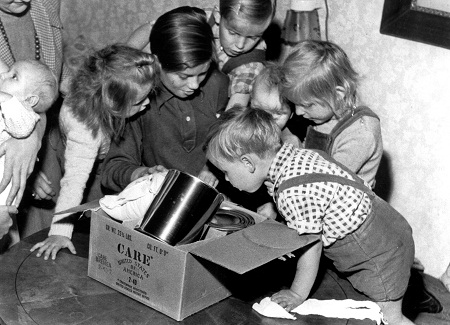
CARE Packages were sent to the hungry after World War II and this continued even during the Korean War and the early years of the Cold War struggle. In this photo, "Children of a refugee family from East Germany crowd close to get a better view of the foods in the CARE Package they received soon after they arrived in West Berlin." (photo courtesy CARE)

If you went shopping after World War II, you could walk into a store and make a life-saving purchase. Even if you were at home, you could do the same great deed simply through mail order. What was this mystery item people bought by the thousands after the war?

These were CARE packages to send to hungry people in countries lying in ruin. General Lucius Clay, commander of the American military government in Germany, made appeals to the public to send these packages. So did many others from all walks of life. This is how America reacted to the plight of those suffering overseas.

General Clay wrote, “when a CARE package arrived the consumer knew it was aid from America and that even the bitterness of war had not destroyed our compassion for suffering.”

You had several options when buying a CARE package. There were general rations which you could send to a family, or you could have these sent to an orphanage or hospital. Another option was to buy a CARE package specially designed for infants, one with baby food.

Well, today that CARE package for infants would come in the form of plumpy’nut, the miracle food recently profiled on the NBC Nightly News. This is a life-saving food for small children.

Plumpy’nut is peanut paste that comes wrapped in a small package, like many foods you find in grocery stores; except plumpy’nut is food specially designed to provide quick nutrients to severely malnourished children. It is widely used in areas struck by conflict, natural disasters, or extreme poverty. Plumpy’nut is easy to distribute because it does not require special preparation and storage.

In East Africa, where drought has caused massive food shortages, plumpy’nut is being distributed to children. It is saving their lives. Infants need proper nutrition in what is called the critical first 1,000 days. Without the nutrients, they will suffer lasting physical or mental damage.

Thousands of children have already starved to death in East Africa because of the food shortages, but those that get plumpy’nut can be saved.

Mindy Mizell of World Vision says, “One mom told me how she arrived in Puntland, Somalia with a severely malnourished toddler who wouldn’t play, stand, or smile…he took the plumpy’nut for a few weeks and was just fine! He looks great.”

A full supply of plumpy’nut is needed in East Africa to prevent more deaths.

Edesia, a Providence-based producer of plumpy’nut, has been running its factory 21 hours a day producing the life-saving food. Navyn Salem, Edesia’s director, said shipments are leaving almost every day to head to the East Africa famine zone. The plant was also fortunate to keep running through Hurricane Irene which tore through Providence and many other parts of the East Coast in August. Salem remarked, “we were very fortunate to be in a spot that was spared, phew!!”

Plumpy’nut production has to keep running at Edesia and other factories that produce the miracle food. But funding is always an issue, as aid agencies continually face this challenge. Not enough resources are committed by the international community toward fighting child hunger. The UN World Food Programme and other organizations are well short of funding to meet the demand.

Plumpy’nut is needed in many more areas of the globe: Afghanistan, Yemen, Democratic Republic of the Congo, Pakistan, and Haiti, just to name a few. All of these countries have high rates of child malnutrition, and plumpy’nut and its variations are desperately needed.

After World War II, stores like the H. & S. Pogue Company of Cincinnati even had displays of CARE packages. The Cincinnati Enquirer reported that upon Pogue’s grand opening of their display in 1947, Captain Victor Heintz made the first purchase. Heintz was a World War I veteran who served on the front lines in France. Years later, he was again coming to the aid of France in the form of a CARE package.

Another Cincinnati resident, Siegfried Deutsch, got started well before Pogue’s CARE outlet opened. Deutsch bought at least 35 CARE packages. The Enquirer said number 35 went to a poverty-stricken mother and her young daughter in Vienna, Austria, Deutsch’s homeland.

Retail stores today could offer an outlet for people to buy CARE plumpy packages for starving infants overseas. As the CARE package made such a difference saving lives, winning the peace, and rebuilding Europe after World War II, plumpy packages can do the same today.

Article first published as Plumpy’nut: A Modern-Day CARE Package on Blogcritics Magazine.

Leave a comment

Filed under global hunger, History

Halloween 2011: Add Plumpy’nut Treat for Starving Children Overseas

Add plumpy'nut for starving children overseas to this year's Halloween celebration (photo courtesy usa.gov)

There is something special that could be added to this year’s Halloween festivities. In addition to treats, why not have plumpy’nut added to each bag of candy?

What is plumpy’nut? Essentially it is a precious treat for children in developing countries because it can save their lives. The plumpy’nut family of ready-to-eat foods is a peanut paste used to treat dangerous levels of malnutrition in children ages 0-5.

Without proper nutrients in these early years, severe physical and mental damage can take hold.  Plumpy’nut can nourish these small children and change their lives forever.  Right now small infant children in Somalia, Pakistan, Democratic Republic of the Congo, Yemen, Afghanistan and other countries are in desperate need of this food. There is extremely low funding for child feeding programs globally.

This is where Halloween comes in. If trick or treaters across America asked for some plumpy’nut with every doorbell ring, this food could be donated and save millions of lives around the world.

Since plumpy’nut is not something sold in stores, this particular treat would have to be in the form of a dollar. If you donated that dollar to the non-profit organization Edesia, which produces the life-saving food, it could then be channeled right into the production of plumpy’nut for starving children. Or you could contact the World Food Programme, Save the Children, Action Against Hunger or UNICEF who place the plumpy’nut orders with Edesia and other producers.

This plumpy’nut aspect of Halloween is something parents could set up in their neighborhoods. UNICEF has been running trick or treat campaigns since after World War II. You could also set up a plumpy’nut Halloween as part of their program.

So let this year’s Halloween have the classic themes of candy, full moon, Dracula, the Wolfman and others…but let’s welcome a new addition…..plumpy’nut. Treats for all. A Halloween for the ages.

Learn more about plumpy’nut from Rhode Island based Edesia.

Article first published as Halloween: Trick or Treat or Plumpy’nut on Blogcritics.

Leave a comment

Filed under global hunger