
It was on November 10, 1947 when Secretary of State George Marshall appealed to Congress about feeding the hungry in Europe. With winter approaching Italy, Austria and France were in a desperate situation.
Read the full article at Examiner.
It was on November 10, 1947 when Secretary of State George Marshall appealed to Congress about feeding the hungry in Europe. With winter approaching Italy, Austria and France were in a desperate situation.
Read the full article at Examiner.
Filed under History
On this day in history, October 1, 1947, President Harry Truman hosted a special meeting at the White House about hunger. He met with the newly formed Citizen’s Food Committee.
Their goal was to stop the wasting of food. Europe was facing a desperate hunger crisis. The more food saved meant the more that could be sent overseas to feed the hungry.
The Citizen’s Food Committee was led by Charles Luckman, the President of Lever Brothers of Massachusetts. Their job was to take the message of no food waste to the American public. Truman said,
It has been estimated that we waste about 10 percent of all the food we buy. Just think of that! We waste 10 percent of all the food we buy. Clearly, by wasting less, American families can help significantly in feeding hungry families abroad.”
The Committee helped to raise awareness about food waste, but also hunger across the globe. In the coming months Americans would donate lots of food overseas through events such as the Friendship Train. Going coast to coast the Train picked up canned goods to be shipped to Europe.
Defeating hunger was essential for building peace after the war. These are timeless lessons that Truman stressed as he sought the recovery of war-torn nations. At the White House meeting Truman emphasized,
Apart from humanitarian considerations, if rations are significantly cut this winter, economic rehabilitation will come to a stop. This, in turn, would increase the degree and duration of dependence by other nations on special assistance by the United States. Most important, if we turn our backs upon these people they will turn from hunger to despair and from despair to chaos in areas where stability is essential to the peace and economic security of the world.”
Food served as the foundation of the 1948 Marshall Plan, which ultimately rebuilt Europe. We need to remember these lessons today. Food can lead to peace and economic development. As war has engulfed the Middle East and Africa there are millions of refugees who are depending on international food aid.
Back here at home we can fight hunger more effectively by wasting less food. Schools and food banks have developed recovery programs to cut down on this waste. There are ways we can more effectively fight hunger, as Truman prioritized on this day in history.
Read the article at Examiner.
Filed under food waste, Harry Truman, History, Marshall Plan
It all started around a bonfire one autumn night in 1945. Students at the College of Mount St. Joseph in Ohio were fired up to begin a project to “Help those who cannot help themselves.”
Read the article at History News Network.
Filed under History
A plan originally proposed by President Dwight Eisenhower is being used by the United States and its allies during the Ukrainian crisis. The Open Skies Treaty, which includes the U.S., Russia and over 30 other countries, allows for observation flights over the territories of each member state.
Read the full article at Yahoo! Voices
Filed under History
 Cincinnati, Ohio has a very special place in the celebration of National School Lunch week (October 14-18). For it was teacher Ella Walsh who, in the early 1900’s, started one of the nation’s earliest school feeding programs.
Walsh, who taught at Cincinnati’s Jackson School, saw children coming to class hungry. Times were tough. She knew they needed help. So Walsh and her assistants set up a lunchroom. The “penny lunch” program was started.
Children who could afford it would pay a penny and get a lunch. Most could not afford, but still would receive the meal. Soup, spaghetti, rice, beans and fruit made up an early menu of the “penny lunches.”
The “penny lunches” spread to more parts of the city and even other cities. Dr. John Withrow was quoted as saying “started, you cannot stop them.” These were meals children and their families could count on, no matter what the circumstances. And there were rough times they had to face.
During World War One, many breadwinners were overseas with the Army and malnutrition became a bigger crisis according to a Cincinnati Enquirer report. Having “penny lunches” was vital for families facing this strain. The Cincinnati Post reported in 1933 that these school meals saved the lives of children during the Great Depression.
Then there are the little unsung heroes of Cincinnati. During World War II, the Cincinnati Times Star told the story of 10 year-old Charles Graff Jr., who collected sales tax stamps. He gave the stamps to his school so they could be redeemed and pay for school lunches for children in need. Graff had to study at home because he had the disease hemophilia. But he kept collecting the stamps and encouraging others to contribute. His father worked at the Red Top Brewing Company and got co-workers to give their stamps. Graff grew the school’s lunch fund.
Little by little the nation was building a national school lunch program, culminating in the law signed by President Harry Truman in 1946. When West Virginia had a hunger crisis during the Eisenhower and Kennedy administrations the school lunch and milk programs were safety nets.
The idea is simple common sense. Children should be spared from hunger. The food allows children to concentrate on learning. That is how a community and a nation succeeds. This is a lesson we must remember today and take care of our national school feeding.
I think we should resist cuts to school meals in the federal budget. The recent proposal by the House of Representatives to cut foods stamps also eliminates school meals for 210,000 children. What politicians and other leaders need to be doing is strengthening our hunger relief programs, especially in bad economic times.
The economy is struggling and the government shutdowns and other problems are certainly not helping the average citizen. Hunger can escalate in the presence of lack of leadership and cooperation in Washington, D.C. Food safety nets for children are especially important during these times.
School meals mean a lot to children here and across the world. I recently spoke to a man from Kenya who received school meals from the United Nations World Food Programme (WFP). They changed his life. In fact, the meals allowed him to become a world record holder in the marathon. His name is Paul Tergat, one of the fastest runners ever. Without the meals at school he never could have reached his potential.
That is something to remember with National School Lunch Week. These meals matter and we should do what we can so every child can receive them. Every child deserves that chance to reach their potential.
originally published at The Huffington Post.
Filed under global hunger, History

President Harry Truman (photo courtesy of the Truman Library)
These days what we see on TV, especially about the government shutdown, is not very inspiring. A glance back in time though gives us something we can treasure. On October 5, 1947 a historic television event took place, one that helped fight world hunger.
President Harry Truman delivered the first ever televised presidential address from the White House. His speech was about saving lives from the one enemy that remained from World War II: hunger.
At the time Europe, still reeling from the war, was suffering from a severe drought. Food was in short supply. Truman asked Americans to conserve food. The Citizens Food Committee was formed to rally America behind this effort.
President Truman said, The nations of Western Europe will soon be scraping the bottom of the food barrel. They cannot get through the coming winter and spring without help-generous help-from the United States and from other countries which have food to spare.
“I know every American feels in his heart that we must help to prevent starvation and distress among our fellow men in other countries…. Their most urgent need is food. If the peace should be lost because we failed to share our food with hungry people, there would be no more tragic example in all history of a peace needlessly lost.”
What happened after this TV address was amazing. Americans came together to donate food to Europe via the Friendship Train which crossed most of the country that fall. The “Silent Guest” program was started during the holidays to buy a CARE package for a hungry person overseas. Catholic Relief Services sponsored a nationwide Thanksgiving Week campaign to collect food at churches.
The post-war years saw Americans take action to make sure hungry children overseas received the food they needed to grow and learn.
The Congress followed with passage of the Interim Aid bill that provided food for Austria, Italy and France that winter. This food aid led up to passage of the Marshall Plan in 1948 and the reconstruction of Europe.
World hunger had a high profile in America’s foreign policy at that time. President Truman, Secretary of State George Marshall and other leaders routinely talked about the importance of fighting hunger. The October 5th television address being one example of this outreach. Marshall also addressed the nation about fighting hunger on October 5th.
In order to maintain a steady program of international food aid and development, you need to keep the issue front and center within the halls of government and the public.
Making world hunger a top priority is what Representative Betty McCollum (MN) is trying to accomplish with the Global Food Security Act. This bill would create a White House level coordinator for world hunger relief. Aid agencies want this bill passed. It has go through Congress and there is some support. More is needed.
We are now facing one of the largest hunger emergencies of our time with the war in Syria. This conflict has caused millions to be displaced and hungry. Afghanistan, Yemen, Haiti, Mali and so many other areas are also suffering from severe hunger. It’s clear that action must be taken. We need a sense of urgency.
Food need to be a foreign policy priority for as George Marshall once said, “hunger and insecurity are the worst enemies of peace.”
originally published at the Huffington Post
Filed under global hunger, History

This Memorial Day we can remember the World War One Legacy of Humanitarianism (National World War I Memorial)
Memorial Day is here. It is a chance to remember lost loved ones. There are also the stories of others that may be lost in time, but not in value and spirit. Let’s remember them too.
A dedicated soldier, a member of the American Relief Administration after World War I, who lost his life to smallpox while trying to feed the hungry and sick.
Or a young lieutenant who was given the task of feeding the starving in Montenegro, a region in Europe that had been devastated during that war.
This part of Montenegro was a mountainous area, and with the onset of winter in 1918-19, it was a major challenge to bring relief supplies. Heavy snow had arrived and with damaged bridges and roads, people had given up hope they could be saved.
The New York Times reported on the grave circumstances and the rush of American officers to save lives. People were already living off grass and the death rate soared as winter set in. It would be hard for large supplies of food to reach the suffering.
The starving people told the young American lieutenant,“you can’t save us.”
The lieutenant replied, “Yes, we can.” He planted an American flag on one of their churches and went to work. The American Relief Administration used cables to swing food over broken bridges. They used burros and horses to move food over miles of snowy mountain trails.
The lieutenant’s report on the heroic mission exclaimed “we did it. The people in this district are now happily eating American flour and pork. They have stopped digging graves and are, instead, planting their crops for this year’s harvest.”
That is what American humanitarianism is all about. Helping others, giving them a chance to survive and restore themselves. The American Relief Administration also provided free school meals in war-devastated countries, which brought millions of children back to health.
The same thing is being done today in conflict-torn Mali by Catholic Relief Services, through a grant by the U.S. McGovern-Dole program. That program was named after two veterans of the Second World War, George McGovern and Bob Dole.
It was Herbert Hoover who said famine is the inevitable aftermath of war. We saw that after both world wars. Only humanitarian aid prevented mass starvation. We are seeing the effect today of war in Syria, Afghanistan, South Sudan and other countries where hunger escalates as a result of conflict. The World Food Programme, the largest hunger fighting organization today, is rushing aid to Syrian war victims as we speak.
On this Memorial Day remember too the humanitarian heroes, such as the amazing officers of the American Relief Administration. They were part of the American Army which won a war that many hoped would be followed by lasting peace, freedom for all, and freedom from famine.
While those goals have not been achieved, we need keep up the fight for those ideals which they so bravely pursued. This is the best gratitude we can give them.
Filed under global hunger, History
Last week I wrote an article on Cincinnati.com about the Pope and the Friendship Train. When the Train crossed America in 1947 picking up food for Europe’s hungry, it was not able to make it as far north as Maine. They had to come up with another way to take part and they seized the opportunity.
The Bath Iron Works in Maine was working on replacing the French fleet lost during World War II. They had just finished and were about to send the ships over to France. But why send them empty?
So, the Maine Rotary Clubs went to work and filled up the first ship with food and other supplies. This included 107 tons of food and even seeds for spring planting of crops. The name of this ship was the St. Patrick. It arrived in France during March, 1948 close to the time of St. Patrick’s Day. Happy St. Patrick’s Day!
Filed under global hunger, History
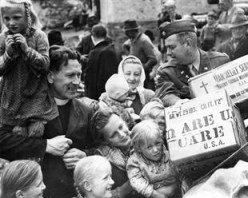
In 1947 Americans fed a “silent guest” during the holidays and this led to a CARE package going overseas to feed the hungry. Credits:CARE
New England is known for its seafood, the Boston Red Sox and Celtics. Less known is how one Christmas holiday New England took on the challenge of feeding the world.
The year was 1947, just two years after World War II, and nations in Europe and Asia were suffering food shortages. Americans were ready to help. When the holidays rolled around that year an announcement was made from Plymouth, Massachusetts asking families to feed a “silent guest” at their holiday meals.
By making a donation to the Silent Guest Committee, a CARE package would be sent to a hungry family in Europe. A newspaper headline saying “Feasts Provide for All” was the idea.
And the donations poured in. From Thanksgiving through Christmas people reached out to help those suffering overseas. CARE packages flooded Europe and other areas to feed the hungry. Food was life and hope for people trying to rebuild from the war ruins. Another headline read “New England Gives Cheer to the Needy.”
Hunger was fought at home too. In Boston, the Volunteers of America fed the homeless and the Salvation Army was very active.
As this Christmas arrives Americans can take in a “silent guest” at their holiday meal. Just taking some spare change they can purchase multiple meals. That’s right. If you were to find one dollar of change in a coat pocket, on a chair, or in a piggy bank you could feed a child for a week.
So this holiday think like Beantown and New England did in 1947 and feed a “silent guest.” Help change the world.
A few charities to send “Silent Guest” donations include:
Filed under global hunger, History
 When President Obama and Mitt Romney take to the stage for a foreign policy debate on Oct. 22, nuclear weapons are sure to come up, especially Iran’s ambitions for the bomb. But the debate should also focus on the countries that actually have nukes, including Russia, China, North Korea and rivals India and Pakistan.
Read the article at the Des Moines Register
Filed under History

 Author William Lambers