Category Archives: global hunger

U.S. Food for Peace and WFP Feeding Hungry Afghans

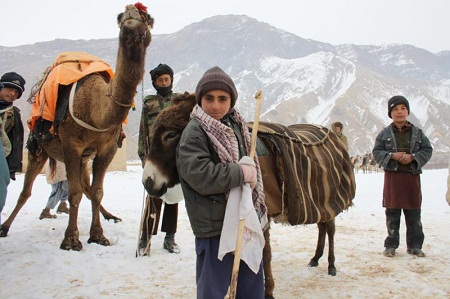
WFP recently distributed wheat to Afghans low on food supplies following a drought. (WFP/Silke Buhr)

Many people are accustomed to having three meals a day. Imagine though if you were allowed just one meal a day for an extended period of time. How would this affect your health, your work? If you were a child how would you be able to go to school and learn?

In Afghanistan, because of a severe drought last year, many already impoverished people were forced to cut back on their daily food intake. The UN World Food Programme (WFP), with support from the U.S. Food for Peace plan, is providing life-saving aid to millions of hungry Afghans as part of a drought relief operation.

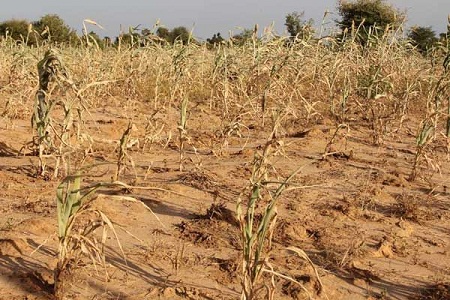
Little rain meant Afghans could not grow enough food to support themselves. When drought strikes the impoverished, they have little to fall back on. The drought causes a spiraling disaster.

An Oxfam press release last November reported that “Families are coping by cutting down their meals, borrowing money and even migrating to Iran or Pakistan. Some 90 per cent of households in the affected area are now living in debt after borrowing money to buy food, and schools have closed as children are being put out to work.”

WFP’s Silke Buhr recently visited one of the food distributions in Samangan, which was one of 14 Afghan provinces struck by the drought. Buhr says WFP distributed a wheat ration which was the result of the U.S. Food for Peace donation. The wheat was purchased in Kazakhstan in order cut the shipping distance down as much as possible.

It was last October that the U.S. Food for Peace program made a $40 million donation to WFP’s Afghanistan relief mission. Food for Peace, which originally started during the Eisenhower administration, has long been the U.S.’s main tool for fighting global hunger. Food for Peace makes donations to support the hunger relief work of WFP as well as other agencies like Catholic Relief Services and Save the Children.

In Afghanistan Food for Peace donations are desperately needed. Even before the drought struck there were at least seven million Afghans suffering from hunger, and many others on the brink of what is called “food insecurity.” Hunger and malnutrition were already a crisis in Afghanistan and the recent drought has made the situation even worse.

Food for Peace and WFP can make the difference for Afghanistan moving toward peace and development. It’s all about the food. Without a base of food security no progress can be made in Afghanistan.

Emergency relief to drought-impacted persons is just the start. Support for the small farmers so they can withstand drought, food for education for children, and food for work to build roads are all critical to Afghanistan turning the corner.

It comes down to funding. Right now WFP needs a significant amount of donations to carry out its 2012 relief mission in Afghanistan.

The recent Food for Peace and WFP collaboration is promising. But will there be enough of it to turn the tide for hungry Afghanistan? It will be up to the political will of the international community to use food to build peace.

Article first published as U.S. Food for Peace and WFP Feeding Hungry Afghans on Blogcritics.

Leave a comment

Filed under global hunger

The Hunger Games Teams Up with WFP and Feeding America

The upcoming movie The Hunger Games, the UN World Food Programme (WFP) and Feeding America are teaming up to aid the world’s hungry.

The cast of The Hunger Games has filmed a public service announcement encouraging people to help fight global hunger. A new web site has been set up where you can take a hunger quiz and make a donation.

Vicki Escarra, president of Feeding America, says, “Unlike the characters in The Hunger Games, we do not live in a country in which food is scarce. There is enough food to feed everyone living in the US, but it’s not getting to millions of low-income people who need it. Thanks to our partnership with Lionsgate, The Hunger Games will help us expand much needed public awareness of the issue and encourage people to join Feeding America in our commitment to helping ensure that everyone has enough to eat.”

Nancy Roman of WFP says, “If all of us did just one small thing to fight hunger we could end hunger around the world. We are deeply grateful for the support of Suzanne Collins, who writes as though she understands hunger in the world, as well as Lionsgate and The Hunger Games cast – who have the power to change lives as they feed people worldwide.”

The partnership emphasizes fighting hunger in the United States and globally where massive hunger emergencies are currently taking place in the Horn of Africa, Sudan, Afghanistan, the Sahel region of Africa and other crisis zones.

The fighting hunger at home and abroad them carries on a U.S. tradition. In 1946, for instance, the U.S. started a national school lunch program while also organizing a massive relief effort to prevent post World War II famine.

In 1954 President Dwight Eisenhower started the Food for Peace program (Public Law 480) to fight global hunger and a special school milk program to improve child nutrition in the U.S.

The Hunger Games, produced by Lionsgate, debuts March 23rd. You can learn more about the film and the fight against hunger at wfp.org/hungergames.

1 Comment

Filed under global hunger

Yemen’s Instability Could Be Fixed by Food Aid

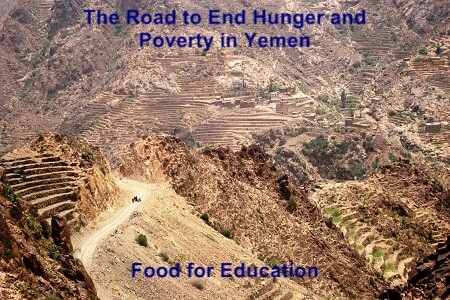
The Road to End Hunger in Yemen (WFP/Maria Santamarina)

Yemen is in the midst of a humanitarian disaster and little is being done to heed the warnings. Already the poorest country in the Middle East, Yemen has child malnutrition rates that rival famine-ravaged Somalia.

Maria Calivis, regional director of UNICEF says, “This year alone, half a million children in Yemen are likely to die from malnutrition or to suffer lifelong physical and cognitive consequences resulting from malnutrition if we don’t take action. Malnutrition is preventable. And, therefore, inaction is unconscionable.”

This level of suffering, on top of political instability, has the potential to plunge the country into complete chaos, a chilling prospect considering al Qaeda’s presence there.

Yemen remains key in the struggle to defeat al Qaeda and extremism, much the same as Korea, Greece, Germany and others were in the struggle to win the Cold War and push back communism. In Korea and Germany, millions of children were given meals in their schools as part of our policy of backing those nations. In fact, General Lucius Clay thought school meals for German kids was about the most important act we did in reconstruction.

During the Cold War, the U.S. helped initiatives to boost agricultural production and build roads in South Korea. Today in Yemen, similar projects are much needed to strengthen the country, but they do not have enough funding to go forward.

In the case of Greece, the U.S. supplied aid, but not just military. Special focus was given hunger relief, both during World War II and in the reconstruction. Greece was plundered during World War II by the Germans. The retreat of the Nazis was not the end, as civil war broke out. Communist forces threatened to take over.

With this chaos and violence came suffering for the people. Former president Herbert Hoover, who organized aid for Greece, said Greece’s people “are sick and hungry.” Enter the United Nations, UNICEF, CARE, Greek relief committees and the Marshall Plan. All of these provided humanitarian aid to help Greece through a period of severe hunger and conflict.

A 1947 U.S. report warned that if the flow of relief supplies to Greece stopped, “chaos would result.” Humanitarian aid fortunately continued.

The newly created UNICEF, for instance, provided milk to Greek schoolchildren as part of an effort to build a nationwide school feeding program. UNICEF was founded on the belief that rehabilitation of children needed to be an international priority.

Today, UNICEF is trying to provide plumpy’nut, a special peanut paste to save Yemeni children from potentially deadly malnutrition. However, low funding prevents them from reaching the vast majority of mouths.

Low funding has forced the UN World Food Programme to scale back food programs for children as well as other hunger relief efforts. In the summer of 2010, the White House admitted that relief efforts in Yemen were “woefully underfunded.” The U.S. has not been able to rally enough international efforts to meet this growing crisis, despite the strategic significance of keeping Yemen afloat.

Congress, meanwhile, is threatening to reduce funding for the Food for Peace program. This would greatly harm U.S. foreign policy as hunger can easily lead to chaos.

Counterterrorism advisor John Brennan says, “As we have seen from Afghanistan in the 1990s to Yemen, Somalia and the tribal areas of Pakistan today, al Qaeda and its affiliates often thrive where there is disorder or where central governments lack the ability to effectively govern their own territory.”

Disorder has no better ally than hunger. How can we expect Yemen to build a peaceful, stable future when the population suffers from dangerous malnutrition that crushes mind and body? For any country to flourish, the most important ally in their quest for peace is food.

Originally published at History News Network

Leave a comment

Filed under global hunger

School Meals Vital for Kenya’s Recovery from Drought

School feeding can break the cycle of undernutrition. Children of parents who have spent more time in formal education are often less stunted and live longer. (WFP/Guillaume Bonn)

In my recent Cincinnati Enquirer oped I talked about how school breakfast makes a difference for hungry and malnourished children in Kenya. This extra meal, in addition to the school lunch, is pivotal for keeping children from suffering malnutrition at a time of national crisis.

As Kenya struggles to recover from the massive East Africa drought of 2011, school feeding is playing a critical role.

Enrollment surged last year in Kenyan schools where the UN World Food Programme (WFP) was providing meals. WFP has a program feeding 630,000 school children in support of Kenya’s national program. After the drought struck in 2011 parents were desperate to find a source of food for their children.

WFP found itself taking on about 200,000 more children and to keep the school feeding going they sometimes resorted to reduced rations. Funding is the issue. WFP relies on voluntary donations from the international community. With enough support WFP can reach more children and help stabilize a hunger crisis.

Funds are limited for the current drought relief mission in Kenya.

Charles Njeru of WFP Kenya says, “with additional funding we could do much more, and even become more innovative. For example, the school feeding impact evaluation of 2009 recommended that we pilot a midmorning snack in a selected district but this has not been possible due to funding constraints.”

WFP Kenya has benefited in recent years from funding by the U.S. McGovern-Dole program which sponsors international school feeding. But will McGovern-Dole support continue to help Kenya overcome this drought emergency?

Njeru says “we have just received our last mcgovern-dole funding this year. we are hopeful that the program will continue supporting (WFP Kenya)…. without these funds, our programme will definitely be adversely affected.”

WFP says rains have improved food security in some parts of Kenya. This encouraging development, coupled with enough support for food aid programs like school feeding, gives Kenya a chance to recover from one of the worst droughts in history.

Article first published as School Meals Vital for Kenya’s Recovery from Drought on Blogcritics.

In my recent Cincinnati Enquirer oped I talked about how school breakfast makes a difference for hungry and malnourished children in Kenya. This extra meal, in addition to the school lunch, is pivotal for keeping children from suffering malnutrition at a time of national crisis.

As Kenya struggles to recover from the massive East Africa drought of 2011, school feeding is playing a critical role.

Enrollment surged last year in Kenyan schools where the UN World Food Programme (WFP) was providing meals. WFP has a program feeding 630,000 school children in support of Kenya’s national program. After the drought struck in 2011 parents were desperate to find a source of food for their children.

WFP found itself taking on about 200,000 more children and to keep the school feeding going they sometimes resorted to reduced rations. Funding is the issue. WFP relies on voluntary donations from the international community. With enough support WFP can reach more children and help stabilize a hunger crisis.

Funds are limited for the current drought relief mission in Kenya.

Charles Njeru of WFP Kenya says, “with additional funding we could do much more, and even become more innovative. For example, the school feeding impact evaluation of 2009 recommended that we pilot a midmorning snack in a selected district but this has not been possible due to funding constraints.”

WFP Kenya has benefited in recent years from funding by the U.S. McGovern-Dole program which sponsors international school feeding. But will McGovern-Dole support continue to help Kenya overcome this drought emergency?

Njeru says “we have just received our last mcgovern-dole funding this year. we are hopeful that the program will continue supporting (WFP Kenya)…. without these funds, our programme will definitely be adversely affected.”

WFP says rains have improved food security in some parts of Kenya. This encouraging development, coupled with enough support for food aid programs like school feeding, gives Kenya a chance to recover from one of the worst droughts in history.

Article first published as School Meals Vital for Kenya’s Recovery from Drought on Blogcritics.

Leave a comment

Filed under global hunger

Sahel Food Crisis: An Interview with Célestine Ouédraogo of WFP in Burkina Faso

School feeding opens new opportunities for children in developing countries. (WFP/Anne Poulsen)

With the food crisis escalating in the Sahel region of Africa, it’s urgent that children be protected from hunger and kept in school.

In Burkina Faso, one of the affected Sahel countries, the UN World Food Programme (WFP) provides school feeding for impoverished children. These meals take on even more importance during the current hunger emergency.

When drought strikes, families are more likely to remove their kids from school and keep them home to work. However, If there is food available at the school then parents are more likely to keep their children enrolled.

In this interview Célestine Ouédraogo of WFP updates us on the status of school feeding in Burkina Faso as the Sahel food crisis unfolds.

How many children are receiving WFP school meals in Burkina Faso?

Each year 90,019 children enrolled in 691 schools in the Sahel Region benefit daily from a flour-based fortified breakfast and couscous-based lunch. In addition to the meals served in schools, 9,510 girls enrolled in the last two grades are receiving a take-home ration of 10 kg of cereals per month, which encourages parents to keep the girls in school and enable them to complete the primary school cycle.

Are these schools in the areas affected by the drought?

Yes, all these schools are in the areas affected by the drought.

The Sahel region is one of the most food-insecure regions, and has among the highest rates of malnutrition.

Does WFP intend to expand school feeding in Burkina Faso?

No.

Does WFP have enough resources to provide school meals for at
least the rest of the year?

YES, thanks to the generosity of 2/3 donors, we have been able to secure funding up to end of 2012, which is essential if we want to ensure that children can pursue their education despite the food insecurity that the country is facing this year.

For more information please visit the World Food Programme.

Article first published as Sahel Food Crisis: An Interview with Calestine Ouedraogo of WFP in Burkina Faso on Blogcritics.

Leave a comment

Filed under global hunger

Sahel Food Crisis: An Interview with Aboubacar Guindo of WFP in Mali

A field of withered crops in the Mali’s Kayes region. Drought has ruined food supplies in the Sahel region of Africa, which includes the countries of Mali, Niger, Mauritania, Burkina Faso, Cameroon, Senegal, and Chad. (WFP/Daouda Guirou)

Almost nine million people urgently need food assistance in the Sahel region of Africa following a severe drought. And time is running out to prevent a massive humanitarian disaster.

Josette Sheeran, the director of UN World Food Programme, says, “The needs of the millions affected by drought in the Sahel are enormous, and the time to act is now.”

Mali is one of the countries caught in the crisis. Mali is not only contending with drought but also conflict in the North between a rebel group and the government. The fighting is creating additional displacement and hunger.

WFP runs school feeding in Mali to save children from hunger and malnutrition and keep them in class. But will there be enough support to keep the program going during this food crisis? WFP depends on voluntary donations to fight hunger around the globe.

Aboubacar S. Guindo, a WFP school feeding officer, talks about where Mali’s program stands now as we head into critical months of this hunger emergency.

How many children are receiving WFP school meals in Mali? Is this a breakfast or lunch ration?

Actually, we are feeding 156,666 kids in 729 schools in the country. They do receive hot meals generally served at midday. In addition to that, the Government undertook under the national budget to cover an additional 651 schools (117.000 children) who are also benefiting from hot meals.

Are these schools in the areas affected by the drought conditions?

Yes, most of the schools are based in the area affected by the drought that results in communities’ increasing vulnerability. The government through the Early Warning System identified 159 communities that are the most affected by this crisis. To respond to this, WFP elaborated an Emergency Operation (EMOP) with a School Feeding component to avoid important drop-outs that schools used to face in this type of crisis. The EMOP will also include nutrition, food for work, and cash components.

In the affected communes all the assisted schools from both government and WFP programs will receive a complimentary meal made of enriched cereals (supercereal) as breakfast. We are planning to assist 150,000 kids under this initiative.

Does WFP intend to expand the program?

For now, the extension WFP will do concerns the coverage of the schools affected by the drought. We are more likely to reinforce government abilities to develop and implement a National SF programme.

Does WFP have enough resources to continue providing the school meals?

Funding is the biggest challenge. We have been obliged last year to reduce the numbers of meals in the northern region due to reductions in funding. In addition to food insecurity, WFP is assessing the needs of the internally displaced due to conflict in the north. This assessment may show in an increase in needs.

We hope to have more contributions from local and international donors in order to continue to provide our support to communities as well as the government so that hunger does no longer constitutes a barrier to the education of any children in Mali.

For more information please visit the World Food Programme.

Article first published as Sahel Food Crisis: An Interview with Aboubacar Guindo of WFP in Mali on Blogcritics.

Leave a comment

Filed under global hunger

Save the Children Starts School Meals for Somali Refugees

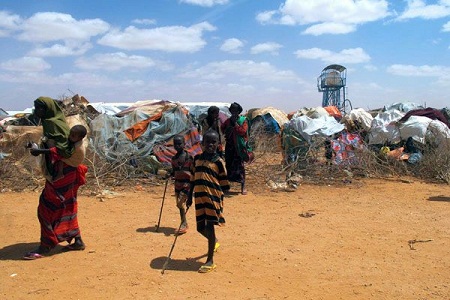
Scene from a refugee camp in Ethiopia where Somalis fled to when food supplies ran out in their homeland. What future do these children face? (WFP/Natasha Scripture)

Imagine if you were a child living in the Gebo and Bay regions of Somalia last summer. Instead of having the opportunity to go to school in the fall you were trapped in a massive drought zone. With food supplies low your family would be forced to flee the region as a matter of survival.

Starting in the summer of 2011 streams of hungry Somalis fled Gebo, Bay and other crisis areas. Some parts of Southern Somalia were declared in famine as starvation had set in. The drought, combined with conflict, placed over 13 million people were put at risk of starvation in Somalia and other countries in East Africa.

Thousands of residents of Gebo and Bay are now in the Kobe and Hilaweyn refugee camps in Ethiopia and depending on relief from aid agencies. Save the Children is helping kids within these camps by providing emergency education and school meals. The meal will be a porridge, made of a corn-soy blend, served as a breakfast at school.

In addition Save the Children wants to provide school meals to children in the Melkadida and Bokolmayo camps, also in Ethiopia.

Save the Children hopes to provide meals to 8,037 children who are currently receiving emergency education in these four refugee camps.  And they want to expand the program to reach more children. There are 43,966 school age children in the four camps.

Save the Children is also working on the construction of schools to expand educational opportunities.

The school meal program, with supplies from the UN World Food Programme, will improve child nutrition. It’s also expected to improve enrollment and enhance the teaching and learning process.

Funding though is critical. Save the Children says resources for the program is expected to run out later this year. That is where the public can help by supporting Save the Children’s East Africa appeal.

Article first published as Save the Children Starts School Meals for Somali Refugees on Blogcritics.

Leave a comment

Filed under global hunger

On Digital Learning Day, think FreeRice

FreeRice has two goals: Provide education to everyone for free. Help end world hunger by providing rice to hungry people for free.

This Wednesday, February 1, is the first ever National Digital Learning Day. It’s a chance to showcase the innovation taking place in classrooms through internet technology and digital media.

One online tool helps students learn and also feeds the hungry worldwide. It is called FreeRice and it’s an online trivia game in which you answer questions on vocabulary, math, chemistry, foreign languages, and even art.

While a student is playing and learning about these subjects, something else magical is happening. For every correct answer, 10 grains of rice, paid for by advertisers, are donated to the UN World Food Programme (WFP), the largest agency fighting hunger. The donations are used in WFP operations fighting hunger and malnutrition.

Last year, for instance, students who played this game helped support school feeding programs in Haiti and Cambodia. The more students play the game, the more support for hunger relief.

Innovative online learning can play a role in tackling the most massive crisis facing man. There are nearly one billion people worldwide who suffer from hunger. A severe drought struck East Africa last year causing food shortages and wide-scale displacement as people desperately searched for help. This crisis is far from over.

Another one is fast emerging in West Africa, in the Sahel region, where the countries of Niger, Chad, Burkina Faso, Mauritania, and Mali are being devastated by drought which has ruined food supplies. Afghanistan, Yemen, Haiti, and so many other countries are suffering deeply from hunger and malnutrition.

The World Food Programme relies on voluntary donations to help these countries fight hunger. This agency is so low on funding that many of their relief operations face suspensions or reduced rations. Right now, children in Mauritania are about to lose their school meal of rice at a time when they need it more than ever. The same holds true in the Ivory Coast, where rice and other supplies are running out for children in a country recovering from an internal conflict last year.

FreeRice is a digital tool that can help these hungry children while helping other children learn. The game’s mission statement is to “Provide education to everyone for free” and “Help end world hunger by providing rice to hungry people for free.” The game is even great for adults who want to test their knowledge on these subjects.

So on this Digital Learning Day I hope many students and teachers will join the already one million players of FreeRice. You can form teams on FreeRice too, so perhaps schools can develop tournaments between classes and even other schools just as they do with football, basketball, debating, and other activities. The sky is the limit for this online learning tool and what it can accomplish.

You can start playing at Freerice.com.

Article first published as On Digital Learning Day, Think FreeRice on Blogcritics.

Leave a comment

Filed under global hunger

Mauritania School Meals Run Out as Drought, High Prices Strike

Impact of Drought in Mauritania: The recent rain deficit in Mauritania has had a severe impact on the land. Many animals have died due to lack of fodder and water leaving families without livestock. (Jacqueline Seeley/WFP)

The hunger emergency in the Sahel region of Africa is fast escalating. Drought and high food prices are taking their toll among millions of already impoverished people across several nations.

Mauritania is one of the countries trapped in this crisis. The UN Food and Agriculture Organization (FAO) reports, “Dry spells and poor rainfall distribution during the growing period (July to October) resulted in a sharp decline in cereal production. The 2011 cereal output was estimated…about 53 percent below last year and 39 percent below the previous five years average.”

The ranks of the hungry in Mauritania are rapidly increasing. FAO says there could be over one million people now “food insecure” out of a population of three million. These are families that are already living in poverty and not able to cope with dramatic price increases.

At a time of low crop production and high food prices, the safety net of school meals for children becomes ever so valuable. However, the UN World Food Programme (WFP) is so low on funding that supplies are about to run out for the breakfast and lunch it has been providing to schoolchildren throughout Mauritania.

At a time when school feeding should be expanded, in Mauritania it is days away from coming to an end. WFP relies on voluntary donations from the international community.

Jacqueline Seeley, WFP information officer, provides us with more details in the following interview.

How many children are currently taking part in the WFP school feeding program in Mauritania?

145,633 children.

Are the schools in areas impacted by the drought and high food prices?

Yes, greatly. There is presently no funding in the pipeline for the school feeding and given the current crisis, the school feeding programme ensures that children at least receive two meals per day. This takes a large burden off of vulnerable families…as of the end of February families will be forced with the challenge of finding ways to feed their children.

Does WFP have enough resources to continue the meals program?

No. Food in the pipeline lasts until end of February, but after that, there will be nothing. No financing is foreseen given the urgency of the crisis as all donors prefer to finance the emergency response.

Are there more children who need these meals?

This caseload of 145,633 is the maximum caseload we planned for 2012; however the need of children who are hungry is higher, yes, especially with the food crisis.

How can someone get involved with helping WFP Mauritania?

Through wfp.org, money can be sent to WFP to support its operations. For direct contributions to Mauritania, contact jacqueline.seeley@wfp.org.

Article first published as Mauritania School Meals Run Out as Drought, High Prices Strike on Blogcritics.

Leave a comment

Filed under global hunger

How a Silent Guest Can Help Save Hungry Yemen

In a letter to the New York Times last February, I wrote about an emergency safety net plan to feed millions of hungry Yemenis suffering from high food prices.

Since that time, child malnutrition in some parts of Yemen has increased so much as to rival famine-ravaged Somalia.

Maria Calivis, UNICEF’s regional director, says, “This year alone, half a million children in Yemen are likely to die from malnutrition or to suffer lifelong physical and cognitive consequences resulting from malnutrition if we don’t take action. Malnutrition is preventable. And, therefore, inaction is unconscionable.”

Calivis adds, “Conflict, poverty and drought, compounded by the unrest of the previous year, the high food and fuel prices, and the breakdown of social services, are putting children’s health at great risks and threatening their very survival.”

Neither UNICEF nor the UN World Food Programme (WFP) received enough funding during 2011 to carry out their full hunger relief missions in Yemen.

These UN agencies rely on voluntary donations from the international community. If donors do not contribute, then hunger relief missions have to be scaled back or in some cases halted.

So what can someone do? Take action! UNICEF has a relief fund for Yemen. The World Food Program USA is also hosting a Yemen fund. You can even sign a petition to help WFP fight hunger in Yemen.

Or you can take in a “silent guest.” Starting in the holidays of 1947, the United States helped starving countries with a “silent guest” program. At mealtime, people were asked to imagine a silent guest at their table. Then they could mail the cost for feeding that silent guest to a committee in Plymouth, Massachusetts. This donation would buy a CARE package which was sent to hungry people in war-devastated Europe.

Today, maybe at your next meal, you could take in an infant child in Yemen who needs plumpy’nut to prevent potentially deadly malnutrition. You could send that donation to UNICEF which provides the plumpy so it can help treat all the cases of child malnutrition in the country.

Some of the countries who benefited from silent guest donations back in 1947 were Italy, Austria, France, and Greece. At that time Greece was recovering from a famine and facing a civil war.

Another country helped by the silent guest program was Germany. It is Germany that today has taken the lead in helping fight hunger in Yemen with a recent donation of $31 million to the WFP mission.

WFP will need over $200 million to feed millions of Yemenis during 2012. The rest of the international community should follow Germany’s lead.

The donation from Germany will help the emergency safety net plan which includes rations for 1.8 million Yemenis and also plumpy for infants. A school feeding program which has faced severe cuts over the last couple of years is getting a restart too.

The WFP Food for Education plan, which distributed take-home rations to schoolchildren, was suspended in 2010 and did not resume until May of 2011. Then it was a limited distribution, not even close to the previous levels of about 115,000 students. These rations benefited the children and their families. It’s food for the body and the mind as it keeps children in school and learning reading, math, science, and writing.

As significant as Germany’s recent donation is, it will be able to help revive Food for Education only to almost half of what it once reached in terms of students.

Lubna Alaman, director of WFP Yemen, says “The Food for Girls’ Education [program] is targeting only 53,000 girls and their families, and the food will be distributed for three school terms in 2012.”

So there is a long way to go to get all these hunger relief plans fully active again.

The choice with Yemen is simple. Invest now and avert an epic disaster like Somalia faced. We can save a generation of children in Yemen from the malnutrition that damages or even kills them in the first years of life.

Or drift along, pretending that Yemen will somehow turn out OK with an average response to humanitarian needs. It won’t, because no nation can have peace, political stability, and development on empty stomachs and malnourished bodies and minds.

Article first published as How a Silent Guest Can Help Save Hungry Yemen on Blogcritics.

Leave a comment

Filed under global hunger