Category Archives: global hunger

Let’s Get the Map Out to End Global Hunger

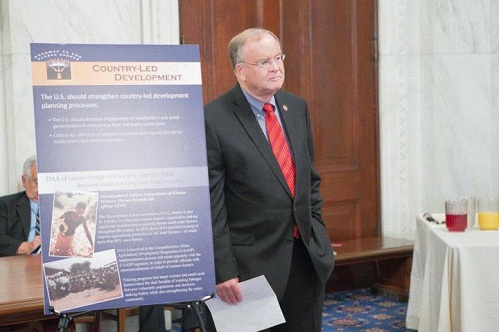
Rep. Sam Farr of California: “Hunger is a threat to our national and fiscal security. Our national leaders understand that we cannot have a stable world with out addressing the root causes of poverty and hunger.”
Credits: World Food Program USA photo

Humanitarian groups are calling on the United States to fully adopt the Roadmap to End Global Hunger, a series of strategic steps to rescue the nearly one billion suffering people who cannot access basic food.

The Roadmap, first introduced in 2009, calls for the US to increase its funding for hunger relief programs. While this might seem a challenge in the current cash-strapped environment, the Roadmap notes that jumping to $5 billion a year on global hunger relief “is just over one tenth of one percent of the US budget, yet would support increased food security for hundreds of millions of people worldwide.”

Currently, US hunger-fighting programs like Food for Peace and the McGovern-Dole school lunch program do not even add up to $2 billion in funding a year. To further compare, the annual cost of the U.S. nuclear weapons program is estimated to be $52 billion.

Bill O’Keefe, the vice president for advocacy at Catholic Relief Services, says, “This Roadmap makes clear that we as a country have to do more if we are going to end global hunger. In the current Congress, we have fought hard just to maintain current spending levels and still face the possibility of significant cuts. The Roadmap shows that spending to end hunger is a good investment that is supported by a majority of the American people. Hunger around the world can be significantly reduced if we follow these recommendations.”

An increase in funding would give U.S. food assistance programs far more reach. Add the increase in funding to more local purchasing of food in developing countries and the budget can stretch even further. Food purchased in developing countries generally provides a savings compared with shipping the food from the United States.

The key provision of the Roadmap, though, lies in leadership. That has to start at the top, with the appointment of a Global Food Security Coordinator. The Roadmap states, “The US should ensure coordination and integration of food security programs by appointing a Global Food Security Coordinator responsible for overseeing development and implementation of the government-wide global food security strategy, with corresponding budget authority over all global food security programs.”

There has to be someone in charge, and someone visible in charge. Global hunger is escalating and drought has sent countries into famine or near-famine levels numerous times the last few years. Conflicts in Sudan, Syria, and other areas have also increased the ranks of the hungry.

Not only does the government have to be fully mobilized to fight global hunger; so too does the public. We can effectively do this if we have a “food ambassador” in view every day leading the way. Congress and the President need to take action on this provision of the Roadmap right away.

“If you want to end global hunger, follow this Roadmap,” said Congressman James McGovern of Massachusetts. “We can ensure no child wakes up [and] goes to school or goes to bed hungry. This report tells us how to do it. I want to drive down this road to end hunger.”

Article first published as Let’s Get the Map Out to End Global Hunger on Blogcritics.

Leave a comment

Filed under global hunger

Budget Cuts by Congress Would Impact Hungry South Sudan

One year after gaining independence South Sudan is still searching for peace. Conflict and hunger threaten to ruin the young nation.(Sara A. Fajardo/CRS)

South Sudan is facing a humanitarian emergency, with nearly five million people suffering from hunger. South Sudan’s conflict with neighboring Sudan is escalating the hunger crisis. Civilians fleeing the fighting are walking for days without food until they can reach aid stations.

The UN World Food Programme (WFP) says, “In the past weeks, the refugee population in South Sudan’s northern Border States has rapidly increased to more than 160,000 individuals. More than 32,000 Sudanese refugees arrived in Upper Nile state alone, increasing the refugee population in Maban County to over 105,000 individuals.”

WFP, the world’s largest hunger fighting agency, is racing to provide aid. One its key partners is the US Food for Peace program, the largest single source of funding for WFP. Congress, though, is planning to reduce funding for Food for Peace and other global hunger fighting programs.

The House Appropriations Committee just approved a bill that would cut the Food for Peace program by 22 percent, down to the level of $1.15 billion for the coming fiscal year. Who will this hurt? South Sudan as well as other nations that need food assistance.

Kathleen Kahlau of Catholic Relief Services (CRS) said last week that proposed cuts to Food for Peace are a severe threat. In a CRS webcast on South Sudan Kahlua said that “we are very concerned about the cuts to international food aid as proposed by the Congress. Please help us keep these drastic cuts from happening.”

CRS has written a letter to Secretary of State Hillary Clinton stating, “Please ensure that the Administration is engaged in every way possible with the governments of Sudan and South Sudan and with important partner countries and regional bodies to prevent a return to war, to end attacks on civilians, and to protect the basic rights of the Sudanese people, including the freedom of movement and access to humanitarian aid.”

Diplomatic efforts at demilitarizing the border and resolving the dispute over oil revenues need to be reinforced with food for the hungry.

South Sudan’s troubles go far beyond its border areas. The country is facing low food production resulting from drought. Internal conflict between rival tribes has caused large-scale displacement and hunger.

WFP warns the crisis may get much worse, “with thousands more refugees expected to arrive in the coming weeks before the rains make the trek across the border impossible.” The agency is currently short $86 million in funding to fight hunger in South Sudan.

See also An Independent Nation’s Parallel Path to Lasting Peace.

Article first published as Budget Cuts by Congress Would Impact Hungry South Sudan on Blogcritics.


Leave a comment

Filed under global hunger

Unrest and Funding Shortages Threaten Yemen School Feeding

Funding shortages and lack of security have limited the ability of the UN World Food Programme (WFP) to provide school feeding for Yemeni children. The school feeding is part of WFP’s response to the hunger crisis in Yemen where nearly half of the population is “food insecure.”

WFP depends entirely on voluntary donations from the international community. As WFP notes, its school feeding project for Yemeni schoolgirls, “has been under-funded for much of its implementation period.”

Civil unrest in Yemen has made it much more difficult for aid to be delivered in parts of the country. A WFP report says, the “school feeding activity will therefore be suspended in Sa’adah, Al Jawf, Mareb, Abyan (currently inaccessible under UN security regulations) and parts of Amran governorates. Should the situation and hence access improve, WFP will look to reinstate the programme in these currently suspended areas.”

In 2011, the WFP school feeding “project reached only 59,000 school girls during May 2011 compared to the planned figure of 114,639 participants during the three distributions in the school year (September to June).”

This year the project has been reduced to 53,000 students. A distribution of school feeding rations, with 2 months supply of food, took place in February but none has occurred since. WFP says the next school feeding distribution is scheduled for September or October.

WFP school feeding in Yemen provides take-home rations to schoolgirls. This also means food for the family of the student. For instance, this year’s distribution to 53,000 schoolgirls meant about 371,000 Yemenis received a food supply.

If the school feeding project were able to return to the level of 114,639 students, then the food rations would be reaching nearly one million Yemenis total.

School feeding is also a way to increase the enrollment of girls. If parents know food is provided, they are more likely to send their children to school.

It’s the kind of program that you would want to see established throughout the whole country. More funding though is needed from the international community. The US McGovern-Dole school feeding program would be a potential source of funding provided the Congress shows more support for this global initiative. McGovern-Dole has not received the funding levels advocates have called for in recent years.

WFP also runs a school feeding project as part of its aid to Somali refugees who have fled to Yemen. This program too is facing funding shortages.

All the people of Yemen have to choose peace and progress over the violence and instability that currently exists. This will allow Food for Education and other projects to go forward at full strength to defeat the crushing poverty that exists in the poorest country in the Middle East.

Article first published as Unrest and Funding Shortages Threaten Yemen School Feeding on Blogcritics.

Leave a comment

Filed under global hunger

Olympic Torchbearer: Games Can Highlight Global Hunger Crisis

Vadsana Sinthavong carrying the Olympic Torch (WFP/Caroline Hurford)

The Olympic Torch Relay is underway in the United Kingdom leading up to the opening ceremonies of the Games in London. One of the Olympic torchbearers is Vadsana Sinthavong, who represents the largest hunger fighting organization, the UN World Food Programme (WFP).

Nearly one billion people worldwide suffer from hunger and malnutrition and WFP is active in over 70 countries. Vadsana works with the school meals program that fights child hunger in her home country of Laos.

Vadsana recently took a few moments to talk about her experience being part of this Torch Relay. She also talks about her mission trying to end global hunger and how she thinks the Olympics can play a role.

Tell us your reaction when you found out you were going to be the WFP representative at the Olympic Torch Relay?

I was in Vietnam, on vacation, and didn’t have access to the internet. All my colleagues started calling me — eventually they reached me to tell me the news. I thought it was so amazing. I couldn’t believe it — I was thrilled, just so happy. It’s a great honour for my family and for my country, too. I was very proud I would be able to represent WFP and our work with people watching from all over the world..

Are you experienced in running and relay races?

Not really. I never ran a relay before, and our sport lessons in school didn’t really include running. But when I was younger I walked a lot – to school, of course, but also many other trips were made on foot. One time when I was 11, I walked 40km in one day to bring a buffalo that was a present for my older brother on his wedding day. There were very few trucks at the time and our family could not afford one, so I had to walk.

But even though I didn’t run much before, I started preparing myself when I heard of my selection to carry the Olympic Flame. Even when I went to remote villages to do trainings and assessments for our school meals programme, I always found some time to train a little.

How important do you think school feeding is for any country to have a strong Olympic Team?

Well, first of all, with the daily nutritious snack we provide, children have more energy and they can concentrate better in school, and be more active during breaks. They have more opportunity to build their brains and bodies, and to become good sports people, or do anything else they want to achieve in life.

But I think the real impact is much more long term. In Laos, for example, every second child in rural areas is chronically malnourished. These children don’t grow up as tall or strong as they could be, and of course that also impacts their ability to be competitive in sports.

Studies have shown that educated children grow into men and women who produce and earn more, and who are less likely to have malnourished children. So school meals help prevent chronic malnutrition in future generations, and those kids will have a better chance to participate and succeed in the Olympics than their parents and grandparents did.

(Note: There is an interesting correlation between stunting rates in a country and Olympic performance; if broken down to per head of population, nations with high stunting rates are significantly underrepresented in regards to medal scores and team sizes at Olympic Games. You can find more information about this here: Banerjee, Abhijit and Esther Duflo (2011): Poor Economics. A Radical Rethinking of the Way to Fight Global Poverty. Chapter 2)

What role do you think yourself and the London Olympics can play in furthering the cause of ending child hunger?

The Olympics are one of those events that focus the attention of the world on one place. Even the Torch Relay leading up to the Games really engages people, both locally and from all over the world.

When I ran my portion of the relay early in the morning on a Sunday, but still so many people came to watch and cheer me on.

So the Olympics are a great opportunity to highlight the problem of child hunger and show how WFP fights hunger all over the world. I was so proud to be the one who represents WFP’s work in front of the eyes of the world.

Here in Laos, the main focus of my work is to cooperate closely with the Ministry of Education to assist them in building their own National School Meals Programme. The Lao Government recognizes the value of school meals in bringing children to school and keeping them in class longer, and they plan to ultimately provide school meals to every student in the country. I am very happy to be part of WFP’s effort to help Laos achieve this goal.

How far was your part of the torch relay? 

I ran quarter of a mile, or 300 meters, but it felt much shorter. This was such a special moment for me! I felt proud and happy to represent WFP, and was overwhelmed with the support from the people along the road who had come to see the Olympic Flame travel through Birmingham, even though it was so early in the morning on a Sunday. I could have run a lot farther – the moment was over much too soon.

What were some of the landmarks along your route? 

I started in front of Bullring Shopping Centre, and on my stretch of the relay I noticed a lot of Indian restaurants and shops. I was surprised, I didn’t know the UK is such a diverse country!

For more information about the World Food Programme visit their home page.

Article first published as Olympic Torchbearer: Games Can Highlight Global Hunger Crisis on Blogcritics.


Leave a comment

Filed under global hunger

The Challenge of Getting Food to Afghan Schoolchildren

Imagine you have been given a special assignment: to make sure every child in Afghanistan is able to receive school meals. If you are successful, you can save Afghan children from hunger and malnutrition. The meals will help children have the energy and strength to come to school and learn. In essence, you will be playing a huge role in building Afghanistan’s future.

Your mission begins. You line up funding, of course, or you won’t get anywhere. Once you have funding to purchase the food for the school feeding, can you buy it locally and help out Afghan farmers and food producers? Maybe you can, maybe not. You might need to mix local production with some imported food.

Then there is the transportation of the food. This is a decent challenge no matter where you are in the world. In Afghanistan though it is especially difficult as the road system is not well-developed. Weather can wreak havoc in parts of Afghanistan. There is also the issue of security for your food transport in a country plagued by conflict and unrest.


Stuck In The Mud in Afghanistan: Drivers have to dig trucks out of the mud or shovel dry dirt onto the roads in order to get vehicles moving again. (WFP / Hukomat Khan)

In a nutshell, these are some of the challenges facing the UN World Food Programme (WFP) as it tries to provide food for schoolchildren in Afghanistan. WFP is the largest food aid organization in the world and it is entirely voluntarily funded by governments and the public. WFP’s goal is to work with the Afghan government to provide meals for every child at school as well as take-home rations. This food also serves as an incentive for parents to send their children to school. The stronger the school feeding program, the stronger the enrollment and class performance.

Back in April WFP sent out a convoy of trucks to bring 200 tons of school meals to the remote Daykundi province of central Afghanistan. The mission had to be delayed briefly when violence flared up around the country. But WFP was determined to get the food there.


High Climbers: The unpaved roads – some at an altitude of more than 2,000 metres – become impassable in the winter months, and are left muddy and slippery in the spring. (WFP / Hukomat Khan)

Shershah Wahidi, the Senior Logistics Assistant, said, “The roads in this part of Afghanistan don’t usually reopen until late May. But we had to send food to these villages early this year because this region remains without food during winter. We wanted to make sure that supplies for the schools were in place in good time to convince students to start attending classes as early as possible.”


On The Edge: Many of the drivers working for WFP in Afghanistan have been driving these routes for more than 20 years. (WFP / Hukomat Khan)

A week-long trek, through rain, mud, and sometimes snow, followed. It was Afghanistan’s version of Mr. Toad’s Wild Ride, but WFP made the deliveries of high-energy biscuits and vegetable oil to the school feeding program.

Another convoy in June was not as fortunate. WFP reports: “On 4 June, a WFP convoy carrying food – 15 light trucks clearly marked with WFP logos – was attacked by anti-government elements in Parwan province. Although the drivers escaped unharmed, three trucks were burned, with their cargo of High Energy Biscuits lost.”

Funding for Afghan hunger relief continues to be an issue as WFP has “received less than one fifth of its 2012 funding needs so far” for its country operation. This includes the school feeding program as well as nutrition and food for work programs.

This shortage of food aid funding becomes a critical topic for debate as the US plans to reduce its Food for Peace program (Title II). The US makes donations through Food for Peace to countries around the world suffering from hunger. The less funding Food for Peace has, the less potential for donations to Afghanistan and other countries. The McGovern-Dole international school meals program is another US aid program whose funding is also being considered by Congress.

The World Food Program USA said last week that “recent congressional budget cuts reduce the impact of emergency funding by limiting both short- and long-term assistance programs. At a time when the need for food assistance is greater than ever, Title II programs should be fully-funded to improve the lasting success of the U.S. and recipient countries.”

It’s a daunting challenge getting food to Afghan schoolchildren. When one obstacle is cleared, another one is sure to present itself. What’s at stake is the future of every Afghan child as well as their country. If the children are fed and educated, Afghanistan can build a future of prosperity.


Biscuit Power: When distributed regularly to schoolchildren, high energy biscuits (HEBs) can act as an incentive for students to attend class regularly, as well as help to combat micronutrient deficiencies. WFP plans to give HEBs to nearly one million schoolchildren in Afghanistan this year. (WFP / Assadullah Azhari)


Buying Domestically: Most of the biscuits distributed by WFP in Afghanistan are imported from India, but WFP is working to build local capacity in order to buy more locally in future. (WFP/Silke Buhr)

Article first published as The Challenge of Getting Food to Afghan Schoolchildren on Blogcritics.

Leave a comment

Filed under global hunger

Eisenhower Believed Allied Victory was Inspiration for Fighting Global Hunger

Dwight Eisenhower (Eisenhower Library photo)

Times may be tough for the US, but we have seen tougher. The struggle to fight global hunger need not be relegated to the backburner.

In 1948 when Dwight Eisenhower made a speech about fighting child hunger, he invoked the great resilience of America in overcoming challenges. He used the example of June 1944 just after the Allied Landings of D-Day to start the invasion of Nazi-occupied Europe. A massive storm struck the coast, and the destruction it caused could have severely harmed the Allied forces. But even greater than the storm was the resolve of America and its allies in overcoming obstacles.

Today, both Congress and President Obama should show stronger support for fighting global hunger, which means increased funding for the US Food for Peace and McGovern-Dole programs.

Right now these global hunger fighting programs are in serious jeopardy of more budget cuts.

The World Food Program USA reports, “Despite this increasing need, national budget cuts have decreased the funding for Title II, the main legislation for food assistance in the Food for Peace program. The reduction from $1.84 billion to $1.46 billion since 2010 can negatively impact vulnerable populations in a variety of ways, making each recurring crisis deeper and more costly to address.”

Afghanistan, South Sudan, Yemen, East Africa, the Sahel region of Africa and many other areas are suffering from severe hunger and malnutrition. Food for Peace and McGovern-Dole donations make a huge difference for these crisis points. But if not enough resources are provided to these hunger fighting initiatives, then the enemy of hunger can live to fight another day.

The US has to increase its Food for Peace arsenal. If America has enough resolve to battle world hunger, we can take the greatest step toward world peace there is.

Article first published as Eisenhower Believed Allied Victory Was Inspiration for Fighting Global Hunger on Blogcritics.

Leave a comment

Filed under global hunger, History

Norwegian Charity Says More Aid Needed for Somali Refugee Children

Displaced children in Somaliland are deprived of basic rights such as access to clean water, food, health services and education. Photo: NRC/Astrid Sehl

The Norwegian Refugee Council is calling on the world to increase aid for Somali children displaced by conflict and famine.

Last summer the world was stunned with tens of thousands of Somali children starving to death. A severe drought had struck Somalia and East Africa, causing massive food shortages. Conflict within Somalia made the situation far worse by preventing aid from reaching the needy.

Thousands of children and their families were able to flee the worst hunger and conflict areas. Many of these “children of famine” found refuge in camps in Dadaab, Kenya.

A year later their plight in the refugee camps is largely silent to the world. The Norwegian Refugee Council (NRC) wants to change this by focusing on these children’s needs. They have a chance to recover if the world gives them enough help.

Somali refugees need the basics of food, water, shelter. They also need education to learn and develop the skills needed to get out of these camps and build a life. NRC issued a report in May about the lack of educational resources at the Dadaab camps.

Dadaab does not have enough school facilities and teachers. There are 221,000 school age children in the refugee camps but only 57,000 are enrolled in school. Funding is needed to build up the schools.

The NRC Regional Director Hassan Khaire says, “The universal right to education applies also for refugee children in Dadaab, but only in theory. The international community has to step up and demonstrate the importance of investing in the development and future of young Somali refugees.”

NRC is partnering with other organizations on developing accelerated learning programs to help children “catch up” and get their education back on track.

For those who are already enrolled in school at Dadaab, there is the problem of staying the course. The NRC report says, “The number of students who actually complete school is much lower, as the drop out rates are very high especially for girls.” The challenge is getting kids into school in East Africa and then keeping them there to finish their education.

School feeding programs run by the UN World Food Programme and other groups are vital especially with malnutrition being such a threat to the refugees.

Astrid Sehl, an NRC officer, recently took some time to answer a few questions on how the world can help the children of the East Africa famine.

What is being done to increase the number of schools and teachers in the Daddab refugee camp?

UN and non-governmental organizations are doing what they can to build more schools and educate more teachers in Dadaab – e.g. the joint Education strategy (Accelerated learning program). However, as always, funding when it comes to crises and education, is very limited, and a lot more should be done!

Could take home rations be added to any existing school feeding in order to reduce the dropout rate?

Yes, take home rations is a good idea. For the time being, we provide school feeding and we are investigating funding opportunities for take-home rations (or introducing school gardens, where the kids are taught how to grow vegetables and they can bring the knowledge and produce home).

For children displaced inside Somalia has NRC been able to reach them with educational materials?

Yes, we have large educational programs for internally displaced persons across Somalia – in Somaliland, Puntland and South Central. So we’re supporting thousands of internally displaced children and youth with education, skills training, we train teachers and build schools – but again – more efforts are required to meet children’s right to education.

Leave a comment

Filed under global hunger

We Need Less Political Fundraisers, More Humanitarian Aid

Herbert Hoover and General John J. Pershing hosted an Invisible Guest Fundraising Dinner in New York to help feed the world’s hungry (Hoover Presidential Library and Museum)

You know the race for the presidency is on when you start seeing huge political fundraising dinners. Actor George Clooney recently hosted one for President Obama where the cost was $40,000 a plate. Mitt Romney and the Republicans, not to be outdone, are having one at $50,000 a plate.

These events are great for the campaigns to build their war chest. But all it means for the rest of us is lots of political ads. Not very inspiring. History offers us an alternative.

In 1920, Herbert Hoover, almost a decade before he became president, set up fundraising dinners to help millions of people suffering from hunger after World War One. The war, as well as drought, had devastated food production in Europe.

Hoover, the head of the American Relief Administration, appealed to the public through a series of fundraising dinners called “The Invisible Guest.” An empty chair was placed at the dinner table to represent one of the hungry “children of famine.” These were innocent victims of war “wasting away in their own homes,”as Hoover put it. War brings hunger even after the guns fall silent.

Like many political fundraising dinners of today, the “invisible guest” events had high profile figures attending. General John J. Pershing, who commanded American forces during World War I, presided with Hoover over one of the “invisible guest” events in New York City.

One thousand tickets were sold for $1,000 each at the New York event alone. Guests at the dinner, including John D. Rockefeller Jr., brought total donations up to $3 million dollars that night according to Hoover’s memoir. Other invisible guest dinners took place across the country.

These dinners meant food for hungry children in Austria, Germany, Poland and other war-devastated nations. American food aid saved millions of lives after the First World War, particularly children who need these nutrients or they suffer lasting physical and mental damage. A Hungarian official said American aid, “saved from death and disease many of our children.”

What would be inspiring today is to see America’s political leaders revive the “invisible guest” to fight today’s famine. Like post World War I many countries are reeling from conflict and drought. Newly independent South Sudan is in a border conflict with its neighbor Sudan. Many thousands have been displaced causing great hunger and suffering. Children in Darfur, Sudan are also suffering from malnutrition. Drought has also deepened the hunger emergency.

UNICEF and the UN World Food Programme are low on funding for relief of children and could be a beneficiary from an “Invisible Guest” dinner.

Yemen is also in conflict as the government, backed by the U.S., is fighting Al Qaeda. In the background of this battle is a nation where 22 percent of the population suffers from severe hunger and 60 percent of its youth is stunted from malnutrition. No peace is going to emerge in Yemen under such suffering.

The Sahel region of West Africa is being threatened with famine, at a time when East Africa is still recovering from last year’s famine. In terms of children suffering, 2012 is not all that different from post World War I.

Let’s today have a break from excessive political fundraising and have our political leaders come together to benefit humanity when nearly one billion people suffer from hunger. Bring back the “invisible guest” dinners. George Clooney, a humanitarian who has been very active in seeking peace in the Sudan region, could help start this.

Generosity and humanitarianism defined America during World War I as much as heroism in the battlefield. Today, far more capability exists to fundraise and deliver food aid. We need to maximize this advantage and save the lives of the hungry and suffering. It all starts by setting aside a chair at your table for an “invisible guest.”

Article first published as Obama, Romney, Clooney, and an Invisible Guest on Blogcritics.

2 Comments

Filed under global hunger

UN, Save the Children Start Famine Relief Funds for West Africa

The United Nations World Food Programme (WFP), the world’s largest humanitarian agency, has started a relief fund for the famine-threatened Sahel region of West Africa. Unless humanitarian aid is rushed in, eight countries which make up the Sahel region are at risk of mass starvation.

The charity Save the Children has likewise started a relief fund for West Africa, urging the world to respond before mass famine takes hold. Save the Children warns, “The greatest tragedy is that the world sees disasters such as this coming but fails to prevent them.”

Map of the Sahel region of West Africa. Shaded areas can quickly descend into famine if humanitarian aid does not arrive. (map courtesy USAID Famine Early Warning System)

Individuals can donate to these funds and help save lives in the eight Sahel countries which have suffered a massive drought: Niger, The Gambia, Mauritania, Mali, Burkina Faso, Senegal, Chad, and Cameroon.

Mothers and their babies wait in line in a maternal health care centre in Niamey, Niger, where WFP provides supplementary feeding for moderately malnourished children under three years of age. (WFP/Rein Skellerud)

Niamey, Niger, maternal health care center: a child eats his ration of Supplementary Plumpy – a nutritious peanut-based product packed with vitamins, minerals, and milk proteins. If children receive this food, they will survive the crisis. Aid agencies are low on funding to provide the food. (WFP/Rein Skellerud)

Already children in West Africa have perished from malnutrition. The World Food Programme has warned for months that the hunger crisis in West Africa could reach epic proportions during the summer. WFP says, “Malnutrition rates, particularly affecting children under two, are generally high in the Sahel, and usually rise during the lean season, leading to significant peaks in acute malnutrition and mortality.”

The lean season, or period between harvests, runs through September. Severe drought, though, has drastically reduced the amount of food farmers can produce, leading to shortages and high prices for any available supply. Conflict in Northern Mali has created a refugee crisis which is adding to the disaster in the region.WFP is pleading for funds as it plans to feed over nine million people in the Sahel. The smallest children are most at risk because they need nutrients at this early age or they will suffer lasting physical and mental damage. When the malnutrition reaches its severest, children will die, as is already happening in the Sahel.

Special foods like plumpy’nut can save children’s lives, but low funding for humanitarian aid often prevents enough supplies from being deployed quickly enough into the field. If the world would act faster, and more consistently, famines could be prevented.

Country Director Vitoria Ginja speaking to a beneficiary at Janjanbureh distribution point in the Central River Region, The Gambia. (WFP photo)

Last year the world waited too long before responding to the hunger crisis in the Horn of Africa. Massive drought struck Somalia, Kenya, and Ethiopia, but it was not until summer was well underway that the world’s attention shifted significantly to the disaster.

Save the Children says, “Early signs of an oncoming food crisis were clear many months before the Horn of Africa emergency reached its peak. Yet it was not until the situation had reached crisis point that the international system started to respond at scale.”

This year a similar tragedy awaits West Africa unless the world responds now.

You can donate to the relief funds at the World Food Programme and Save the Children.

See a series of articles on the Sahel Food Crisis.

Article first published as UN, Save the Children Start Famine Relief Funds for West Africa on Blogcritics.

Leave a comment

Filed under global hunger

This Memorial Day You Can Save a Life in Famine-Threatened West Africa

This Memorial Day is a time to remember lost loved ones. It’s also a time when people can rally to save the lives of millions of people threatened by starvation in the Sahel region of Africa.

A severe drought has ruined food supplies in this part of West Africa, which includes Niger, Mauritania, Mali, and five other countries. Conflict in Mali has created a refugee crisis; small children have already starved to death as a result of the food shortages. Aid agencies do not have enough resources to defeat the famine.

West Africa Faces Food Crisis (Australian Broadcasting Corporation video)

How can someone help? Do exactly what General John J. Pershing did after World War I. That war, in which he commanded American forces, produced a massive food shortage that threatened millions with starvation in Europe and other areas. Pershing co-hosted a fundraising dinner along with Herbert Hoover who ran American relief efforts during and after the war.

Description: New York City, Children's Relief Fund, 12/29/1920, Invisible Guest Dinner (Hoover Presidential Library and Museum photo)

A chair was placed at the table signifying an “invisible guest,” one of the hungry and suffering. Funds were collected at the dinners through the cost of the plate and also additional contributions. The money funded the work of the American Relief Administration overseas, the agency that led the fight against the other enemy of the World War I- Hunger.

Description: CRB, American Relief Administration Food Distribution, Poland, CA 1919 (Hoover Presidential Library and Museum photo)

Today, Memorial Day offers an opportunity for people to have their own “invisible guest” event. If it leads to a donation of even the cost of one Memorial Day cookout meal, it can save a life.

The director of the UN World Food Programme, Ertharin Cousin, says, “Time is not on our side. If no new food or cash contributions are received immediately, the resulting inability to pre-position and distribute enough food at the peak of the lean season, from June to September, would be catastrophic for the most vulnerable, food insecure people – especially women and children.”

Children being screened for their nutrition status at a supplementary feeding centre in Mauritania. (WFP/Jacqueline Seeley)

The UN World Food Programme has started a relief fund where people can donate to the Sahel relief effort. Save the Children also has its own Sahel relief fund. Both offer great opportunities to feed an “invisible guest” this Memorial Day.

If the donations come in, children will be saved from starvation in the Sahel region of Africa.(WFP/Rein Skullerud)

Article first published as This Memorial Day You Can Save a Life In Famine-Threatened West Africa on Blogcritics.

1 Comment

Filed under global hunger, History