Impact of Drought in Mauritania: The recent rain deficit in Mauritania has had a severe impact on the land. Many animals have died due to lack of fodder and water leaving families without livestock. (Jacqueline Seeley/WFP)
The hunger emergency in the Sahel region of Africa is fast escalating. Drought and high food prices are taking their toll among millions of already impoverished people across several nations.
Mauritania is one of the countries trapped in this crisis. The UN Food and Agriculture Organization (FAO) reports, “Dry spells and poor rainfall distribution during the growing period (July to October) resulted in a sharp decline in cereal production. The 2011 cereal output was estimated…about 53 percent below last year and 39 percent below the previous five years average.”
The ranks of the hungry in Mauritania are rapidly increasing. FAO says there could be over one million people now “food insecure” out of a population of three million. These are families that are already living in poverty and not able to cope with dramatic price increases.
At a time of low crop production and high food prices, the safety net of school meals for children becomes ever so valuable. However, the UN World Food Programme (WFP) is so low on funding that supplies are about to run out for the breakfast and lunch it has been providing to schoolchildren throughout Mauritania.
At a time when school feeding should be expanded, in Mauritania it is days away from coming to an end. WFP relies on voluntary donations from the international community.
Jacqueline Seeley, WFP information officer, provides us with more details in the following interview.
How many children are currently taking part in the WFP school feeding program in Mauritania?
145,633 children.
Are the schools in areas impacted by the drought and high food prices?
Yes, greatly. There is presently no funding in the pipeline for the school feeding and given the current crisis, the school feeding programme ensures that children at least receive two meals per day. This takes a large burden off of vulnerable families…as of the end of February families will be forced with the challenge of finding ways to feed their children.
Does WFP have enough resources to continue the meals program?
No. Food in the pipeline lasts until end of February, but after that, there will be nothing. No financing is foreseen given the urgency of the crisis as all donors prefer to finance the emergency response.
Are there more children who need these meals?
This caseload of 145,633 is the maximum caseload we planned for 2012; however the need of children who are hungry is higher, yes, especially with the food crisis.
How can someone get involved with helping WFP Mauritania?
Through wfp.org, money can be sent to WFP to support its operations. For direct contributions to Mauritania, contact jacqueline.seeley@wfp.org.
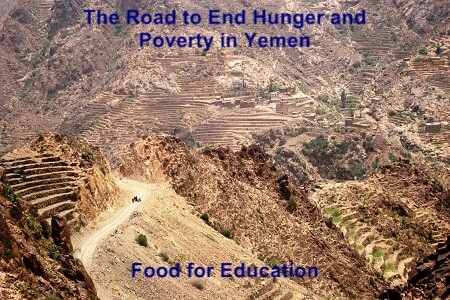
In a letter to the New York Times last February, I wrote about an emergency safety net plan to feed millions of hungry Yemenis suffering from high food prices.
Since that time, child malnutrition in some parts of Yemen has increased so much as to rival famine-ravaged Somalia.
Maria Calivis, UNICEF’s regional director, says, “This year alone, half a million children in Yemen are likely to die from malnutrition or to suffer lifelong physical and cognitive consequences resulting from malnutrition if we don’t take action. Malnutrition is preventable. And, therefore, inaction is unconscionable.”
Calivis adds, “Conflict, poverty and drought, compounded by the unrest of the previous year, the high food and fuel prices, and the breakdown of social services, are putting children’s health at great risks and threatening their very survival.”
Neither UNICEF nor the UN World Food Programme (WFP) received enough funding during 2011 to carry out their full hunger relief missions in Yemen.
These UN agencies rely on voluntary donations from the international community. If donors do not contribute, then hunger relief missions have to be scaled back or in some cases halted.
So what can someone do? Take action! UNICEF has a relief fund for Yemen. The World Food Program USA is also hosting a Yemen fund. You can even sign a petition to help WFP fight hunger in Yemen.
Or you can take in a “silent guest.” Starting in the holidays of 1947, the United States helped starving countries with a “silent guest” program. At mealtime, people were asked to imagine a silent guest at their table. Then they could mail the cost for feeding that silent guest to a committee in Plymouth, Massachusetts. This donation would buy a CARE package which was sent to hungry people in war-devastated Europe.
Today, maybe at your next meal, you could take in an infant child in Yemen who needs plumpy’nut to prevent potentially deadly malnutrition. You could send that donation to UNICEF which provides the plumpy so it can help treat all the cases of child malnutrition in the country.
Some of the countries who benefited from silent guest donations back in 1947 were Italy, Austria, France, and Greece. At that time Greece was recovering from a famine and facing a civil war.
Another country helped by the silent guest program was Germany. It is Germany that today has taken the lead in helping fight hunger in Yemen with a recent donation of $31 million to the WFP mission.
WFP will need over $200 million to feed millions of Yemenis during 2012. The rest of the international community should follow Germany’s lead.
The donation from Germany will help the emergency safety net plan which includes rations for 1.8 million Yemenis and also plumpy for infants. A school feeding program which has faced severe cuts over the last couple of years is getting a restart too.
The WFP Food for Education plan, which distributed take-home rations to schoolchildren, was suspended in 2010 and did not resume until May of 2011. Then it was a limited distribution, not even close to the previous levels of about 115,000 students. These rations benefited the children and their families. It’s food for the body and the mind as it keeps children in school and learning reading, math, science, and writing.
As significant as Germany’s recent donation is, it will be able to help revive Food for Education only to almost half of what it once reached in terms of students.
Lubna Alaman, director of WFP Yemen, says “The Food for Girls’ Education [program] is targeting only 53,000 girls and their families, and the food will be distributed for three school terms in 2012.”
So there is a long way to go to get all these hunger relief plans fully active again.
The choice with Yemen is simple. Invest now and avert an epic disaster like Somalia faced. We can save a generation of children in Yemen from the malnutrition that damages or even kills them in the first years of life.
Or drift along, pretending that Yemen will somehow turn out OK with an average response to humanitarian needs. It won’t, because no nation can have peace, political stability, and development on empty stomachs and malnourished bodies and minds.
The African nation of Chad is in the middle of a hunger crisis as drought has struck, ruining the country’s food supply. Chad is part of the Sahel region of Africa which in recent months has seen poor crop production. Hunger and malnutrition are growing, and the international community needs to act fast to avert a massive humanitarian disaster. (see Sahel Food Crisis: Race Against Time To Save Lives.)
Many families have less food, and what food is available on the market has gone up in price significantly. Many of these families are already living on fewer than 2 dollars a day so any increase in food prices is extremely serious.
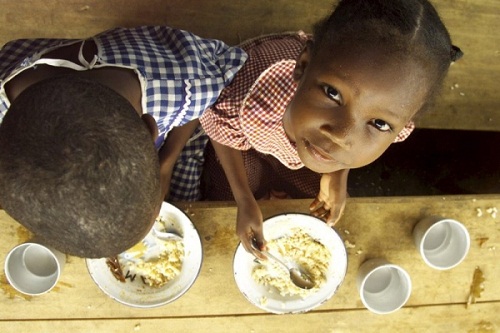
The United Nations World Food Programme (WFP) is providing school feeding in Chad as part of its response to the crisis. These meals not only save children from hunger but also keep them in school and learning.
When a hunger crisis hits a community, children often drop out of school to help earn wages for the family. This negative coping strategy denies children education and may even put them in danger.
Critical for Chad will be ensuring that school feeding is continued through the upcoming months when the food shortages will be at their worst. Malek Triki, WFP information officer, provides us an update on the school feeding response in Chad.
How many children are currently receiving school meals through WFP in Chad?
Currently, 205,000 schoolchildren (of which 45% are girls) are receiving schools meals in 790 primary schools across Chad. WFP plans to assist more than 250,000 school children in 2012 and around 265,000 in 2013.
Are the schools in communities impacted by high food prices and/or drought?
Yes, most of the schools assisted by WFP are located in areas affected by high food prices and the drought, especially in the Sahelian zone. The poor harvest means that the food availability is highly reduced, which translates into high food prices on local markets. Schoolchildren will depend more and more on school meals as their main source of food.
What are the latest reports of nutrition levels among school children?
Schoolchildren are in the age category of 7 to 14 years, which falls out of the age category targeted by nutrition surveys in Chad (under 5). However, the global acute malnutrition levels stand at 16% – beyond the emergency threshold rate of 15%.
Does WFP have enough resources to carry out school meals in the coming months?
If the current level of funding doesn’t improve, WFP will not be able to carry out school meals in the coming months. Out of about US$ 10 million required for the year 2012, only US$ 2 million have been secured. There is an urgent need to have funds to purchase over 5000 Mt of assorted commodities including MML, pulses, oil and salt.
The "Doorway to Helping the Needy of the World" located in the Matthew 25: Ministries processing center (photo courtesy Matthew 25: Ministries)
Cincinnati, Ohio has historically been at the forefront of the fight against hunger, this tradition starting with “penny lunch” programs in the early 1900s and more recently with universal free breakfast for public schools.
Since its founding in 1991, Matthew 25: Ministries has been a big part of this tradition, fighting hunger both in the United States and other countries. Based in Blue Ash, Ohio the charity is dedicated to helping those in need, whether it is disaster victims in Joplin, Missouri or earthquake-devastated Haiti.
Matthew 25: Ministries even has its own food processing center which makes a special rice/soy blend. Around 1 million meals of this food were sent to Japan to help victims of the earthquake and tsunami that struck there last year.
Matthew 25: Ministries recently completed a Fighting Hunger Food Drive in Cincinnati which was kicked off by a 5K Road Race.
In the United States one in 6 people are suffering from hunger according to studies by Feeding America. Matthew 25: Ministries is on the front lines taking on this growing hunger crisis. Let’s find out how in this interview with Joodi Archer, the organization’s media relations director.
How many food pantries does your agency support year round?
We work with the majority of our food pantries during our Fighting Hunger 5K. Last year, we served approximately 40 pantries and shelters during that time. We do work with some pantries and shelters on an ongoing basis throughout the year depending on the quantities and types of food we have donated to us – most of these pantries would also benefit from our Fighting Hunger Food Drive. Matthew 25: Ministries is committed to serving the needs of Greater Cincinnati during the holiday season and throughout the year.
Is most of your support to the pantries in the form of canned goods or rice/soy blend you produce?
For our 2011 Fighting Hunger Food Drive, approximately 20,000 pounds of the 60,000 total pounds of distributed food consisted of our rice/soy blend. Throughout the year, approximately 25% of the total pounds of locally distributed food could be our rice/soy blend.
Are you seeing a greater need for assistance from food pantries in the area?
The need for assistance is escalating at a significant pace, mirroring the downturn in the economy and continuing high unemployment rates. Pantries are reporting double and triple the requests for assistance and are struggling to meet the needs of recipients. The pantries we provide for often serve hard-to-reach, non-mobile populations, and they are struggling to meet the increasing requests for assistance.
How can someone get involved with Matthew 25?
People of all ages and financial means can get involved with Matthew 25: Ministries. Here are some suggestions:
Volunteer: Matthew 25: Ministries is always in need of volunteers at our 132,000 square foot warehouse in Blue Ash, Ohio. Opportunities exist for individuals, families, and groups of any size. (Please see our volunteer guidelines for more information.) For groups located outside of the Greater Cincinnati area, Matthew 25: Ministries provides a great opportunity for day-long volunteer trips or overnight multiple-day trips. Please call 513-793-6256 for more information and for help with scheduling your visit.
Contribute: More than 99% of Matthew 25: Ministries’ cash and in-kind donations go towards programs. In 2011, for every $1 donated, Matthew 25 distributed $64 in humanitarian aid. That means that even a small gift will have an enormous impact on the lives of those in need.
Collections: Collect products and goods for the poorest of the poor. This is a great way for groups such as schools, businesses, clubs, etc. to help. We are always in need of clothing, personal care items, non-perishable food, medical supplies, and educational materials. Contact Matthew 25: Ministries for suggestions of critically needed items.
Fundraise: Host a spaghetti dinner,auction, or concert. Make Matthew 25: Ministries a part of your church’s mission budget, mission Sunday, or special collection. Raise money as a general donation or to support a specific project. For example, a small but sturdy house in Nicaragua costs about $1,300. One M25M donor spearheaded enough fundraising activities to pay for the construction of twenty-two houses-each with a cement floor, solid door, shuttered windows, and waterproof roof! Ask M25M for assistance on fundraising ideas or promotional materials.
Pallet to the Poor: Sponsor a pallet of goods to send to the poor. A four-foot by four-foot pallet costs $192 and typically contains about $4,200 in products and supplies. Each pallet is labeled with the name of the sponsoring individual, group, or organization. A letter of acknowledgment and thanks lets the donor know where the pallet of products is going. Contact Joodi Archer for more information on the Pallet to the Poor Program.
Connect: Introduce a potential corporate donor to Matthew 25: Ministries. Your phone call or e-mail connecting Matthew 25: Ministries to the correct contact individual can save weeks or months of research to establish a connection. Corporate donors receive many benefits from partnering with Matthew 25: Ministries including substantial tax benefits. See our Corporate Partners section for more information.
As the State of the Union is upon us for 2012, let’s look briefly at history to tell us what should be atop the foreign policy agenda.
When the fighting of World War One came to an end on November 11th, 1918, there still was an “enemy” who remained on the offensive. The war had ruined agriculture and food supply systems, thereby unleashing the most unrelenting of foes–hunger and malnutrition.
Lieutenant Harwood Stacy saw in Poland such terrible conditions with infants that “looked terribly emaciated.” He said a basic item like milk “was as precious as gold.” A Polish hospital director pleaded for food for children “so we may supply the needs of these little ones who cannot comprehend why they are not fed.”
The American Relief Administration, backed by Congressional funding as well as donations from citizens, came to the rescue. Millions of children were spared a lifetime sentence from malnutrition that damages both mind and body. Without this aid World War One, which leveled enough suffering, would have led to millions more lives being lost.
All it took was providing the children meals, even similar to the “penny lunch” programs that had been pioneered in Cincinnati, Ohio in the early 1900s by teacher Ella Walsh. Another Cincinnati “penny lunch” organizer, Alice Wheatley, was also a supporter of the Red Cross during World War One. It was the Red Cross which provided school meals to thousands of children in France during the World War One years.
Now, nearly 100 years later, a different hunger crisis is unfolding that demands to be the top foreign policy priority. For hunger has started a new powerful offensive against the poor and vulnerable. Last year a massive drought occurred in East Africa placing over 13 million people at risk of starvation. That crisis is still ongoing and humanitarian aid has to keep flowing. However, there is also drought striking large parts of West Africa as well.
People in Niger, Chad, Mauritania and other parts of the Sahel region of Africa are feeling the effects of reduced harvests and high food prices. A massive humanitarian disaster waits around the corner if we do not act now.
In some parts of Yemen, a country known in the U.S. as a haven for Al Qaeda, child malnutrition rates rival those of famine-ravaged Somalia. Aid agencies, who rely on voluntary donations, cannot keep up with the growing tragedy.
In the new nation of South Sudan, conflict among tribes continues to leave many people hungry and displaced. Peace has not yet been achieved with neighboring Sudan. To add to this, drought has struck. In North Darfur, the UN World Food Programme says the “overall food security situation has considerably deteriorated compared to November 2010.” Poor harvests and high food prices now strike at a population trying to build peace.
In Afghanistan, a country devastated by years of conflict, drought hit 14 provinces last year. Low funding for aid agencies led to a reduction in food and agricultural assistance to the needy population. Food for peace therefore has a limited reach when it’s most needed.
In 2012 America’s top foreign policy objective should be to rehabilitate the children of drought and conflict across the globe. For if we do not, we give up on peace and stunt the future of so many suffering countries.
This is not an insurmountable challenge. It is far less expensive than war. But it needs to get on the agenda of our leaders in Washington and in the public conscience as it did after World War One, World War II and the Korean War. Feeding the children of “drought and conflict” is the U.S. foreign policy mission for this new year.
WFP has resumed school feeding in Ivory Coast. But will the funding pipeline be maintained by donors for the program to continue? (file photo by WFP/Ramin Rafirasme)
Secretary of State Hillary Clinton traveled to the Ivory Coast (Côte d’Ivoire) this week and spoke of hope for the future. Hope was something not often talked about when this African nation was embroiled in violence last year over a disputed election.
The fighting is now over. A chance for Ivory Coast to build a promising future has begun. Clinton said, “I am inspired by how quickly not only the government but the people have moved from the violence and conflict of last spring to successful legislative elections in December and to a commitment that is in the air to build a better future for all Ivoirians and particularly for the next generation.”
Hunger, though, is still a major threat in the Ivory Coast. A report from the UN Food and Agriculture Organization (FAO) said, “In spite of the improved security situation, food security remains a major concern. Access to food for many households is being constrained by the disruption of their livelihoods.”
Catherine Bragg, of the UN Office for the Coordination of Humanitarian Affairs (OCHA), told IRIN news, “I don’t want the world to move on and say everything in Côte d’Ivoire is fine.”
Humanitarian aid is critical for this country traveling the road to peace. A whole generation of children in the Ivory Coast needs nutrition and education, something many had to go without during the months of fighting and displacement. In January, the UN World Food Programme (WFP) started to provide school feeding to 600,000 children in 3,400 schools around the country. The initiative also provides food for about 25,000 voluntary teachers.
The school feeding gives these children a very important meal, which includes rice, of about 700 calories. Providing food at school boosts attendance rates not to mention class performance. So two key areas of Ivory Coast’s recovery are addressed with this program.
This free meal is of the utmost importance for so many impoverished families that lost so much during the conflict. Funding, though, is the critical issue going forward. WFP relies on voluntary donations from the international community. Food to reinforce peace depends on keeping the donor pipeline moving.
WFP says that the Ivory Coast school feeding program is only 11 percent funded. The program can run for the time being. However, by April supplies will be needed to maintain the school feeding. Donations now are critical because it can take several months for a donation to translate into delivered food. If no action is taken there is the the risk of children facing reduced rations or even losing their school meal come spring. This would impact the recovery process and the health and education of children.
As Clinton said while in the Ivory Coast, “Families need good schools to send their children to attend, everyone needs good healthcare, and I am very hopeful that the president’s agenda will help revitalize this dynamic, very important country at a time when we all need to do more to set a positive vision for the future.”
School meals are a vital building block for this vision. So it’s important that this program be supported and evolve into a national school feeding program for the Ivory Coast. Such a vision need not be too far off in the future, if the will exists now.
Fears of a nuclear-armed Iran may provoke a Middle East arms race, one that would place even more burdens on an impoverished region.
We see a similar scenario in Asia with India and Pakistan, where malnutrition rates are high while spending on nuclear weapons continues. The World Food Programme’s relief operation for flood-ravaged Pakistan has faced severe funding shortages.
At the same time, costly nuclear missile tests by Pakistan and India have gone forward; and in North Korea there have been famine conditions as the country has developed its nukes.
We need to challenge all these countries. But not to an arms race; rather to what President Kennedy called a “peace race.” This is our best hope for unifying the world in eliminating the threat of nuclear weapons and lifting this burden off all peoples.
This unity must first begin at home between Democrats and Republicans. A starting point should be ratifying a pact eliminating all nuclear weapons testing, finally finishing a job started long ago by Presidents Eisenhower and Kennedy.
Back in 1963 when Kennedy put before the Senate a treaty with the Soviet Union limiting nuclear weapons testing, he gained strong support from the other side of the aisle. Republican Senator Everett Dirksen met with President Kennedy to help him win over key votes for treaty approval.
Former President Dwight Eisenhower, a Republican who actually started the road toward the treaty during his administration, lent his support in the form of a letter to the Senate. Eisenhower urged the treaty be passed as “people are frightened… world fears and tensions are intensified. There is placed upon too much of mankind the costly burdens of an all out arms race.”
Expensive and dangerous nuclear weapons: Dwight Eisenhower talking about pursuit of a nuclear test ban treaty in March of 1960 (audio and photo courtesy of the Eisenhower Library)
The Limited Test Ban Treaty won approval from the Senate one year after the Cuban Missile Crisis when the US and Soviets almost went to nuclear war. The 1963 treaty was a first step towards arms control in the fast-escalating nuclear age.
President Kennedy signs the Limited Test Ban Treaty in October, 1963 in the Treaty Room at the White House (courtesy Kennedy Library)
But decades later, what Ike and Kennedy started is not yet finished. The Comprehensive Nuclear Test Ban Treaty(CTBT) still needs to be ratified. This treaty goes a step further than the limited one of 1963 and bans all nuclear test explosions, including underground. The United States and seven other nations have yet to approve this treaty for it to take effect. Russia has already ratified it.
The U.S. Senate rejected the treaty in 1999 and the bipartisan cooperation of 1963 was absent, with almost all Republicans voting together against it. Now, in 2012, is the time to reconsider ratification for the sake of America’s national security.
Resuming nuclear weapons testing places additional costs on an arsenal that already costs Americans at least $52 billion a year. Progress toward nuclear disarmament is needed to reduce this burden which drains our treasury. But costs alone are not the only issue.
What would Russia and China’s reaction be should we resume nuclear weapons tests? As the Russian deputy foreign minister said, his country intends to fully comply with its CTBT commitment, “if other nuclear states do likewise.” But if we resume nuclear testing, will Russia follow? What will China do? Would a new arms race come next?
The CTBT is an important step toward nuclear disarmament, because you reach a wall in arms reductions if you are leaving the door open to new nuclear testing and development.
A CTBT would increase momentum toward gaining a disarmament agreement with Russia on tactical nuclear weapons, and offer hope of arms reductions in Asia, where China and rivals India and Pakistan have nuclear weaponry.
Arms Control Under Secretary Ellen Tauscher says, “Nowhere would these constraints be more relevant than in Asia, where you see states building up and modernizing their forces. A legally binding prohibition on all nuclear explosive testing would help reduce the chances of a potential regional arms race in the years and decades to come.”
But without a commitment to end nuclear weapons testing, it is far less likely such agreements will ever take place. Unity among the nuclear states is also needed to implement diplomatic pressure to get North Korea and Iran to abandon their nuclear ambitions.
One way Kennedy gained support for the limited test ban treaty was to ensure that the U.S. would commit to extensive research into technologies needed to ensure the reliability of the nuclear arsenal.
Today, there are opportunities to quell fears that the CTBT is not verifiable, and that nations could cheat the treaty. As Jonathan Medalia writes in a Congressional Research Service report, the U.S. could add additional planes for its nuclear detection system operated by the U.S. Air Force. This Atomic Energy Detection System has been place since the start of the Cold War, even detecting the Soviet Union’s first tests in 1949 and 1951.
The Air Force’s WC-135 Constant Phoenix aircraft collects air samples from areas around the world where nuclear explosions have occurred. (U.S. Air Force photo)Enhancing our own technical means would complement the treaty’s existing monitoring system which, even though not fully operational, detected North Korea’s 2006 and 2009 nuclear tests.
In ratifying the CTBT, the U.S. can join Russia and urge other nations to follow their lead and take further measures to reduce nuclear weapons. As diplomat Gerard Smith once wrote, “In urging others not to acquire this awesome capacity, the United States and Russia may persuasively say that they have found it expensive, dangerous and, ultimately, useless.”
Nuclear weapons in the world is a shared risk among all nations, for the cost of the armaments, the danger of terrorist theft, and the international tensions are a burden all countries feel. It is in the interest of all nations to end nuclear testing once and for all, and work toward further agreements reducing the nuclear menace.
A mother attends to her severely malnourished child at an inpatient feeding centre in Mao, Chad. Credit: UNICEF Chad/2011/ Esteve
In the Sahel region of Africa millions of people are caught in a severe hunger crisis. Niger, Mauritania, Chad, Burkina Faso and Mali are primarily the countries affected right now.
Drought has reduced food production, and high prices reign over the existing food supply. For families living in poverty, food is out of reach. UNICEF says more than a million children under five years of age will need to be treated for severe malnutrition in the region.
If the international community does not act now, the situation will get much worse. Action has to be taken well before the lean season between harvests, which could start as early as February or March. The UN World Food Programme (WFP) says, “food security problems in the lean season lead to significant peaks in acute malnutrition and mortality, taking it beyond critical levels.”
It can take months for a donation to translate into food on the ground. So donors need to come forward quickly to help avert a disaster in the Sahel.
Navyn Salem of Edesia, whose organization produces plumpy’nut food aid, points out that if donors wait until the ultimate disaster strikes, it leads to very expensive airlifts of emergency food aid. That is money that could have been used to purchase more food and shipped at lower cost months earlier.
Right now WFP is facing a tough time funding its relief operations as hunger is on the rise in many parts of the globe. In Niger, WFP had to increase its funding requirements to feed over 3 million people, one million higher than previous estimates. So far, less than half of the required funding has been received to provide the food aid.
Denise Brown, WFP country director, warns “Unusually high food prices are affecting needy people who are facing growing difficulties as they struggle to feed themselves and their children. I am deeply worried about the food situation deteriorating in the coming months and we cannot sit back and wait for the worst to come.”
The US Food for Peace program, started by Dwight Eisenhower, has been able to send some funds for Niger relief. However, the US Congress has been threatening to reduce future funding for Food for Peace despite the massive global hunger crisis now unfolding.
In Chad, cereal production in 2011 decreased 50 percent compared to 2010, according to the Food and Agriculture organization. Who becomes the most vulnerable when such a food crisis hits? It’s the smallest children under five years of age.
A WFP report says, levels of acute malnutrition were at a “critical” level in 6 out of 11 regions surveyed in Chad. Other areas were categorized as having “Serious” levels of malnutrition. The smallest infants in this danger zone run the risk of lifetime physical and mental damage unless food aid can reach them in time.
UNICEF says, “What is going to be required to save lives is the sweet, peanut-based therapeutic food known as ‘Plumpy Nut’, enough nutrition professionals in the field to work the feeding centres, and a string of other interventions that bring more food into communities.”
The Sahel region is in need though of more than emergency food aid. There has to be a way to build up the resilience of the region to future droughts, and gradually reduce the need for outside assistance. When the current crisis stabilizes, investments in the small farmer will need to move forward. Only this food security investment can prevent another hunger crisis of this magnitude.
By 1 June, about 40,000 people displaced from Abyei after the town's takeover by Sudan Armed Forces had been registered in the Abyei area, Unity State and the greater Bahr El-Ghazal region and were receiving humanitarian assistance. Photos: UNMIS/Issac Gideon.
This Wednesday, when Villanova University squares off against Seton Hall, you can expect another competitive Big East Conference basketball game. This game will differ from others in that it will seek to build support for Peace in Sudan.
Villanova and Seton Hall are partnering with Catholic Relief Services (CRS) in “Playing for Peace” to help bring an end to conflict, hunger and suffering in Sudan and South Sudan. Sudan and South Sudan fought a decades-long civil war that ended in 2005 with a peace agreement. However, violence has continued and the agreement has not been fully implemented.
Peace activism will take place throughout the game. Students will be handed a flyer showing how they can help by contacting the White House and urging the administration to support the peace process.
South Sudan became the world’s newest country last July, gaining independence from Sudan. However, peace in the region remains elusive as conflict and border tensions continue. It is critical that UN peacekeeping missions be supported and fully funded to protect civilians, and help establish conditions to build a lasting peace and development.
A peacekeeping mission called UNISFA was deployed to Abyei, which is a disputed territory on the border between Sudan and South Sudan. This oil rich region is claimed by both Sudan and South Sudan, and fighting has taken place there for years despite the 2005 agreement. UNISFA is there to make sure the area is demilitarized and made safe for civilians.
The threats go beyond the guns. Hunger and poverty still dominate the countryside. Drought often harms food production efforts and malnutrition is a major threat to children. Displacement from conflict makes this situation even more desperate. Conflict exists not only between South Sudan and Sudan, but also between rival tribes.
At this very moment, aid agencies are trying to help 50,000 displaced persons in the Jonglei State of South Sudan. CRS reports that the ethnic conflict between the Lou Nuer and Murle tribes has claimed an estimated 1,000 lives in the past six months. One of the driving forces behind this internal conflict is the lack of resources. Hunger and poverty feed desperation and violence.
Isaac Boyd of CRS Sudan says, “After nearly four decades of working in Sudan and South Sudan, CRS recognizes that sustainable development and peace are tightly interwoven. To contribute to a lasting improvement in the level of basic services and economic opportunities available to people throughout South Sudan, it is imperative to support communities to find meaningful, concrete ways to resolve their differences and put an end to destructive conflict. Simultaneously, tensions between groups are often exacerbated by the scarcity of basic services like access to water, schools, or health clinics. Development and peace have to happen at the same time.”
Will there be enough resources for aid agencies to reinforce the drive for peace? CRS is sponsoring emergency aid as well as long-term food security projects. The UN World Food Programme (WFP) is reporting that its 2012 relief operation for South Sudan is short 179 million dollars. WFP relies entirely on voluntary donations from governments and the public.
Without food, children in Sudan will suffer lasting physical and mental damage, thereby stunting the next generation. Without food for schoolchildren, education will suffer. A national school lunch program still needs to be established.
Playing for Peace is part of a series of events about Sudan sponsored by Villanova University. For more information, please visit the CRS newswire.
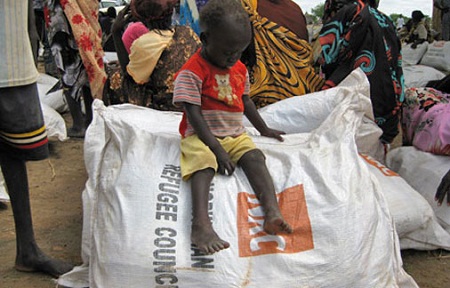
This child in Sudan is receiving food aid from the Norwegian Refugee Council (NRC). Many more children in the world are in need of food safety nets. (NRC Sudan photo)
Herbert Hoover’s book American Epic Volume Four gives a country-by-country breakdown of the siege of hunger after World War II. Detailed reports reveal the crisis of child hunger and the desperate race to find solutions.
The book is a great history of the World War II era and the fight to save millions from starvation after the fighting had ended. It tells a story not often covered in the histories of this time period.
But I think the book represents more than an outstanding history. It’s something we can learn from in today’s struggle to win peace.
When I saw Hoover’s book a few years ago, I asked: Why not have something like this today? Why not have a country-by-country look at all-important child feeding? I felt this was not being covered enough in the news. The “silent tsunami” of high food prices had struck and the number of hungry children worldwide was fast growing.
So I contacted Jennifer Parmelee of the UN World Food Programme (WFP) in Washington, D.C. I presented my idea and it took off from there. It led to the creation of an interview series covering school feeding programs worldwide and then the book Ending World Hunger.
Laura Sheahen of Catholic Relief Services/Caritas also was very instrumental in helping develop the series. The feature continues online at Blogcritics today with its most recent update including the Norwegian Refugee Council providing school meals in the Democratic Republic of the Congo.
The idea is to bring the issue of child hunger into the spotlight and talk about solutions, and to connect the issues of hunger and nutrition to the pursuit of peace and development. This is something American Epic does.
A school meal program for Germany saved that country after World War II and it can do the same for others today.
Yet hunger has not been made enough of a priority and low funding plagues relief operations in Afghanistan, Yemen, Ivory Coast, Haiti, Sudan, and other nations. In East Africa, critical months lie ahead in saving the region after the massive drought last year.
In Sudan food is vital to the peace process. Whether it’s the nutritious peanut paste plumpy’nut (or plumpy’sup for malnourished infants), food for school age children, or agricultural development, it can mean the difference between peace and conflict.
Currently, low funding for the United Nations World Food Programme (WFP) has led to reductions in its school feeding for Afghan children. In Benin, WFP is able to feed only 64 percent of children in the school feeding program. The funding shortages again limit the reach of the program.
There is a lot more that can be done to fight hunger around the globe.
Hoover’s American Epic showed what a food ambassador could do to rally cooperation, both domestically and internationally, for fighting hunger, and why it’s so important that child feeding programs get the support they need. Nutrition matters.
As Hoover said, “Civilization marches forward upon the feet of healthy children. We cannot have recovery of civilization in nations with a legacy of stunted bodies or distorted and embittered minds.”
I think the Congress needs to think of this when they are drawing up the new budget. Think of what the consequences will be of reducing U.S. international food aid – what that will mean for future generations, and what it will mean for our prospects for peace.
I think that is a key lesson to take from Hoover’s American Epic.





 Author William Lambers