Tag Archives: World Food Programme

Budget Debates in Congress Loom Over Yemen Crisis

Budget decisions made by the U.S. Congress in the coming weeks will have their effect on Yemen. Proposals for reducing international food aid would limit the U.S. ability to respond to the humanitarian crisis escalating in Yemen, already the poorest country in the Middle East.

Congress has proposed reducing funding for the U.S. Food for Peace plan, which in 2011 supported the UN World Food Programme’s (WFP) relief operation in Sana’a City and Northern Yemen. In addition, Food for Peace funded Save the Children’s voucher initiative, also in the North. This program showed promising results and if enough funding were available could be continued and expanded.

Currently, the UN World Food Programme and UNICEF are facing funding shortages for their relief programs in Yemen. The prospect of the U.S. decreasing its food aid budget is a forerunner of disaster for an already distressed humanitarian operation.

Before this year’s political unrest and violence unfolded, Yemen was already suffering a humanitarian crisis with high rates of child malnutrition. The year’s events have made this situation worse with prices of food and other basic goods on the increase. Food is becoming out of reach.

UNICEF recently reported “food security & nutrition indicators continue to be alarmingly low. Protein intake continues to decline, with increasing numbers of households reporting no consumption of meat (74.2%), fish (65.0%), chicken (34.2%), and eggs (43.3%).”

UNICEF, which surveys households in the Sana’a, Amran, and Hodeida governorates, highlights the alarming child malnutrition crisis. UNICEF says, “More households reported decreased number of meals among children <5yrs (33.6%) compared with the previous round (22.6%), with children in rural households being the most vulnerable to meal reduction (40.4%) compared with urban households (28.6%).”

The World Food Program USA is rallying support for increasing U.S. international food aid so there can be a stronger response for the crisis in Yemen and other countries.

WFP USA states, “Despite the fact that cuts to these critically important international programs cannot possibly make a meaningful contribution to reducing the debt or balancing the budget, unfortunately they are under threat this week as the Senate debates International Affairs accounts.”

A take action page has been set up to help citizens contact their representatives in Congress to oppose the budget cuts to international food aid.

Article first published as Budget Debates in Congress Loom over Yemen Crisis at Blogcritics.


Leave a comment

Filed under global hunger

On Halloween Remember the World’s Hungry

This Halloween please remember the world's hungry (photo courtesy USA.gov)

It’s Halloween 2011 and time for the Wolfman, Dracula, and other monsters and ghosts to have their one night of the year. And let’s not forget Egypt’s famous Halloween contribution, the Mummy, and a couple of creatures that have appeared in this column when they helped with fundraisers, the Mothman and the Yeti.

Halloween means lots of candy too! In fact billions of dollars are spent on Halloween festivities. But this year please take a silent guest with you when trick or treating, or at your Halloween party. You can help one of the world’s nearly one billion hungry who on Halloween, or any other day, will hope to get maybe one meal if they are lucky.

There are many ways that Halloween can be combined with fighting hunger. In fact, in 1947 students used Halloween not to collect treats but to collect canned goods for the Friendship Train that fed the hungry in war-torn Europe.

On Halloween night, maybe in place of one of the treats, you could ask for a dollar to buy a week’s worth of meals for a hungry child. You can send the dollar to food aid agencies like the World Food Programme, Save the Children, Feeding America, UNICEF, Catholic Relief Services and others.

Or perhaps take a few minutes after coming home from trick or treating to play a few rounds of the online game Free Rice. For every correct answer you get, rice is donated to the hungry in developing countries.

There are many ways you can combine Halloween and fighting hunger. For this night is one of imagination. So the best ideas are to come: from you.

Article first published as On Halloween Remember the World’s Hungry on Blogcritics.

Leave a comment

Filed under global hunger, History

Biden Optimistic Global Hunger Struggle Can Be Won

Vice President Joe Biden spoke last Monday at the World Food Program USA award ceremony. He praised this year’s winners, Bill Gates and Howard Buffett, who have dedicated their talents to fighting hunger around the globe.

But Biden also made an admission of guilt—-for being optimistic that we can win the struggle against global hunger. This battle is now ongoing in the famine zones of East Africa, drought-ravaged Afghanistan, Yemen, Pakistan and numerous other regions.

Biden said, “I am often accused of being an optimist. I plead guilty, because I believe strongly in the human capacity-and desire-to build a better world. But I am particularly confident in our ability to feed the future because we have done it before.”

Biden talked about our support of South Korea, once a war-torn country with millions starving. Today South Korea has strong economic development and is a donor to the UN World Food Programme’s hunger-fighting missions.

Biden said, “Beginning in the 1950’s, we provided agricultural support-research, training, and partnerships with American firms-to South Korea, which was one of the poorest countries on the planet. Today, it is the world’s 15th largest economy, and a major trading partner responsible for hundreds of thousands of American jobs. ”

This is a long way from the South Korea that U.S. Army major Charles Arnold saw in 1951 during the Korean War. Arnold, who led a UN Civil Assistance team, said children arrived at feeding stations and “greeted us by rubbing their stomach and saying hungry.” After regular meals from Arnold’s team, the children took on a new, healthy look. They began to smile.

South Korea was also a country that benefited from the famous CARE packages that fed so many hungry people in Europe after World War II. President Truman urged Americans to send these CARE packages to feed those hungry and displaced by the Korean conflict.

As time went on, South Korea gained from agricultural development projects, similar to those Biden praised in the current “Feed the Future” campaign. South Korea was also one of the beneficiaries of the U.S. Food for Peace program started under President Eisenhower and expanded during President Kennedy’s administration.

George McGovern was Food for Peace director under President Kennedy. He writes that about 2 million South Korean children were receiving school meals under this hunger-fighting initiative. These meals made children healthier and better educated. This is a contrast to Afghanistan today, where low funding for the UN World Food Programme has meant that many impoverished children have lost their school meal ration.

In addition, proposed budget cuts to international food aid, including Food for Peace, will mean school feeding, Feed the Future and other aid projects will face cutbacks. This is a severe threat to peace.

Biden also said, “We will continue to support your work, by urging our friends in Congress to resist the urge to slash foreign aid budgets, because long-term solutions now can reduce the cost of massive relief efforts and instability later.”

Hunger-fighting programs currently make up less than one tenth of one percent of the federal budget. So slashing them does virtually nothing to eliminate the debt. Funding cuts though would devastate U.S. foreign policy. It is virtually impossible for countries to develop and have peace when generation after generation of children grow up malnourished and stunted in mind and body.

Biden finished his speech on Monday citing Nobel Peace Prize winner Norman Borlaug, who saved millions from hunger through his agricultural innovations. Borlaug said: “If you desire peace, cultivate justice, but at the same time cultivate the fields to produce more bread; otherwise there will be no peace.”

This is a message Congress needs to hear again and again as it makes crucial decisions about our foreign policy. The Food for Peace tradition of the U.S. is very much at stake in the current debates on the federal budget. What they decide in the coming days will have major implications on whether the struggle against global hunger can be won.

View a video of Biden’s speech.

Article first published as Biden Optimistic Global Hunger Struggle Can Be Won on Blogcritics.

Leave a comment

Filed under global hunger, History

WFP and Aschiana Provide Food for Street Children in Afghanistan

Since last year I have been writing about a promising take-home ration program for street children in Afghanistan. The UN World Food Programme (WFP) and the Aschiana Foundation are teaming up on this initiative which helps Afghan children caught in a severe poverty trap. Below are some photographs of the food distributions courtesy of WFP.

In the coming weeks the Congress will be deciding whether to cut international food aid. Programs like this one will be in jeopardy if the U.S. Food for Peace and other hunger fighting programs are scaled back. WFP depends on voluntary donations from the U.S. and other countries. See my interview with Nora O’Connell of Save the Children for more about the budget crisis.

Assadullah Azhari of the World Food Programme took these photos of the WFP-Aschiana program:

WFP’s Food for Training Program in Afghanistan provides rations for street children at Aschiana Foundation Centers. Funding is needed by WFP and Aschiana to ensure these programs can be maintained and expanded to reach impoverished children. (photo courtesy WFP/Assadullah Azhari)


Leave a comment

Filed under global hunger

Congress Needs to Invest in Nutrition at Home and Abroad

There is a lot of talk in Washington, D.C. about cutting spending. But if Congress is serious about looking for savings, then it should look to investing in child nutrition at home and abroad.

That investment will not only save us money, but will do more to build peace than any other initiative we can spend on.

Josette Sheeran, director of the UN World Food Programme, talks about how vital it is we invest in child nutrition. And how we save in the long run.

Children who do not receive proper nutrition, especially in the first thousand days of life, suffer lasting physical and mental damage. These future citizens will be less productive, less educated, and more susceptible to disease. This places a greater burden on everyone.

In the United States, hunger is a huge drain on the economy. Bread for the World reports: “A 2007 study co-authored by Harry Holzer of Georgetown University found that a conservative estimate of its cost to the economy was $500 billion per year, due largely to lower productivity and higher healthcare costs. Holzer points out that this amount has undoubtedly increased during the recession.”

In the U.S. we have to make sure that children can get access to the food they need to thrive. This includes filling in the gaps in food aid, such as the summer and after-school feeding programs.

Overseas nutrition plays a vital role in how effective our foreign policy will be. Look at the crisis points in Afghanistan, Sudan, Yemen, Pakistan, and elsewhere. All these countries have extremely high child malnutrition rates. If only more investment were put into fighting child hunger, steps could be taken toward peace and economic development.

Right now, though, Congress is proposing reducing international food aid as part of its budget cutting. Yet these programs currently make up less than one tenth of one percent of the federal budget. So even getting rid of them entirely would do almost nothing to solve the debt crisis. Reducing them will damage our foreign policy.

If Congress cuts food aid, they will essentially be increasing the burden on American taxpayers down the road. Hunger and malnutrition breed instability, disease, and even conflict. All these come with a price tag.

But if we make enough investment in nutrition, we can save many a child and country from despair, and form future partnerships in peace and trade.

Article first published as Want to Cut Spending and Build Peace? Invest in Child Nutrition on Blogcritics.

Leave a comment

Filed under global hunger

Emergency Child Malnutrition Rates in Yemen

Children in Yemen are wasting away as conflict and a struggle for power continue in the beleaguered country. UNICEF just released findings from a nutrition study in the Abyan governorate in Southern Yemen. They found a shocking Global Acute Malnutrition rate among 18.6 percent of the children. The emergency threshold number is considered 15 percent.

When children do not receive proper nutrition, their growth is stunted in body as well as mind. They became more susceptible to illness.

While the South is suffering with malnutrition, so too is the North. In this area years of conflict between the government and rebels has taken its toll on the population. UNICEF says that “In Sa’ada, high malnutrition rates continue to be identified and children referred for treatment.

Out of a total of 234 children screened, 47 were referred to a therapeutic feeding center, while 128 were enrolled in outpatient therapeutic care (75% admission rate for severe acute malnutrition).”

A number of households in Yemen are reporting family members going to bed hungry. UNICEF says the capital Sana’a reported the highest percentage of household members going to bed hungry due to lack of food (67.5%) compared (to) Amran (45%) and Hodeida (25%). Food prices have risen steeply in recent months putting an extra crushing burden on the poor.

Even before this year of political unrest, hunger was a crisis in Yemen. This year had deepened this catastrophe to the highest levels of emergency.

Funding remains low for hunger relief missions by the UN World Food Programme and UNICEF. These agencies depend entirely on voluntary funding from the international community.

Supplies of the miracle food plumpy’nut, which can stave off malnutrition, are not available to all children. Funding for UNICEF and WFP would need to be increased. Without this supply, another generation of children will be burdened with long-term physical and mental impairment.

Leave a comment

Filed under global hunger

Interview: Para Hunzai of the World Food Programme in Cambodia

The UN World Food Programme provides school meals to children in Cambodia (World Food Programme)

Para Hunzai of the UN World Food Programme (WFP) recently reported on the massive flooding taking place in Cambodia. Thousands of people have been displaced from their homes. Livelihoods have been lost as farm lands have been swept away. This crisis is taking a great toll on the many families in the country already living in poverty.

WFP provides assistance in Cambodia, including a school meals program which is a crucial safety net to help the poor overcome shocks like the floods. School feeding keeps children fed, healthy, and learning. Para recently took time to discuss the impact of this program and ways you can get involved to help feed and educate children in Cambodia.

How many children are currently receiving the WFP school meals?

During the coming school year (October 2011 – July 2012) 342,000 primary school children will receive hot nutritious breakfasts consisting of rice, yellow split beans, fish, salt and oil. Over 65,000 of the poorest families also receive a monthly scholarship of either 10 kg of rice per month or the cash equivalent of US$5 as an incentive to send children to school.

What has been the impact of the meals in terms of class attendance and performance?

An independent impact evaluation commissioned by WFP in 2010 showed that the impact of the school meals and food scholarship activities is evident on three levels:

Education: The impact of school meals was evident in higher enrolment (an analysis of Ministry of Education, Youth and Sports (MoEYS) data shows a 2-2.5 percent increase upon a school’s inclusion in the School Meals Programme, with a bigger increase for girls at 3 percent; furthermore, over the period 2002-2009 the increase in enrolment was 6.1 percent higher for schools that were part of the School Meals Programme); increased attendance (based on the household survey, food scholarship activities contributed to an annual increase of around 3 percent) and reduced drop-out rates (the School Meals Programme reduced drop-outs, especially in grades 2-4 by around 2.7 percent).

Nutrition: The School Meals Programme helped reduce morbidity among pupils in general and absence from school as a result of illness among girls. The potential for nutritional improvement through school meals was evidenced through a decrease in night blindness, attributed to the use of vitamin A-fortified vegetable oil.

Value-Transfer: The food scholarship constituted a predictable and regular value transfer to households worth 23.5 percent of household income. Among School Meals Programme beneficiaries the figure was 14 percent. Food scholarship activities enabled poor families to extend the period during which they did not have to buy rice and increased resilience to food shortages during lean periods, thereby reducing their vulnerability and increasing options for investing in assets. Households also confirmed that the food scholarship activities constituted a credible compensation for income lost if children were attending school, thereby reducing child labour.

Is there a plan to expand the program if needed?

WFP’s school meals and scholarship programme covers over 2,000 schools in 12 out of 24 provinces, reaching over half a million school children. Based on need, WFP’s Education Programme has been re-targeted to reach a greater number of children this school year. The Scholarship Programme is being scaled up from 900 to 2,000 schools (from 20,000 to 60, 000 households) (Oct 2011-July 2012). In addition, a pilot cash scholarship programme will reach 5,000 students in various schools. The expansion of the programme is reliant on resources and need and is re-assessed accordingly. WFP targets the most food-insecure provinces.

What are the prospects of a national school lunch program in Cambodia where all children can receive the meals?

They say breakfast is the most important meal of the day, this is especially true for children from poor households who sometimes eat little or no breakfast. This affects their ability to concentrate on lessons for the rest of the day. Therefore, WFP provides breakfasts before the school day commences. WFP has been implementing its school feeding programme in Cambodia since 1999. WFP is working closely with the Ministry of Education and with NGO partners to explore cost-effective options for possible nationwide scale-up in the future. Currently, WFP and the Ministry of Education target the poorest and most food insecure areas in 12 out of 24 provinces. There is currently no school lunch programme.

How can someone get involved and help school feeding in Cambodia?

Supporters of WFP can help create awareness of issues of food insecurity and malnutrition of vulnerable populations including primary school children in Cambodia. A recent national survey indicates that almost 40 percent of children under 5 are not as tall as they should be (stunted) and are not receiving the micronutrients needed to grow. Awareness-raising can be done by spreading the word of WFP activities through sharing communication and advocacy material published on the WFP website (for information on Cambodia, see http://www.wfp.org/countries/cambodia ).

WFP is 100 percent voluntarily funded, raising every dollar it spends. Donations are greatly welcome to ensure programmes continue to reach the desired impact. The website www.freerice.com is also a way to raise awareness, better your vocabulary, and raise money. The website lets users play word games. For every right answer users can donate rice directly to WFP beneficiaries including to the WFP school meals programme in Cambodia.

Article first published as Interview: Para Hunzai of the World Food Programme in Cambodia on Blogcritics.

Leave a comment

Filed under global hunger

Is Anyone Paying Attention to Food Shortages in Afghanistan?

This a file photo of a girl during class in an accelerated learning center in Balkh Province in Northern Afghanistan. The province she lives in has now been struck by massive drought which is causing severe food shortages. The UN says the Balkh Province has one of the highest rates of "severe food insecurity." (Photo: Mats Lignell / Save the Children)

As drought and food shortages have struck Afghanistan, there are alarming reports of child malnutrition. A survey by the charity Oxfam Novib in two drought-affected provinces (Faryab and Saripul) showed global acute malnutrition (GAM) in nearly 14 percent of small children. The global emergency threshold number is 15 percent.

A study by the aid agency Medair showed GAM rates of 30 percent for children 6-59 months in the Badakhshan Province in northeast Afghanistan.  This is a high number of children threatened with such poor nutrition that they face lasting physical and mental damage.

The charity Save the Children is taking action by helping community-based management of acute malnutrition (CMAM) in drought-ravaged northern Afghanistan. This includes providing the miracle peanut paste Plumpy’nut to save small children from the potentially deadly effect of malnutrition. Funding will be crucial to Save the Children so it can carry out this work.

Save the Children is also starting a cash-for-work program in Faryab and Saripul to help families struggling with high food prices and unemployment. The U.S. Food for Peace program is sponsoring this initiative. It could not come at a more critical time.

The United Nations says: “The drought has added burden to an already volatile and impoverished country with considerable challenges and unacceptably high rates of malnutrition.” The UN just issued an appeal for $142 million for drought relief. Even before this disaster began to strike, the UN was low on funding for humanitarian aid in Afghanistan.

The drought and resulting food shortages place even further strain on an already weakened country. The United Nations reports that “even in normal times Afghanistan has high malnutrition rates with 59% and 9% of under five (U5) children being stunted and wasted, respectively, and 72% of children 6-59 months, 48% of non-pregnant women and 18% of adult men being iron-deficient.”

This malnutrition rate among children is coupled with a lack of education. The UN states there is a “silent crisis of the 42% (5,000,000) children who are not in school due to poverty and vulnerability. More children will be affected by the drought.”

The country already has many street children who are forced to beg for food and other basics. The drought may very well increase the ranks of children forced into this kind of desperation.

What will come next, without robust intervention, will be a steady deterioration within Afghanistan. It is already under way. The charity CARE reports that in the provinces of Jawzjan and Balkh, 80 percent of farmland is unusable because of the drought. People are being forced from their homes in search of food and new jobs to support themselves.

World Vision, working in Ghor and Badghis provinces, finds that “the drought has already severely affected households in these regions where many water sources are running out, children started to get small jobs instead of going to school to improve their family income, while some households started to sell their assets to buy food.”

When food safety nets are not in place, one thing leads to another. Families get forced into desperate actions. If they sell assets to get food today, it also means fewer resources for their livelihood tomorrow. Children may drop out of school and thus sacrifice their future. This is what is happening in Afghanistan. When funding is low for aid agencies, it means there is nothing for the poor to fall back on.

The UN World Food Programme, for instance, had to severely cut back its school meals program because of low funding from the international community. So that is one less safety net in place.

The international community will need to act quickly to support aid agencies working to bring relief and long-term solution to Afghans.

The Afghan people will never be able to make progress if they are constantly fighting off one shock after another. It’s not until there is solid respite from shocks that real development can take place. This all starts in the area of food and nutrition. For without healthy children, there is no road to peace and progress in Afghanistan.

Article first published as Is Anyone Paying Attention to Food Shortages in Afghanistan? on Blogcritics.

Leave a comment

Filed under global hunger

The Investment We Need to Make in Afghanistan

WFP's Food for Training Program in Afghanistan provides rations for street children at Aschiana Foundation Centers. Funding is needed by WFP and Aschiana to ensure these programs can be maintained and expanded to reach impoverished children. (photo courtesy WFP/Assadullah Azhari)

In my article Food and Hope for Street Children in Afghanistan, I talked about a promising collaboration between the UN World Food Programme and the Aschiana Foundation; the idea being food for Afghan children can give them an opportunity to get the education and the training they need to have a future. It’s the one chance Afghanistan has.

The World Food Programme (WFP) has provided photos of this initiative. It’s a life changer for street children, who live in poverty and are forced to beg just to get basics. With rations provided to them by WFP, they can concentrate on tutoring and training provided at Aschiana Foundation Centers.  It’s a safety net for the street children and their families.

Many an ill of a society can be fixed if children get the right nutrition and education. It’s vital we remember this now, when many people want to turn away from Afghanistan.

A massive drought has struck parts of Afghanistan this year. Food shortages exist in many provinces. Food prices are high. Malnutrition is likely to get worse. The UN World Food Programme is facing a huge funding shortage despite the recent 40 million dollar donation by USAID. The international community needs to come together and invest in fighting hunger in Afghanistan.

The Afghanistan drought crisis comes at the exact time Congress is proposing reducing international food aid, one of the most inexpensive foreign policy initiatives. Reducing Food for Peace and other hunger fighting programs will harm Afghanistan and other countries where development and peace are on the line.

Support for the World Food Programme, Aschiana Foundation, Save the Children, Catholic Relief Services, World Vision, Oxfam and others is vital at this stage. There should be no withdrawal of humanitarian aid from Afghanistan.

Article first published as The Investment We Need to Make in Afghanistan on Blogcritics.

1 Comment

Filed under global hunger

WFP Director Warns of Hunger Threat Stalking Yemen

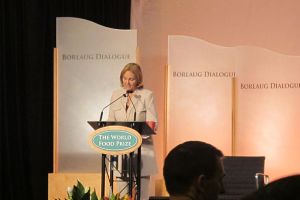
During her keynote address at the 25th anniversary of the World Food Prize on October 13, WFP’s Executive Director Josette Sheeran said, "Most of the world is not placed to handle the volatility in food prices and supplies. (WFP/Rene McGuffin)

Josette Sheeran, the UN World Food Programme (WFP) director, warns of a humanitarian disaster unfolding in Yemen. Sheeran said last week, “Rising food prices and political instability have left millions of people in Yemen hungry and vulnerable. Malnutrition is stalking the lives of women and children.”

WFP says that even before this year’s political unrest, “more than 50 percent of Yemeni children were chronically malnourished and more than 13 percent were acutely malnourished.”

This year’s chaos in Yemen has made it much harder for these children to gain access to needed foods. Lack of nutrition for children stunts physical and mental growth.

Lubna Alaman, WFP’s Representative in Yemen, says, “The challenges to reach and meet the urgent needs of the most vulnerable are huge, especially in the midst of a very volatile security situation.”

WFP is feeding displaced persons in Southern Yemen and also in the North, where years of conflict have left nearly half a million people struggling in hunger and poverty.

Nationwide, WFP is running a safety net operation to reach nearly 1.8 million Yemenis impacted by high food prices. However, low funding has severely limited the reach of this mission. WFP relies on voluntary funding from the international community.

Sheeran says that “WFP food assistance provides vital nutrition and stability at a time of great need.” If the program becomes fully funded, more Yemenis can be reached.

While Yemen is immersed in hunger and instability, the U.S. Congress is proposing reducing international food aid programs as part of budget cuts. The savings will be minimal and the consequences disastrous. Food aid programs currently make up less than one tenth of one percent of the federal budget.

Hunger and malnutrition are silent, but are so powerful that they can devastate a population within weeks if left unchecked; or they can slowly weaken the people through prolonged malnutrition. Yemen is caught in this trap.

The international community has to act now to put in place the safety nets which can save Yemen from hunger and malnutrition. There cannot be true change in Yemen as long as malnutrition has free reign.

Article first published as WFP Director Warns of Hunger Threat Stalking Yemen at Blogcritics Magazine.

Leave a comment

Filed under global hunger