Tag Archives: South Sudan

In Search of Peace in South Sudan

Father Joseph Otto of Magwi, South Sudan holds mass every day, even if no one attends. If only all of South Sudan, or everywhere for that matter, could hear him when he reads “Blessed are the peacemakers” from the Gospel of Matthew in the Bible. For what South Sudan needs more than anything is apostles of peace.


Father Joseph Otto of St. Theresa Parish in Magwi, South Sudan (Photo by Karen Kasmauski for Catholic Relief Services) 

Conflict threatens South Sudan a year after it gained independence. There is fighting with its northern neighbor Sudan, which is causing a major humanitarian emergency with hundreds of thousands of refugees. The UN World Food Programme (WFP) is airlifting food to the displaced, including Plumpy’Sup to prevent the wasting of thousands of infants.

The longer the conflict goes on the greater the humanitarian nightmare. There needs to be a demilitarized border zone between South Sudan and Sudan and safe humanitarian access to reach all of the suffering.

There is also internal conflict. In Jonglei, the largest state in South Sudan, 24 soldiers were killed last month in attacks from an insurgent group.

The United Nations Mission in South Sudan (UNMISS) says it is “particularly concerned by the apparent emergence in Jonglei of an armed insurgency group linked to the militia leader David Yau Yau, which is believed to be acting in concert with groups of armed youths who have evaded the civilian disarmament operation in the state.”

Last year fighting between the Lou Nuer and Murle tribes escalated. People were killed or kidnapped, homes burned to the ground, and thousands displaced.


Displaced people in Pibor, Jonglei state (OCHA photo)This year the fledgling government began a major peace and disarmament initiative. Hilde F. Johnson, the Special Representative of the Secretary-General to South Sudan, says, “The widespread possession, and use, of illegal weapons by the communities and the proliferation of small arms constitutes a significant threat to peace and security in South Sudan, and is seriously exacerbating inter-communal violence in Jonglei…A pro-active reconciliation process and peaceful disarmament is the only way forward to maintain peace and security for the people of the area.”


Will disarmament of rival tribes occur throughout South Sudan? (United Nations photo)
The disarmament process has resulted in the release of some of the kidnapping victims. A mother who, along with her two-year old son, was rescued by the army during the disarmament campaign said, “I was thinking day and night about my village and parents…and almost lost hope of seeing (them).”

The tribal violence is not the only threat, though. Flooding has also struck Jonglei, causing more displacement and suffering for at least 68,000 people. The UN is continuing to assess this latest development as it tries to deliver humanitarian aid.

The road to peace in South Sudan has many twists, turns and rocks that have to be navigated. It starts by ending conflict among rival tribes, the theme of a series of peace conferences this year.

After one of these conference in Magwi County earlier this year, Sylvia Fletcher of UNMISS said, “The success of the new nation of South Sudan in large part will be determined by the capacity of peace between communities and the ability first for coexistence, [and] next for concerted development efforts that will engage all communities.”

It’s more than giving rival tribes a peaceful way to resolve differences; it’s also ending the hunger, poverty, and lack of education that cause desperation and chaos. A society cannot develop if its citizens are hungry and malnourished. In fact, malnutrition can stunt someone early in life to the point that they never recover.


Commitment to community fosters trust and peace in war-ravaged southern Sudan. Father Joseph Otto of St. Theresa Parish in Magwi greets a child after Mass. (Photo by Karen Kasmauski for CRS)

South Sudan needs national infant feeding and school lunch programs. The World Food Programme provided 355,000 schoolchildren with meals and take-home rations during July, a hopeful sign for South Sudan, particularly if this is the start of a self-sustaining national program.

A system of roads needs to be built connecting all corners of the country. These are the foundations of peace, development, and a sound economy. Small farmers must be allowed to grow their crops in peace.

Once the guns fall silent and disappear from South Sudan there is no telling how much the country could achieve. Other countries can continue to offer help, but ultimately the answer must come from the peacemakers within South Sudan.

See also An Independent Nation’s Parallel Path to Lasting Peace.
Leave a comment

Filed under Africa

South Sudan: Life-Saving Air Drops Bring Food to Starving Refugees

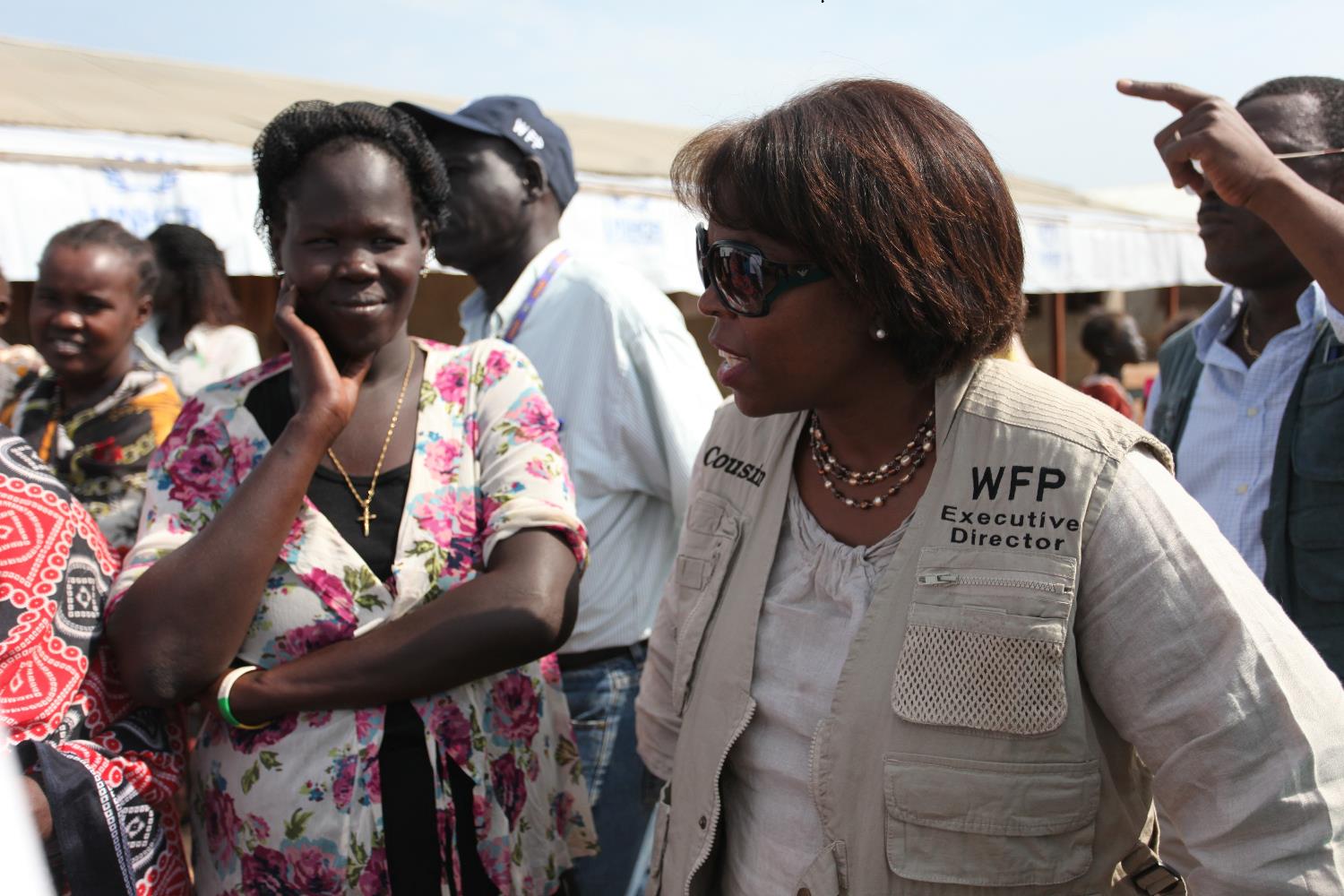
Executive Director Ertharin Cousin says WFP has started urgently needed food to refugees in South Sudan (World Food Programme photo)

The United Nations World Food Programme (WFP) has started life-saving air drops of food for refugees in South Sudan. Ertharin Cousin, the WFP director, said the air drops began today in Maban County of South Sudan‘s Upper Nile State.

Enough food was supplied to feed over 2,000 refugees for a month. More supplies are on the way. Cousin said today, “This is the first in a series of airdrops that aims to replenish rapidly diminishing food stocks for more than 100,000 people who have fled the fighting north of the border.”

Fighting in Blue Nile State and South Kordofan of Sudan has forced civilians to flee into South Sudan. The refugees are severely malnourished going for days without supplies after being driven from their homes by the violence. These are victims of the ongoing conflict between South Sudan and Sudan as both sides cannot win the peace despite numerous diplomatic efforts.

The air drops of food became necessary because of poor roads in South Sudan and the dramatic increase in the numbers of refugees. WFP is trying to feed millions of people throughout South Sudan, Sudan and Darfur. Drought and poverty alone are incredible challenges for civilians to overcome. The conflict between South Sudan and Sudan has further increased the numbers of hungry and malnourished.

Once Sudan and South Sudan end the conflict there is hope of rebuilding an area that holds much promise in the way of agriculture. Cousin adds, “We are working together in the quest not only to achieve a food secure nation, but also to help realise their agricultural potential to become the breadbasket of Africa.”

Leave a comment

Filed under global hunger

Donations Needed for Life-saving Air Drops of Food into South Sudan

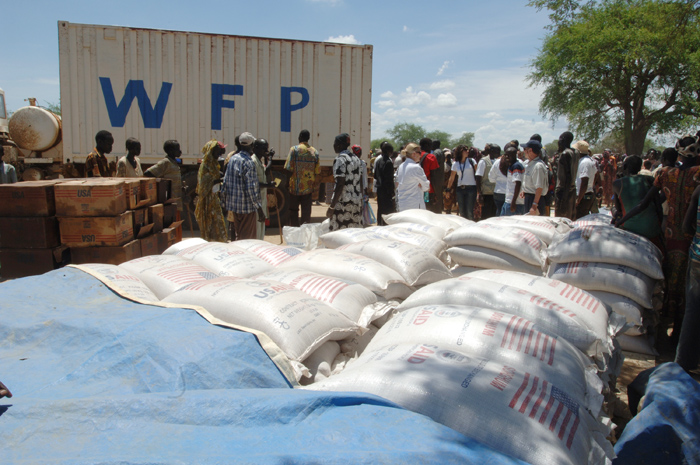
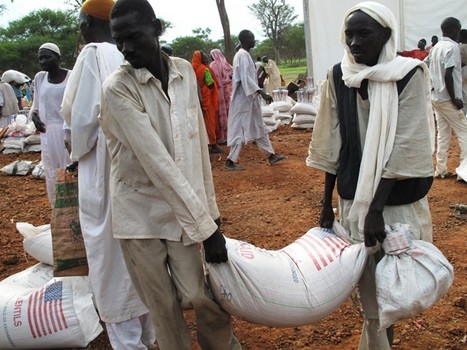
WFP provides food assistance to refugees who arrive in Maban County in South Sudan’s Upper Nile State, Donations are needed to airlift more food to the starving refugees. (WFP/George Fominyen)

The UN World Food Programme (WFP) is appealing for 6.5 million dollars so it can provide life-saving airlifts of food to starving refugees in South Sudan. WFP relies entirely on voluntary donations from governments and the public.

WFP wants to air drop 2,000 metric tons of food into Maban County to make sure civilians fleeing fighting in Sudan’s Blue Nile State have enough food to survive. These refugees have fled to the Upper Nile State in South Sudan to escape the violence and find aid.

Chris Nikoi, the WFP director in South Sudan, says “WFP is pulling out all the stops to keep providing desperately needed food to refugees in Upper Nile State. People in camps have told me how they arrived weak and hungry after weeks of trekking and foraging in the forest before crossing the border. Our food assistance has been a lifeline to more than 100,000 refugees in Maban County, but continuing that lifesaving support will require some extraordinary measures given the size of the refugee influx into an area with limited infrastructure.”

WFP also plans to air drop 3,000 metric tons of food to the Yida refugee camps in Upper Nile State. The number of refugees there is fast increasing. Malnutrition rates, particularly among children, are alarming according to WFP and other aid groups.

If children do not receive enough nutritional support they will suffer lasting physical and mental damage.

The air lifts of food become necessary because of the poor roads in South Sudan, many of which become impassable when rain hits. Food that was pre-positioned in crisis areas by WFP was not enough because of the fast increasing numbers of refugees.

Challiss McDonough of WFP says “we do hope that the donors will recognize the importance and urgency of this situation.” WFP needs funds to provide the airlifts and also to maintain a steady flow of food supplies. The longer the conflict continues between South Sudan and Sudan the more food aid will be needed to save lives.

Leave a comment

Filed under global hunger

Budget Cuts by Congress Would Impact Hungry South Sudan

One year after gaining independence South Sudan is still searching for peace. Conflict and hunger threaten to ruin the young nation.(Sara A. Fajardo/CRS)

South Sudan is facing a humanitarian emergency, with nearly five million people suffering from hunger. South Sudan’s conflict with neighboring Sudan is escalating the hunger crisis. Civilians fleeing the fighting are walking for days without food until they can reach aid stations.

The UN World Food Programme (WFP) says, “In the past weeks, the refugee population in South Sudan’s northern Border States has rapidly increased to more than 160,000 individuals. More than 32,000 Sudanese refugees arrived in Upper Nile state alone, increasing the refugee population in Maban County to over 105,000 individuals.”

WFP, the world’s largest hunger fighting agency, is racing to provide aid. One its key partners is the US Food for Peace program, the largest single source of funding for WFP. Congress, though, is planning to reduce funding for Food for Peace and other global hunger fighting programs.

The House Appropriations Committee just approved a bill that would cut the Food for Peace program by 22 percent, down to the level of $1.15 billion for the coming fiscal year. Who will this hurt? South Sudan as well as other nations that need food assistance.

Kathleen Kahlau of Catholic Relief Services (CRS) said last week that proposed cuts to Food for Peace are a severe threat. In a CRS webcast on South Sudan Kahlua said that “we are very concerned about the cuts to international food aid as proposed by the Congress. Please help us keep these drastic cuts from happening.”

CRS has written a letter to Secretary of State Hillary Clinton stating, “Please ensure that the Administration is engaged in every way possible with the governments of Sudan and South Sudan and with important partner countries and regional bodies to prevent a return to war, to end attacks on civilians, and to protect the basic rights of the Sudanese people, including the freedom of movement and access to humanitarian aid.”

Diplomatic efforts at demilitarizing the border and resolving the dispute over oil revenues need to be reinforced with food for the hungry.

South Sudan’s troubles go far beyond its border areas. The country is facing low food production resulting from drought. Internal conflict between rival tribes has caused large-scale displacement and hunger.

WFP warns the crisis may get much worse, “with thousands more refugees expected to arrive in the coming weeks before the rains make the trek across the border impossible.” The agency is currently short $86 million in funding to fight hunger in South Sudan.

See also An Independent Nation’s Parallel Path to Lasting Peace.
Article first published as Budget Cuts by Congress Would Impact Hungry South Sudan on Blogcritics.


Leave a comment

Filed under global hunger

Sudan, South Sudan Need Demilitarized Border

Civilians living in the border areas between South Sudan and Sudan are caught in the deadly crossfire between two rival nations. Lives have been lost, families displaced from their homes and communities. And it could get much worse.

There is fear the two nations will start an all-out war, a return to the level of suffering during the two-decade conflict that ended in 2005.

President Obama said directly to both Sudan and South Sudan last month, “It doesn’t have to be this way. Conflict is not inevitable. You still have a choice.”

South Sudan and Sudan can choose to implement the much needed “safe demilitarized border zone” which the UN Security Council is urging them to adopt. By pulling back their forces, they can stop the bloodshed, lower tensions and the risk of miscalculations by their forces, and allow humanitarian aid to flow more freely. There is tremendous hunger and poverty in this region.

The UN World Food Programme’s (WFP) Sudan director Chris Nikoi says, “The food security situation in the border states was already precarious. Now the border clashes threaten to displace more people and disrupt already fragile livelihoods.”

Food, water, medicine, shelter, and education need to constitute the sole focus on both sides of the border. This can only happen once Sudan and South Sudan pull their armies back from the brink.

John Quincy Adams once said about a buildup of arms on the Great Lakes along the U.S. border with British-ruled Canada in 1816, “the moral and political tendency of such a system must be to war and not to peace.” The U.S. and Britain chose then to demilitarize rather than escalate, having had enough of conflict from previous years. Treaties followed rather than war.

Such diplomacy is the only answer to South Sudan and Sudan’s struggle too. For it can open the only road to peace for the two countries: dialogue and negotiation.

See also “An Independent Nation’s Parallel Path to Lasting Peace”.

Article first published as Sudan, South Sudan Need Demilitarized Border on Blogcritics.

Leave a comment

Filed under global hunger

South Sudan and the War of 1812

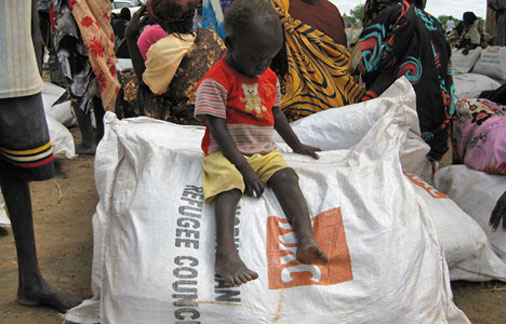
This child in Sudan is receiving food aid from the Norwegian Refugee Council (NRC). Many more children in the world are in need of food safety nets. (NRC Sudan)

At a Senate hearing in March, actor and Sudan activist George Clooney was asked about how to keep Americans, especially youth, engaged with the conflict and hunger in South Sudan. Can people here in the U.S. feel a sustained connection to a country many thousands of miles away?

Imagine for a moment a country that has recently gained its independence. War, territorial and boundary disputes, and the inability of the young government to cope with emergencies are the tragic realities.

Cities and towns have come under assault from their northern neighbor, forcing civilians to flee their homes in terror. Farmers have been forced away from their land by armies, thus ruining food production.

What you just read would describe South Sudan today. The description could also fit the United States during the War of 1812.

For when the United States was a young nation, like South Sudan now, it experienced war on its soil. This year is the 200th anniversary of the War of 1812, which President Obama and British Prime Minister David Cameron talked about at their White House meeting in March. During that war the British burned the White House to the ground. After the War of 1812 had ended, little by little the two sides moved away from conflict and toward partnership.

The Rush-Bagot Agreement of 1817 disarmed the Great Lakes and Lake Champlain, which during the war were the scene of naval battles and fierce bombardments on coastal towns. A naval arms race was averted. This allowed the U.S. border with the British colony of Canada to develop in peace rather than diverting resources into costly warships which might have provoked a new war.

One of the most tense standoffs between Britain and the U.S. in the decades after the War of 1812 was over who owned the Oregon Territory of the Northwest. In 1846 veteran diplomat Albert Gallatin, one of the peace commissioners during the War of 1812, published an essay urging calm between the two rivals. His words for peace were what any standoff needs to get resolved.

Today, South Sudan is faced with building peace with their neighbor Sudan. The two sides fought a civil war that ended in 2005 with the Comprehensive Peace Agreement. But this agreement has a long way to go before becoming a genuine peace.

Last summer, fighting erupted between South Sudan and Sudan over the disputed territory of Abyei. A United Nations Security Force has been dispatched for the demilitarizing of Abyei and to ensure protection and humanitarian aid for civilians.

In South Kordofan and Blue Nile, fighting is raging. U.S. Ambassador Princeton Lyman says “conflict has been raging there since last May, arising from issues never fully resolved in the civil war because people in those states, particularly in the Nuba mountains, fought with the South.”

There is also internal conflict in South Sudan between rival tribes, the Lou Nuer and the Murle, that has displaced many thousands of people in the Jonglei state. These two tribes have repeatedly attacked each other over the years through cattle raids and kidnappings. The scale of their battles, though, has increased substantially in recent months.

In May a peace conference is set to begin to deal with this deadly rivalry. Archbishop Daniel Deng Bul, head of the Peace, Reconciliation and Tolerance in Jonglei Committee, says, “I am expecting everybody who loves peace to participate in this process because we have lost so many people. I hope everybody will come, sit together and try to find a lasting solution for the problems.”

There is an initiative underway to collect the guns that have proliferated in Jonglei and there are plans for a buffer zone between the Lou Nuer and the Murle to help transition to peace.

Deng Bul says, “It is important for all citizens not to carry arms because the arms are tempting [people] to unnecessary actions. If we want to have development in Jonglei, we must make sure that everybody is not carrying a gun.”

South Sudan desperately needs its own peacemakers before it’s too late. The internal and external conflict has harmed the region’s food supply. Drought has also struck. These two elements, combined with preexisting poverty, are creating a hunger crisis approaching famine. The UN World Food Programme, which relies on voluntary funding, says nearly five million people in South Sudan are suffering from hunger. Food is desperately needed to reinforce the peace process.

South Sudan needs the United States and others to stay with them during these rough waters as it tries to build a road to peace.

As we mark the 200th anniversary of the War of 1812, students and other citizens can take time to reflect on the peace with Britain that emerged from the ashes. This learning adventure in American history can also offer a way for students and others to connect with South Sudan. How can this newly independent nation build their own road to peace?

For what the governor of Ohio, Thomas Worthington, proclaimed after the War of 1812 rings true. Worthington said we must seek the day “when bloody wars engendered in pride and wickedness, and prosecuted in fury and unrighteousness, shall forever cease, and when every human being, in the true spirit of humanity, meekness and charity,shall do justly, love mercy, and walk humbly with his God.”

Article first published as South Sudan and the War of 1812 on Blogcritics.

Leave a comment

Filed under global hunger, History

South Sudan Faces Hunger Emergency

South Sudan is facing a major hunger emergency as drought has ruined food supplies. The UN World Food Programme (WFP) says nearly 5 million people “could suffer from food insecurity in 2012, with an estimated 1 million people severely food-insecure.”

Ahnna Gudmunds, a WFP Sudan officer, says, “Households will face significant difficulty obtaining food during this period. Volatile food supply and poor diets are likely to intensify the severity of the hunger season.”

It gets worse. Conflict in the Jonglei State, the largest in South Sudan, has caused suffering, displacement and even more hunger. Fighting between the Lou Nuer and Murle tribes has escalated in recent months. The two sides have a history of violence. One side kidnaps members of the other or steals cattle, the other side then responds with an attack and the cycle of violence continues.

WFP is feeding about 170,800 people displaced by this conflict. This emergency food aid must be followed by longer term development aid.

Gudmunds explains that Jonglei is “one of the most underdeveloped states with a very poor, and sometimes non-existing, infrastructure. Some of the counties may be accessible by road only for few months a year due to rains.”

WFP is rushing to make sure supplies are in place ahead of these expected rains in April. The international community needs to ensure WFP has enough funding to carry on the relief work. South Sudan, which gained its independence last year, is reeling from war and drought.

There is also no shortage of weapons making the conflict between the Lou Neur and Murle that much more dangerous. Both tribes were armed during the decades long Civil War between the South and North Sudan. That war ended in 2005 with the Comprehensive Peace Agreement (CPA).

A report from the Small Arms Survey says, “Despite post-CPA disarmament drives, both groups have remained armed and active. Their ongoing feud is highly suggestive of civil war-era dynamics, exacerbated by post-CPA jockeying for services, power, and influence.”

The government of South Sudan is currently undertaking a campaign to disarm civilians in Jonglei. Most everyone would agree that disarmament is needed. But the question is when this disarmament should take place.

The Enough project warns that the time for disarmament is not right and will undermine the peace process. There needs to be confidence-building, dialogue and humanitarian aid well in process before traveling the disarmament path.

Amanda Hsiao, Enough Project South Sudan field researcher, says, “Without the capacity to simultaneously disarm rival communities, to ensure the security of disarmed communities, and to stop the flow of arms back into the hands of civilians, forcible disarmament at this moment will undermine, rather than facilitate, the government’s efforts toward peace-building in Jonglei.”

Jennifer Christian, Enough Project Sudan policy analyst, adds, “What the people of Jonglei require right now is humanitarian assistance, security, and the establishment of a mechanism through which they may peacefully resolve their grievances with other communities.”

Catholic Relief Services (CRS) is focusing a great extent of its peacebuilding in South Sudan on development. For CRS only hope will light the road to peace in Sudan. Peace and development are clearly linked.

Sara Fajardo, a CRS officer says, “Decades of violent conflict have left their mark. We need to provide alternatives to violence by investing in ‘peace dividends’ such as building roads, digging borehole wells, helping to strengthen the health care system, and providing seeds and tools for agriculture to name a few. These are all crucial components in giving people a reason to hope and build a future. ”

CRS is working on these projects in South Sudan as well as reinforcing relief efforts for the displaced. However, funding for these projects is key. CRS, for instance, faced low funding for its school feeding programs in Bor County, Jonglei. These programs came to an end last year.

Also crucial will be ensuring the United Nations Peacekeeping Mission in South Sudan (UNMISS) has enough resources to help protect civilians. Hilde Johnson, director of the mission, says, “UNMISS has reinforced its presence in key areas of Jonglei State and is conducting continuous air patrols to deter violence.”

It was such air patrols that detected and sounded the alarm of a large force of the Lou Neur readying to attack the Murle in December.

Dialogue, development and disarmament need to take place in South Sudan. Until they do hunger and misery will continue in this impoverished nation. Right now, South Sudan is trapped in a major food crisis, with the future of millions of people hanging in the balance.

Article first published as South Sudan Faces Hunger Emergency on Blogcritics.

Leave a comment

Filed under global hunger

Big East Basketball to Shine Light on War-torn and Hungry Sudan

By 1 June, about 40,000 people displaced from Abyei after the town's takeover by Sudan Armed Forces had been registered in the Abyei area, Unity State and the greater Bahr El-Ghazal region and were receiving humanitarian assistance. Photos: UNMIS/Issac Gideon.

This Wednesday, when Villanova University squares off against Seton Hall, you can expect another competitive Big East Conference basketball game. This game will differ from others in that it will seek to build support for Peace in Sudan.

Villanova and Seton Hall are partnering with Catholic Relief Services (CRS) in “Playing for Peace” to help bring an end to conflict, hunger and suffering in Sudan and South Sudan. Sudan and South Sudan fought a decades-long civil war that ended in 2005 with a peace agreement. However, violence has continued and the agreement has not been fully implemented.

Peace activism will take place throughout the game. Students will be handed a flyer showing how they can help by contacting the White House and urging the administration to support the peace process.

South Sudan became the world’s newest country last July, gaining independence from Sudan. However, peace in the region remains elusive as conflict and border tensions continue. It is critical that UN peacekeeping missions be supported and fully funded to protect civilians, and help establish conditions to build a lasting peace and development.

A peacekeeping mission called UNISFA was deployed to Abyei, which is a disputed territory on the border between Sudan and South Sudan. This oil rich region is claimed by both Sudan and South Sudan, and fighting has taken place there for years despite the 2005 agreement. UNISFA is there to make sure the area is demilitarized and made safe for civilians.

The threats go beyond the guns. Hunger and poverty still dominate the countryside. Drought often harms food production efforts and malnutrition is a major threat to children. Displacement from conflict makes this situation even more desperate. Conflict exists not only between South Sudan and Sudan, but also between rival tribes.

At this very moment, aid agencies are trying to help 50,000 displaced persons in the Jonglei State of South Sudan. CRS reports that the ethnic conflict between the Lou Nuer and Murle tribes has claimed an estimated 1,000 lives in the past six months. One of the driving forces behind this internal conflict is the lack of resources. Hunger and poverty feed desperation and violence.

Isaac Boyd of CRS Sudan says, “After nearly four decades of working in Sudan and South Sudan, CRS recognizes that sustainable development and peace are tightly interwoven. To contribute to a lasting improvement in the level of basic services and economic opportunities available to people throughout South Sudan, it is imperative to support communities to find meaningful, concrete ways to resolve their differences and put an end to destructive conflict. Simultaneously, tensions between groups are often exacerbated by the scarcity of basic services like access to water, schools, or health clinics. Development and peace have to happen at the same time.”

Will there be enough resources for aid agencies to reinforce the drive for peace? CRS is sponsoring emergency aid as well as long-term food security projects. The UN World Food Programme (WFP) is reporting that its 2012 relief operation for South Sudan is short 179 million dollars. WFP relies entirely on voluntary donations from governments and the public.

Without food, children in Sudan will suffer lasting physical and mental damage, thereby stunting the next generation. Without food for schoolchildren, education will suffer. A national school lunch program still needs to be established.

Playing for Peace is part of a series of events about Sudan sponsored by Villanova University. For more information, please visit the CRS newswire.

Article first published as Big East Basketball to Shine Light on War-Torn and Hungry Sudan on Blogcritics.

Leave a comment

Filed under global hunger, peace