Tag Archives: Olympics 2012

The Final Olympic Event: The Global Hunger Summit

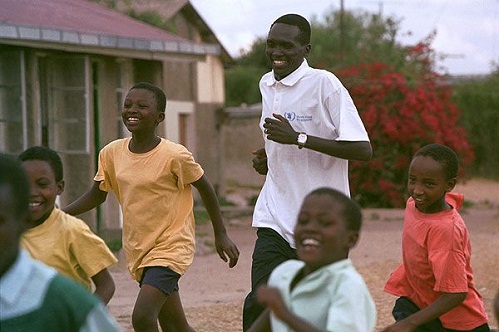
Two-time Olympic silver medalist Paul Tergat says “As sports men and women, it is important for all of us to use our privileged positions to raise awareness about the challenges that some of the less fortunate among us have to face.” (photo courtesy of the World Food Programme)

This Sunday British Prime Minister David Cameron is hosting a summit on the global hunger crisis. This meeting, coming at the close of the London Olympics, hopes to draw the media spotlight toward the nearly one billion people worldwide who suffer from hunger and malnutrition.

For humanity, the most important Olympic event is this hunger summit. Ertharin Cousin, the director of the UN World Food Programme (WFP), says, “The Global Hunger Event comes at a time when the eyes of the world are focused on the pinnacle of human physical achievement at the London Olympics. For far too many children, a lack of food and nutrition means that, sadly, they will never have a chance to compete in life.”

Right now hunger is striking conflict-ravaged South Sudan and Sudan, Afghanistan, Yemen, and Haiti. In the Sahel region of Africa humanitarian aid is needed to prevent famine after a severe drought. Over in East Africa there is still tremendous hunger one year after drought struck the region leading to famine in Somalia.

Drought in the U.S. this summer may cause higher food prices for an extended period of time, making the global hunger fight that much harder to carry out. Aid agencies like WFP depend on voluntary donations from the government and the public to fight hunger.

But will governments be able to provide funds during tough economic times and needs at home? It’s important to remember that food aid is a relatively inexpensive foreign policy expense when you compare it to programs like nuclear weapons spending. Targeting food aid for budget cuts is barking up the wrong tree.

The last time London hosted the Olympics was in 1948, the same year the Marshall Plan started to rebuild Europe after World War II. Following the conflict, the world was on the brink of the most massive famine in history. Former U.S. president Herbert Hoover was appointed as food ambassador in 1946 to coordinate a global response to save millions of lives. UNICEF was created during this time period to meet the needs of children who suffered more than anyone from the war. In 1947 Austria, Italy, and France received pre-Marshall Plan aid so they could have enough food for the winter before the recovery program started.

The food aid provided to Europe offered the foundation for reconstruction. As former Army Chief and Secretary of State George Marshall said, ” Food is the very basis of all reconstruction. Hunger and insecurity are the worst enemies of peace.”

This Sunday in London the starving peoples of the world are hoping the Olympic spirit can come to their aid via the hunger summit.

Article first published as The Final Olympic Event: The Global Hunger Summit on Blogcritics.

Leave a comment

Filed under global hunger, History

Olympic Torchbearer: Games Can Highlight Global Hunger Crisis

Vadsana Sinthavong carrying the Olympic Torch (WFP/Caroline Hurford)

The Olympic Torch Relay is underway in the United Kingdom leading up to the opening ceremonies of the Games in London. One of the Olympic torchbearers is Vadsana Sinthavong, who represents the largest hunger fighting organization, the UN World Food Programme (WFP).

Nearly one billion people worldwide suffer from hunger and malnutrition and WFP is active in over 70 countries. Vadsana works with the school meals program that fights child hunger in her home country of Laos.

Vadsana recently took a few moments to talk about her experience being part of this Torch Relay. She also talks about her mission trying to end global hunger and how she thinks the Olympics can play a role.

Tell us your reaction when you found out you were going to be the WFP representative at the Olympic Torch Relay?

I was in Vietnam, on vacation, and didn’t have access to the internet. All my colleagues started calling me — eventually they reached me to tell me the news. I thought it was so amazing. I couldn’t believe it — I was thrilled, just so happy. It’s a great honour for my family and for my country, too. I was very proud I would be able to represent WFP and our work with people watching from all over the world..

Are you experienced in running and relay races?

Not really. I never ran a relay before, and our sport lessons in school didn’t really include running. But when I was younger I walked a lot – to school, of course, but also many other trips were made on foot. One time when I was 11, I walked 40km in one day to bring a buffalo that was a present for my older brother on his wedding day. There were very few trucks at the time and our family could not afford one, so I had to walk.

But even though I didn’t run much before, I started preparing myself when I heard of my selection to carry the Olympic Flame. Even when I went to remote villages to do trainings and assessments for our school meals programme, I always found some time to train a little.

How important do you think school feeding is for any country to have a strong Olympic Team?

Well, first of all, with the daily nutritious snack we provide, children have more energy and they can concentrate better in school, and be more active during breaks. They have more opportunity to build their brains and bodies, and to become good sports people, or do anything else they want to achieve in life.

But I think the real impact is much more long term. In Laos, for example, every second child in rural areas is chronically malnourished. These children don’t grow up as tall or strong as they could be, and of course that also impacts their ability to be competitive in sports.

Studies have shown that educated children grow into men and women who produce and earn more, and who are less likely to have malnourished children. So school meals help prevent chronic malnutrition in future generations, and those kids will have a better chance to participate and succeed in the Olympics than their parents and grandparents did.

(Note: There is an interesting correlation between stunting rates in a country and Olympic performance; if broken down to per head of population, nations with high stunting rates are significantly underrepresented in regards to medal scores and team sizes at Olympic Games. You can find more information about this here: Banerjee, Abhijit and Esther Duflo (2011): Poor Economics. A Radical Rethinking of the Way to Fight Global Poverty. Chapter 2)

What role do you think yourself and the London Olympics can play in furthering the cause of ending child hunger?

The Olympics are one of those events that focus the attention of the world on one place. Even the Torch Relay leading up to the Games really engages people, both locally and from all over the world.

When I ran my portion of the relay early in the morning on a Sunday, but still so many people came to watch and cheer me on.

So the Olympics are a great opportunity to highlight the problem of child hunger and show how WFP fights hunger all over the world. I was so proud to be the one who represents WFP’s work in front of the eyes of the world.

Here in Laos, the main focus of my work is to cooperate closely with the Ministry of Education to assist them in building their own National School Meals Programme. The Lao Government recognizes the value of school meals in bringing children to school and keeping them in class longer, and they plan to ultimately provide school meals to every student in the country. I am very happy to be part of WFP’s effort to help Laos achieve this goal.

How far was your part of the torch relay? 

I ran quarter of a mile, or 300 meters, but it felt much shorter. This was such a special moment for me! I felt proud and happy to represent WFP, and was overwhelmed with the support from the people along the road who had come to see the Olympic Flame travel through Birmingham, even though it was so early in the morning on a Sunday. I could have run a lot farther – the moment was over much too soon.

What were some of the landmarks along your route? 

I started in front of Bullring Shopping Centre, and on my stretch of the relay I noticed a lot of Indian restaurants and shops. I was surprised, I didn’t know the UK is such a diverse country!

For more information about the World Food Programme visit their home page.

Article first published as Olympic Torchbearer: Games Can Highlight Global Hunger Crisis on Blogcritics.


Leave a comment

Filed under global hunger