Tag Archives: Africa

South Sudan: Life-Saving Air Drops Bring Food to Starving Refugees

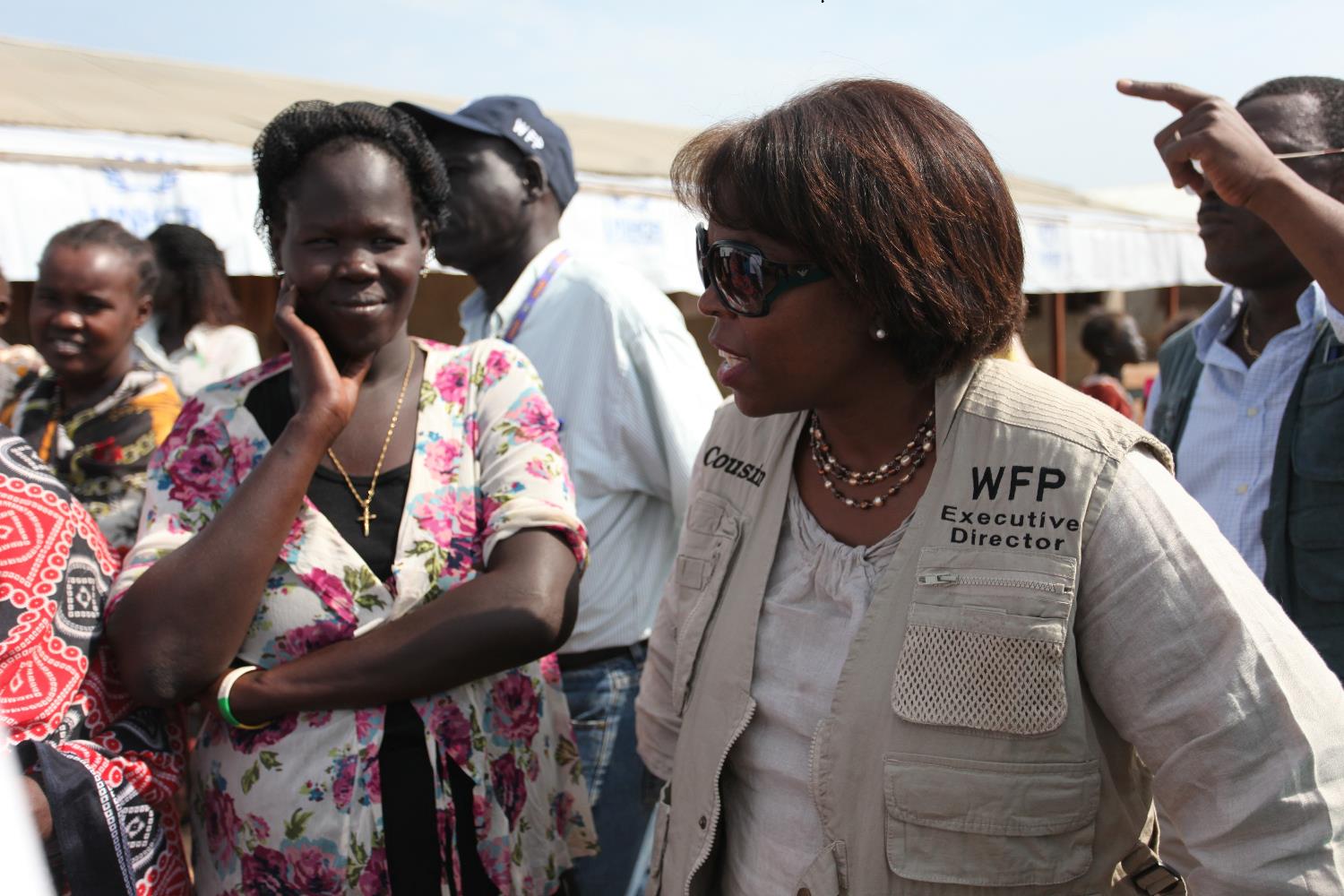
Executive Director Ertharin Cousin says WFP has started urgently needed food to refugees in South Sudan (World Food Programme photo)

The United Nations World Food Programme (WFP) has started life-saving air drops of food for refugees in South Sudan. Ertharin Cousin, the WFP director, said the air drops began today in Maban County of South Sudan‘s Upper Nile State.

Enough food was supplied to feed over 2,000 refugees for a month. More supplies are on the way. Cousin said today, “This is the first in a series of airdrops that aims to replenish rapidly diminishing food stocks for more than 100,000 people who have fled the fighting north of the border.”

Fighting in Blue Nile State and South Kordofan of Sudan has forced civilians to flee into South Sudan. The refugees are severely malnourished going for days without supplies after being driven from their homes by the violence. These are victims of the ongoing conflict between South Sudan and Sudan as both sides cannot win the peace despite numerous diplomatic efforts.

The air drops of food became necessary because of poor roads in South Sudan and the dramatic increase in the numbers of refugees. WFP is trying to feed millions of people throughout South Sudan, Sudan and Darfur. Drought and poverty alone are incredible challenges for civilians to overcome. The conflict between South Sudan and Sudan has further increased the numbers of hungry and malnourished.

Once Sudan and South Sudan end the conflict there is hope of rebuilding an area that holds much promise in the way of agriculture. Cousin adds, “We are working together in the quest not only to achieve a food secure nation, but also to help realise their agricultural potential to become the breadbasket of Africa.”

Leave a comment

Filed under global hunger

Donations Needed for Life-saving Air Drops of Food into South Sudan

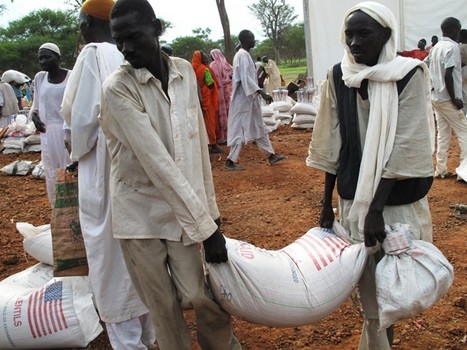
WFP provides food assistance to refugees who arrive in Maban County in South Sudan’s Upper Nile State, Donations are needed to airlift more food to the starving refugees. (WFP/George Fominyen)

The UN World Food Programme (WFP) is appealing for 6.5 million dollars so it can provide life-saving airlifts of food to starving refugees in South Sudan. WFP relies entirely on voluntary donations from governments and the public.

WFP wants to air drop 2,000 metric tons of food into Maban County to make sure civilians fleeing fighting in Sudan’s Blue Nile State have enough food to survive. These refugees have fled to the Upper Nile State in South Sudan to escape the violence and find aid.

Chris Nikoi, the WFP director in South Sudan, says “WFP is pulling out all the stops to keep providing desperately needed food to refugees in Upper Nile State. People in camps have told me how they arrived weak and hungry after weeks of trekking and foraging in the forest before crossing the border. Our food assistance has been a lifeline to more than 100,000 refugees in Maban County, but continuing that lifesaving support will require some extraordinary measures given the size of the refugee influx into an area with limited infrastructure.”

WFP also plans to air drop 3,000 metric tons of food to the Yida refugee camps in Upper Nile State. The number of refugees there is fast increasing. Malnutrition rates, particularly among children, are alarming according to WFP and other aid groups.

If children do not receive enough nutritional support they will suffer lasting physical and mental damage.

The air lifts of food become necessary because of the poor roads in South Sudan, many of which become impassable when rain hits. Food that was pre-positioned in crisis areas by WFP was not enough because of the fast increasing numbers of refugees.

Challiss McDonough of WFP says “we do hope that the donors will recognize the importance and urgency of this situation.” WFP needs funds to provide the airlifts and also to maintain a steady flow of food supplies. The longer the conflict continues between South Sudan and Sudan the more food aid will be needed to save lives.

Leave a comment

Filed under global hunger

Budget Cuts by Congress Would Impact Hungry South Sudan

One year after gaining independence South Sudan is still searching for peace. Conflict and hunger threaten to ruin the young nation.(Sara A. Fajardo/CRS)

South Sudan is facing a humanitarian emergency, with nearly five million people suffering from hunger. South Sudan’s conflict with neighboring Sudan is escalating the hunger crisis. Civilians fleeing the fighting are walking for days without food until they can reach aid stations.

The UN World Food Programme (WFP) says, “In the past weeks, the refugee population in South Sudan’s northern Border States has rapidly increased to more than 160,000 individuals. More than 32,000 Sudanese refugees arrived in Upper Nile state alone, increasing the refugee population in Maban County to over 105,000 individuals.”

WFP, the world’s largest hunger fighting agency, is racing to provide aid. One its key partners is the US Food for Peace program, the largest single source of funding for WFP. Congress, though, is planning to reduce funding for Food for Peace and other global hunger fighting programs.

The House Appropriations Committee just approved a bill that would cut the Food for Peace program by 22 percent, down to the level of $1.15 billion for the coming fiscal year. Who will this hurt? South Sudan as well as other nations that need food assistance.

Kathleen Kahlau of Catholic Relief Services (CRS) said last week that proposed cuts to Food for Peace are a severe threat. In a CRS webcast on South Sudan Kahlua said that “we are very concerned about the cuts to international food aid as proposed by the Congress. Please help us keep these drastic cuts from happening.”

CRS has written a letter to Secretary of State Hillary Clinton stating, “Please ensure that the Administration is engaged in every way possible with the governments of Sudan and South Sudan and with important partner countries and regional bodies to prevent a return to war, to end attacks on civilians, and to protect the basic rights of the Sudanese people, including the freedom of movement and access to humanitarian aid.”

Diplomatic efforts at demilitarizing the border and resolving the dispute over oil revenues need to be reinforced with food for the hungry.

South Sudan’s troubles go far beyond its border areas. The country is facing low food production resulting from drought. Internal conflict between rival tribes has caused large-scale displacement and hunger.

WFP warns the crisis may get much worse, “with thousands more refugees expected to arrive in the coming weeks before the rains make the trek across the border impossible.” The agency is currently short $86 million in funding to fight hunger in South Sudan.

See also An Independent Nation’s Parallel Path to Lasting Peace.

Article first published as Budget Cuts by Congress Would Impact Hungry South Sudan on Blogcritics.


Leave a comment

Filed under global hunger

Top Foreign Policy Goal for 2012: Feeding the Children of Drought and Conflict

As the State of the Union is upon us for 2012, let’s look briefly at history to tell us what should be atop the foreign policy agenda.

When the fighting of World War One came to an end on November 11th, 1918, there still was an “enemy” who remained on the offensive. The war had ruined agriculture and food supply systems, thereby unleashing the most unrelenting of foes–hunger and malnutrition.

Lieutenant Harwood Stacy saw in Poland such terrible conditions with infants that “looked terribly emaciated.” He said a basic item like milk “was as precious as gold.” A Polish hospital director pleaded for food for children “so we may supply the needs of these little ones who cannot comprehend why they are not fed.”

The American Relief Administration, backed by Congressional funding as well as donations from citizens, came to the rescue. Millions of children were spared a lifetime sentence from malnutrition that damages both mind and body. Without this aid World War One, which leveled enough suffering, would have led to millions more lives being lost.

All it took was providing the children meals, even similar to the “penny lunch” programs that had been pioneered in Cincinnati, Ohio in the early 1900s by teacher Ella Walsh. Another Cincinnati “penny lunch” organizer, Alice Wheatley, was also a supporter of the Red Cross during World War One. It was the Red Cross which provided school meals to thousands of children in France during the World War One years.

Now, nearly 100 years later, a different hunger crisis is unfolding that demands to be the top foreign policy priority. For hunger has started a new powerful offensive against the poor and vulnerable. Last year a massive drought occurred in East Africa placing over 13 million people at risk of starvation. That crisis is still ongoing and humanitarian aid has to keep flowing. However, there is also drought striking large parts of West Africa as well.

People in Niger, Chad, Mauritania and other parts of the Sahel region of Africa are feeling the effects of reduced harvests and high food prices. A massive humanitarian disaster waits around the corner if we do not act now.

In some parts of Yemen, a country known in the U.S. as a haven for Al Qaeda, child malnutrition rates rival those of famine-ravaged Somalia. Aid agencies, who rely on voluntary donations, cannot keep up with the growing tragedy.

In the new nation of South Sudan, conflict among tribes continues to leave many people hungry and displaced. Peace has not yet been achieved with neighboring Sudan. To add to this, drought has struck. In North Darfur, the UN World Food Programme says the “overall food security situation has considerably deteriorated compared to November 2010.” Poor harvests and high food prices now strike at a population trying to build peace.

In Afghanistan, a country devastated by years of conflict, drought hit 14 provinces last year. Low funding for aid agencies led to a reduction in food and agricultural assistance to the needy population. Food for peace therefore has a limited reach when it’s most needed.

In 2012 America’s top foreign policy objective should be to rehabilitate the children of drought and conflict across the globe. For if we do not, we give up on peace and stunt the future of so many suffering countries.

This is not an insurmountable challenge. It is far less expensive than war. But it needs to get on the agenda of our leaders in Washington and in the public conscience as it did after World War One, World War II and the Korean War. Feeding the children of “drought and conflict” is the U.S. foreign policy mission for this new year.

Article first published as Top Foreign Policy Goal for 2012: Feeding the Children of Drought and Conflict on Blogcritics.

Leave a comment

Filed under global hunger

Interview: Alain Homsy of the Norwegian Refugee Council in the Democratic Republic of the Congo

School feeding in the DRC (WFP photo)

The Democratic Republic of the Congo (DRC) has suffered through decades of instability and conflict. And as the country moves forward with elections and peace building, it must contend with hunger, poverty, and displacement.

The International Food Policy Research Institute calls the hunger crisis in DRC “extremely alarming.” In fact, its Global Hunger Index (GHI) report recently revealed that, “among the six countries in which the hunger situation worsened, the Democratic Republic of Congo stands out. Its GHI score rose by about 63% owing to conflict and political instability”.

Close to 2 million people have been displaced due to the conflict. A majority of these are located in the North and South Kivu areas of the DRC. And the same report shows that 70% of the population in DRC is undernourished – the highest rate in the world.

The Norwegian Refugee Council (NRC) is coming to the aid of children in the DRC through programmes like school feeding. School meals not only fight hunger and malnutrition, but give children a better chance at getting an education.

Alain Homsy, country director for the NRC in the Democratic Republic of the Congo, recently took time to answer some questions about its school feeding mission.

How many children are benefiting from the NRC school meals program in DRC?

In Grand North Kivu (Beni/Lubero Territories – 2011), in a total of 156 primary schools, 87,848 pupils (43,166 boys and 44,682 girls) have benefitted from the school feeding programme, along with 1,953 teachers (754 men and 1,199 women) and 970 cooks (833 men and 137 women). In addition, two NRC Youth Education Program centres also benefitted from the school feeding program with a total of 192 learners (94 boys and 98 girls).

In South Kivu (Mwenga Territory – 2011), in a total of 52 primary schools, 22,367 pupils (11,220 boys and 11,157 girls) have benefitted from school feeding, along with 524 teachers (445 men and 79 women) and 220 cooks (all women). In addition, one NRC Youth Education programme centre also benefitted from school feeding with a total of 192 learners (74 boys and 91 girls).

Have the meals had an effect on class attendance and performance?

In Grand North Kivu [where sending children to school is a priority for those who can afford it and satisfactory security conditions prevailed for most of past decade] thanks to school feeding, enrolment and attendance went up by an average of 28% in the academic year 2009-10, with a maximum of 63% and a minimum of 2%. The regular meal supply therefore appears to have a clear impact on attendance, although changing security conditions also affect attendance in a significant way. In terms of performances, impact of school feeding is more difficult to demonstrate as it is not solely linked to the quality or quantity of daily food intake, and is also clearly affected by other factors, amongst which is an obviously determining one, the class size. Therefore, in some areas with less populated schools (classes of 25-30), the proportion of pupils who graduated went up by 10 to 15% based on the directors’ verbal comments, while in areas where schools listed high numbers of students (classes of up to 58 pupils), graduation rates sometimes decreased by 80% in spite of school feeding.

In South Kivu [where sending children to school has not been a priority and security conditions were bad for most of the past decade due to presence of the Democratic Forces for the Liberation of Rwanda], thanks to school feeding, enrolment and attendance shot up by an impressive average of 119% – bearing in mind over 52 schools were covered from 2009 to 2011 – with a maximum of 248% and a minimum of 80%. On the other hand, six schools which were either temporarily occupied by Forces of the Democratic Republic of the Congo (FARDC) or located nearby temporary armed forces positions lost up to 20% of their pupils. In terms of performances, the proportion of pupils who graduated after school feeding introduction stands at an average 85.2% for girls and 89.1 % for boys, reportedly being an incremental increase of about 5% [school directors’ estimates – not fully documented].

In addition, it is worth remembering that all school feeding should be accompanied by regular, twice a year minimum, de-worming treatments so that food eaten effectively contributes to better child development and higher concentration and learning capacity.

How long does NRC expect to run this school feeding program? Do you anticipate being able to hand it over to the government or local community?

On a general note, emergency school feeding is indeed expected to have an impact on attendance and performances, as well fed kids not only have a higher concentration and learning capacity but also “they do not need to rush back home for a meal as soon as the school bell rings”, to quote from a Masabele primary school director. [The same teacher argued that school feeding is the main reason for an ever-growing number of registered children, and that it helps pupils stay in school after class hours where they can do homework instead of going straight home for food and being called upon by parents for home chores at the expense of studies.]

As such, taking into consideration current instability in DRC and potential renewed difficulties in connection with presidential elections due in November 2011, NRC believes that there will be continued need for emergency school feeding at least for the whole of the 2011-12 academic year, as it stimulates vulnerable children to attend classes and help schools cope with increased number of pupils both in displacement and return areas.

It is important to note that from The World Food Programme’s point of view, however, emergency school feeding is purely linked to nutritional considerations and therefore targeted to areas where indicators justify it. But in light of the recently revised Global Hunger Index, in which DRC ranks first, it is very unlikely that conditions may evolve for the better in Eastern DRC and therefore emergency school feeding should be extended.

Longer-term perspectives, in terms of handing over to local government, are extremely limited as so far even “free education for all” remains a remote dream in DRC. On the other hand, substitutes to emergency school feeding are currently studied by NRC, first involving gradual introduction of a cash and vouchers approach for schools as a first step towards reducing dependency on the WFP supply lines, while increasing efficiency and stimulating the economy by local purchases of food needed in a selection of pilot schools. Thereafter, self-sufficiency of these schools could be reinforced by developing improved school feeding programmes, including food production on school-owned land by parents of vulnerable children, who in return for their work would gain free or cheaper access to education for their kids and receive a share of the harvests. Additional features of such programmes will include introduction of more fuel-efficient kitchen use, both at school and home level, as well as small-scale animal husbandry for a diversified source of proteins and income-generating purposes.

For more information about the Norwegian Refugee Council visit www.nrc.no

Special thanks to Kaja Haldorsen and the field staff of the NRC in the Democratic Republic of the Congo for helping to coordinate the interview.

Article first published as Interview: Alain Homsy of the Norwegian Refugee Council in the Democratic Republic of the Congo on Blogcritics.

Leave a comment

Filed under global hunger