Category Archives: History

Abraham Lincoln and the Fight Against Global Hunger

A poster during the World War I hunger crisis featuring President Lincoln and a quote from his second inaugural message in 1865. (National Archives)

The Friendship Train that fought global hunger has been the subject of my recent articles in the Des Moines Register and San Francisco Chronicle. Someone who remembered the Friendship Train told me, “Everybody loves trains.”

The Associated Press reported back in 1948 there were two people in Nebraska that had a “complaint” about the Friendship Train. They were disappointed it could not make a stop in their area. So what did they do? They started their own train.

They called it the Abraham Lincoln Friendship Train. The charity Church World Service came to support this train through its Christian Rural Overseas Program (CROP). Today this same group operates hunger walks all around the country which support food aid both at home and abroad.

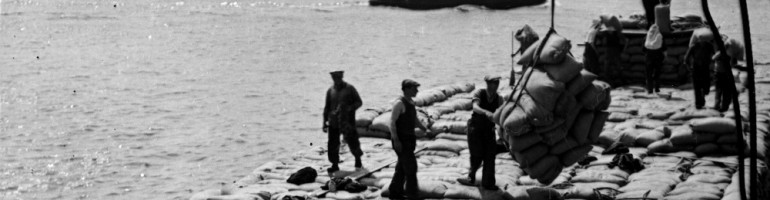
In 1948, the Abraham Lincoln Friendship Train got its start in Lincoln, Nebraska and went across the Midwest picking up more food for Europe. More trains followed. States like Ohio had their own train picking up wheat and dried milk to be shipped on to Europe for the holidays.

The response was so great that train delays took place because so much food was being donated by Americans. Newspaper reports at that time estimated over 2000 train carloads of food were collected.

While this grassroots effort was ongoing, the Marshall Plan to rebuild Europe was under way. This was American peacemaking at its finest. It came from all Americans, whether they were leaders in Washington D.C. or farmers in the Midwest. With nations in such distress after the war, Americans responded with generosity and friendship.

This is a sharp contrast to plans today by the Congress to reduce international food aid when there are countries that are suffering deeply in hunger, malnutrition and poverty.

What hope do the world’s nearly 1 billion hungry people have without food and nutrition? What hope do we have for peace if another generation is stunted in growth and mind because of lack of food?

It was fitting one of the food trains for peace back in 1948 was named after Lincoln. It was he who said, “With malice toward none, with charity for all.” Lincoln asked Americans “to do all which may achieve and cherish a just and lasting peace, among ourselves, and with all nations.”

There is no more important step toward this goal than feeding the hungry.

Article first published as Abraham Lincoln and the Fight Against Global Hunger on Blogcritics.

Leave a comment

Filed under global hunger, History

Eisenhower’s Thanksgiving Mission

General Dwight Eisenhower (NATO photo)

General Dwight Eisenhower needed rest. It was the first Thanksgiving since the end of World War II in 1945 and the general was suffering from bronchitis. With the holiday, you would think Ike could get his much-needed recovery time. But not so. On this Thanksgiving Day, Eisenhower was called for a special mission in Washington, D.C.

The Congress was holding a hearing on whether to provide additional funding for the United Nations Relief and Rehabilitation Administration (UNRRA). It was UNRRA that was helping provide food and other humanitarian aid to millions of people suffering in the aftermath of World War II. But it was not a sure thing the Congress was going to grant more money to this relief effort.

Congressman Sol Bloom of New York called upon Eisenhower to testify in the hearing. With Eisenhower’s busy schedule in Washington that week, Ike had planned to submit just a written statement. But when it came clear that Eisenhower could decide the fate of UNRRA funding, he agreed to appear in person. General Walter Bedell Smith had cabled Eisenhower stating that without UNRRA, “there is no repeat no agency to which we can turn to assist actively in carrying out our responsibilities in connection with the care of displaced persons.” Ike replied, “Thoroughly understand. My testimony will be strong.”

Eisenhower made some late edits and additions to a statement the War Department had prepared for him. On Thanksgiving morning he appeared before the House Committee on Foreign Affairs.

Congressman Bloom introduced Eisenhower, stating that the general was appearing against doctors orders and needed to get back to bed as soon as possible. But before that, Ike read his statement in support of UNRRA reminding Congress, “There are few places in Europe today where people are not cold, hungry and apprehensive of the future” and that “the ravished nations of the world are looking to UNRRA for their relief.”

Ike’s testimony was pivotal in swaying Congress to provide more funding for UNRRA which allowed aid to war-torn countries like Italy, Austria, and Greece. One of the countries in desperate need of aid was visited by Eisenhower in September, 1945, Poland.

Devastated by the war Poland needed food, medicine, clothing and the rebuilding of so many destroyed cities and towns. The U.S. Ambassador to Poland, Arthur Bliss Lane, saw the suffering in Poland and knew how important UNRRA aid was. Lane wrote, “the most terrible sight of all was that of the one-legged children…whose legs or arms were carried away by bombs, or whose gangrened limbs were amputated in mercy.”

Lane added, “There is no doubt that the help furnished by UNRRA and other humanitarian organizations … created a great spiritual bond between the Polish people and Western civilization. The distribution of packages was a constant reminder to the Poles that the West had not forgotten their plight and that the West, especially the United States, was helping as in the past.”

Humanitarian aid from UNRRA, the U.S. army, charities like Catholic Relief Services, CARE, UNICEF, and so many other organizations helped establish the foundation for European recovery and peace.

The lesson of Eisenhower’s Thanksgiving mission is essentially one of Food for Peace. Ike stated, “now that the fighting has ceased and the danger is less obvious, it is perhaps difficult for people in this country to visualize the desperate needs of the people of Europe and the necessity, if our military victory is to have lasting significance, of our successfully completing the job of making a peaceful world. ”

We didn’t forget about Europe after World War II, and today we cannot forget the hunger that afflicts over 900 million people throughout the globe. Whether it’s in Afghanistan, Sudan, Nepal or Iraq, it is vital that hunger and poverty are defeated if we hope to have peace.

originally published at History News Network.

Leave a comment

Filed under global hunger, History

She Wanted to Mourn, But Chose to Save A Life

In my article Armistice Day, World Peace and Feeding the Hungry, I talk about the amazing work of the Belgian Relief Commission. They fed the hungry in Belgium, as well as Northern France, during World War One and in its aftermath.

One of its anonymous donors was a woman who wanted to buy flowers for a friend’s grave. She wanted to mourn. But she also was aware of the Belgian relief fund which had been collecting donations. She considered the two choices and decided to spend the 2 dollars on the Belgian relief fund. The Cincinnati Enquirer reported, “The possibility of saving a child in Belgium from starvation was the reason given” for her donation.

Two dollars in 1917 was worth about 2 months’ of meals. Frederick Chatfield, Cincinnati Branch Commissioner for relief in Belgium, reported the anonymous woman’s donation in an article discussing contributions and shipping. He said, “Cincinnati has responded splendidly to our appeal.”

The food sustained millions trapped by the fighting of World War One. In an article published by the newspaper in late 1916, Milton Brown wrote from Belgium, “Herbert Hoover, who heads the commission, is a remarkable man. He describes his job as feeding a kitten with a 40-foot pole, the kitten being in a cage between two hungry lions.”

On this Armistice Day, a two dollar donation could actually achieve close to two weeks’ worth of meals in countries suffering from conflict, natural disaster or extreme poverty. It could mean plumpy’nut to save small children from potentially deadly malnutrition; or it could mean school meals that not only prevent malnutrition, but help keep children learning in school.

There are tremendous needs around the globe today, and many ways you can help. Catholic Relief Services has set up an East Africa Relief Fund to fight the famine and drought there. Save the Children is collecting donations to help feed and give medicine to victims of massive floods which have struck Thailand.

Edesia, a producer of plumpy’nut, is holding a fundraiser titled the 11-11-11 project. Plumpy’nut is a special peanut paste desperately needed in many countries including Sudan, Guatemala, Afghanistan, Yemen and the Democratic Republic of the Congo.

The UN World Food Programme (WFP) has a We Feedback campaign which is like taking in a Silent Guest, one of the world’s hungry, at your next meal. WFP also has the online game called Free Rice which raises money for the hungry, and is free for the user to play.

To help those who are hungry within the United States, Feeding America supports a network of emergency food banks.

Article first published as She Wanted to Mourn, But Chose to Save A Life on Blogcritics.

Leave a comment

Filed under global hunger, History

Armistice Day, World Peace, and Feeding the Hungry

One of the guns of Battery D, 105th Field Artillery, showing American flag which was hoisted after the last shot had been fired when the armistice took effect. Etraye, France. 11/11/1918Credits: National Archives

It was just a piece of paper. Yet on the morning of November 11, 1918, it meant peace.

For on that paper was a message from United States General John Pershing, ordering ceasefire on all fronts at 11 a.m. Germany had accepted the armistice. The Great War, or World War I, was over.

While the battlefields were filled with the most devastating firepower ever assembled, it was a small piece of paper that was the most powerful instrument of that day.

The announcing of the armistice on November 11, 1918, was the occasion for a monster celebration in Philadelphia, Pennsylvania. Thousands massed on all sides of the replica of the Statue of Liberty on Broad Street, and cheered unceasingly. Philadelphia Public Ledger. (National Archives)

Celebrations sprang up across the world. The Cincinnati Enquirer wrote, “It was Victory Day, and all Cincinnati helped celebrate this most momentous event in the history of the world.”

Americans fought and died right up to the armistice. Many who survived lived with the effects of shellshock . A whole world was in fact left shellshocked by the Great War, and millions of people were threatened with starvation and poverty as a result.

“Hunger knows no armistice,” a poster for the Near East Relief Committee stated. To tell the full story of World War I and its aftermath is to tell of hunger and great humanitarians.

The article in the Cincinnati Enquirer made it a point to mention the city’s impressive record providing relief throughout the conflict. In fact, in 1917 the paper printed the appeal of Frederick Chatfield, a leader for Belgium relief, who said one dollar a month would save a Belgian child from starvation and give him the extra food needed to keep him from disease. The newspaper even printed the names of those who sent in donations.

Cincinnati adopted the town of Hastiere in Belgium in order to help it rebuild from wartime destruction. Among the buildings damaged was a little church, built in the eleventh century, that was bombarded by shells.

The men and women who suffered through World War I deserved a lasting peace. However, the world was at war once again just two decades later. The Second World War would bring even more destruction than the first.

But on this Armistice Day, 2011, let’s remember that dream of world peace that should have followed the First World War, and not give up on that dream. The pursuit of world peace is the best memorial we can leave to the generation that sacrificed so much in the horror of the first World War.

Lands struck by war can recover. Interestingly, I recently received two messages from Belgium, one confirming that the country is a donor to the UN World Food Programme to help this agency fight hunger in conflict and disaster zones around the globe. The second message is from Hastiere. All is well there, and the little church is rebuilt-the Great War long in the rearview mirror.

Article first published as Armistice Day, World Peace and Feeding the Hungry on Blogcritics.

Leave a comment

Filed under global hunger, History, Uncategorized

A School Lunch Hero for Disabled Children

In 1944 World War II was still raging. Students though at a school for disabled children in Cincinnati were facing their own daily struggles. Even having enough money for a school lunch was no easy task.

The school had a fund set up to provide lunches for the students. Keeping this fund resourced was the problem; that is, until the school received some help from someone very generous. As a result, the school lunch fund got a big boost which meant many more meals for the students.

Who was this mystery helper? It was one of their own students, 10 year old Charles Graff Jr. However, Graff had to study at home because he had the disease hemophilia. This is a disease where any slight cut could cause severe and even deadly bleeding. As Charles was confined to his home, a teacher from the school visited him there to give lessons.

Charles also had a hobby, collecting sales tax stamps. These were stamps placed on various items sold in stores, and you could redeem these stamps for cash from the government. So Charles kept collecting and as the Cincinnati Enquirer reported, he would give them to his teacher who would drop them off at the school. The tax stamps would then be redeemed, providing the school with a fund to buy the student lunches or sometimes even clothes.

Charles’s father, who worked at the Red Top Brewing Co., got co-workers involved to provide Charles with more stamps. More stamps meant more meals for the children.

Charles was ahead of his time. In 1944 there was no National School Lunch program; there was a limited luncheon program under President Roosevelt.

In 1946 President Harry Truman signed into law the National School Lunch Act, which provided free or reduced-price lunches for needy children all around the country. Healthier children meant better educated and more productive citizens for the future. It was a program built to last.

Charles, whose nickname was Bubbles, remained confined to his home and sometimes a wheelchair, due to his condition. That did not stop him though from being the “official” for many games his friends played on the street. Charles would officiate the games from his window.

The hemophilia took his life in 1950 at the age of 15. His legacy carries on. What Graff did in helping his classmates receive lunches is an example for all to follow. Fighting child hunger is about problem solving. You need people to find solutions, not excuses for why children cannot access basic foods.

Groups like Feeding America work to make sure children do not go hungry. This means strengthening the national school lunch program when required, or filling in gaps with after-school meals and summer feeding. For this reason, Charles Graff would make a great honorary ambassador for Feeding America.

Article originally published as Cincinnati’s School Lunch Hero for Disabled Children on Cincinnati.com and A School Lunch Hero for Disabled Children on Blogcritics.


Leave a comment

Filed under global hunger, History

On Halloween Remember the World’s Hungry

This Halloween please remember the world's hungry (photo courtesy USA.gov)

It’s Halloween 2011 and time for the Wolfman, Dracula, and other monsters and ghosts to have their one night of the year. And let’s not forget Egypt’s famous Halloween contribution, the Mummy, and a couple of creatures that have appeared in this column when they helped with fundraisers, the Mothman and the Yeti.

Halloween means lots of candy too! In fact billions of dollars are spent on Halloween festivities. But this year please take a silent guest with you when trick or treating, or at your Halloween party. You can help one of the world’s nearly one billion hungry who on Halloween, or any other day, will hope to get maybe one meal if they are lucky.

There are many ways that Halloween can be combined with fighting hunger. In fact, in 1947 students used Halloween not to collect treats but to collect canned goods for the Friendship Train that fed the hungry in war-torn Europe.

On Halloween night, maybe in place of one of the treats, you could ask for a dollar to buy a week’s worth of meals for a hungry child. You can send the dollar to food aid agencies like the World Food Programme, Save the Children, Feeding America, UNICEF, Catholic Relief Services and others.

Or perhaps take a few minutes after coming home from trick or treating to play a few rounds of the online game Free Rice. For every correct answer you get, rice is donated to the hungry in developing countries.

There are many ways you can combine Halloween and fighting hunger. For this night is one of imagination. So the best ideas are to come: from you.

Article first published as On Halloween Remember the World’s Hungry on Blogcritics.

Leave a comment

Filed under global hunger, History

Biden Optimistic Global Hunger Struggle Can Be Won

Vice President Joe Biden spoke last Monday at the World Food Program USA award ceremony. He praised this year’s winners, Bill Gates and Howard Buffett, who have dedicated their talents to fighting hunger around the globe.

But Biden also made an admission of guilt—-for being optimistic that we can win the struggle against global hunger. This battle is now ongoing in the famine zones of East Africa, drought-ravaged Afghanistan, Yemen, Pakistan and numerous other regions.

Biden said, “I am often accused of being an optimist. I plead guilty, because I believe strongly in the human capacity-and desire-to build a better world. But I am particularly confident in our ability to feed the future because we have done it before.”

Biden talked about our support of South Korea, once a war-torn country with millions starving. Today South Korea has strong economic development and is a donor to the UN World Food Programme’s hunger-fighting missions.

Biden said, “Beginning in the 1950’s, we provided agricultural support-research, training, and partnerships with American firms-to South Korea, which was one of the poorest countries on the planet. Today, it is the world’s 15th largest economy, and a major trading partner responsible for hundreds of thousands of American jobs. ”

This is a long way from the South Korea that U.S. Army major Charles Arnold saw in 1951 during the Korean War. Arnold, who led a UN Civil Assistance team, said children arrived at feeding stations and “greeted us by rubbing their stomach and saying hungry.” After regular meals from Arnold’s team, the children took on a new, healthy look. They began to smile.

South Korea was also a country that benefited from the famous CARE packages that fed so many hungry people in Europe after World War II. President Truman urged Americans to send these CARE packages to feed those hungry and displaced by the Korean conflict.

As time went on, South Korea gained from agricultural development projects, similar to those Biden praised in the current “Feed the Future” campaign. South Korea was also one of the beneficiaries of the U.S. Food for Peace program started under President Eisenhower and expanded during President Kennedy’s administration.

George McGovern was Food for Peace director under President Kennedy. He writes that about 2 million South Korean children were receiving school meals under this hunger-fighting initiative. These meals made children healthier and better educated. This is a contrast to Afghanistan today, where low funding for the UN World Food Programme has meant that many impoverished children have lost their school meal ration.

In addition, proposed budget cuts to international food aid, including Food for Peace, will mean school feeding, Feed the Future and other aid projects will face cutbacks. This is a severe threat to peace.

Biden also said, “We will continue to support your work, by urging our friends in Congress to resist the urge to slash foreign aid budgets, because long-term solutions now can reduce the cost of massive relief efforts and instability later.”

Hunger-fighting programs currently make up less than one tenth of one percent of the federal budget. So slashing them does virtually nothing to eliminate the debt. Funding cuts though would devastate U.S. foreign policy. It is virtually impossible for countries to develop and have peace when generation after generation of children grow up malnourished and stunted in mind and body.

Biden finished his speech on Monday citing Nobel Peace Prize winner Norman Borlaug, who saved millions from hunger through his agricultural innovations. Borlaug said: “If you desire peace, cultivate justice, but at the same time cultivate the fields to produce more bread; otherwise there will be no peace.”

This is a message Congress needs to hear again and again as it makes crucial decisions about our foreign policy. The Food for Peace tradition of the U.S. is very much at stake in the current debates on the federal budget. What they decide in the coming days will have major implications on whether the struggle against global hunger can be won.

View a video of Biden’s speech.

Article first published as Biden Optimistic Global Hunger Struggle Can Be Won on Blogcritics.

Leave a comment

Filed under global hunger, History

Plumpy’nut: A Modern-Day CARE Package

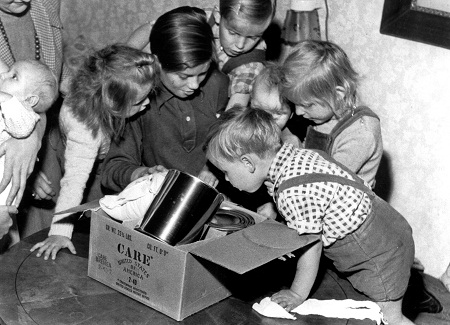
CARE Packages were sent to the hungry after World War II and this continued even during the Korean War and the early years of the Cold War struggle. In this photo, "Children of a refugee family from East Germany crowd close to get a better view of the foods in the CARE Package they received soon after they arrived in West Berlin." (photo courtesy CARE)

If you went shopping after World War II, you could walk into a store and make a life-saving purchase. Even if you were at home, you could do the same great deed simply through mail order. What was this mystery item people bought by the thousands after the war?

These were CARE packages to send to hungry people in countries lying in ruin. General Lucius Clay, commander of the American military government in Germany, made appeals to the public to send these packages. So did many others from all walks of life. This is how America reacted to the plight of those suffering overseas.

General Clay wrote, “when a CARE package arrived the consumer knew it was aid from America and that even the bitterness of war had not destroyed our compassion for suffering.”

You had several options when buying a CARE package. There were general rations which you could send to a family, or you could have these sent to an orphanage or hospital. Another option was to buy a CARE package specially designed for infants, one with baby food.

Well, today that CARE package for infants would come in the form of plumpy’nut, the miracle food recently profiled on the NBC Nightly News. This is a life-saving food for small children.

Plumpy’nut is peanut paste that comes wrapped in a small package, like many foods you find in grocery stores; except plumpy’nut is food specially designed to provide quick nutrients to severely malnourished children. It is widely used in areas struck by conflict, natural disasters, or extreme poverty. Plumpy’nut is easy to distribute because it does not require special preparation and storage.

In East Africa, where drought has caused massive food shortages, plumpy’nut is being distributed to children. It is saving their lives. Infants need proper nutrition in what is called the critical first 1,000 days. Without the nutrients, they will suffer lasting physical or mental damage.

Thousands of children have already starved to death in East Africa because of the food shortages, but those that get plumpy’nut can be saved.

Mindy Mizell of World Vision says, “One mom told me how she arrived in Puntland, Somalia with a severely malnourished toddler who wouldn’t play, stand, or smile…he took the plumpy’nut for a few weeks and was just fine! He looks great.”

A full supply of plumpy’nut is needed in East Africa to prevent more deaths.

Edesia, a Providence-based producer of plumpy’nut, has been running its factory 21 hours a day producing the life-saving food. Navyn Salem, Edesia’s director, said shipments are leaving almost every day to head to the East Africa famine zone. The plant was also fortunate to keep running through Hurricane Irene which tore through Providence and many other parts of the East Coast in August. Salem remarked, “we were very fortunate to be in a spot that was spared, phew!!”

Plumpy’nut production has to keep running at Edesia and other factories that produce the miracle food. But funding is always an issue, as aid agencies continually face this challenge. Not enough resources are committed by the international community toward fighting child hunger. The UN World Food Programme and other organizations are well short of funding to meet the demand.

Plumpy’nut is needed in many more areas of the globe: Afghanistan, Yemen, Democratic Republic of the Congo, Pakistan, and Haiti, just to name a few. All of these countries have high rates of child malnutrition, and plumpy’nut and its variations are desperately needed.

After World War II, stores like the H. & S. Pogue Company of Cincinnati even had displays of CARE packages. The Cincinnati Enquirer reported that upon Pogue’s grand opening of their display in 1947, Captain Victor Heintz made the first purchase. Heintz was a World War I veteran who served on the front lines in France. Years later, he was again coming to the aid of France in the form of a CARE package.

Another Cincinnati resident, Siegfried Deutsch, got started well before Pogue’s CARE outlet opened. Deutsch bought at least 35 CARE packages. The Enquirer said number 35 went to a poverty-stricken mother and her young daughter in Vienna, Austria, Deutsch’s homeland.

Retail stores today could offer an outlet for people to buy CARE plumpy packages for starving infants overseas. As the CARE package made such a difference saving lives, winning the peace, and rebuilding Europe after World War II, plumpy packages can do the same today.

Article first published as Plumpy’nut: A Modern-Day CARE Package on Blogcritics Magazine.

Leave a comment

Filed under global hunger, History

Honoring Irish History by Helping Famine Victims in Somalia Today

Last month I published an interview with Kate O’Malley of Irish Americans Support Somalia. The group is dedicated to raising awareness and funds to help save lives in East Africa. Here are some updates as posted on their facebook page. The video below highlights a donation made by several organizations to Edesia, which is producing plumpy’nut for aid agencies to distribute in East Africa.

Here is the update from Irish Americans Support Somalia:

“In memory of Ray McKenna, and in the spirit of “Honoring our History by Helping Famine Victims Today”, Edesia received a total of $1250.00 in donations on October 9, 2011 from the following organizations: Rhode Island Police Officers Emerald Society, Friendly Sons of St. Patrick of Pawtucket, Providence St. Patrick’s Day Parade Committee, Ancient Order of Hibernians – State Board and Newport Chapter, and the RI Irish Famine Memorial Committee. Thank you!

Did you know that our online reach now extends to supporters from 7 countries and 9 U.S. states?  And that’s just who we know about!  With your help we can build this movement which so far includes people in Australia, Japan, Haiti, Ireland, South Africa, British Columbia, and OH, NC, VA, CO, CA, FL, RI, CT, and MA in the USA.  Irish or not, we are concerned parents, newspaper editors, committed high school and college students, nationally renowned authors, university professors, business owners, musicians, community activists, historians, and most importantly we are global citizens who can make a difference.

Why now?  Why us?  Unicef reports that a child is dying every 6 minutes in Somalia and that 750,000 people are presently at risk.  We all have something to contribute. Please offer your ideas, your talents, your time, your resources, your influence, your word of mouth, your compassion. In the words of Margaret Mead, “Never doubt a small group of thoughtful, committed people can change the world. Indeed, it’s the only thing that ever has.”

Visit Irish Americans Support of Somalia at Facebook and WordPress.

Leave a comment

Filed under global hunger, History

Humanitarian heroes, both large and invisible

The Oct. 13 editorial, “Borlaug Vision Brings World to Iowa,” highlights the World Food Prize event this week in Des Moines.

It’s worth noting, too, that surrounding this critical world hunger symposium is a landscape filled with humanitarian heroes of the past. The most recognizable, of course, are Norman Borlaug and Herbert Hoover, who saved many millions of lives. But there are many others whose names we may not know.

Read my article at The Des Moines Register

Happy World Food Day October 16th!

Leave a comment

Filed under global hunger, History